

Undersized tomatoes
I haven't been able to get a straight answer on this. I bought a fruiting early girl tomato plant late in the season and the tomatoes that had been on the plant ripened and were large but since then all of the tomatoes have been golf ball sized when they should be closer to tennis balls. I have consistently watered them when finger deep became dry (check daily).
What is causing small fruit?
We've had a few heat spikes as high as 95 or 100 degrees. While rather inland sunset says we have some coastal influence so not sure if that matters.
I haven't fertilized after transplanting (planted in container with a "ready-to-use organic mixture contains fir bark, Canadian peat moss, horticultural sand, mushroom compost and a wetting agent. plus received 1 Tbsp plant food below and 1/5 chicken manure when transplanting)
I have this tomato/veg plant food:
http://www.truevalue.com/product/Tomato-Vegetable-Food-4-5-3-15-Lbs-/38393.uts
The well-aged chicken manure I purchased:
Comments (20)
 11 years agolast modified: 11 years ago
Hey Winorchids! I'm no expert on this, but here's what I've observed. I have grown quite a few early girls in the past, and mine have never been anywhere near tennis ball size. I think early girl is one of the tomatoes where the size can vary a lot. So, it might have to do with heat like you described.
I dont think fertilizer would hurt, though. I am a big fan of soluble fertilizers at this point in the season. The dry stuff needs time to break down, and our plants want a snack NOW! If you use a chemical fertilizer like Miracle Gro, look for a BLOOM formula. Use it at half strength. Don't put it on a bone dry plant, either. My favorites are organic liquid formulas like Neptune's Harvest and Texas Tomato Food. You probably won't be able to find either of those at your local nursery, but Texas Tomato Food is shipped very quickly. If you have grow stores in your area, which I know you must because of your location (haha), they may carry Neptune's, and/or other high quality bloom fertilizers. Or, just go to your local garden center and see what they have. If you can find a formula that includes micro nutrients, that helps a lot.
Another alternative would be to topdress with compost or worm castings. I would not add chicken manure at this point, because it will be too high in nitrogen to promote fruiting.
I am glad you are actually getting some tomatoes despite your struggles!
Jenn
Related Professionals
Orlando Landscape Architects & Landscape Designers · Columbus Landscape Architects & Landscape Designers · Torrington Landscape Architects & Landscape Designers · Elmira Landscape Architects & Landscape Designers · Terre Haute Landscape Contractors · DeRidder Landscape Contractors · Middletown Landscape Contractors · Willmar Landscape Contractors · Winona Landscape Contractors · Cumberland General Contractors · Gloucester General Contractors · Kalamazoo General Contractors · Pocatello General Contractors · Evanston General Contractors · Sanford General Contractors 11 years ago
I grew Early girl in 2013. The fruits size was pretty erratic, mostly about golf ball size (+/-).
There can be different reason for smaller fruits. The major one, IMO, is when the plant is not pruned, left with so many branches and fruit trusses. So the plant has to distribute its energy/resource to all that foliage and all those fruits. As a consequence, you will get smaller fruits but maybe more of them. It is a know fact that championship growers use it all the time : by limiting number of fruits , they get bigger furits. Now , of course, the varieties genetic has a limit too. Early Girl is a saladet size, I think. JMO
Seywinorchids
Original Author11 years agoThank you for the info. As a novice gardener I am definitely learning through a lot of trial and error, especially before I found this forum. I won't buy fruiting/larger tomato plants again. I only did so because the Better Boy I had bought and planted at appropriate transplant size and time got blight (apparently happened to lots of people in the area the nursery said). I also was overhead watering and learned my lesson. So with this one I bought it late to replace it so I wouldn't miss tomato season. I did plant it in 15 gallon "smart pot" (black sack sort of thing) so I believe space wouldn't be an issue.
As far as potting material, fertilizer type, organic vs not I just keep listening to my nursery which may not be proving correct? It seems like each person recommends a different bag of material despite me only doing container gardening (not sure if it is because of herbs vs tomatoes but got different recommendations for first vs second round of tomato plants I purchased).
I actually just asked them yesterday if I need a liquid fertilizer and they said to just use the solid stuff I had that is organic even though it will be slow to release. Everything they recommend is organic.
I agree my issue is probably the plant being laden with fruit while still so small and then stressed with transplanting before roots develop.
Should I buy the master nursery "liquid gold" formula or the "fish emulsion" product? Or look into how to make compost tea from the EB stone chicken manure? 11 years ago
You can't make compost tea from chicken manure. Well you could but it wouldn't be compost tea, it would be manure tea and is used very differently. Plus chicken manure is primarily nitrogen only and can burn roots if not used correctly. Use the EB Stone Tomato Vegetable Food.
The problem with nursery employee advice and why you get mixed recommendation (there is a lesson in there :) is that they are seldom growers. They have no practical experience so only preach what the vendors have told them. Organic gardening is great - I am one - in the ground. In containers it is a whole different ballgame with a whole different set of guidelines and unless one first takes the time to understand how organics works in containers they fail. Which is one reason why most container gardeners are not organic gardeners.
Too many of nursery employees don't understand the differences and just focus on "organics". The advice you were given would be valid IF you also added one of the many bacterial and fungal supplements available or at least some fresh active compost that didn't come from a bag that had already been steam sterilized. The you have to figure out how to keep those bacteria and fungi alive in the heat build up natural in a container. Then you add earthworms in the soil, etc. But you don't. So it all just sits there. This is all discussed in greater detail over on the Container gardening forum here.
So organic container gardeners have come to understand that they either have to use at least some synthetic supplements or they use liquid organic supplements that are already pre-digested. They will work great but dry products won't. For example, feather meal isn't a nutrient in and of itself. It is a source of nutrients IF it is first consumed, digested, and returned to the soil by 'something' alive in the soil. That 'something' exists naturally in a garden bed of dirt. It does not exist naturally in a container.
Fish emulsion is good if it is the 5-1-1 blends that contains all 3 basics rather than the brand that is only nitrogen. Fish and kelp blended emulsions are even better as they also provide micro-nutrients. Beyond that are literally hundreds of organic liquid blends to choose from and they all work well.
Now as already mentioned, EG is not large fruit producer by genetics. It falls into the 8 oz. medium size fruit family with a few +/- ounces in size. Pruning it is optional. If a few larger fruit is what you prefer, prune it, if smaller but more number of fruit is what you want, don't prune it.
Dave
winorchids thanked digdirt2winorchids
Original Author11 years agoYes, my nursery doesn't seem to be so helpful considering I am taking step by step advice from them and it is varying by person, leaving things out, etc.
Ah make a compost tea out of the granular EB stone tomato food. How does one do that when you aren't using compost?- 11 years ago
It is the same methods you would use to make compost tea (or iced tea for that matter :). Mix up a solution of the tomato food - 1 part fertilizer to 10 parts water and let it sit for a couple of days. How much you need for your plants determines the size of the container you'd use.
Then dip out a measured portion and dilute it to 1/2 strength (add equal amount of water to it) and pour it on the plant. You can dump it into the water directly and let it settle out on its own but then you will need to stir it up a couple of times or you can make a big tea bag for it out of cheesecloth just as one would do with compost when making compost tea.
Dave
winorchids
Original Author11 years agoI may be crazy but I found myself at hardware store today that is otherwise a haul from my house. I picked up several fertilizers because I didn't have time to research them and figured I can return any not worthwhile.
Any thoughts on which would be beneficial for container grown vegetables and at what stage of development (tomatoes and I'm also growing squash, cucumber and heat friendly peas)?
Particularly which when blooming/fruiting like my current tomatoes? And for my other newer veggies, which to apply between transplanting and blooming/fruiting?
The threads I've read on here seem to discourage too much N after plants grow to right size (so they can support fruit well)? And it sounds like P is encouraged during fruiting plus K overall?
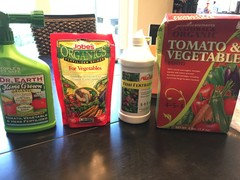
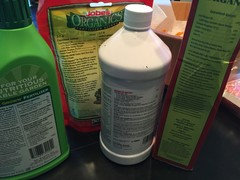
From left to right:
Organic 4-6-2 liquid contains some extra ingredients beside NPK (probiotics?) and is meant to sprayed through hose on plant leaves?? Says it uses aloe to increase microbial hydration using slimy layer of aloe? (Lol!)
Organic 2-7-4 dry fertilizer spikes recommends up to 8 of the inch or so long spikes per plant
5-1-1 liquid fish fertilizer derived from seagoing fish emulsion
Organic 4-5-3 dry fertilizer mix with 9% calcium and 1% sulfur (plus 1.3% humid acids and bacteria - 1.5 million CFUs per gram)
- 11 years agolast modified: 11 years ago
I have used the Dr. Earth, it is ok, it smells horrid. My neighbor said it smells like when she used to have to express her dog's anal glands. I have a problem attracting flies but if you don't, that's the one I'd go with here of these 4 you bought.
I don't like spikes in general, the organic ingredients need to mix with soil life to break down, which they can't do if they are in a spike. The spike concentrates the food in one area, which is not normal.
I don't like Alaska 5-1-1 and would especially not recommend it for any fruiting plants at this point in the season. You could use that on greens or herbs, or very small tomato plants not fruiting yet -- but not on blooming tomatoes, squash or cukes. It will supress blooming/fruiting. I have seen it in my own garden. It also smells horrid. I use Neptune's Harvest Fish & Seaweed, a product that is similar, but differently processed. It's much more available to the plants, and smells much less. It has a different NPK ratio that's more conducive to bloomers. Unfortunately you have to go out of your way to find it.
Nothing wrong with that dry fert except you need a liquid. You could try making the tea with it, but I would tend to just go straight for the liquid. By the way, I agree with everything Dave said about organics, containers, and liquids. I do grow organic in containers, but this is why I seek out these specialty products because that makes it possible.
Some say the ideal for tomatoes is a 3-1-2 ratio. I think the Texas Tomato food is something near that.
Jenn
- 11 years ago
Wow, winorchids, you have quite a supply of all kinds of fertilizers.
This year I just bought one of those quart size Alaska (0-10-10) stuff plus a small pack of bonemeal ($18.00 worth) . Of course I had a lot leftover from previous years.
At this point in time, only liquid one can make an immediate impact. That is why I am using Alaska 0-10-10 and MG 24-8-16 at very light doze (~1/4 strength ), as supplement.
Sey - 11 years ago
Sorry but I thought I had made it clear above that only liquids will work if you are determined to grow using only organics and in containers. So of the four you bought only the Dr. Earth and the liquid fish emulsion would be of any instant benefit. I guess if you wanted you could brew a tea out of the red box tomato and vegetable food but I wouldn't because you have no real control over exactly how much of each nutrient. I'd return it and the spike things.
The Dr. Earth has the additional problem (to the odor problem Jenn mentioned) of being only a foliar feed in that set up and foliar feeding has a whole other set of issues. The Dr. Earth in a regular bottle that is intended for mixing with water and using as a root drench on the plants is much better. So personally I'd return it too.
So that leaves you with the fish emulsion. Not the ideal but usable IF mixed at 1/2 strength and used to water the plants every 7-10 days.
Honestly I think you need to slow down and give this all some more thought or it is just going to be a big waste of more money and best you'll end up with is a few tomatoes that will cost you $10 or more each. You have already been taken advantage of by the local nursery and are stuck with that loss but why spend more?
Think of it this way. You started off with a very handicapped tomato plant, put it in a container rather than in the ground so handicapped it a bit further even tho you are using a good size, spent $$ on an expensive but unnecessary soil mix to fill that container, and then you decided you only wanted to grow it using only organic supplements. That complicates the whole process even more.
So while you are learning a great deal and that has value for next time I wouldn't take advantage of you further by encouraging you to throw anymore money at this plant. Instead I'd use what you already have that can't be returned for a refund and settle for just taking what you can get from this particular plant.
Meanwhile I'd use the rest of my time to learn more about the better varieties available, learning about how to successfully grow tomatoes in containers, and researching why you want to only grow organically and why organic growing in containers is challenging.
Does that sound like a plan to you?
Dave
- 11 years agolast modified: 11 years ago
there are two primary reasons why fruit could be smaller: 1) too small container and roots don't have enough room. 2) the plants have nothing to eat.
here's the deal with growing in containers.. it's best to START off
using slow release granular at the beginning of the season when plants
are in vegetative growth. after a month or two the soil in the container
will be pretty depleted of nutrients so this is when you begin using
water soluble fertilizer. sure you can add some more granular ferts, but
as mentioned by Dave, it won't be available to the plants for a while
until it releases into the soil and breaks down. - 11 years ago
This is all very good advice.
I didn't notice the Dr. Earth was in a foliar sprayer before. That is definitely not optimum. Foliar feeding is for micronutrients, not the macros (N-P-K). I wonder if you can just take the top off the bottle and measure into a watering can and use it as a soil drench? I suppose the idea in this case is that the foliar spray might help prevent disease. What we want is to feed your plant, though.
Here's the thing. When we start out at something new, it's easy to be enthusiastic but a bit unsophisticated. Lord knows, I have done this a hundred times. Anyway, we wind up doing things like buying four fertilizers at a time, but at a hardware store -- rather than a nursery, or grow store, or online where we can get the REALLY good stuff. If we could go back and do it over again, we'd probably just buy ONE fertilizer, but choose a really good one for our situation.
None of those fertilizers are BAD (except maybe the spikes?) but none of them is really what you wanted for this plant, right now.
I really do recommend that you keep your eyes open for hydroponics/grow shops - yes, I do mean shops that cater to marijuana growers. They carry really, really good fertilizers!
Meanwhile, I might try the Dr. Earth as a soil drench and either return the rest, or save them for leafy greens and herbs.
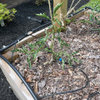
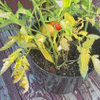
I do agree with Dave that growing organic in containers is a bit of an advanced judo move. But it can be done. Here, I just snapped a couple shots. These are in 20 gallon containers, 5:1:1 mix (see container forum), and receiving liquid ferts I've mentioned before.
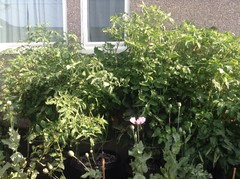
Cherokee Purple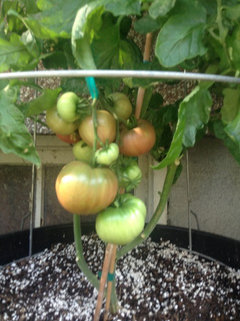
Jenn - 11 years ago
PS: I have been a member here since 2002 and have learned an IMMENSE amount reading the Container Growing forum. That was where I learned about Neptune's Harvest in the first place. It's where I learned about Al's mixes. I also like his concept of container growing as being "manual hydroponics." He doesn't like organics in containers but I have still learned from him and adapted my methods being informed by his opinions. I do seem to be doing all right :)
winorchids
Original Author11 years agolast modified: 11 years agoSorry to be a dunce, at the home improvement store I couldn't get internet access and the information was all too jumbled in my head. I tried to look for liquids only and they had so few, which surprised me given what you'd said. I was trying to find something with mostly P with some K and less N in liquid form and couldn't find it. I was looking for something like 3-6-4 or 3-4-6. Not sure if that was right? The only two liquids I found were the Dr. Earth (closest at 4-6-2), another like that but with higher N, and Fish 5-1-1.
What is the NPK ratio that is ideal for vegetables (tomatoes and ideally also things like squash/cukes) in containers at mid to later stage in the season/plant life cycle? I get that it should be liquid and not a foliar feed. I am returning the other fertilizers. If you can link me an Amazon product I receive it in 2 days free shipping. I need a liquid fertilizer for my other veggies so it would be good to buy one I could use for tomatoes+the veggies I named also. Also what about minor/secondary nutrients for these container grown veggies? Calcium?
The two so far mentioned I have some question about...
Neptune's Harvest - There seem to be a few types on Amazon: 2-3-1 and 2-4-1 -- which of these is recommended?
Texas Tomato Food - 3.1 -3.1 - 7
http://www.amazon.com/Urban-Farm-Fertilizers-Competition-Fertilizer/dp/B005LVNVCW
I also found this 4-4-4
- 11 years ago
<What is the NPK ratio that is ideal for vegetables (tomatoes and ideally also things like squash/cukes) in containers at mid to later stage in the season/plant life cycle? >
Unfortunately there isn't an "ideal" for all vegetables at all stages of life. So we all just do the best we can with what is available by changing the dilution or changing the frequently of application. A common recommendation for tomatoes is 3-1-2 but it is just a recommendation, something to shoot for, and not cast in stone. So don't get hung up on the label numbers quite so much, ok?
<The only two liquids I found were the Dr. Earth (closest at 4-6-2), another like that but with higher N, and Fish 5-1-1.>
Both are used by many with good success so you could have bought either one. As mentioned above, the odor is the only issue with either. Ex: if you mix the Dr. Earth at half strength you now have a fertilizer that is 2-3-1, mix it at quarter strength and you have 1-1.5-0.5. In other words they are all adjustable. Then depending on the strength you feed it every time you water or every other time or 2x a week, etc.
But its been what 10 days since the original question so what have you fed them in the mean time? That's the important issue - just feeding them. And if you have to wait for something to be shipped it just adds more delay.
All of the 4 you linked at amazon are good and would work well - they are just just different. If I was picking I'd buy them in this order:
1. Texas Tomato food or Neptune's Harvest Organic Hydrolized Fish & Seaweed Fertilizer
2. Dr. Earth
- Neptune's Harvest HF136 2-4-1 Organic Hydrolized Fish Fertlizer
JMO
Dave
- 11 years ago
W...two of the most sought after nuggets are: 1. what variety of mater to grow (best) 2. what is the best fertilizer. You have been counseled by the heavyweights on this forum...and it sounds like you really want to learn. With time...you will be doing great and giving advice yourself. Personally, I have become dialed-in on my container growing (3 years seriously)...and now I am learning about my new raised bed. So much to learn....part of the journey!
winorchids
Original Author11 years agoI came across this post and it has proved very helpful (reposting here in case another newbie comes across this thread for the same advice): http://forums2.gardenweb.com/discussions/1417883/fertilizer-program-containerized-plants-long-post
I wish this forum had "stickies"! You seem to be echoing everything contained within it so I am sorry I could have saved you all some time! Also contains info about secondary and micronutrients that I found useful. Tapla suggested Foliage-Pro 9-3-6 which has the 3-1-2 ratio and also has secondary and micronutrients. I may switch to that at some point.
We want to switch over to a raised bed or in ground next spring, so I will need to do another big wave of learning before that happens.- 11 years ago
No problem We do have "stickies" in a way but they are called FAQs (frequently asked questions) here. Unfortunately very few folks ever check them out or do a search so we are used to rehashing things. Never hurts to go over stuff again. :)
Foliage Pro is another often recommended brand when diluted to 1/3 strength for containers. And yes the micro-nuts are just as important as the NPK and all of the fertilizers you linked above also contain them.
Dave - 11 years ago
NPK Ratio:
Not very long ago, any fertilizer with 1- 1 - 1 ratio ( triple 10, triple 16, etc) was called/considered " All Purpose". But I think they found out that N, P, K are not used in equal amounts by the plants. Nowadays a 3 - 1 - 2 ratio (like MG all purpose blue stuff) is considered more or less all purpose. A GW member ( Al, user name TAPLA) in container gardening has argued strongly that 3-1-2 ratio is almost near perfect ratio for most plants.
Then there are those who say that the "N" in 3-1-2 ration is too high for tomatoes in flowering and fruiting stage.
There is a brand called Texas Tomato Food that is almost 1-1-2 ( 3.8-3.1- 7.0).
WOW ! twice as much K than N.
I have read Cornell and U of Mo recommendations. they are all different.
So really there is a confusing situation. Maybe that old All Purpose ( 1- 1- 1 ratio) is the best after all .
Sey


digdirt2