Software
Houzz Logo Print
mariy_necro

Propagating VFT???

11 years ago
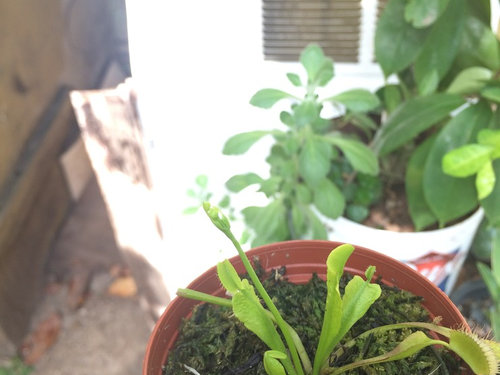
I read on a few places that as long as the flower stalk isn't too grown you can just snip it off and stick it in growing medium and it takes. Has anyone done this? My Venus is growing a flower stalk and I would love to try this, but I'm scared to try it and kill it. So, I'd like to know if anyone has done this successfully.

This is what mine looks like right now. It recently re-grew a bunch of traps.


Comments (18)

  • 11 years ago

    Help

  • 11 years ago

    I've heard it'll work but leaf pullings definitely work!

  • 11 years ago

    Have you done it???

  • 11 years ago

    Your VFT is doing well, why not wait and divide as it comes out of dormancy next year?

  • 11 years ago

    How do i get it to go into dormancy??

  • 11 years ago

    You wait until late fall when the days are shorter and the temperatures begin to drop and the plant will go into dormancy on it's own. Depending on the weather where you live, you may need to put it in a refrigerator. VFT are native to the coast of North Carolina, USA. Hot, humid summers, followed by winter temps below freezing. Just remember it won't need as much water during dormancy, but you never want to let the roots dry out (conversely, you don't want them to freeze). I highly recommend the Carnivorous Plant FAQ at sarracenia dotcom.

  • 11 years ago

    I have tried flow stem prop several times. It never worked for me. But I understand it does work.

  • 11 years ago

    Didn't know this type of plant took to cuttings.very good info.I plan to do alot of cloneinv of plants like vegies and herbs I use most.but I have a soft spot for these carnivourus plants.I'd like to stay updated on this topic,sence I'm planing on a mini garden in my greenhouse made up of a number of vft species. It would be awesome to be able to clone them I think

  • 11 years ago

    carnivore plants are amazing! Do that!


  • 11 years ago

    The Venus flytrap is a plant in a monotypic genus. That means there is only one species of Venus flytrap: Dionaea muscipula. So the short answer is that there is only one kind of Venus flytrap.


    There is more to this, though. Even though there is but one species of Venus flytrap, horticulturists have developed a number of cultivar Venus flytraps. These are plants which have interesting characters. Some are interesting because they have nicely colored traps. Others have strange leaf forms.


    http://www.sarracenia.com/faq/faq2100.html

  • 11 years ago
    last modified: 11 years ago

    Maby I was loose with my terminology, so sorry for neglecting to use the Queens English. I'm aware there is one species of "fly trap", but there are many different carnivourus plants.this is what I ment.in the future I'll be sure to be absolutely spicific.I forgot just how serious of a topic growing plants has become.

  • 11 years ago

    Now that I'm done being chastised for my poor grammar, back to the topic at hand as we did digress. Exactly how do we propagate "carnivourus" plants?what system or method is best?most important here is ph and nutriant solutions that are needed,as I think they require more alkaline soil with poor nutrition, hence the evolution that made them decide to eat bugs.and can they be grown hydroponicly?if so what type of hydroponics,or aeroponics,would be best?wicking,ebb and flow,water culture, nft,drip system,ect?temp and humidity?best lighting and at what intervals?

  • 11 years ago

    Depending on the plant they are propagated in various ways. The main way for VFTs is leaf pullings. They are easy to start from seed but take a long time to reach adult size. PH is you use the right mix should be low, around 3-5. Not sure if hydroponics or aeroponics would work.

  • 11 years ago

    No offense, ladyf888, but hundreds (if not thousands) of people lurk here and I just didn't want a newbie walking away confused.


  • 11 years ago

    No problem.I'm not new to gardening by any means.in fact I come from a long line of accomplished botanists. And I'm currently attempting to take my skills to the next level.I'm versed in all hydroponic systems,including the high pressure aeroponics NASA swears is the best system on earth,though I think any of these systems can be successful if properly built. Hpa is the only system that can opperate in zero gravity so I can see nasa's intrest in the system,and even though it's perfect for propagation its still very high cost to start and build.800$ minimum for basic systems.I am new to propagation however so this is where most of the help will be needed.and I am truly curious to see if these plants can be grown hydroponicly.never seen it befor.

  • 11 years ago

    By the way,I made a rooting solution for a water culture I'm useing to propagate a morning glory cutting.first I made an asprin solution for rooting,to see if it's realy effective. I crushed the tabs and added a small amount of 90% rubbing alchahol as a solvant. Then added boiling water and allowed to stand for 48 hours.solution was clear,with only the slightest bit of cloudiness and asprin was 100% disolved. Then I made a nutriant solution with miriclegrow all purpose plant food,water soluble. Solution was light blue-green.added this to asprin solution and after a few hours it was a lavander color.can anybody explain this?I see no ill effects to the cutting,and its been a full 24 hours.I can provide the miriclegrow composition if it's helpful.

  • 11 years ago

    It has to be a reaction with the plant its self.I mixed another batch exactly the same,only its in a separate container for now.it has not turned lavander yet.but the solution the morning glory cutting is in did turn lavander.only possible varible is the plant.this is only getting more strange as time goes by.maby it was a freak accident. Not to sure at the moment

0
Sponsored