Software
Houzz Logo Print
hzdeleted_26184948

Plants that tie it all together

11 years ago

The recent mulch discussion has me thinking. I love gardens where the plants are full and mingle together but never seem to achieve that look. Even when I fill in with annuals, the garden has a spotty look to it with bare mulch in many places.

Does anyone have favorite plants (and any planting advice!) for tying a garden together?

Comments (18)

  • 11 years ago

    Interesting question - I'll look forward to others' input.

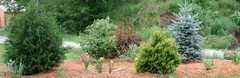
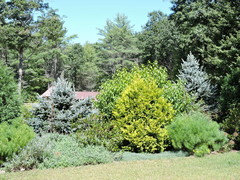
    Part of it is plant spacing combined with time. I try to put things in so that when they are full sized they run together. I have added some plants to the bed below, but mostly the ones you don't see are either just out of the frame or too small to be readily visible. There is about 6 years time difference between these two photos.

    When planted:


    Now (from a slightly different angle since the left blue spruce is hidden behind the arborvitae in the first photo):


    I do use a combination of groundcovers, spillers, and self-seeders to fill in bare spots.

    Groundcovers:

    Dianthus Greystone and Brilliancy

    Veronica Georgia Blue

    Wooly thyme

    Geranium Biokovo

    Spillers:

    Catmint Nepeta

    Clematis Mrs. Robert Brydon

    Self-seeders:

    annual poppies

    Nicotiana

  • 11 years ago

    Thank you for the response and the photos. Pictures are a huge help for me. I can repeat "first year they sleep . . . " a million times and it never makes as big an impact as a picture. Your evergreens are wonderful!

  • 11 years ago

    GREAT question!

  • 11 years ago

    I agree that it is spacing (and being patient enough to wait for things to grow - not one of my strong suits!) and also having some kind of common theme to pull things together, like a repeat of a plant or type of plant.

    I put in a foundation garden for a friend, on either side of her center front door, and one of the plants we chose was a Goldmound spirea. She ended up absolutely loving them. When she choose to extend this foundation garden along the driveway, we put in a few more along it, to tie it together to the foundation bed. The other plants we put along the driveway were not exactly the same as in the foundation planting but we tried to follow a similar color theme. Since we had the Goldmounds, we had a dark green/chartreuse green/purple accent color theme (concentrating on foliage, not blooms, since this was a part-shade area). So we tried to choose plants that way. For instance, in the foundation bed we had purple-foliaged heucheras. Along the driveway, where these is a bit more sun, we put in a ninebark, some purplish/reddish wegiela, and some nandina. The colors aren't all matchy-matchy, but they stand out against the chartreuse in a similar manner.

    For darker greens, we have some boxwoods, some small evergreen hollies, two larger dark green hollies that were there, small azaleas, and some dwarf rhodies - all these also for winter interest, and we did repeat some of them. We filled in with hydrangea, roses, iris, and some hosta and hakone grass, again repeated, with more hostas/hakone in the shadier section and roses, irises, etc., in the sunnier part.

    As usual, I did not leave enough spacing when I originally planted the foundation bed, and had to move out some of the spireas (it didn't help that they grew 50% larger than they were "supposed to", lol) This garden seems to have amazing soil for some reason (I didn't really do much amending to it originally) and things grow at an amazing rate, so overall everything filled in quickly and really, the only place the mulch shows is along the very edge, which we usually fill in with annuals anyway.

    Oh, and close to the end of the driveway there was already an existing small garden (we kind of connected it to the foundation garden and filled in in-between the two) and this garden has pachysandra, lily of the valley, vinca, and ivy. So there is more than enough ground cover to eradicate the need for mulch. This is another option if you don't want mulch (although I wouldn't recommend ivy, pachysandra or LOV!). I am trying to remove all the ivy, and each year pull out some LOV, as well as keeping the pachysandra in check, but it does look nice to have that groundcover instead of mulch, IMO.

  • 11 years ago

    Lots of great suggestions above!

    One thing to think about is planting temporary space holders in between the young plants you expect to eventually grow up and fill in the space. That way you don't have to look at a vast empty mulched expanse for a few years.

    Annuals work, but they're annual and you have to replant them each year.

    One of my favorites is sedum, which comes in myriad sizes and colors and looks neat and compact. One of the nicest things about sedum is that you can dig it up and move it when it's no longer needed in that space and it doesn't seem to notice - it looks the same in the new spot. You also can easily divide it and make more. Sedum roots stay close to the plant so you don't get runners invading your permanent plantings.

    On a separate note: Be careful planting lots of one type of plant to use as a recurring motif in your garden. When I started this garden I planted many Artemisia 'Powis Castle' which I adore - it has lovely gray-green feathery foliage and looks great with all types of plants. It tied together the garden well, in my eyes anyway, until a harsh winter killed off all of the Powis Castle and I had big holes. Part of the problem was my fault cutting it back at the wrong time, but my biggest mistake was relying on a plant of dubious hardiness to take a starring role.

    Bottom line: If you're going to plant a monoculture make sure it's hardy in your conditions.

    Claire

  • 11 years ago

    Even if hardy, a disease or insect that likes a particular plant can result in same problem. That's why nhbab's varied designs will remain attractive and healthy for years, even if she loses a plant or two.

  • 11 years ago

    I have nothing to add because everyone has given such great advice. Photos really help, as you can see with nhbabs, so you might want to include a photo of the one area in your garden that bothers you the most ... you'll probably get lots of suggestions.

  • 11 years ago

    Diggerdee made me smile! I have vinca and ivy and a little lily of the valley (also bittersweet, Concord grape, garlic mustard. . . ) Do invasive species count as a theme?

    We live in a family property that was neglected for a number of years. When we arrived parts of the yard were waist deep in bittersweet vines. As much as I admire the effect of plants growing together, I hesitate. I think the long battle with various invasives make me very nervous with anything creeping, weaving or spreading.

    To make matters more complicated it is a big yard. Sometimes I feel like I get one part in some order, look up and suddenly find another spot went all to heck.


  • 11 years ago

    Maisie, I have the same problem plus I have 3 or maybe 4 shrubs bought at end of season sale for my shrub garden that is still a dream. I think I tend to have too many one of a kind plants. I did get a good start on a kidney shaped bed except the inside curve is impossible for the lawn mower and I need to install some edging. I've been tying that bed together with dark leaves starting with a weeping crab. I have 2 dark leafed perennials that bloom late next to a Mayflower viburnum (bed starts off pink and white in the spring). I plan to move some dark purple dwarf iris to in front of the dark leaf perennials (sorry, can never remember what they are). This would give upright straight leaves to offset the bushy shrubs but the color would complement to dark leaves. The back side of the bed that gets more shade has a white flowering day lily, some small hosta and a lungwort. I'm thinking of moving the lungwort to the north end of the bed. I think the silvery look to the leaves will go well with the purple tones. Until I get out there to re-edge the inside curve, some of the ideas are still in my head.

  • 11 years ago

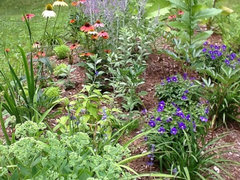
    Here is a slightly fuzzy shot of a small garden bed showing my patchy problem! The bed was renovated this spring, so it is extra patchy, but it illustrates the issue.

    The bed had become so overrun I dug it out, saved some odds and ends (peonies, a few daylilies, some sedum autumn joy.) Like defrost, I tend to like one of this and one of that. I was determined to try something different here. The concept is a ribbon of Russian sage with peonies on one side (for spring bloom) and echinacea on the other for summer.

    Some of the sage went in as small seedings, with a few larger plants. I knew the peonies in particular would be puny for a while. I filled in with some nicotiana for height and salvia and Browallia for blue (totally different blue but interesting it its own way.)

    So despite a clear plan and vision I managed to plant another patchy hodgepodge! Yikes!

  • 11 years ago
    last modified: 11 years ago

    In that garden with those plants, I can see the Russian sage (Perovskia) tying it all together using repetition in the way Dee described above. The R. sage will provide a consistent color and texture of both flowers and foliage, but it's so airy that it wouldn't overpower your other plants. It just needs to grow a bit to pull things together. I would underplant with wooly thyme or one of the other low-growing thymes or a short Sedum or Veronica Georgia Blue or a low sedum to fill in around the other plants. None of those will be a problem except possibly a few of the low Sedums like S. acre which sprouts from even the smallest of broken off sprigs. If you want to fill in while other things are growing, add some wave petunias or other spreading annuals. If you leave the tall Sedum, Ehcinacea seedheads, and Perovskia in the fall, you will have some winter interest.

    User thanked NHBabs z4b-5a NH
  • 11 years ago

    Maisie, I understand completely what you mean about the "big yard". Growing up in a rowhouse in the city with a postage-stamp sized yard, my mother's little garden always looked full and wonderful. I now have almost an acre, and when I first started gardening it was such an adjustment. I'd put in for example, half a dozen irises. In my mom's garden, they would have looked wonderful and amazing and full and just right tucked in this or that corner; in my yard, they looked spindly and tiny and woefully inadequate -if you noticed them at all! I really had to adjust my mindset into thinking in terms of each bed, of concentrating on the beds, and not trying to "do" the whole yard at once. Certainly you want to proceed with a plan that will ultimately look good and be all tied in, but it can be daunting with a big yard, especially if one has young kids, older parents, a job or two, etc. It's a process, IMO...

    babs, sometimes I think people must wonder if we have stock in growing veronica Georgia Blue, lol. I can never recommend this plant enough, and I always smile when I see you suggest it too!

    User thanked diggerdee zone 6 CT
  • 11 years ago

    Dee, sometimes I feel a bit silly when I recommend the same plants repeatedly, but they are always ones that grow well, bloom well, and have no problems in my garden.

  • 11 years ago

    I agree completely! :)

  • 11 years ago

    Thank you so much. I will definitely check out the Veronica given endorsements from you two. I am amazed and humbled by the generosity of people here. It seems every question I've looked at anywhere on the forum, nhbabs had already responded to with patient, thoughtful guidance.

    And Dee you hit the nail on the head, small space growing up where small changes had a big impact. And also so right about life in general but now my kids have gotten bigger, just one job at this point, a degree finished last year, and older relatives more or less settled for the moment. Getting back into the garden has been wonderful in some ways - I really like the way the bright echinacea is working with the blue grey sage! - but I look up and there is so much to do!

    and keep the plant recommendations coming! Although tried and true doesn't always work for me. I can send my mom and sisters into fits of giggles by reminding them of my efforts to grow nasturtiums. I think the most successful year I had three leaves and one flower. . .

  • 11 years ago

    Something no one has talked about is having a good mix of tall vertical and low spreading plants. A few tall plants towering over a sea of spreading groundcover, ferns or bulbs can have a nice effect.

    User thanked edlincoln
  • 11 years ago

    Thanks again everybody.

    Ed, I really like your description. That is defiantly what I tend to miss, the low spreading plants.