Software
Houzz Logo Print
jravd3

Lawn Help

11 years ago

Hello, I need some serious help with my front lawn. I had a soil test done last year and as expected it came back as heavy clay. Soil pH 8.0, Manganese 161 ppm rated as "Very High" on the chart provided with the test. I worked with a local store to figure out the best route to correct the soil. I was given the following 2 year plan:

Late September 2014/2015: Healthy Gro fertilizer, Hi Calcium Limestone, and seed.

Late November 2014/2015 Hi-Calcium Limestone and Fertrell 5-3-4

Mid March 2015/2016- Chem Preemergent

Early April 2015/2016 Healthy Gro, and Hi-Calcium Limestone,

Early July 2015/2016 Healthy Grow, and Hi Calcium Limestone


This plan has worked great for our backyard, it looks like a golf course, but the front has been completely overtaken by weeds and has large bare spots. I have applied the same products, and given the same amount of water to both.


The only difference is drainage. The backyard does not drain well, grass only seems to grow well where the water drains poorly. We have a sump pump that drains on the side of the house and the grass there does better than anywhere, but it is constantly wet even if there has been no rain for several days.


I think I am going to have to restart the front completely, but I don't want to keep making the same mistakes. Does anyone have any input?

Comments (19)

  • 11 years ago

    I'd really need to see an image of the test.

    If your pH is 8.0, then lime is exactly the wrong response. It's just going to turn a severe problem into a complete and total disaster.

  • 11 years ago

    Well, that's disappointing. The store closed so I bought enough limestone to carry me through the end of the year based on the plan they provided...


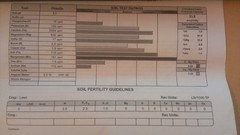
    Test results below (test done by A&L Eastern Labs if that matters):

  • 11 years ago

    If you could tell us your closest city and state, that always helps. It gives me an idea of your basic soil chemistry and soil composition (although individual plots always vary widely, of course). Plus your grass type. Some do demand different treatment than others, although the vast majority respond best to the same optimal levels of ions in the soil.

    The Healthy Grow fertilizer was not a mistake and is probably responsible for your great back lawn. It's not completely organic (and I'm not completely thrilled with the parts that are organic), but if it's working for you, there's absolutely no need to change it at this point. Use of organics can mask or negate a lot of soil chemistry problems. I could expand, but I'm complaining enough in this post!

    I don't believe some of the answers on this test. Correct me if I mis-read a number here, my vision is very poor and this is kind of fuzzy. I should be OK except when trying to decipher 3, 8, and 9... :-)

    Your CEC at 33.9 would be one of the highest I've ever seen, if not quite the highest. That would imply an almost completely clay soil with possibly a little bit of silt. We're talking soil you could dig up and make a pot out of without much processing. While that's possible, it encompasses less than 1% of the surface area of the country. The at home jar test could corroborate that.

    (There's an exception where your CEC will show high due to a calcium excess in the soil, but that doesn't seem to be the case here. Calcium is a touch high, but nothing unreasonable and shouldn't be throwing your CEC out of whack).

    The numbers in no way support a pH of 8.0. See how the calcium, magnesium, and potassium bars are all in the Optimal range, two bordering on Medium? Plus that nice low sodium number? Those are the ions that are the heavy-hitters in your soil pH (sodium tends to be rarer, but a very strong alkaline). For Optimal numbers (a little on the low side), I'd estimate your pH around 7.2 to 7.5. Half a point on the pH (logarithmic) scale is a third as alkaline as they claim.

    (I don't like the bars and I'm actually reading the saturations; calcium should be in the next range up if you want my honest opinion, 80% and up is a rather high saturation of Ca when the goal would be 65%).

    Granted, your calcium saturation at 80+% is on the high side, but calcium is a weaker alkaline element.

    That would be if I believed the CEC number, of course, which I don't...but it's equally likely that they messed up both. We just don't know.

    Regardless, at this stage of the game, limestone is a Really Bad Idea. Best case, you're very close to optimal on everything and don't need it--and adding it will throw the pH too high. Worst case, the CEC is severely wrong and the pH is close to right. Adding it will damage the soil even worse than it already is.

    If you look at the recommendations down below, the laboratory did get those right as far as the read goes. Recommended calcium and magnesium additions (or, limestone) is 0--so now I don't trust the store you went to, either. They clearly don't have the faintest clue on soil chemistry but sold you limestone that's detrimental anyway.

    That high manganese number doesn't scare me; mine is almost that high (the land I'm on used to be agricultural). That's pretty harmless and relatively easy to get around...again, if correct.

    I'd extremely strongly advise re-testing through Logan Labs. Just the basic $20 soil test will tell you everything you never wanted to know about your soil.

    Unfortunately, you're already a good chunk of the way down the road with this plan, so there's already a lot of potential damage. It can be fixed--at worst by not increasing the damage and letting the excesses leach out over time.

  • 11 years ago

    Thanks for the detailed and quick response.

    The closest major city would be St. Louis, MO.

    Yes according to the test the CEC is 33.9. Since the test results are suspect I will detail the test procedure I followed to see if it was incorrect to begin with: The store told me to go to 4 or 5 different spots around the lawn, dig down several inches to get a good sampling of the entire area. When I dug up the sample and brought it in I remember the sample was bright orange and was thick/dense/moist like pottery clay. The store employee even joked that I could make an ash tray out of it.


    To say that my experience with soil make up, lawn care etc. is limited would be an overstatement. However, just from observation, since the areas that do best are poorly drained and constantly wet, and I know I have clay soil, that leads me to believe the soil must be supersaturated for an extended period of time to allow the water to get down to the roots. Am I misinterpreting what I see? If that is the case what is the best course of action? Or is it best to wait for new test results before jumping to any conclusions?


    I will look into getting another sample sent for evaluation at the lab you suggested.

  • 11 years ago

    Forgot to mention, grass is fescue.

  • 11 years ago

    What is your watering regimen? How often and for how long?

    What kind of grass do you have?

    Is the problem area in the shade or full sun?

  • 11 years ago

    >>Or is it best to wait for new test results before jumping to any conclusions?

    At this point, that's the wisest course of action.

    http://www.loganlabs.com/doc/Soil%20Sampling%20Instructions.pdf

    There's the Logan sampling instructions. They recommend fifteen mixed samples, but I can say that I generally do around twelve or so myself. Give or take. Four or five was a little trim, all things considered.

    You may actually be one of the rare folks with a clay soil, it does happen. You can collect extra soil to do the at home (and free) jar test if you like, which would give us a general handle on your soil type before the test results come back.

    Even if it's clay, we can work with it. Clays can be flocculated (gathered together) into peds (small, stuck-together collections of soil particles) that will allow air and water to penetrate your soil. If the OM (organic matter) levels come back low, we can work on raising it to also increase air and water penetration. And we can go with the shampoo method, which also helps flocculate soils.

  • 11 years ago

    Please do the jar test because I really want to see the results. I have a feeling you might be one of the few people who actually has a high clay content from some of the things you have said.

    I'm so curious about this one, that instead of sending you off to hunt down the procedure on your own, I'm going to outline it for you here:

    Test Procedure:

    1. Get a clear glass jar with a lid - mason jars work really well.
    2. Put roughly one cup of soil in the jar
    3. Fill the jar with water
    4. Put the cap on the jar
    5. Shake it until the soil is fully dissolved**
    6. Set a timer for two minutes
    7. At two minutes, take a picture of the jar
    8. Set a timer for 2 hours
    9. At two hours, take a picture of the jar
    10. Attach the pictures to this post***
    11. Take a picture 48 hours after you started the test

    Test notes:

    **If the soil will not fully dissolve in the water, pour the water out of the jar but keep the soil. (Alternatively you can just go dump the soil in the yard and get more, either way works - just do whatever is easier). Now refill the jar with a 50/50 mixture of white vinegar and water. DO NOT PUT THE LID BACK ON THE JAR YET. Instead, put your ear down near the mouth of the jar and listen for a fizzing noise. If you hear any fizzing, wait until it stops, then stir the solution and soil around and listen again. Repeat this until you don't hear any fizzing. Sealing the jar while it is still fizzing could make it explode and sen shards of glass into places you don't want shards of glass.

    ***After you post the pictures from the 2 minute mark and the 2 hour mark, we might be able to give you a read on your soil, but we may still want to see the picture at the two day mark as well.

    How the test works:

    All sand and rock will settle to the bottom within the first two minutes of the test. Generally, it takes up to two hours for all the silt to settle. This will form a layer on top of the sand. It can take up to two days (sometimes even longer) for clay to settle.

    Once everything settles, you should essentially have three visible layers in your jar. Sometimes, the layers aren't so distinct. Because you are physically there looking at the jar, your eyes will often pickup the subtle difference between the layers that are harder to see in a photograph. Therefore, it is recommended that you mark a soil line on the jar at each interval (2 minutes, 2 hours, 2 days).

    As an example take a look at my jar test in this thread: http://forums2.gardenweb.com/discussions/2950556/i-want-the-best-yard-in-the-neighborhood?n=76

  • 11 years ago

    You might add a few drops of liquid soap to help break up the small soil particles, too.

  • 11 years ago

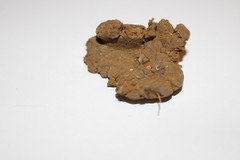
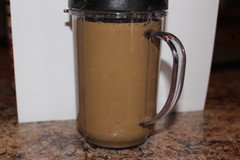
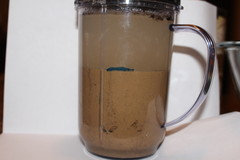
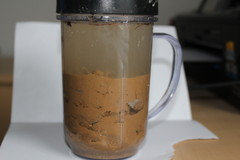
    Thanks for all of the responses everyone. Here are the first two pictures of the jar test. I also added a picture of the soil itself to give an idea of what I am working with. It rained last night so it was so sticky I could leave a finger print in it. The hard part about getting a sample was getting a clean sample (i.e. no rocks). As soon as I dug into the ground I hit all kinds of rock.


    Anyways... here are the pictures so far:

    2 min:

    2 hr:

  • 11 years ago

    20% sand, 80% silt. There's some cloudiness in the water, denoting a very tiny amount of clay, but not really enough to matter.

    That puts you on the borderline between a silt loam and a silt soil.

    And yes, it's a running joke. Almost nobody has clay. Every soil type will be a bad actor if it has low organic matter, or has deflocculated.

    That now puts the measured CEC very much in doubt, so your pH could actually be higher than I'd expect if the measured ions are correct. Pure silt should have a CEC in the 15-20 range, although it does vary.

    I might take a small sub-sample of that and put it in a dish, then add vinegar. Stick your ear down next to it and see if you hear sizzling noises or see froth and bubbles. Report back, but you can discard the sample if you don't get sizzling. If you do, we'll be replacing about half the water in the above with vinegar to get the soil to break apart and re-trying the test.

  • 11 years ago

    Mmmm.... a dirt smoothie.

    For what it's worth I was hopeful that you had a fair amount of clay in your soil. I've yet to see a soil test that did, and curiosity is getting the better of me.

    By the way, low clay content is generally a good thing. If you had a high clay soil, your lawn would be the least of your household concerns. Clay can be very plastic and will expand and shrink based on moisture content. Let's just say these two characteristics are less than desirable for your foundation.

  • 11 years ago

    >>I've yet to see a soil test that did, and curiosity is getting the better of me.

    I've seen one or two in my time, including my own (40% light clay, 60% silt, 0% sand, still not a clay soil). But they're not common.

  • 11 years ago
    last modified: 11 years ago

    Thanks everyone. In order to make sure I got a different sample from a different part of the yard and redid the test. The pictures are below 2 min followed by 2hr. Sorry to ask again, but I am not as well versed in this to tell how close it is to the other sample.


    Same result?

  • 11 years ago

    Bwahahahahahaha!! Just laughing at the joke. Unless you have a brick factory nearby, you probably have some sort of salt imbalance instead of clay. Whatever issues your soil has can be fixed. Trust me. The easiest way to start is to fix the soil biology. You'll need to fix that anyway. Unless you have poisoned your soil with fungicides or diesel fuel, all you should need is some organic fertilizer at 15-20 pounds per 1,000 square feet. Actually you should start at 10 pounds per 1,000 and then a month later you can apply at 15-20 pounds per. But that won't fix everything. A soil test from Logan Labs followed by a reading from morph, our resident soil test palm reader, followed by your action on all of morph's suggestions, should get your soil tuned up.

    Having a "clay" soil that isn't clay, or even if it is clay, turns into an excuse for people not to have an excellent lawn. It can be fixed.

  • 11 years ago

    The second test is essentially identical to the first--but it has no clay instead of only a tiny amount. 20% sand, 80% silt.

    I never object to organic matter, so is you want to start hurling around 10 pounds per thousand of any organic feed or grain, I'm totally cool with that starting right now.

    And yes, David is right; clay becomes an excuse. Which it really isn't as clay can support a perfectly lovely lawn and gardens. It simply requires special considerations. But so does every other soil type.

  • 11 years ago

    Thanks everyone. I am sending soil test out soon. I am still confused why there is such a dramatic difference between the back yard and front yard when same water/fertilizer/etc has been applied in the same amounts. The front is +75% weeds or bare spots now. There is a house across the street that was vacant for 4 years and their lawn looks 10x better with no maintenance, watering, or fertilizer.


    The yard is 5k sqft measured and I have been putting 2 50lb bags of Healthy Gro per application (counting both front and back yards). I guess the questions I have now while waiting for the soil test are: what types of organic feed/grain should I start with and at what frequency of application? and How do I start over with reseeding in the fall?

  • 11 years ago

    With dramatic differences, do separate tests front and back (I hope I mentioned that before!)

    10 pounds per thousand of soybean meal or cottonseed meal (soybean will probably be easier to get for you) will provide a tolerable feeding. 15 pounds per thousand is a very good feeding, but the stuff usually comes in fifty pound bags. With 5K square feet, just go with 10 to use 1 bag.

    Did you want to overseed or completely wipe the deck and restart? This year, I'd go with overseeding and plan on a full renovation next year if it's still necessary (that will be post your soil test).