Software
Houzz Logo Print
jkhdawg

Soil Test Results Are In

11 years ago
last modified: 11 years ago
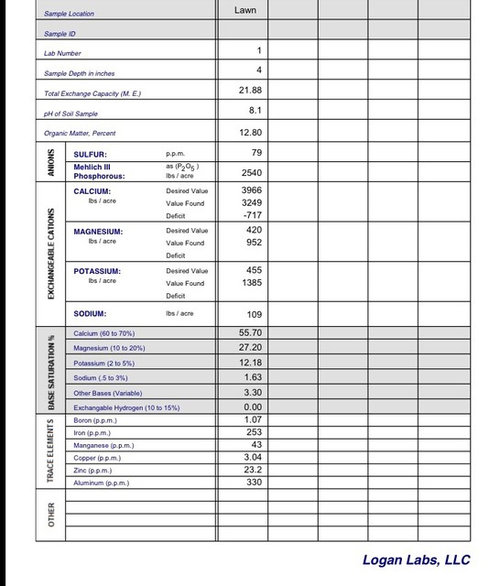
Morpheus, hoping you can help me out with the results. Get me on the right track to any necessary lawn recovery.

I live in upstate NY. Fescue/KBG mix.

30,000 sq ft lawn

Fertilized w/ 300lbs soybean meal late May

Have not had to water much this season due to all the rain. From end of May to mid June received more than 5in of rain. Last few weeks have been hit with frequent rain/storms.

Mow every 5 days at highest level. Or about 4.5in long.

Comments (8)

  • 11 years ago

    This presents some very interesting challenges. I'm guessing your lawn quality is so-so to fair, the soil is very tight and hard to dig, and color is slightly disappointing but not awful.

    I would love to know what this soil was before it was your lawn, and what's been done to it. It's out of whack in some ways that are impossible for upstate NY without chemical modification.

    EC 21.9: Very high, probably a silt soil with some clay. This soil is resistant to change, which in this case is kind of a pity. It'll take time, but can be balanced.

    pH 8.1: Ridiculously high, set off by the high magnesium levels (and high K to a far lesser extent). Anything I do has to be pH-neutral or acidic, which is going to be difficult.

    OM 12.8: Well into the Extraordinary range! There's absolutely no need to work on this, although organic feeding, mulch mowing, and mowing in your fall leaves is never a bad idea.

    Sulfur 79: Fine, but with less margin than I like. It won't be a problem, but seeding this fall might not go off as well as you'd like if you do it. Excessive S reduces seedling survival.

    Adding elemental sulfur to reduce pH isn't particularly effective unless it's dug in, and even then... Sulfates tend to be neutral to acidic, so use of some sulfate chemistry can help lower pH.

    Phosphorus 2540: This is so far over the top it's ridiculous and potentially starting to cause some issues. There's no easy way to reduce this, so we let it ride and allow it to drop over time. No phosphorus will be needed for decades, and definitely avoid any phosphorus sources, no matter how small. Always reseed to fill in any open holes as particulate erosion from this soil will contribute (strongly) to eutrophication of waterways.

    Calcium 55.7%: Actually, low. Calcium is an alkaline mineral, so we don't want to use calcitic limestone. To lift this, gypsum is our only option at this point (and the sulfates in the gypsum will tend to remove a little magnesium and sodium, and a touch of potassium, which is good). Most landscape places and smaller garden shops either have gypsum or can order it for you, and I've seen it at Home Depot upon occasion as well. Any brand is fine. Recommendations below; I'm taking this slow, so your calcium levels probably won't fully recover before the next soil test next July. The target in your soil is 65-70%, I'd be happy anywhere in there.

    Magnesium 27.2%: Incredibly, off the charts high. Don't apply any magnesium sources (cheap lime would be a particularly bad mistake, but Epsom salt or any magnesium bearing minerals would also be an error). This will tend to make your soil tight and impenetrable, although your organic matter levels are high enough to help compensate. Gypsum applications should dispel a little of this, and the target in your case is around 12%.

    Potassium 12.2%: Off the charts high. No potassium is required or desired (and should be avoided), but this won't cause you too many problems. The gypsum should dispel a little of this. Excess K can block uptake of iron, magnesium (probably a good thing), and zinc, so we do want to let this drift down over the years to no higher than 7-8%.

    Sodium 1.6%: Entirely normal, but to push the pH down I'd like to dispel some of this. Gypsum removes sodium very easily, so that'll help. Sodium has only minimal use in plants, and only very tiny amounts are required. You receive enough sodium in normal rainfall to meet all the plants' needs even if the soil has absolutely none.

    Minor Elements: Boron is right in range, but no more is needed or desired. Mn is high, Zn is incredibly high (but pretty harmless), Cu is high, and Fe is normal but I do mention it below.

    Iron 253: A perfectly reasonable number. At a pH of 8.1, practically none of this is available and almost all is locked in forms the grass can't touch. While adding iron is useless at a pH this high, the grass will still get a chance at any unbound iron before it binds up. Use of Milorganite will help with your lawn color a touch.

    There's a method of lowering pH by using ferrous sulfate, but in this case I'd skip it this year. We have enough calcium deficiency that I'd rather not add this to the mess.

    Recommendations:

    August 1: Apply 15 pounds of gypsum per thousand square feet.

    October 1: Apply 15 pounds of gypsum per thousand square feet.

    April 15: Apply 15 pounds of gypsum per thousand square feet.

  • 11 years ago

    Morpheus, let me start by saying thank you. It truly is much appreciated.

    To clarify, I live north of the Adirondacks. North of Albany and south of Montreal. Sometimes people hear upstate NY and they think Buffalo.

    I would say that for a one year old lawn, done by myself with little to no expertise that my lawn is doing better than fair.

    Surprisingly the ground is quiet soft at least first few inches of the soil. However I did hit hard ground at about 4in which is why I was only able to go down 4in with my probe when I took soil samples.

    A local farmer owned about 25 acres of undeveloped land which was divided into 4 parcels. We purchased the largest parcel almost 7 acres. It was completely wooded and we cleared about an acre to build. The DEC actually declared most of the property wetlands in 1975. However we had them back out along with the Army Corp of Enginneers and had both resurvey the parcel. DEC declared it as wetland run off and Army Corp marked a small piece of our property as wetland. However we got the permit and it didn't change the building process. I have no intentions expanding my lawn. The 30,000 sq ft lawn I have now is enough.

    As I've already said, it was a completely undeveloped and wooded lot. We cleared about an acre. We have full basement and built up. Builder used back fill (sand) about the first 20ft from the house all the way around. We have a relative that works for the local town that provide the fill for the rest of the yard. Truly a mish mash of dirt, clay, silt etc etc. My father n law is a farmer (diary) and he provided us with all of the topsoil (directly out of his field where the cows graze, poop etc) that we used to build up the lawn on top of the fill. We added about 4in of topsoil to entire lawn. Then used my father n laws tractor with grade, leveler attached to finish off topsoil before seeding.

    We seeded in June of 2014 with mix of Fescue/KBG/Rye. No chemicals, no fertilizers. Just watered. In September I over seeded with KBG (98%). Again only watering.

    This year, I fertilized late May and plan to fertilize again in August, September & October.

    Other than Weed-B-Gon, I've never used any chemicals only organic fertilizer.

    Here are a few photos that I just took.

  • 11 years ago

    What a test! and what a story! I wonder what caused your top 4 inches to be so heavy with magnesium and potassium? You might ask your father in law about how he's fertilized over the years.

  • 11 years ago
    last modified: 11 years ago

    dchall, the area where my father n law dug the topsoil has never been fertilized. It's a large fenced area where he lets about 100 milking cows out of the barn for the night. Keep in mind these are diary cows. The cows are feed silage, grain and dry hay. The only thing the soil gets its cow urine, cow manure and rain.

  • 11 years ago

    I was talking to wife tonight and she reminded me that we had the town deliver several loads (used as fill) that where mostly sweeping of sand, salt from roads, debris they wash out of the sand & cement trucks. And a lot of what the town gets come from local quarries.

  • 11 years ago

    Cow poo is rather high in P and K and, over the years, will deposit those on the soil. So there's that explanation, along with where the OM came from.

    Grazing cows will tend to remove those resources and recycle them (back into poo), stabilizing the system minus leaching. But with being fed grains and whatnot, there are organic inputs.

    Notice those "let's just point everywhere" blades in the lawn? The gypsum will help with that since calcium is critical to structure. Increasing density will also help out the lawn, which the calcium'll help with.

    Other than that, I really want this soil to spend a year reacting with the gypsum (binding the calcium and with the sulfates binding and washing out sodium and, hopefully, some magnesium). I'd like that pH to drift down a hair. Gypsum will be utterly harmless to wetlands.

    Next year, my recommendation would probably include some ferrous sulfate to kick out some resources, combined with some more gypsum to replace any calcium that gets dispelled (calcium levels being rather low, we'll want to maintain them). But we'll need to see the tests at that time.

  • 11 years ago

    I can get gypsum at the local Tractor Supply store. I will pick it up tomorrow and get it down this weekend. Okay to continue with fertilizing (soybean meal) schedule (late Aug, Sept & Oct).

  • 11 years ago

    Soybean fertilization is perfectly fine and won't interact with the gypsum (or anything else that ever needs to go in the future).