Software
Houzz Logo Print
aztec

Strange lawn brown spot pattern

11 years ago
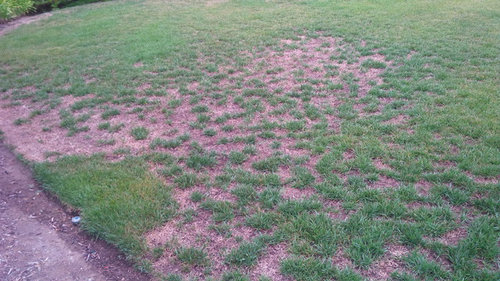
We bought a house last year in So Cal, and the previous owner had been massively watering the lawn with huge rotors. We swapped them to Hunter MP Rotators. Spacing is head-to-head, they are visibly operating as they should, definitely not clogged, and we run them for an hour twice per week (sometimes more). And yet, when July hit, we got this pattern of brown/bare spots. The area surrounding 4 of the heads is still green in about a 2' radius, but beyond that the bare spots begin. The rest of the lawn looks pretty good, where 12 or so other heads are spraying.

In the pic below, you can see the MP3000 rotator and its 2' green radius. There are rotators to the left and right that throw to about this rotator. And there's another one across from it that nearly reaches as well (you can see the green in the upper right which continues to be green all the way to that rotator).

Ideas?


Comments (7)

  • 11 years ago

    Could be a few issues causing this. What type of grass? Do you fertilize? I will tell you off hand, that you may be watering too much. When watering, you want to do deep infrequent watering. Which means 1" all at once 5-7 days apart when the temps are in the high 90's to 100's. You can use tuna cans to tell how much your sprinklers put out in a given amount of time.

    After we know what grass you have others will chime in on other issues that they may see/know of. I have a Bermuda yard, so I won't be much help in any other areas, since you don't have Bermuda.

  • 11 years ago

    Where are you in SoCal? Big Bear? Palm Desert? Malibu? See my point? SoCal has every zone, so we need more info. And zones are not helpful. I lived there for 30 years, so I need your real location.

    What kind of grass? I'm guessing Marathon I, II, or III. It's very popular and for the most part, completely inappropriate for SoCal unless you live west of I-5 in Orange or San Diego Counties or west of the 405 in LA County. I think what you're seeing is the strongest clumps of Marathon fescue.
    Those are the survivors. The rest either died of drought or from disease from too much water. In order to fill those bare spots in you'll need to
    overseed in the fall. Depending on where you live fall comes at
    different times. Or if you live inland I would strongly encourage you to use a grass that is less of a water hog. Tiff 419 bermuda is cheap and one of the best turf grasses you can get. It's a lot of maintenance, though. If you want less maintenance you could use St Augustine. It's the opposite of high maintenance. There are other grasses with less of a maintenance need, but I would not necessarily recommend them. Need to know where you live. Would you be willing to use a prairie type grass if it would looks like Kentucky bluegrass?

    As was mentioned, you have watering issues. Put some cat food or tuna cans in the yard and time how long it takes to fill all of them. Be sure to put some in the really green spots and in the really thin spots. And note which cans fill fastest. This is both diagnostic for us and informational for you. The time it takes to fill the cans is how long you should be watering when you water. And when you realize that it's about 2-5x longer than you're watering now you'll see how this watering schedule will work. Deep and infrequent watering will develop deep roots that can go for days (in the heat) and weeks (in the cooler months) without watering. THIS WORKS. It works in Vermont and Phoenix and everywhere in between. It will work for you. When the temps get into the 90s (like maybe West Covina and to the east) you should be watering once a week. West of there it should be more like once every 2-3 weeks. Yes, that's right!

  • 11 years ago

    Excellent questions!

    This is inland San Diego, Rancho Santa Fe.

    Regarding under/overwatering... The lawn looked awesome over the winter and spring. We got by with no irrigation until maybe April, at which point it was starting to become a mixture of green and straw color. The previous owner had watered 5x per week using old school rotorss, which seemed ludicrous, so when we resumed watering in April, we did it just 2x per week. It looked fine. Then, like a good water-conscious citizen, we swapped over to the MP Rotators (staying at 2x per week, but running for much longer, to get about 1.25" of water on it weekly). In June, the lawn started getting those bare spots, and by July it got much worse.

    Those spots are the most sunny spot of the lawn. In another area, it's largely shade, and in the winter it remains soggy all the time. The grass doesn't seem to mind that, so this makes me think that overwatering wasn't the cause of this problem.

    I've also done a fair bit of probing into the soil, and the bare areas are no more/less moist or dry at any time than the areas doing well.

    We did not fertilize this year. I don't know if the previous owner did. Probably not, given if it cost money, they wouldn't likely have done it.

    No idea what grass type it is. The previous owner did just about everything wrong, so I will guess it is something totally inappropriate for the area. I have had landscape guys look and they aren't sure what it is. It's been in the ground for 5+ years.

    I'm definitely open to a higher maintenance lawn if it reduces water usage. Prarie grass, no.

  • 11 years ago

    The day after watering, check to see how deep the water penetrated. You can do this by pushing a screwdriver into the soil. You can feel when you hit dry soil.

  • 11 years ago

    Screwdriver easily goes down 5", uniformly around the area.

    I now know what grass it is -- Marathon II. I've searched the web and its surprisingly unclear what grass is best for low water with still the resemblance of a traditional lawn. Sea Paspalum is about the most interesting so far.

  • 11 years ago

    dchall_san_antonio....

    Thanks for the detailed response. That mix of prarie grasses doesn't look bad at all, considering what it is.

    St Augustine... my dad has that up in LA and says he waters every week or three in the summer, never any other time unless it is unusually dry/hot. But then I read stuff on the interwebs and mostly it sounds like it needs considerable water.

    As for our current grass, the previous owner was a watering maniac, 5 days/week. I turned it OFF over the fall and winter, and it held up ok. As spring got warmer, I began watering again, usually 2 days/week. It held about even, never looking good, never terrible. When I went to the MP rotators, a month later is what you see. I watered 2-3x per week, but heavier. The green spots got REALLY green.