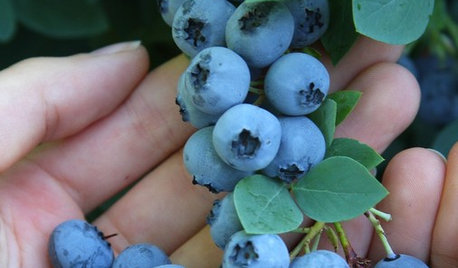
I have been growing blueberries over the past few years, and they are by far the hardest thing I have tried to grow - probably why I am so determined to grow them. I don't need to grow them - I can get all the sweet blueberries I want at a local farm for $7 a gallon, but I just can't give up.
I have learned a few things about growing blueberries that I will share - I plant all my blueberries in the ground.
1. Acidic Soil - As everyone will tell you, getting the soil right is the key. However, I have found that that is not as easy as others have found it to be. I have always planted my plants in slightly raised beds with peat moss and pine bark as the primary elements of the soil, however, I have still had issues. Basically if your new growth is yellow, the Ph is probably too high. If you are not getting any growth, even though you water and fertilize, the Ph is probably too high.
In my at least five varieties of wild southern blueberries grow wild on the wooded vacant lot next to my house - they have very small berries, and do not produce much, but they are abundant and grow well. So I thought I must have good soil for growing blueberries - well sort of. The wild blueberries roots grow very shallow just under the mat of leaves and straw on the ground of the wooded area. However in my area, there is a whitish-gray clay from a few to several inches below the surface- I learned early on when I moved into this house that that gray clay kills a lot of plants. So I try to plant in raised mounds to avoid clay - but when I plant a 2 gallon plant, part of the root system will be typically be below the level of the clay. Even though I dig a big hole and fill with good stuff, the clay still seems to negatively influence the Ph and give the blueberry plants a problem. The ones that survive a couple years develop new shallow root systems, so they are not affected by the killer gray clay and grow well.
If your suspect your soil is too high, using acid producing fertilizer and sulfur will eventually lower the Ph, but it takes at least a year to work well. On the other hand, battery acid from your auto parts store can work fast - in a couple weeks. I know most people are scared of battery acid, but it is not pure sulfuric - it is only 1/3 full concentration, and while you should be careful, I have gotten the acid on my skin with no ill effects. I dilute it about 50% with water (always add acid to water not water to acid), and use 1 to 2 tablespoons of the dilution with 2 gallons of water. A few applications spaced over a couple weeks has fixed the Ph and started growth or greened-up the plant in many cases.
2. Tap Water - I have proven that too much tap water is bad for bluberries. The effects range from yellow leaves, to stunted growth, to death. Recently, in a very dry period, I purposely overwatered a couple of stunted bushes - 1 of these was well established for many years. The bush was raised, and the ground around the bush was bone dry for many inches down, so the excess water just soaked into the surrounding ground. I sprayed the plant with a hose full blast for over 30 seconds - a few days later, the ends of all the leaves turned brown - this happened on every plant I watered excessively. I have had blueberries planted in pine bark and peat moss make whitish yellow leaves after too much tap water.
It is a pain, but I suggest very little tap water - if you have a way to save rain water, that is probably best - but otherwise, 1/2 tablespoon of the diluted battery acid mix I mentioned earlier to 2 gallons of tap water lowers the Ph of my water to about 5.5, fine for routine watering.
3. Too much fertilizer. I have killed and burned plants with too much fertilizer. I suggest sparing amounts of granulated fertilizer (Google correct application guidelines) in the spring before growth starts, then using water soluble fertilizer - ammonium sulfate or other fertilizer for acid loving plants like Miracid every couple weeks after harvest.
4. Termites. I know people will tell you they won't eat live plants, but the ones around here do ( I think they are Formosan - the kind that are killing the Live Oak trees in New Orleans). I have had at least 3 blueberry bushes just keel over due to termites. Every time, it has happened fast - in a couple days they go from looking fine to dead and shriveled. On a couple of smaller ones, they ate through the main stem and the plant just fell over. On a larger one with a large root system, they basically separated the plant from the main root ball a few inches under ground. I know it was termites because I saw them and saw the tunnels they created in the plants.
Granulated lawn insect killer seems to get rid of them - however, you can soak them in Malathion and they just laugh at you.
5. Tree roots. I have had several plants go from growing great to not growing at all for no apparent reason. I have dug up several plants and found that a tree root is choking the berry plant. I have seen a single small root enter the nice, rich, soil mound around the blueberry and quickly spread out to completely fill the area with tree roots. Tree roots grow a long way (I have seen tree roots enter a blueberry bed at least 30 feet from the nearest tree), and they love the rich, moist, fertilized soil around your blueberry. I go around my plants or beds a couple times a year with a shovel, sinking it as far as it will go - you can feel the roots being cut if they are there. I have several times seen plants that have completely stopped growing for a couple months really take off a couple weeks after severing the tree roots growing into plant.
6. Too much water. Around here, in the spring, we get a lot of rain and the water table moves to within a few inches of the surface (you dig a shallow hole and it fills with water) - blueberries don't like this - it will kill them. Make sure you don't plant blueberries in low areas, and if you are in an area like mine, make sure you plant the bushes above the ground.
7. Too little water. Blueberries handle drought well - that is it takes a severe drought to kill the plant. But they need water to grow. If you keep them moist but not soggy and don't use water with a Ph that is too high (keep it below 5,5), they will grow all summer - but if they get a bit dry or get too much water with a Ph that is not acidic, they will shut down growth in a heartbeat.
8. Birds. Unless you have have a whole lot of blueberry bushes, or you build an enclosure to keep out the birds, don't expect to eat many blueberries until you get large, mature bushes. I had a row of about twelve 2-year old plants, most of which had a good crop - and only got to eat a few berries. Those birds are smart - they feast on berries only when they get blue enough that you might think about picking them. And they can devour a lot. Squirrels will eat them too - I had three squirrels in one little bush one day. The u-pick farm I go to has enough for all the birds and critters, all the pickers, and many, many just get too ripe.
On the up side, if you get plants established for a few years in the right environment, they are very hearty - a neighbor has some that were planted many years ago that produce every year with absolutely no attention - and they produce enough so there is plenty for man and bird.
In summary, I have found blueberries very challenging to grow, - they need a very specific mix of water, soil Ph, and fertilizer to thrive - and just when you think you might get to eat a few, the birds get them. So if you plan to plant blueberries that grow well, plan to put in some time and give them the environment they need, and be patient.






inkfin
Related Professionals
West Palm Beach Landscape Architects & Landscape Designers · Augusta Landscape Architects & Landscape Designers · Muskogee Landscape Contractors · Spring Landscape Contractors · Kearney Landscape Contractors · Brooklyn Landscape Contractors · Brattleboro Landscape Contractors · Superior Landscape Contractors · Riverside Landscape Contractors · Longview Landscape Contractors · Sarnia Landscape Contractors · Vicksburg Home Additions · Vineland Home Additions · Charleston Home Additions · Gloucester Home Additions