Software
Houzz Logo Print
edlincoln

How is this alive?

11 years ago
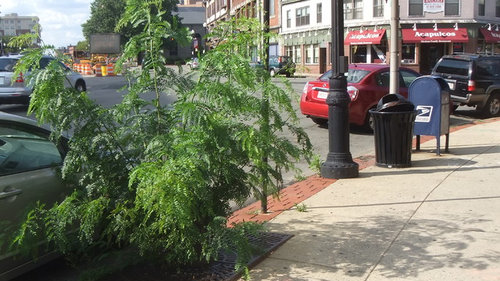
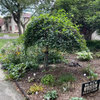
An illustration of WHY honeylocust is so popular as a street tree. If you look, this tree was planted in a tiny square cut into the sidewalk...no exposed soil or grass for hundreds of yards in any direction. The tree was chopped down at waste level. We had a drought this year, and it was in the middle of a heat wave. But the tree seems to still be making a go of it.


Comments (17)

  • 11 years ago

    Someone yrs ago posted a study of urban-tree lifespans. Honeylocust was a clear winner, tho they too suffer from the harsh conditions. But monoculture hurts them the same as most trees -- allows the spread of diseases/predators.

  • 11 years ago

    This is actually fairly typical of the species. Pretty hard to kill a HL.

    +oM

  • 11 years ago

    This is one of the problems with street trees. When you look at the requirements and desired characteristics a tree needs to survive in a square cut into the pavement, few trees fit the bill. So they tend to overuse those few trees everywhere, making them vulnerable to disease and people just plain getting sick of them. But often it's hard to come up with a good substitute. Why I think people with the benefit of yards should take advantage of the opportunity to plant something unusual a few yards back from the road, where they have more options. Also part of why I haven't planted honeylocust.

  • 11 years ago

    Well I have a Sunburst HL and love it. I planted it 5 years ago. In my area they are less common in yards than in street situations. Our town does a decent job of planting different things. They are big on Ginkos and those trees do pretty well as a street tree.

  • 11 years ago

    I couldn't agree more with you, Ed. As a sometimes-city forester/all the time city horticulturist, I can echo that finding species and cultivars suitable for street tree use is a daunting challenge, especially in a world where every few years, whole genera are taken out of the equation because of some new-to-the continent insect or disease issue. So take green ash for example: Whether you personally like the tree or not, it was an absolute workhorse. Got saturated clay? Plant a green ash. Got dry, gravelly crud? Plant a green ash. Got a little cut-out in a sea of concrete? Plant a green ash, and it will at least grow and prosper. Now, of course, out of the question with EAB. And that's but one example. Take those same challenges (and there's lots more) and substitute American elm....exactly the same deal. A tree type which worked everywhere and worked well is no longer an option for the most part. Add in overhead wires......

    I take your example of using "good" sites in a slightly different direction. I'm not sold on the downsizing of the urban forest which has taken hold over the past twenty years or so. Sure, sure, Mr. Power Company likes Japanese tree lilac under the wires (or what have you) but this is never going to amount to what we had years ago when nobody was thinking about wires except the power company. Streets back in the day of the American elm were green corridors through our cities. Now, with all the mini ornamental species being used under wires everywhere, we've got streets lined with lollipops on sticks, never to touch each other, always to remain discreet little balls of green. Not at all the same effect.

    I do sympathize with the plight of the power distribution people though, and for this reason, wherever no overhead obstacles exist, I strongly recommend that space be used for a full-sized "shade tree" or tall-growing conifer, not one of the minis. Save them for under the wires.

    +oM

    edlincoln thanked wisconsitom
  • 11 years ago

    Honeylocust often looks kinda ragged here. They get some kind of leaf bug. Not as bad as the locust leafminer on Robinia pseudoacacia, but it does seem to affect HL.

  • 11 years ago

    +oM,

    Why weren't the old elms hacked by power companies in the early/mid 20th century?

  • 11 years ago

    It's not just the power companies who want lollipop trees. More and more customers seem to think that trees are supposed to be smaller than the house...and they have a single level home.

    If you want something really interesting, go visit Manhattan. Not KS, the island. Walk around a little and check out how they plant street trees in the big city.

    Some time ago, I recall an effort to propagate trees that have survived in some of the largest cities for decades in an effort to have trees capable of handling the incredibly tough situations. My question is...if you stop smoking and your lung function increases almost exponentially, what happens when you propagate a tree from the city and grow it in the country?

  • 11 years ago

    Interesting thought wayne. Sort of like swinging a bat with weights on it or running in a pool.


    Why on Earth would someone want a lollipop tree smaller than their one story home? Ugh, all these homeowners and their silly demands. They make it darned near impossible to find something interesting at the local garden center. All our trees but one are going to be large trees when full grown. That's why they call it a tree. The 'lollipop' trees are a glorified shrub.

  • 11 years ago

    @ Hairmetal: I do not suggest elms were somehow magically excluded from line clearance activities. If I gave that impression, sorry. No, the earlier practice was to "valley out" large trees with wires going through them, elms or otherwise. So, during winter months, this practice looked fairly hideous with all the foliage gone-a big tree with a "V" cut through it for wires. I imagine you've all seen this. But............all through the growing season, those trees looked more or less normal, shaded the ground like a normal tree, and really functioned pretty well despite the treatment. Now, with the lollipops on sticks, all of that is avoided, of course. So Mr. Power Distribution is happy but our city streets look ridiculous. That is, of course, my opinion.

    +oM

  • 11 years ago

    In my village the street side trees are lopsided. Trimmed up on the road side so garbage trucks/snowplows can pass under them. No trimming on the sidewalk side. They look ridiculous.

  • 11 years ago

    Our lines are also buried.

  • 11 years ago

    Deb, as I spent just shy of 30 years doing tree work, I know well the tendency for some practitioners to do just as you say-trim up to standards on the street side and do little or nothing on the back side. I too always disliked that and while it is not a part of our program in this city these days, there were times in the past where I had to argue against that very practice. I agree-it is a ridiculous way to prune trees.

    Nevermore, in my view, that's a real waste of vertical space that you describe in your subdivision. It is exactly what I rail against-the use of mini-trees in spaces that would fully support a tall-growing species. I could write a book on why that's wrong, but for now, suffice to say that street trees-where no obstacle is present, do the best job they can when they are tall-growing types. If, by chance, anyone would actually want me to expound on this concept, I'd be happy to.

    +oM

  • 11 years ago

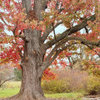
    Re: the above picture; This is what a ginkgo is for...

  • 11 years ago

    Well.....that honeylocust was very likely struck by a vehicle. I'm not aware of any magical powers on the part of gingko trees which would tend to repel cars and trucks.

    +oM

  • 11 years ago

    Haha, +oM

    I was referring to the use of ginkgos in urban areas in very difficult growing conditions.

    However, they are essentially disease and pest proof, so maybe small vehicle proof and large vehicle resistant?