Software
Houzz Logo Print
irma_stpete_9b

Porterweed sudden death

11 years ago

For the second year, a very healthy looking volunteer 5-ft tall porterweed has suddenly dried up completely. This time was following 2-3 weeks of rainy weather. Examined the root system, saw nothing unusual or insects. My theory is that the plant, which is a volunteer in my yard and rarely needs or receives water from other than rain, is not prepared to handle such riches of water except to grow larger than the root system can handle. I've cut back the other porterweeds as a precaution. Does this make sense?

Comments (23)

  • 11 years ago

    No, sorry, it really does not make sense when you stop to investigate how plants grow. But we don't even have to drill down into that right now. A simple logic exercise will suffice: The question then becomes, could a plant (or fungus, or animal, or....) evolve in such a manner that it is utterly unsuited for life? Even just reading that sentence, the answer is obvious that no, a plant could not evolve in such a manner. So now, let's look into a very stripped-down overview of a couple of the signalling mechanisms plants use to direct their growth: First, we often hear that plants' greatest need upon being transplanted is to regenerate a root system. And that is indeed the case. Sometimes, folks wishing to boost growth will use fertilizers, and yes, growth of the plant parts that one can see will be boosted. So how do the roots manage to keep up? Via auxins-plant growth hormones-which are produced in the growing tips of the branches and branchlets, which are then sent down to the roots to signal to them that expansion is required. Now please-somebody reading this is actually going to know about these things. I'm really trying to keep it simple, as we know, nothing in biology is ever actually simple! But very generally, plants "know" how to keep top growth and root growth in "balance". I use the quotation marks around the word "balance" because in fact, nothing in nature is ever actually in balance, if by that word we mean some stationary level of development. All is constant flux, but these messenger chemicals do the work of telling the various plant parts how to grow and how much growth to put on. Sure, we humans can easily upset this so-called balance. Such things as unwarranted fertilizer use, excessive or insufficient watering.....all affect these chemical pathways. How could they not? But I don't think it likely that any species of plant anywhere just simply doesn't know how to control itself. If that were so, the world around us would be a very different place, full of biological failures. And while it is true that species come and go, they do so on a very long time trajectory (other than where mankind is influencing things) and a truly inefficient and impractical design would quickly be winnowed out by competition.

    +oM

  • 11 years ago
    last modified: 11 years ago

    OK! Thank you!

    New information I forgot to mention: at the base of these 5-foot mostly full sun volunteers, the trunk develops a kind of split open area just above soil line. The living plant seems "secure", and the area hard, not soft or rotting, but is this a sign of coming demise? Is this a malformation caused by too-rapid growth due to sudden overwatering...or would that contradict your explanation of plant self-control? This year's plant seemed to have a good root system for such a shallow plant - 4 large sideways roots and lots of hair-like roots at the base.

    I think dog pee can be eliminated as a cause of the demise.

  • 11 years ago

    I think the key question here is what kind of soil do you have? If you are in an area where the rain could cover the roots or soak the soil then it is more likely that the roots could not absorb nutrients or started to rot. I don't think the plant would die because it became too big for the root system to handle. If that were the case then there would be drooping in the heat of the day and then revival overnight.

    There are many reasons for plant decline... It's difficult to pinpoint one single reason without a lot more information.

  • 11 years ago

    These porterweeds grow in sandy soil that drains quickly.

  • 11 years ago

    I have porterweeds that grew beautifully. I live in Saint Petersburg, FL as well. I haven't had any sudden death with them with all the rains we had. In fact, it made them grow a lot and BIGGER means more flowers. I love it. I am sorry about your plants though :(

  • 11 years ago

    So it remains an interesting question as to why the plant died. Anything other than rain that was unusual? No white on the undersides of the leaves? No burrowing animals? No strong fertilizer? No extra mulch around the plant? No weed-wacker stripping of the bark? You said no dog pee--which makes me think that it could be too much dog pee:) Do you know where your dog pees? One or two pees wouldn't do it, but a culmination over an extended period might contribute to an unhealthy plant.

    What kind of a porterweed was it? Purple? Red? Blue?

    I like questions like these. They are mind benders.

  • 11 years ago

    Tom, thank you for thinking on this. No dogs, but fence is incomplete on one side, so a wandering dog is not unheard of. Maybe a lifted leg both times; maybe a skinny mini-tree is the perfect enticement. Only other possibilities are burrowing animal (I do get those, but haven't seen evidence near the porterweeds) and weedwhacker (I could have goofed without knowing it there). Well, I guess that gives enough "possibles" to produce a probable.

  • 11 years ago

    I once heard an expression-something to the effect that a picture is worth lots of words, lol! Maybe, if you could, provide us a visual aid. I'm only just barely aware of the plant called porterweed-me not being an actual Floridian-but plants across genera have many similarities, and maybe a photo would show something that we're not getting in the narrative.

    +oM

  • 11 years ago

    I would love to put photos on GW but, being a tech dork, my attempts result in a message refusing for being too big (I drag and drop from photos (JPEG) with my point & shoot camera that I have transferred to the computer. Don't have Windows but a Mac. (Help?!)

  • 11 years ago

    Well, I'm the complimentary dork to your dorkness, so somebody else is going to have to handle this one! I know it's easy as pie with the Houzz interface but for whatever reason, I still post no photos on my many visits to these forums.

    +oM

  • 11 years ago

    There are many different porterweeds. My favorite is the large purple one called

    Stachytarpheta frantzi. It is a terrific nectar plant for both butterflies and hummingbirds. It gets huge here. I have some that are perhaps twelve feet high. It blooms year round here, as long as there isn't a freeze. It does best, however, in August and September on my property. Right now they have butterflies visiting them pretty much constantly.

  • 11 years ago

    Sounds like mine, but longer living.

  • 11 years ago
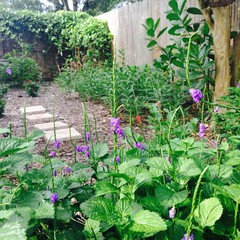
    As u can see my porterweed
    They are maybe two feet high and abut 5
    Feet wide from one plant. I planted it there this spring from small plant.
  • 11 years ago

    Gorgeous!

  • 11 years ago

    Yes. That looks like a stachy frantzi. It will spread if it can. It will go up if it has to.

  • 11 years ago

    Looks like a great group of species.

    +oM

  • 11 years ago

    Back to the trunk scarring at the bush base... I see now it has also occurred 4 inches above ground on my prized petrea vine which has a trunk about 2" wide. Scar is about 2" x 4". I would not have weedwhacked near it. I'm thinking SQUIRRELS. http://icwdm.org/wildlife/Squirrels/BarkStripping.aspx

  • 11 years ago

    Don't want to hijack this thread, but I have two huge porterweed growing for 3 years. They are enormous, at least 6ft tall and as wide. I have never gotten a flower. The long flower spikes form and begin to turn black from the tips down. Something is infecting the spikes. I'm suspecting thrips or something like that but I obviously can't use insecticide as they are in butterfly gardens.


    I am ready to give up on them and cut them down. Does anyone know what it killing all the buds?


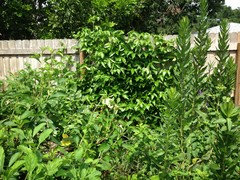
    Not a great photo, but the Porterweed is on the left of the photo. Passionvine on the fence, Goldenrod next to the Porterweed. If you look carefully you will see the long flower spikes which never open. They begin to turn black and never flower. The bush is extremely healthy. Too healthy!


    Jane

  • 11 years ago
    last modified: 11 years ago

    Splitting bark is caused by inconsistent watering. I used to have this problem with my brugmansias in the summmer until I put them in pots with a 50/50 mix of regular top soil and perlite.
    Jane_NY - it looks like you are giving your plants a lot of nitrogen. Porterweed thrives on neglect. Also, are you growing it in NY or FL? Move it to a place where it isn't getting so much nitrogen fertilizer and isn't on a sprinkler system and see what happens. If you don't have a place like that, put it into a pot with a mix of 50/50 potting soil and perlite and don't fertilize it but once a year in the spring with a timed-release bloom fertilizer.

  • 3 years ago

    I had 6 beautiful healthy plants and there all died one after one of student death. I live in costa Rica. Looks like when they reach 3 years and are huge, they died...so sad because I love them. They grow in full sun in a clay soil. Do they have a short life spam ?

    irma_stpete_10a thanked Mat Tamarindo
  • 3 years ago

    Mat, I'm sorry your Porterweed plants have died. In my yard, they come and go. All begin as volunteers and grow where they popped up - some in sun, some in shade, all in sandy, unimproved soil. I have several that are perhaps 10 years old and in full sun. I had some a few years old, growing in shade but then (because neighbor's trees were cut down) had more sun and seemed suddenly to die. Where they die, there are already replacement volunteers growing. Do your plants self-seed so that you have small volunteers to replace the 3-year old ones? I can't imagine the challenges of growing in clay soil!


  • 3 years ago

    I have had many, all of same kind. They die at about three years. However, I prune them, and some kinds of plants decline after several heavy prunings.

    irma_stpete_10a thanked four (9B near 9A)
Sponsored
Peabody Landscape Group
Average rating: 3.5 out of 5 stars8 Reviews
Columbus' Reliable Landscape Design & Contracting