Software
Houzz Logo Print
peter1242

Canned Pears

11 years ago

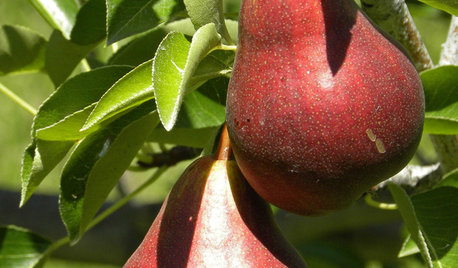
I still have about 20-25 pounds of pears, after I threw out the rotted ones, and they are getting ripe fast. I was going to make pear wine, but I blew the budget on a pressure canner. I see that pears are high acid so they can be easily canned without much worries (I don't think they are asian pears - they are soft, juicy, and bell shaped - I am guessing they are Boscs.) I am not sure though I would want to can halved pears, does anyone have any good recipes for pear butter/sauce or pear preserves or any other ideas?

Comments (11)

  • 11 years ago

    Here is one of the most popular ones here.


    Caramel Pear Butter

    Lots of other threads on 'pears' too with recipes in them.


    http://www.gardenweb.com/gardenweb/query/pears/topic=harvest

    Dave

  • 11 years ago
    last modified: 11 years ago

    From the image you previously posted, I doubt those pears you have are asians. They looked more like bartletts, commons, comice, maybe even like you say, boscs. To get a fairly accurate id, search pear varieties...

    For some varieties, you can individually wrap them in paper to extend shelf-life and help them ripen evenly. But if yours are ripening that fast, like you say, time to eat and work them up!

    I've never preserved them other than wine, so I have no recipes. I have a good juicer though, and even the hardest common pears make great juice! Let us know what you decide.

    Edit: looks like I didn't need to offer a recipe... Dave's link has lots!

  • 11 years ago

    Thanks guys.

  • 11 years ago

    Wine is high acid, right? Google reveals the Ph is under 3.6. So if I wanted to just can pears (also high acid) in wine there is no reason I can't do this, without concern for adding acid or pressure canning with long processing times?

  • 11 years ago
    last modified: 11 years ago

    Ok... wait... lol... I think Dave will answer this better, but just to clarify... you are hoping/wondering if you are safely and effectively able (see how I got around using 'can'? lol) to can (shucks, I should have used 'preserve') pears in wine?

    Hmmm... that's interesting. My pear wine came in at like 3.35 or 3.45 I think. It's been a while but I know it was under 3.5. I just remember being happy it came out just right. As long as wine is good for canning, and I don't see why not, you could use any low pH wine. However, from a winemaker's point of view, remember that once you open a wine, that's it... oxidation is going to set in fast. The best time for adding something, and I haven't looked this up at all, would be either early in the winemaking process, or during 'bottling'.

    Wait... there's a wine company I remember seeing when I was looking up my bottling techniques that actually puts wine bottles over pear flowers right after pollination and grows them in the bottles. I have no idea how they sanitize the fruits for bottling though.

    If your research bears this out, another idea would be to either use a stronger spirit, like brandy or vodka (anything really.) Or if you do want to use wine, and you do find out it may oxidize, then go the 'fortification' route. Here in Tn. we can get 95% alcohol legally. That will work lol. Just fortify your favorite wine with the spirit and use that. If you use the grain alcohol, depending on how high the % alcohol, you won't even have to can them lol. The alcohol is a great sanitizer and preserver.

    Another trick, if it's legal in your state, is to freeze wine. This is how they used to make apple jack in 'the old days'. The water will stay frozen longer than the alcohol. So as the wine thaws, the alcohol, the sugars, and the flavors will drip out of an upside down container (do not freeze a wine bottle, especially a full one!) What you are left with is basically a 'brandy'. This is called freeze distillation, and you would need to check with your state to find if it's legal.

    Anyway, you'll need to do some research, but there's a lot of info out there. When it comes to wine and spirits, if it's imaginable, someone has tried it! lol.

    Edit: While I was typing Dave responded... Dave, are talking 'poaching' as in cooking? If so, the flavor will remain, I don't know if it will effect the pH, but the alcohol will be gone... not a deal breaker though.

    Peter (6b SE NY) thanked rgreen48
  • 11 years ago

    I will use fresh wine straight out of the bottle. Thanks.

  • 11 years ago

    Just keep in mind that as soon as you open the wine the oxidization will start. The PC may slow it down, but it won't stop it. Some wines oxidize to a decent tasting vinegar... others... not so much. You could learn how to use sulfites. As you may already know, that's what winemakers and fruit preservers use. Look on a box of raisins. The sulfites bind with the oxygen and the wine will stay wine longer.

  • 11 years ago

    Sorry, but if it is canned wouldn't that stop the oxidation?

  • 11 years ago
    last modified: 11 years ago

    I doubt it. It should slow it down, but just like pouring distilled water, any contact with air will cause it to absorb oxygen. Oxygen affects wine by causing a chain reaction. Even when wine is in a corked bottle, it is always in flux. The winemakers challenge is to manage that flux. Of the many chemical reactions slowly taking place, oxygen and bacterial contamination are the worst on storage.

    The first reason sulfites are used at bottling is because the wine comes in contact with air. The chain reaction then starts. If the proper amt. of sulfites are added, sulfur binds with the oxygen and the wine can be 'stabilized' without tasting like sulfur - rotten eggs. Even with sulfites the wine will go vinegar eventually.

    You can reduce the risk of oxygen contamination by pouring the wine very gently. No splashes. You can get sulfites very easily and cheaply. It would probably cost you less than a penny a jar to use. You'd just have to learn the amt. to add, and that wouldn't be hard, there are calculators on many winemaking sites. I use potassium metabisulphite. This is what I would recommend. There is also a product called sodium bisulfite. Look up the differences if you decide to go this route. Again, it may seem daunting, but it's not too bad.

    The other option is to just try the straight wine without the sulfites and see how long it lasts. It may go a month, and depending on the wine and its natural ability (its chemical makeup) to ward off oxidation, it could go years. In general, high tannin red wines are slower to oxidize than whites, and grape wines are slower oxidizers than fruit wines. Try different kinds and see what happens. On a good note, pears do contain fairly high amts of tannins. These substances act as preservatives.


    Edit: oh, and basically, as long as your canning process is good, the worst that can happen is you'll have pears packed in vinegar lol.

  • 11 years ago
    last modified: 11 years ago

    I'm so interested in pear wine. So far the varieties I have had are just so so. Seems like it could be very good though . . . I dunno. If you have a lot of pears, I would put them up in pint or quart jars in a low sugar syrup. I did that one year and I was surprised at how much better my home canned ones were compared to store bought. I soaked some in brandy one year for ginger pear liqueur. Was just OK, pretty good to add to white wine heated in the micro in the winter to take off the chill. If you can afford the brandy, it was relatively easy and cheap. But didn't use a whole lot of pears . . .