Software
Houzz Logo Print
shawsj

help interpreting Logan Labs test results

11 years ago
last modified: 11 years ago
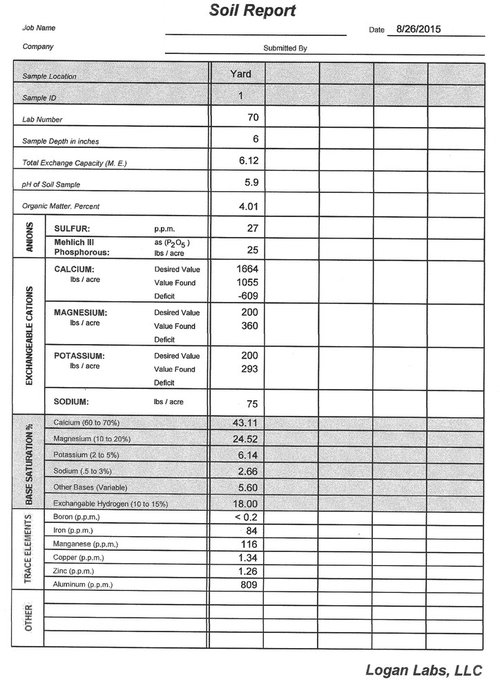
I recently moved into a new house with newly sodded Bermuda in Chapel Hill NC (approx 2000 sq ft lawn). I sent a soil sample of the underlying soil under the sod (red clay appearing) and have attached the results from Logan Labs. I would appreciate recommendations of how to fertilize the lawn based on the soil results. thanks


Comments (5)

  • 11 years ago

    I'm sorry--I'd love to help, but I don't see anything attached?

    Steve thanked User
  • 11 years ago
    last modified: 11 years ago

    thanks, I just got the picture to upload

  • 11 years ago

    Got it! Um, what's the condition of this lawn? The numbers are a little conflicted, but if you made me guess about the grass, I'd say pretty poor.

    EC 6.1: You don't have red clay, you have red sand with some red silt. :-) No, really, this EC is completely inconsistent with significant clay, although you could have some of the lightest, lowest-EC clays. Even so, you don't have a lot of them. Try the free at-home jar test (which I or somebody else will read) to verify this if you like. The reason it acts like clay is detailed below--all soils are tight, impenetrable, and puddly under some circumstances, and boy, do you have those circumstances.

    pH 5.9: Always a symptom, never a disease, and this isn't much of a symptom anyway. It's just a bit below optimal and we're going to fix that. More below under calcium, magnesium, and potassium.

    OM 4.0%: Right at the extreme top of the Fair range. Given your lower EC, I'd always mulch mow the lawn, mow in all your fall leaves, and seriously consider importing leaves off the curbside from surrounding properties. This isn't an extreme emergency or anything like that, but the raised OM will increase water retention, improve your soil biology, loosen the soil for you (and keep it that way), and generally nurture the roots of your lawn (and anything else you have).

    Sulfur 27: A good answer, with a bit less margin than I generally see, but that's not a problem here. I don't need any significant margin since I'm not using sulfate-based chemistry.

    Phosphorus 25: Extremely low, and a severe hit to lawn quality. Target here will be 200--eight times more than you currently have. We use starter fertilizer, the cheapest stuff off the shelf you can get. Recommendations below.

    Calcium 43.1%: Extremely low. Target here would be around 60-65% (modified by the magnesium). For this, we have to use calcitic lime--Encap, Mag-I-Cal, or Pennington Fast Lime. Cheaper limes contain too much magnesium, work too slowly, and require far more per unit area. Recommendations below, and we aren't going to finish this in one year.

    Magnesium 24.5%: Extremely high, but not as bad as it looks. Some of this saturation level is the low level of calcium in the soil, and it'll naturally drop a little as calcium flows in. High levels of magnesium make for impenetrable soils that cling together. Target for your soil would be around 12%.

    Potassium 6.14%: A bit high, but certainly not a problem--I like a little extra potassium in a soil for resistance to cold, heat, insects, and disease. This will naturally drop a little as the calcium flows in.

    Sodium 2.7%: A bit high, but the calcium will dispel this and drive a little out of the soil. If it stays high once calcium levels start to come up, we'll probably want to dispel the sodium directly. This isn't going to be a problem for the Bermuda, but it'll shift your pH upward without adding any advantage to your lawn. Sodium is toxic in larger amounts and only used in tiny amounts by plants.

    Minor Elements: Most are perfect. I do mention boron (deficient) and iron (low) below.

    Boron <0.2: Deficient, which isn't great for the lawn (quite bad, in fact; boron is used for photosynthesis and also for meristem development into functional adult cells). We use Milorganite as a carrier and 20 Mule Team Borax as the boron source. You can purchase 20 Mules at the grocery store in the laundry section. In a wheelbarrow or the like, dump the Milo. Spraying very, very lightly with water (I use a spray bottle like the kind people use to damp their clothes when they iron) will help the boron stick. Add the recommended amount of 20 Mule Team Borax and stir, spraying occasionally to get the stuff to stick to the Milo. Then apply over the recommended area. So if going for 1 bag usage over your lawn (1 bag per 2,000 square feet), you'd add 8 tablespoons of 20 Mule Team Borax.

    Iron 84: Not deficient, but not going to produce fantastic color, particularly as the pH rises and calcium levels come up to normal. Whenever you like, you can feed the lawn with Milorganite (it won't interact with or cause any overfeeding problems with the starter) to slowly raise this.

    Recommendations:

    Note: The starter will adequately feed your Bermuda through the season, but you may wish to tap in a little extra nitrogen. 0.2 lbs per thousand square feet per month wouldn't be a problem if you wish to do it (synthetically). The sky's the limit organically.

    September 1: Apply starter fertilizer at bag rate.

    September 15: Apply 6 pounds per thousand square feet Encap, Mag-I-Cal, or Pennington Fast Lime.

    October 1: Apply starter fertilizer at bag rate.

    October 15: Apply 4 tablespoons of 20 Mule Team Borax in 1/2 bag of Milorganite over 1,000 square feet--or, in other words, 8 tablespoons 20 Mules in 1 bag of Milo over your entire lawn.

    April 1, 2016: Apply 6 pounds per thousand square feet Encap, Mag-I-Cal, or Pennington Fast Lime.

    May 1, 2016: Apply starter fertilizer at bag rate.

    June 1, 2016: Apply starter fertilizer at bag rate.

    July 1, 2016: Apply starter fertilizer at bag rate.

    July 15, 2016: Apply 6 pounds per thousand square feet Encap, Mag-I-Cal, or Pennington Fast Lime.

    August 1, 2016: Time for a re-test!

    Steve thanked User
  • 11 years ago

    Thanks for your recommendations! The sod was half-brown when I moved into the house a few weeks ago (the sod was laid down about 2 weeks prior), and after watering it 2x/week it has greened up some, but I'll follow your schedule regarding the soil.

  • 11 years ago

    Good, that means we'll correct the problems before they damage the new sod. This schedule is fine for new sodding and doesn't require any revision.