Software
Houzz Logo Print
sugi_c

Spiders or spider mites?

I'm a little embarrassed that I don't know how to tell the difference.

To my knowledge, I've never had any spider mites. But recently, it's dawning on me that I wouldn't know if I had spider mites because I basically assume that my 6.7 million spiders of all kinds are building webs everywhere, and every day I swipe them down from everywhere. It's a rare morning when I walk out and don't walk directly into some webbing somewhere.

So I've been wondering for a few weeks now, and reading up what I could about it though I still can't tell the difference; I get that leaf to leaf or all around a bud or something would be spider mites, not a spider. Good to know, but not enough.

The other evening, I was spraying neem oil on one section of my yard more a preventive measure since my neighbor was talking about the Japanese Beetles "this time of year." I'm so traumatized by the multitude of bugs in this new yard and while I'm not QUITE at the point of spraying Talstar (but am approaching rapidly), I'm willing to give anything a go if it means I don't have to SEE my next pest, or incur its wrath.

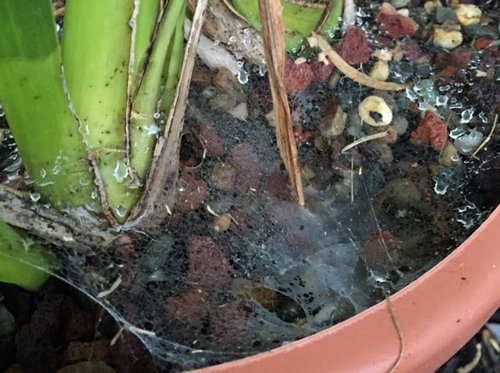
While I never noticed when I was watering the plant, I noticed this weird webbing all across the soil of one pot when I sprayed it.

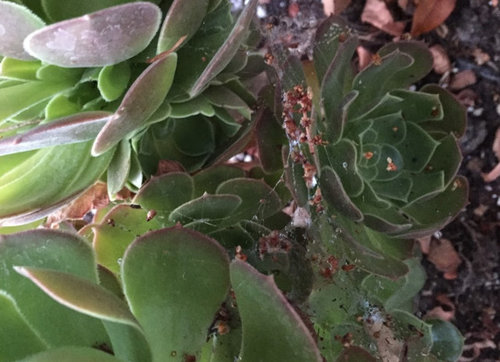
And then a little further down that side of the garden, I had noticed webbing on one Aeonium rosette a few days prior but didn't give it much thought (and just reminded myself to wipe that down "later") until I found the soil webbing that looked SO STRANGE once it was sprayed with neem.

This is the Aeonium, which of course, I then had to go spray since the webbing becomes so clear for a photo upon spraying:

Now I have plenty of spider webs going from tree to tree, plant to table, roof to plant on the ground, etc. With or without a spider present there, I understand those are spider webs.

I've never seen anything like the soil webbing above, but for the Aeonium type of webbing which happens occasionally, I'd assume spider before spider mites.

Are these spider mites??

Cause, you know, yesterday being my birthday and all, that would make one great discovery. LOL

It's only across a few rosettes and the crap on it is from the tree next door that drops on everything. These two are the only plants I find any webbing on right now....

The cymbidium, I don't mind thowing out, but if this is spider mite webbing on my Aeonium, I need to treat it. But I guess I first need to ID it.

This is so unacceptable.


GK


Comments (12)

  • 11 years ago

    Likely not spider mites. When I find suspicious webbing I gently disturb it to see if something shows itself. If you can see it, it is not spider mites. When you treat plants without cause (preventative), you kill the good with the bad and the bad rebound quicker than the good.

    tj

  • 11 years ago

    Your header says that you're in northern California. If that's true, you can stop worrying about Japanese beetles. And then please tell your neighbor that those particular beetles are NOT in California.

  • 11 years ago

    fall is spider time ...


    they have grown to max size ...


    and the dewy nights and morns.. really make their webs appear ...


    most spiders are our friends... even if they web in your pots ...


    and that web could have been long abandoned.. you just noticed it.. as noted.. destroy it.. and see if it returns ... i just pick up a stick laying around.. and twirl it up like cotton candy ... and throw stick back on ground ...


    ken

  • 11 years ago

    Oh whew...I am so relieved to read that nobody thinks they are spider mite webs. Whew, whew!! Is there some definitive way to determine mite webs vs spider webs?

    Thanks TJ. You are right. And I haven't sprayed a thing, good or bad, in the last 15 years with the mentality of "come what may" but this yard has been trying. I have never seen so many good and bad bugs in my life...and in the last month resorted to BT to kill the hornworms that are decimating my tomatoes and since I'm spraying anyway, I bought the neem which I'd read up on here. It appeared to be pretty innocuous overall, so that I used along one fence where most of my succulents live in light shade and dappled sun--that's the area where both of these photos were taken. None of it was sprayed on my edible or flowering plants, as I read that neem can damage blossoms... The only thing I have consistently used except when I lived in SF was snail bait and they seem to be having quite the blast anyway this year.

    Jean, we sure do! I can't confirm my neighbor ID'd what she saw correctly but upon hearing that and about two minutes before I ordered neem, lol, I did google it and Japanese Beetles were spotted in the Sacramento area, right above me, per the CA Dept of Ag. I only read one article but that was close enough for me!

    Ken, my spiders are year round, I'm afraid. January has much less than the other months but there is no month where I can't find spiders crawling on my plants or webbing here and there. Come spring, there's virtually no plant I can't find a spider on or at least evidence of some spider having been on it.

    That said, I still find it really bizarre that at this yard, for the first time ever in my gardening life, I have not seen ONE aphid. Spiders are not predators of aphids, are they? I've never seen a ladybug here either..probably because there are no aphids. Not complaining but I find it so bizarre!

    Thanks again, folks!

  • 11 years ago

    Most Spiders a passive predators, they spin those webs that capture any insect that gets caught in the web, although a few a hunters, ie. the Wolf Spider. But these spiders do not build webs on soil. Spiders are easily seen. Spiders do not eat plants.

    Spider mites are not spiders, they are mites ("Acari") although they do look very much like Spiders and do spin webs. They are very small and live up in a plants leaves, usually found on the back side of leaves. Spider mites suck the sap from plant leaves and leave mottled specks that can, if an infestation is severe, be detrimental to the plant. Spider mites are most active when it is hot and dry.

    The web found on the potting soil could be from many sources, but not likely Spider mites and not Spiders. Perhaps this article may be of some help.

    http://www.ipm.ucdavis.edu/PMG/PESTNOTES/pn7405.html

    kimmq is kimmsr

    Sugi_C (Las Vegas, NV) thanked kimmq
  • 11 years ago

    Spider mites are usually noticed by either their webbing or stippling pattern of damage on leaves. AFAIK, they prefer a softer, leafier leaf.

    Real spiders (not spider mites) are pure predators, never considered a pest on plants, but protectors of them.

    Sugi_C (Las Vegas, NV) thanked Tiffany, purpleinopp Z8b Opp, AL
  • 11 years ago

    Kimm, I know the spider aren't eating the plants. They're just ruining my view is all. :-

    Tiffany, I can't stand the webs!

    Rhizo, I have seen those spiders EVERYWHERE! I am so relieved. SO, SO RELIEVED that they don't look like spider mites to you guys!!

    You guys rock. Thank you!


  • 11 years ago

    Spider mites are microscopic. There webs are tiny.

  • 10 years ago
    last modified: 10 years ago

    Although "Japanese Beetles were spotted in the Sacramento area, right above me, per the CA Dept of Ag." it's helpful to know that the Ag Dept sets traps for them during the season every year at ports and airports. When one or several are trapped, then protocol requires official to trap very intensively -- used to be 9 mile square around the find. If more are found, then an eradication follows.

    So I repeat, but with a slight revision: Japanese beetles are "not established" in CA.

  • 10 years ago

    There's a great site on UC Davis that talks about all the different types of vegetables and all of the pests and diseases in California. They have good descriptions and pictures, too. Here's the address if you want to look around on there

    http://www.ipm.ucdavis.edu/index.html

  • 10 years ago

    My comment is just a bit late but regarding the Japanese beetles, preventative spraying with neem oil is a short term deterrent at best. For best results the beetles must be sprayed directly or you have to target the grubs. And even when sprayed directly neem oil may not be a good choice according to a Colorado State University Extension publication.

    http://extension.colostate.edu/topic-areas/insects/japanese-beetle-5-601/

    From the link: "Neem-based products that contain azadirachtin (e.g., BioNeem) can be used to deter beetles for 3-4 days. (Note: Neem oil products that have no azadirachtin are not effective for Japanese beetle control. Such products usually are sold as ‘neem oil’ and contain the active ingredient “clarified hydrophobic extracts of neem” but do not list the ingredient azadirachtin on the label.)"

    Hope this helps.

    Rodney

Sponsored
Urban Upkeep LLC
Average rating: 5 out of 5 stars6 Reviews
Columbus High Quality Painting Expert