Software
Houzz Logo Print
bmk161

Soil Test Help! Morpheus

11 years ago
Hi Morpheus,

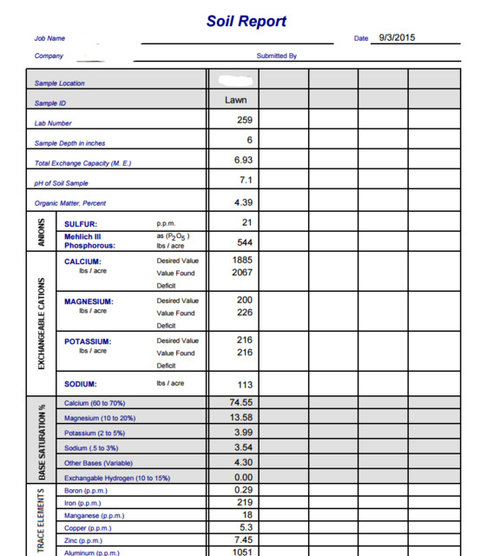
Here are my logan labs result......doesn't look bad to me (kidding, I have no clue).

I have a dog and a child so if that influences anything, leme know. If you could, let me know what options i have for organic and chemical ferts. I'll be planting this weekend.


Thank you for your help - I'm excited to have your expertise!!

Comments (12)

  • 11 years ago

    It isn't bad at all, really, and most of the mis-balances just have to fade by themselves or be ignored over the long term. Which is not a problem.

    EC 6.9: Sandy with some silt. It'll hold tolerable levels of resources, but I'd re-test every 2 years or so.

    pH 7.1: A little high due to the excess calcium, but this is absolutely no barrier to a fantastic lawn (or gardens, for that matter). It's not ridiculous in any sense.

    OM 4.4: In the Good range. With your lower EC, I wouldn't mind seeing it go up, but it's not an emergency. Certainly mulch mow your new lawn, mow your fall leaves, and consider feeding organically.

    Sulfur 21: Perfect. We won't need any margin as you require no sulfur-based adjustments.

    Phosphorus 544: High (target here is 220), but not a problem. However, I'd avoid phosphorus-based fertilizers, so no starter when you seed and stay on the low to zero side of the phosphorus equation for future fertilization applications.

    Calcium 74.6%: High, but not unreasonable. This (somewhat) and sodium (considerably) are what's raising your pH. If it has a natural tendency to leach out, great. If not, it's not a problem. However, don't lime until a soil test shows you require it as we don't want to send this any higher.

    Magnesium 13.6%: Pretty much perfect, although I wouldn't mind a slightly lower answer. No magnesium required or desired.

    Potassium 4.0%: Nose-on perfect.

    Sodium 3.5%: High, and this is not helping with the pH. The method to get rid of it adds calcium, however, and it's not necessary in a lawn. Very sensitive plants might have an issue with this, but grass certainly won't. I'd almost rather let this ride, re-test in a year, and see what happens to it.

    Minor Elements: Most are fine, except boron (below). I did mention iron, but the situation is rather marginal.

    Boron 0.29: Extremely low, and the only adjustment you've got. We use Milorganite as a carrier and 20 Mule Team Borax as the boron source. You can purchase 20 Mules at the grocery store in the laundry section. In a wheelbarrow or the like, dump the Milo. Spraying very, very lightly with water (I use a spray bottle like the kind people use to damp their clothes when they iron) will help the boron stick. Add the recommended amount of 20 Mule Team Borax and stir, spraying occasionally to get the stuff to stick to the Milo. Then apply over the recommended area. So if going for bag rate Milorganite (1 bag per 2,500 square feet), you'd add 10 tablespoons of 20 Mule Team Borax.

    Iron 219: Really a very nice number, but a lot is bound up at a pH of 7.1. Whenever you like, you can use Milorganite to raise this (which will also boost your phosphorus, but it's minor enough to ignore in this case for a year or two).

    Recommendations:

    October 20th or so: Apply 4 tablespoons of 20 Mule Team Borax per thousand square feet.

  • 11 years ago

    Thank you Morpheus! I plan to mulch everything from here on out.

    As for the boron, Can i assume with that being the recommendation that i can add it via 4 bags of milogranite? At the rate of 10 tbsp per bag?


    If so, it seems you're not wanting me to do it for another 6 weeks, correct? Nothing on seeding day then.

    I'm not surprised your recommendation on no starter fertilizer, with this lawn being really new, I had applied the starter fertilizer about 5-6 weeks ago so its probably still lingering.

    Would I soil test every year around the same time?

    Thank you so much, I really appreciate it!

  • 11 years ago

    Awesome, I'll do the milo/mule in about 6 weeks and pray for rain in between :)

  • 11 years ago

    It won't be a problem. You'll still be irrigating a bit at that time, so I might synchronize this just before irrigating the lawn. It'll move the 20 Mules into the soil, plus the iron from the Milo.

    Burn potential on the 20 Mules is essentially zip, but why take chances on a young lawn?

  • 11 years ago

    I'm sure morph has you well under control, but boron is one of those necessary elements where you need a certain amount, but if you go over a certain limit, you can essentially poison the soil. If you want to see what looks like, put 'Boron, CA' into Google Maps and zoom in. That's where the 20 Mule Team stuff is mined. Those folks can't grow squat around there. The high school stadium must be artificial turf.

  • 11 years ago

    Yeah wow! I plan to measure out the tbsp accurately

  • 11 years ago

    I do add a pretty wide margin (and I ain't telling as to how much) to the recommendation, and I'm always very gentle with boron anyway. While it'll rise (hopefully, although the new grass will be rather demanding of the stuff*), this will take several years to lift into normal range.

    * Boron is used in photosynthesis and in meristem (plant stem cell) development. Young plants are growing at a furious rate and have somewhat higher demands for boron than mature plants do as their cells differentiate rapidly.

  • 11 years ago

    Since I'm not planting my back yard until next fall would you recommend a different approach to the boron (like apply earlier) or just wait and do it all at once?

  • 11 years ago

    I think PSU4ME might like some nitrogen fertilization advice too. When do you advise a nitrogen fertilization for a new lawn in the fall, what are his options, things like that. Oh, and advice on winterization application (when and what) and when to apply nitrogen next year. Hopefully you have this somewhere you can copy and paste so you don't have to write it out all the time.

  • 11 years ago

    >>Since I'm not planting my back yard until next fall would you recommend a different approach to the boron (like apply earlier) or just wait and do it all at once?

    If you want to do the back earlier, sure. Any time is great, or you can just wait until October and do the whole thing at one shot.

    You can save the box for next year, or use it in the wash as it's meant to be used. The stuff is about as toxic as table salt, and has no considerations for dogs or children. Although it might cause a little itching of the paws (or bare feet), so maybe water it in. It's kind of scratchy, rough stuff with a moderately high pH. I find my hands get a little rough when working with it when I make laundry soap, but my exposure is pretty long-term and combined with other fairly caustic chemicals.

    >>I think PSU4ME might like some nitrogen fertilization advice too.

    Sure. Regrettably, I do try to tune this for the locale of the writer. I really should just boilerplate it, but I never get around to it.

    No fertilizer is required for the first thirty days, but if you want to use Milorganite at seeding time that's completely fine. It'll provide a gentle feeding for months, which is perfect for the new babies.

    October 1: Milorganite, soybean meal (these at normal rate) or half rate of a synthetic fertilizer that's high nitrogen, low everything else (29-0-4 being a good example but hardly the only acceptable one). Half rate on the synthetic because we don't want to over-stress the new grass, and it's ability to absorb nitrogen is limited right now anyway.

    October 15: If you used synthetics on the first, use another 1/2 rate application now.

    November 1: We're probably getting close to winterization. If you think that won't happen until after November 15th, you can half rate a synthetic again. No more organics are necessary if you applied those instead; they're still working away.

    Grass Growth Stops But Is Still Green: Apply synthetics at full rate. It's too cold now for organics to work quickly, and the window we have here is pretty trim.

    Next Spring: You're going to be itching to feed this stuff because it won't be growing at the normal rate yet. Hands. Off. I don't even recommend organics at this time, until....

    May 1: Organics can be applied at bag rate at this time if you wish. Milorganite and soybean meal are both great choices.

    Memorial Day: If you didn't use an organic on May 1, feed synthetically at bag rate now.

    Summer: Yeah, you're itching again, aren't you? No. Just say no. It'll do far more harm than good! But if you want to drop 10-20 pounds of corn meal or cracked corn to fight fungal infections and very, very gently boost the lawn, that's fine.

    August 1: Organics at full rate again! Or...

    Labor Day: Synthetics at full rate.

  • 11 years ago

    Yeah, that's confusing. I know.

    The rolled up apps for a new lawn:

    Organics: Seeding Time, October 1, May 1 (by the following fall it can be treated as an established lawn). Winterize with a synthetic.

    Synthetics: October 1 (half rate), October 15 (half rate), November 1 (half rate if not too close to winterization). Winterize at full rate.

    For established lawns:

    Organics: May 1, August 1 (optional), September 1, October 1 (optional but recommended). Winterize with a synthetic.

    Synthetics: Memorial Day, Labor Day, October 1 (optional but recommended), Winterization.