

Dying grass or overwatered?
Hey all,
My St. Augustine looks great in the front yard with the exception of these new spots that popped up. I water 3 to 4 times a week so my thought is its getting over watered. However, this is also a spot where the water runs off quickly so maybe not enough water? Thoughts? I live in Houston, TX by the way.


Also, does houzz let us have a signature? That would be a lost easier than saying where we live and what type of grass we have every time we post.
Comments (18)
 11 years ago
No signatures. I built my location into my screen name and zone.
That's a fungal disease. Apply corn meal at a rate of 20 pounds per 1,000 square feet ASAP before it spreads and/or gets any worse. Corn meal is the beginning of a biological attack on the disease causing fungi. It takes about 3 weeks to see improvement.
You're watering way too much. Put out some cat food or tuna cans and turn on the sprinklers. Time how long it takes to fill the cans and memorize that time. It will be between 20 minutes and 8 hours. That will be your watering time from now on. If your daytime high temps are in the 90s, you should be watering once per week. When temps fall back into the 80s, back off to once every 2 weeks. With St Augustine you can probably go cold turkey with the schedule change. I just revived some St Aug that has not had any water for 12 weeks, and it bounced back.
treesaround thanked dchall_san_antonioRelated Professionals
Wilmington Landscape Architects & Landscape Designers · Greenville Landscape Architects & Landscape Designers · Bakersfield Landscape Architects & Landscape Designers · Cowansville Landscape Architects & Landscape Designers · York Landscape Contractors · Richmond Landscape Contractors · Bend Landscape Contractors · Fort Smith Home Builders · Rome Home Builders · Carbondale Home Builders · Lewiston Home Builders · Superior Home Builders · Eugene Home Builders · Calgary Home Builders · London Home Builders 11 years ago
You're in Houston, so you can get Microlife brown patch formula or Rhizogen & fight fire with fire. Its not even peak fungus season here yet, so get started populating with good fungus. Chemical fungicide is really just a band aid...
- 11 years ago
Personally I would not use a chemical fungicide, but that's me. I know corn meal works. I don't know of any chemical fungicides that work, because I stopped gave up with them back in the 90s. This looks like a newer product with very few warnings. Since you have it you could give it a try and please let us know how it works for you.
The problem I have with chemical fungicides is that a very large proportion of the beneficial microbes living in your soil is the class of fungi. If you start wiping them out on a monthly basis (as recommended on the Scotts label), your soil will decline in various ways. Interestingly the grass will respond by appearing to need fertilizer, which Scotts also sells. Hmmmm! What you can do is to use this stuff until you see it working and the grass returning to all the same color. Then you can replenish/restore the beneficial microbes in your soil with just a little compost and organic fertilizer. A little compost is a lot less than 1/4-inch, but it's hard to measure less than 1/4 inch. I would get a bag of it and just start throwing it around. Then follow that up with an organic fertilizer. And since we're talking about a fungus, go ahead and use corn meal as your organic fertilizer. Call your local feed stores to get availability and price. It should be under $10 for 50 pounds. Apply at 20 pounds per 1,000 square feet as often as you want to. Generally you can apply organics on St Aug in May, September, and November. You can apply any time, so I shoot for the federal holidays beginning with Washington's Birthday, Memorial Day, 4th of July, Labor Day, and Thanksgiving.
If you have the Floratam variety of St Augustine, what you see in the picture is about all the worst it's going to appear. Floratam is "disease resistant." In my experience with it that means it gets a disease and looks bad, but it grows back so fast that it never completely dies out. The disease continues to run through the new grass as more new grass fills in. The older varieties of St Aug could not keep up with the disease and would go totally tan in just a few weeks. But even at that state, corn meal would bring it back.
- 11 years ago
Treesaround, Check out one of your local resources, A Ph.D.
who has conducted a long list of Scientific, documented studies and is also an
entertaining presenter if you get a chance to watch his VOD’s. Feel free to consider any and all recommendations
but you will have to look outside a lawn forum at times to get a balanced recommendation
and your local Universities are always a good place to start. Below is an example of a slightly different
perspective.
“One more point of interest, the ONLY organic solution which
is effective on lawn diseases is the sphagnum peat for Take-All Patch. Sphagnum
peat is not effective against Brown Patch. Lately there have been claims made
that corn meal and a garlic extract is effective. This is absolutely false.
Even if these purveyors claim that a University tested and/or recommended the
product. Everyone trying to do the “environmentally friendly-to-a-fault” thing
have been wasting their money. They would have been better off making corn
bread and using their garlic for cooking purposes!”I will explain how these University tests and
recommendations have been misrepresented in a desperate attempt to find an
organic fungicide in the fourth column in September section entitled: Brown
Spots in the Lawn and Effective Solutions at:
http://www.plantanswers.com/garden_columns. htm. Also in that web-version I
will write more about the importance of fungicides, chemical or not.© Dr. Jerry Parsons - Professor for Texas A&M University
and a Texas Cooperative Extension HorticulturistB.S., Agricultural Education, University of Tennessee
(Martin), 1969M. S., Horticulture, Mississippi State University, 1971
Ph. D., Horticulture, Kansas State University, 1974
HONORS AND AWARDS:
1982 Superior Service Award from the Texas Agricultural Extension
Service1987 Extension Covington Award from the American Society for
Horticultural Sciences (ASHS)
1987 Award in Excellence of the Texas A&M University
System1990 Faculty Distinguished Achievement Award In Extension
from the Association of Former Students of Texas A&M UniversityProfessional Agricultural Workers of Texas Award, 1995
1991 Award in Excellence - Group of the Texas A&M
University SystemThe 1993 Garden Communicator's Award from the American
Association of NurserymenVice-Chancellor's Award in Excellence - Member of PLANT
answers Internet Team-19972008 Career Achievement Award from Texas AgriLife Extension
ServiceThe first TNLA Region I Hall of Fame Award for
"Outstanding Contributions to Our Industry", Texas Nursery and
Landscape Association (TNLA), Nov. 10, 2009 - 11 years ago
That's a lot of credentials to throw around on a public lawn forum, but I'll bite. What's the takeaway? Just that corn meal isn't blessed by university researchers & we should keep buying name brand chemical products?
- 11 years ago
My takeaway was stated
in my opening paragraph. If the original poster needs clarification I am happy
to expand.
I provided credit to my source since on a previous post in another thread, it
was stated “scientific” proof was required. That thread got a bit off topic and
I felt bad about it.
Since a “chemical” product was already purchased, I felt the OP might want to
consider how to make the best use of their investment if fungus is the issue. I feel the local
Universities are a worthwhile resource to consider in addition to suggestions
they might get on this forum. They typically are familiar with the climate,
types of grass, common problems and soil and offer multiple controlled studies to back up recommendations’.
I encourage the OP to consider alternate positions and think it is beneficial
for them if the forum regulars provide similar links to controlled studies
offering why the investment they already made should be wasted and additional
investment should be made in corn meal. - 11 years ago
>>That's a lot of credentials to throw around on a public lawn forum, but I'll bite. What's the takeaway? Just that corn meal isn't blessed by university researchers & we should keep buying name brand chemical products?
Pretty much. If I want to, I can happily prove that corn doesn't work...by selecting the proper requirements for my results. The rest of us just sit at home, apply our corn meal, and note that it works.
Corn is not generally considered a very effective disease treatment to begin with--just because it takes time, which is time the grass can sustain damage. Preventative? Absolutely. I do zinnia, famous for every fungal disease in the book, usually fatally. I have great zinnia except years when I skip the corn...like this one.
I'm a glad hand with the fungicides myself, but minor problems can often be solved by corn. I just did it on a brown patch issue too minor to bother with much else, plus alternaria blight running rampant through the gardens (which is not an emergency in mid-September, although May to August I'd be pulling out the fungicides no questions asked).
In this case, I'd go with a fungicide just because the areas look rather larger than I like and with rather more damage than I consider acceptable. But if the OP decided to use corn meal, I wouldn't blink. It'll at least slow the damage down and the season of disease propagation's not that far from ending.
treesaround
Original Author11 years agoVery good info everyone. I've been researching cornmeal and for all intents and purposes it seems more like a preventative measure than a cure. I really like the idea of not using a chemical fungicide but to be honest I've pretty much used them all my life (chemicals) with good results. Also, the cornmeal seems like it will take time and quite frankly I don't have the luxury of that.
You see, I was all set to put down the Scott's fungicide but since I had just put down fertilizer I was told I needed to wait a week. Well, we got a ton of rain and we all know that's not good for inhibiting fungus. Houston is forecasted for another bout with rain tomorrow but clear skies for the weekend so a good time as any to apply the fungicide. The Scott's fungicide seems relatively unknown around these parts so I guess I'll be the guinea pig and try it out for everyone to see. If it fails then oh well, at least winter is around the corner, right?
- 11 years ago
Scotts fungicide is not going to hurt anything & the corn meal is not going to help much, but at least the corn meal has some lasting benefits. That Microlife stuff I keep talking about has corn meal, alfalfa, bat guano & all kinds of other healthy stuff already in it. My dad's been using rhizogen on his 3 acres & has had only 1 fungal spot this year, where he usually loses whole sections before summer is over. Both products are better than using chemicals, so try them AFTER you get some ROI off that $12 bag of Scott's...
- 11 years ago
We should definitely point out that you can also source each of those items separately and they'll be cheaper than buying a bag of prepared fertilizer. That's why we use grains and establish mixes for our lawns.
(Or, ask me about my Miracle Gro replacement that costs less than one sixth what MG does, just without the potassium).
- 11 years ago
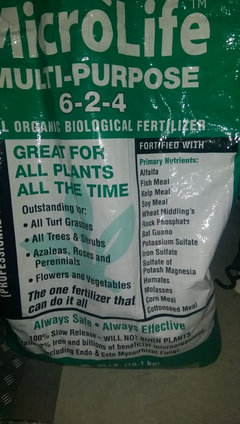
Look at that label morph, that's a lot of ingredients! You can buy all those ingredients for less than a bag costs? I pay about $40 for a 40 pounder, but I've heard I'm paying too much per bag.
- 11 years ago
Most of that can be subbed out or cut, or shouldn't be used without a soil test (although I'm less worked up about that in this instance as the proportions are tolerable on the major resources, if a bit high on K).
Four of those ingredients are entirely acceptable in an organic program but are not, in and of themselves, an organic feeding--rock phosphate, potassium sulfate, iron sulfate, and SulPoMag. I don't object (except to the SulPoMag due to generally adequate magnesium levels in most soils).
It's actually wiser to give the grass what it wants when it wants it--alfalfa once in fall, in addition to a good feed with soy. Kelp whenever you like, but primarily about six weeks before it's about to undergo stress--and only a tiny bit is required if sprayed as a concentrate. Corn as a defense against fungi, so every 90 days, or en masse as an organic matter enhancer.
Constantly adding micros isn't a problem, but your soil will stabilize to the proper levels pretty quickly after starting organics no matter what you do (assuming no toxicity problems, which this won't correct anyway). Once on an established lawn, fine. Once a year, sure, if you feel you must. More than that, no need.
I produce a stunning lawn on soybean meal, kelp concentrate, and a bit of soap.
- 11 years ago
We call all that extra stuff lagniappe around here--ha! All that OM is great, but the Mycorhizical & bacteria supplements are the real reason I started using it. All my biology had been scrapped from the grading & synthetics.
- 11 years ago
I usually end up defending corn meal at least once a year when someone brings up either Dr Parsons or Dr Chalker-Scott from University of Oregon. Frankly I don't care that neither one of them can prove that corn meal works. The single reason I went 100% organic back in 2002 was that corn meal cured a persistent fungus problem I had had in my roses and in the St Augustine. With the Texas heat and the sensitivity of chemical fungicides to such heat, I decided to give corn meal a try. Three weeks later I had the first new grass growing there in 2 years. Waste of money? Not hardly!
Chalker-Scott has a list of myths that she 1) invented and 2) debunked completely without reference to her cherished scientific evidence. She claims to have the scientific evidence in her back pocket, but she never specifies what it is. Parsons is simply embarrassed because the idea that corn meal would be effective against fungal diseases in peanuts sat on a Texas A&M website for at least 5 years after I first saw it and long after this discussion about the ineffectiveness of corn meal for such purposes came to public attention. They talked about corn meal every weekend for years on Parson's local radio stations in San Antonio. They still talk about it. It works. I have used it on diseased turf every year since 2002 and it worked every year. Texas A&M has a long history of being anti-organic at every possible opportunity. I am always surprised (and a little suspicious) when I read anything from them that I agree with.
As for the MicroLife fertilizer, it looks like every other commercially bagged organic fertilizer. And the price is the same at about $1 per pound. Corn meal costs $0.16 per pound this year. Molasses costs $0.10 per pound. Alfalfa pellets cost $0.24 per pound. If I mixed one pound each of those, the total cost would be $0.50 and I'd have 3 pounds of material for an average cost of $0.17 per pound. That is the reason why we went to grains in the first place. If you try any one of the grains in that bag of MicroLife you'll find your lawn responds very well and likely no different from the MicroLife bagged product. Of if the MicroLife product is better, is it 5 times better to account for costing 5 times more? I'm not going to say anything is wrong with Microlife, it's just another organic fertilizer. Okay I have a little more to say. Note that there is fish meal in the MicroLife. Most people quit using fish because it can get smelly fast. But the other thing it does fast is go to work. I'll bet the MicroLife product does not take a full 3 weeks to show improvement. It might happen in as little as a few days to a week. So if you were in a hurry, it might be a good product to try.
- 11 years ago
I see we have the same opinion of Dr. Chalker-Scott. I lost any respect for her when she implied that water gels generated copious toxic compounds at normal soil temperatures. Mind you, they can do that...if you heat them to five hundred degrees. In my 90 degree or less soil, no.
It went downhill from there as I noticed the amount of "gotcha" chemistry she uses. It works if you don't evaluate the statements, but the instant you do, things start to fall apart.
- 11 years ago
dchall_san_antonio(8 San Antonio), That’s a defense? Only on
an internet forum where a few posters live safely in a bubble and can pat each
other on the back unchallenged could that be considered a defense and even then
it is weak.You Insult a highly credentialed source so you don’t have to
address the points he made. Insult a second, un-mentioned resource to further
dismiss any opposing positions as unworthy of an intelligent rebuttal while
deflecting the need to actually counter the actual reference, claim a
University is anti-organic with no link or reference, have the omnipotent power
to project Dr. Parsons feelings of embarrassment, and finally simply mention an
experience you claim cured a fungus solely because of corn meal and it just
works because you said so?It is common to
provide a link and credit to sources and required to be considered seriously.
Who is the author of this peanut study and how did they respond to Dr. Parsons’s
reply and he to theirs? Only by
considering all positions, verifying the controls, data and conclusions, confirming
it can be repeated consistently, can an independent person make an informed
decision. Don’t want to address that so you dismiss any conflicting source? No
controls on your assertions, no referenced controlled turf studies, something
about peanuts I’d love to read, just trust you because you have over 10,000
comments? I was expecting another personal
insult about boat payments.I have no dog in this fight but appreciate an open exchange
of ideas when conducted respectfully. Please provide the link again to an
actual peanut study confirming corn meal is an effective fungicide on turf.I’m sure you have a long list of degrees and certifications
that put Dr. Parsons to shame and multiple examples and pictures posted of the
great lawn you currently maintain and multiple pictures of all the lawns you
have maintained over the years. I
haven’t been able to find any though. Someone outside of your bubble might want
to review actual sources and independently determine what practice to follow
based on their budget and goals.Morpheuspa added a straw man, or at least threatened to
build a straw man if he wanted to, that he could then easily beat, followed but
the assertion, it just works while also dismissing the source never referenced
in my original reply based on a supposed quote that apparently disqualifies
this Dr. from series consideration on any and all previous and future subjects.
With around 14,000 comments between them or “we” as they often refer to
themselves it seems, just reading a few suggest the same disqualifying standard
can be used against “we”.More power to a few that enjoys concocting material at the
claimed low prices but time also has value and sourcing and mixing all those
items and making multiple applications is not time well spent for all. I also
didn’t realize this was exclusively an organic lawn care forum. Nothing wrong
with organics, especially the true organic gardeners’ that don’t use herbicides
or take other shortcuts, but many might prefer a simple management practice
that leaves time to enjoy the yard.You two sure got it good; shutting down dissent simply by
denigrating any challenge as unworthy of actually needing to address with
counter studies and asserting your way is the best way simply by saying it’s
so. You are likely to maintain your self-appointed
position of superiority though because people like me will quickly tire of the noise
and never make it to 10 posts much less 10,000. The forum will be worse for it
though as resources that might have contributed useful information will find it
isn’t a receptive place for a reasonable exchange of ideas.








treesaroundOriginal Author