Software
Houzz Logo Print
aj262

Strawberry Tree possible with East coast humidity?

10 years ago

It seems the Strawberry Tree (Arbutus sp)thrives on the native West coast area where it is dry. What about the East coast with humid summers? The fact I can only find this for sale in CA/OR/WA seems to be a sign I shouldn't even bother. I don't mind if it grows even slower.

Forest Farm is $19/plant shipped. Fruit taste is irrelevant so germinating seeds would be fine if that is possible. 60 days in fridge?

Zone 8b/9a.

Comments (25)

  • 10 years ago

    I wouldn't even consider A. menziesii. The tree has serious issues even in its native range and is not particularly adaptable to any sort of cultivation or siting other than in its preferred exposed, rocky, "excessively drained" acidic soils that exhibit low summer moisture content. It dislikes pollution and is difficult to establish in any sort of urban area. And it is prone to at least 21 identified fungal and bacterial leaf issues, at least 4 types of cankers (several of which result in a high mortality rate), butt rots and root rots.

    Even here in its native setting, Pacific madrone is not "grown" but "allowed to grow". The only ones seen in a garden setting - even in very rural, site appropriate locations - are those that have seeded themselves and they are not inclined to accept any transplanting. Unfortunately, due to loss of habitat, climate changes and some rather rampant disease issues, this tree is in decline. It is rare to see an unblemished, healthy tree even growing wildly although many will linger on to an advanced age in spite of their stressors.

    A J thanked gardengal48 (PNW Z8/9)
  • 10 years ago

    Looking at Arbutus unedo, Sandy loam on a slope. Zone 8b/9a with full exposed sun. Same temps as native, just ridiculous humidity for about four months. My exact issue would be losing it to things like phytophthora.

    Thanks for the help.

  • 10 years ago

    A unedo grows well here and it is about as far from dry as you can get. Nor is it very sunny. What it doesn't get here is warm and humid. And Winters are relatively mild compared with E USA.

    A J thanked floral_uk z.8/9 SW UK
  • 10 years ago

    Had Sunset National Garden Book at hand, Arbutus unedo native to S Eur, Ireland (!). Sunset zones 31-32 for outside of California/US west coast.


    Learn something new every day.

  • 10 years ago
    last modified: 10 years ago

    I have seen 'Marina' with spectacular bark in the Los Angeles area, near the ocean - perhaps that might have more potential for you than A. unedo. But it is not very hardy, you would definitely have to be USDA 8b+ to expect to keep it for long.

    In general you would probably be better off trying some of the many interesting heaths (and other broad-leaved evergreens) native to the Southeast. The sandy soil vegetation I saw on just one site near Orlando for instance contained multiple different species, the most dramatic of which was Gordonia lasianthus. But there were also manzanita-like heaths and evergreen oaks, which along with the pines made it all look very Californian.

    There was a dramatic split there between the primarily deciduous vegetation growing in waterside bottomland and the primarily evergreen vegetation that occurred in the sand just slightly above it. Even here where we do not have the torrid summers of the East the same pattern occurs, with the Arbutus-Gaultheria-Vaccinium combination being a feature of drier soils and deciduous species being dominant or at least prevalent on moister ones; Gaultheria and Vaccinium are common under deciduous trees here, even in wetlands but in those situations are frequently confined to old stumps and logs, which keep them above the water table.

    A J thanked Embothrium
  • 10 years ago
    last modified: 10 years ago

    'Marina' will not grow anywhere on the east coast at all. Nantucket may be cool enough in summer but would be far too cold in winter.

    The same is broadly true of A. menziesii. which is so susceptible to root rots it gets them in its native habitat on irrigated soils! Again maybe in some very sheltered/walled garden on coastal Mass. the hardiest clones out there could persist but that's still a long shot.

    Happily A. unedo and A. X andrachnoides grow on well drained soil in most of the southeast, the former is hardier, probably to 7b, than the latter which is only 8a although maybe ok in a mild 7b if well established. "Hardy" in this case is meaning ability to survive long term, perhaps not form the best looking plant. My A. 'Elfin King' was injured by the penultimate winter, killed to the ground by the last, but vigorously resprouted. My former (!) A. x andrachnoides had just been moved the prior year but I don't think it would have been hardy anyhow. It showed injury faster than Arbutus unedo and there's every reason to think it's less hardy. In 8b/9a though I'd try A. X andrachnoides, Woodlanders has sold it for decades. They are in the coastal plain though on sand: I wouldn't plant either of those on mucky clay soil. If that's what you have, maybe consider a raised berm, or as bboy suggests, a locally native Ericaceae or Theaceae. (not that all of those are easy, either)

    A J thanked UpperBayGardener (zone 7)
  • 10 years ago
    last modified: 10 years ago

    A. unedo is burned by the coldest winters here so I don't see it being a long term prospect in Zone 7 anything. A. x andrachnoides is half Grecian strawberry tree so it is logical that it would be less hardy than A. unedo. We pretty much never see it here even though it has been on the local market to a limited extent in later times - I never picked up on Woodlanders offering it.

    Speculation about the parentage of 'Marina' includes it being a clone of A. x andrachnoides but as I remember it there is something that doesn't seem to fit.

  • 10 years ago

    I see Woodlanders says they got A. x andrachnoides from Brookside Gardens, who imported it from Europe. However, no arbutus comes up when the Brookside plant database is searched online - maybe their planting died.

    Woodlanders has only one borrowed photo from Israel and no photos of their actual stock of the tree on their web site. The Israeli photo could just as well be showing A. unedo 'Rubra'.

  • 10 years ago
    last modified: 10 years ago

    "so I don't see it being a long term prospect in Zone 7 anything"

    Well, as I said, it depends on whether your "long term prospect" is merely surviving or remaining a full-sized plant, forever. I'm perfectly happy it if dies down once in a while. Some in Fredericksburg and Williamsburg survived 1994, which still might have been worse in some sense than either of the past 2 winters. Wmbg hit 0F - ornamental water gardens so frozen we could walk on them and admire the fountain-mountains - and the top of the plant 'Compacta' was only very slightly damaged. Sheltered by a large magnolia tree and building wall, but still. Then, the moronic hayseeds who took over the grounds planning decisions there after Dr. Baldwin died tore out both to replace them with a Betula nigra!

    "However, no arbutus comes up when the Brookside plant database is searched online - maybe their planting died." Yes, that would make sense for a plant I'm suggesting is only zn 8! Mine was actually OK before I moved it, in the upper single digits, but of course, 7b climates vary in how much and how often they dip below that, and for how long. Brookside probably got their plant before 1994, which would have completely incinerated it.

    Me and another fou de plantes in the DC area both tried 'Marina' once upon a time. To my eyes it looked very different than whatever Woodlanders was selling as X andrachnoides, which, again, looked different than any clone of A. unedo I've seen(!). The leaves are gigantic - I've seen the famous old A. X andrachnoides at Kew and it doesn't look like 'Marina'. What I read somewhere is 'Marina' could have some Arbutus canariensis in it, which would help explain its insistence on a maritime/mediterranean climate. OTOH Greece is actually quite muggy in summer, which would explain why some plants from there can at least survive in the SE w/o dying of root rot.

    BBoy the Woodlanders nursery lot seemed like a cramped, jumbled collection of mini-hedge rows and I doubt they post many pictures of full-sized specimens from there, on their website. I just drove past it when I was in the area, I didn't visit, but I got the impression it's best a place to visit only during open houses. No strollable display garden, probably.

  • 10 years ago
    last modified: 10 years ago

    FWIW, I would never have thought to look them up there, but the National Arboretum is reporting as "alive" an Arbutus unedo 'Compacta' - and very surprisingly an A. menziesii, though the latter in "off-site holdings". Do they have a little known annex in Anacortes? LOL.

  • 10 years ago
    last modified: 10 years ago

    Woodlander recommendation looks nice as a source. Would A. xalapensis (Texas Madrone) be better suited?

    Woodlanders also brought Stewartia monodelpha (Tall Stewartia) to my attention.

  • 10 years ago

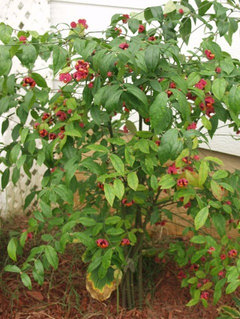
    strawberry tree? are you reffering to this (hearts a bustin' shrub/tree) these are currently in season here

  • 10 years ago

    'Strawberry tree' is the common name most often applied to Arbutus unedo (it produces an odd strawberry-shaped fruit, edible but not very tasty), although by extension also frequently applied to other trees in that genus.

    I believe 'strawberry bush' is a common name applied to Euonymus americanus, as is hearts-a-burstin, wahoo, bursting heart and a few others.

  • 10 years ago

    ok didnt know the strawberry "bush" sometimes look like small trees

  • 10 years ago

    The OP gave the botanical name at the top of the thread so there's no doubt about what species is being discussed.

  • 10 years ago

    As far as I know there is still an Arbutus unedo growing at the US National Arboretum. It's not terribly attractive after a cold winter, but is probably 5 to 6 feet high. It's probably a bit too warm AND too cold here for it.


  • 10 years ago

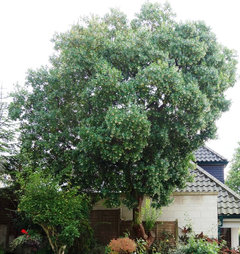
    This one is Arbutus unedo, I believe. It's growing in the next street to mine. As you can see it is currently in bloom and it will remain lush and green

    throughout the winter. You can also see it has had one trunk cut off, sadly, presumably as it was overhanging the building. It is more or less at maximum height now.

    There was a big old A x andrachnoides in a local park but it has been removed for some reason. However, it has been replaced with new young speciment. The bark on it was astonishingly beautiful.

    The writer of the linked article considers A unedo totally hardy and never harmed by frost - but clearly s/he isn't talking about the N E US. Arbutus

    A J thanked floral_uk z.8/9 SW UK
  • 10 years ago

    Arbutus unedo thrives in the coastal southeast US humidity if planted in sandy, draining soil. Grows best in zones 8 and south. I grew a number of them when we lived in Beauford, SC. purchased from Woodlander's Nursery. A fast grower. Excellent evergreen specimen tree or useful as a dense hedge. Will retain branching to the ground if desired.

    If any of you with horticultural knowlege visit the Aiken, SC area please locate Woodlander's Nursery. It is not a business of beauty designed to trap your dollars. It is rather funky, with a propagator who can root those difficult varieties. Pro's will love it.


  • 10 years ago

    This would be 9a with gusts of 8b. My list of preferred tree:

    1. Arbutus x andrachnoides :Strawberry Tree Hybrid

    2. Arbutus unedo


    3. Arbutus texana: Texas Madrone


    Wanted to get this in the ground this fall. If spring is better, should I attempt germinating A. unedo seeds? Those seem to be available and very cheap. Fruit quality isn't an issue.

  • 10 years ago

    Would A. xalapensis (Texas Madrone) be better suited?


    No. Susceptible to root rot in the SE climate. It only grows in TX (naturally) in the areas generally west of the dry line in summer.

    A J thanked UpperBayGardener (zone 7)
  • 4 years ago

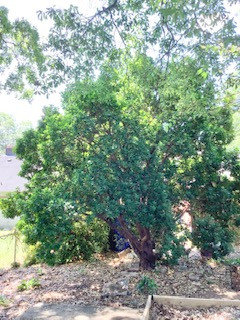
    I planted Arbutus unedo in a Southeastern humid climate, in clay soil on a slope in zone 8a approximately 20 years ago. It is an impressive shade tree. The birds love the fruit, get drunk and fall out of the tree.

  • 4 years ago
    last modified: 4 years ago

    A picture is worth a thousand words, HU-659273525. But I'm glad your tree is doing well for you. They are one of my favorite BLEs although mine in zone 7a has been almost killed to the ground before and surely will be again someday, it came roaring back to life. I haven't seen any drunk birds yet, and in fact they seem to avoid mine.


    [Haha I now spot a mistake on that thread. The huge cyclamen blooming in September in Rye had to be something like C. graecum, not C. coum. Although now I seem to recall having a sidebar convo with someone on GOTE and finding out those cyclamen were some brobdingnagian hybrids that had just been introduced to the UK market, bred to make plants that looked a bit like C. persicum hybrids but were hardy enough for milder parts of NW Europe. Totally forget the name now, and I googled at the time to find they hadn't been brought to this side of the pond yet, as is so often the case. I'm still waiting for Clematis X 'Advent Bells', whose hybrid vigor might give it a better chance fighting my winters]

  • 4 years ago

    davidrt28, my first houzz photo, Arbutus unedo:


  • 4 years ago

    https://jcra.ncsu.edu/horticulture/plant-profiles/details.php?ID=25

    North Carolina JC Raulston arboretum (7b, quite humid), has articles on best varieties for NC weather.