

Logan Lab test results help
My Logan Lab results are in and even with my limited knowledge I can see we need adjustments!
We live in central Oregon about seven miles NW of Redmond. The lawn is 4,300 sq. ft. 15 year old sod mix of KBG/fescue/rye grass. Irrigation is automatic sprinklers from a well. This summer we have worked toward 1" per week at one time. In the past I know the lawn was over-irrigated but now we wait until the lawn shows stress which has worked out to one watering per week or less if the weather cools which it has now. There are some large boulders under some areas of the lawn and rocky soil. Most of it gets full sun except where six juniper trees provide partial shade. For the last five or six years we used a Restore type organic fertilizer which was suggested to help reduce the heavy thatch (about 1 1/2 to 2"). No other organics or amendments were used. We have always dethatched in early spring (bought a used machine from a rental company). This spring we kind of gave up and returned to synthetic (fed too early I now know). Unfortunately we had an early warm spell and then lots of rain. By mid April there were small patches over the entire lawn of dying grass. The local Extension Service couldn't diagnose but since we never saw any grubs or bugs we assumed fungus. Scott's fungus control was applied and the lawn gradually grew back and looked pretty good by late June. During the "healing" period we aerated and applied 4 yards of compost as suggested by the Extension Service. They also advised aerating and dethatching this fall. After doing lots of reading on this forum we decided to use organic grains. Since then we have used cracked corn in July and September and soybean meal 15 lbs/1000 sq. ft the first weeks of August and September. Mu husband got a kick out of making tea from our compost pile and has added that twice.
Since mid August we have developed yellow areas which I also remember seeing last year at this time, maybe a fungus or rust?
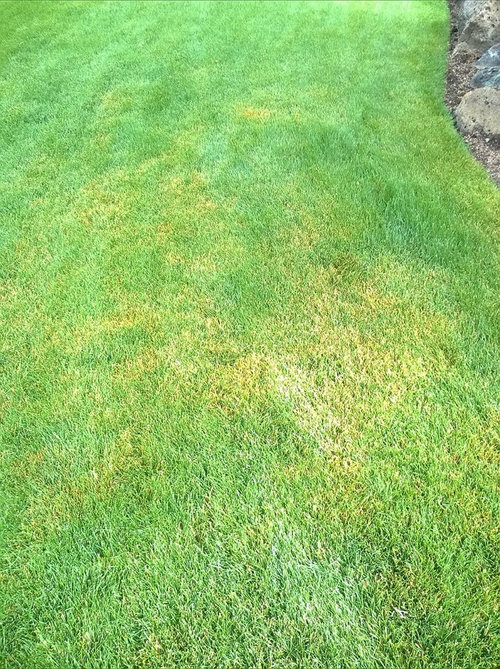
I need advice on how to address this and what schedule we should follow for the organic grain feedings. We have alfalfa pellets on hand and have access to soybean meal, cracked corn, and Milorganite. Also, should we follow the suggestion of aerating and dethatching? We don't have leaves available but plan on replacing our old mower with a mulch mower by spring.
Any advice on the lab results would be much appreciated. Note the sample depth shows 6" which includes the deep thatch layer.
Kathy
Comments (28)

jmcue
Original Author11 years agoSorry, will get the lab test attached when I figure out how to do that, first time posting!
Related Professionals
Topeka Landscape Architects & Landscape Designers · Miami Landscape Architects & Landscape Designers · Tulsa Landscape Architects & Landscape Designers · Philadelphia Landscape Architects & Landscape Designers · Redding Landscape Architects & Landscape Designers · Madison Landscape Contractors · Brainerd Landscape Contractors · Lima Landscape Contractors · Santa Barbara Landscape Contractors · Springfield Home Builders · Elk City Home Builders · Flint Home Builders · Middletown Home Builders · Bakersfield Home Builders · York Home Builders- 11 years ago
This test presents us with some interesting challenges, but overall it's not bad. I do see signs of either a naturally magnesium-heavy soil or some severe overuse of dolomitic limestone.
I'll account for the six inch sample depth and turn it down to the normal four inch.
Exchange Capacity 9.5: Could be loam, could be sand and silt, only a jar test would give us a guide on that. It's a nice number, and resources will stay put pretty well with lower levels of drift. Once balanced, testing every other year will be just fine.
pH 7.2: Not a barrier to a gorgeous lawn, which is good because this isn't going to move much. I have some minor hope of dispelling some of the magnesium, but you're stuck with most of it.
OM 1.8%: Near the top of the Poor range. In this case, always mulch mow, mow all your fall leaves, and if convenient you can import leaves from other lawns that get deposited by the curbside. Organic feeding is a good idea. I'd like to see this at 4% or better eventually.
Sulfur 28: Normal, with some remaining margin for playing. I don't need a great deal of margin in this case, so no problem there.
Phosphorus 150 (100 adjusted): Moderately low, and a limiter to lawn quality. We use starter fertilizer to raise this. Just get the cheapest as they're all about the same. Recommendations below.
Calcium 54.9%: A little low, but nothing severe. I'm turning the 498 pound per acre shortfall down to 332 pounds. I'd still like to raise this a bit, as well as eject a little of the magnesium from your soil. We use gypsum to do both, available at most landscape, garden, and even many big box stores. Get the pelletized, it's a lot easier to handle and almost all of them have it or can order it. Gypsum is pH-neutral, but in your case will probably result in a slight drop in your pH. Recommendations below.
Magnesium 30.2%: Quite high. I'm hopeful the gypsum will dispel some of this; it tends to make soils tight and very hard to dig (and is the reason many people think they have clay when they really have sand or silt).
Potassium 9.0%: Very high, but this is not a problem. While a fan of high potassium, even I find this to be a bit over the top. Avoid any potassium sources, which is usually very easy as most things don't have a great deal of K.
Sodium 1.7%: A perfectly fine answer, but I'd like to drive out some sodium to lower your pH overall (sodium is a strong alkaline). The gypsum will accomplish that quite nicely.
Minor Elements: Everything but boron (very low) and iron (a complex issue) are fine. Both B and Fe are mentioned below.
Boron 0.28: Very low. We use Milorganite as a carrier and 20 Mule Team Borax as the boron source. You can purchase 20 Mules at the grocery store in the laundry section. In a wheelbarrow or the like, dump the Milo. Spraying very, very lightly with water (I use a spray bottle like the kind people use to damp their clothes when they iron) will help the boron stick. Add the recommended amount of 20 Mule Team Borax and stir, spraying occasionally to get the stuff to stick to the Milo. Then apply over the recommended area. So if going for bag rate Milorganite (1 bag per 2,500 square feet), you'd add 10 tablespoons of 20 Mule Team Borax.
Iron 137: Not deficient, but rather heavily bound at your pH and not going to produce the best color in your lawn. Whenever you like, you can use Milorganite as an organic feed and also to increase the color of the lawn. Over time, your iron levels will slowly rise when using Milo.
Recommendations:
September 19: Apply starter fertilizer at bag rate.
October 1: Apply 10 pounds per thousand square feet gypsum.
October 15 (this is close enough to 1 month): Apply starter fertilizer at bag rate.
November 1: Apply 4 tablespoons (not a misprint) per thousand square feet of 20 Mule Team Borax in a Milorganite carrier.
April 15: Apply 10 pounds per thousand square feet gypsum.
Memorial Day 2016: Apply starter fertilizer at bag rate.
Labor Day 2016: Apply starter fertilizer at bag rate.
- 11 years ago
>>I need advice on how to address this and what schedule we should follow for the organic grain feedings. We have alfalfa pellets on hand and have access to soybean meal, cracked corn, and Milorganite
We're probably going to need a closeup shot of the problem area, but that does look like rust. It tends to flourish towards the end of summer when temperatures are still tolerably warm but evenings are damper.
It generally doesn't do any damage, it's just unsightly. Cracked corn or corn meal at 10-20 pounds per thousand square feet will slowly clear up the problem over a few weeks, and the starter fertilizer will also help (rust detests free nitrogen).
I'm a fan of soybean meal for the high nitrogen levels (7-1-2), which means less goes down per thousand to adequately feed the lawn.
I have this fall's and next spring through Labor Day's nitrogen needs met with the starter fertilizer, but you can always use organics if you like. For the next year, since you don't need the nitrogen, the alfalfa at 10-20 pounds per thousand square feet soon would be great. For northern lawns, use more than once a year isn't recommended as it can damage the roots (alfalfa contains growth hormones--a little is great, too much is damaging).
A general schedule for when you're feeding your lawn with organics (or, not in the next year) is as follows:
May 1, August 1, September 1, October 1 -- then winterize with a good synthetic when the grass stops growing but is still green. I'm not sure when that date would be for you as the Pacific Northwest can be a bit touch and go.
Each feeding can be Milorganite at bag rate, or soybean meal at 15 pounds per thousand. Alfalfa and corn are extras with low nitrogen levels.
You can still follow that schedule if you like, it won't do any harm even with the starter going down.
Corn once per year at 10-20 pounds per thousand square feet is great as a very gentle fungal defense and also to supply organic material to the soil. It's a poor feed, so unless you're applying 40 pounds per thousand or more it really doesn't count.
>>Also, should we follow the suggestion of aerating and dethatching? We don't have leaves available but plan on replacing our old mower with a mulch mower by spring.
Dethatching...are you sure that's thatch and not just dead grass blades? Your grass mix, unless desperately overfed, won't tend to produce a vast amount of thatch, although KBG is certainly going to produce some. Feeding organically will actually tend to take care of that for you as the thatch decays off very easily in an organic environment.
Aeration, it depends. If you had machinery rolling across the lawn, it wouldn't be a bad idea in that area. I am otherwise not a fan of aeration as it's of no great positive (or negative) effect, and can be much more cheaply, easily, and with longer-lasting effects simply by spraying shampoo. Look up shampoo applications around here, there's a lot about that.
With those magnesium levels, your soil is undoubtedly tight and hard. Aeration won't do jack to correct it, but the gypsum applications will by adding calcium and dispelling a little magnesium. Dropping the sodium levels, feeding organically, and mulching the grass next year with your new mower will also help.
(You probably just started yet another flame war about aeration, so this will be my absolute last word about that...but I'll be happy to further discuss your test and organics).
- 11 years ago
A starter fertilizer is one with a high second number (to make it easy, most also say "Starter" as part of their name). So 20-27-5, 18-24-6, and other numbers like that are all starters. Things where the second number is equal to or lower than either of the other numbers are not starter fertilizers.
(Classically, they're called that because many people use them at seeding time to "start" the lawn. Whether that's correct is an entirely separate argument).
You can absolutely mix organic and synthetic fertilization and they play extremely well together. Even if you drop a grain-based organic and the starter on the same day, you should be fine--although I wouldn't try that with Milorganite as it does have some fast nitrogen in it. But soy, alfalfa, corn, oats, rice hulls, and so on, go for it.
If the ground is unfrozen on November first and not going to freeze in a short period of time, the borax is fine. It's extremely water-soluble and will enter the soil in a single rainfall. 20 Mules is actually used as a laundry booster because it's a boron bleach (safe for colors) that dissolves very well.
If you suspect that you're going to get ground freeze before that, you can certainly apply the 20 Mules on October first instead. It won't fight too much with the gypsum.
jmcue
Original Author11 years agoThank you for such great information. My husband was all set to aerate but I'm sure he will be influenced by the ease and low cost of shampoo versus fighting the aerator and paying the rental fee! I think the lawn was overfed with synthetics at least the first 7 or 8 years so as you say we'll continue to add the organics.
- 11 years ago
>>I think the lawn was overfed with synthetics at least the first 7 or 8 years so as you say we'll continue to add the organics.
Fortunately, most synthetics are high nitrogen, low everything else, and fade out fast (six weeks, tops). The actual damage to the soil biology is generally minimal, and easily repaired simply by feeding organically now and then.
They can strip the soil of some nutrients, but in your case that didn't happen. You're a touch low on calcium and low on boron, but that's about all, and low boron is relatively common.
Overall, you're in great shape to fix the few issues, shift to completely organic feeding after the phosphorus balancing is done, and re-test the soil every other year or so to make sure that nothing's drifting too far off the mark.
jmcue
Original Author11 years agoOh Boy, I'm in a panic here. My husband put the spreader setting noted on the bag of the starter fertilizer 18-24-6 and said it worked out fine for the lawn area (about 4300 sq. ft.) but TWO bags were used, each stating it would cover 5,000 sq. ft. What should we do? Also, will this alter the timing of the next starter application suggested for mid October?
- 11 years agolast modified: 11 years ago
The EPA isn't going to be happy.
Other than wasting product and money, as you just seeded, and you are watering 2-3 times a day, so no harm.
jmcue
Original Author11 years agoIt's a 15 year old lawn, no new seed, watering 1" per week at one time or less now that the weather has cooled, how much extra water should we apply?
- 11 years ago
First, go give your husband the stank eye. A bit of crossed arms would go well.
I'm using the numbers for Sta-Green Lawn Starter Fertilizer here since I'm not sure of the exact brand. These numbers should be more than close enough.
18 pounds of 18-24-6 would normally go 5,000 square feet. In this instance, he applied 36 pounds over 4,300 square feet. Which works out to 8.4 pounds (a bit less) per thousand square feet.
That delivers:
1.5 Pounds of Nitrogen: Very high, but still just barely in tolerable range with some special attention. Areas of overapplication above the average are much more likely to be damaged.
2.0 Pounds of Phosphorus: High, but tolerable. No burn expected even in areas of overapplication.
0.5 Pounds of Potassium: Within normal range. No burn expected.
Overall:
This was not a good mistake to make--phosphorus and potassium will be OK, it's the nitrogen that's the kicker here.
Recommendations:
If this waters in via rainfall, make certain it gets AT LEAST 2 inches of rain all at once. If the rainfall is lower than that, irrigate up to 2 inches.
If you irrigate, irrigate at least double the normal amount, with 2" or more of irrigation being optimal. We're trying to dilute the nitrogen through the soil profile--and if some gets lost below the root zone, I'm not complaining in this instance.
Skip the October application of starter (you already did it) and use a gentle dose of organics only.
Skip the soybean meal this month and any other organic. You don't need the extra nitrogen and this just slid into the range where I wouldn't recommend adding anything additional until this dose of N has time to process out.
Expectations:
Sufficient irrigation should minimize burn, and if temperatures are below 80 and you irrigate/get enough rainfall, you might get away with no damage. Might. At the very least, heavy irrigation or heavy rain will reduce the amount of damage that's about to happen...
- 11 years agolast modified: 11 years ago
Cancel; you didn't seed. Edited to remove instructions that don't apply since there's no seed down.
jmcue
Original Author11 years agoHa, didn't have to give the stank eye, almost 48 years of marriage and I've never seen THAT expression on his face when informed of the error. Should we irrigate immediately or wait until morning? Will the one heavy irrigation be sufficient or do we need to put on extra water later, looks like temps will be in the mid 70's the next few days.
- 11 years ago
Oh, honey, never pass up the opportunity to give them the stank eye. :-)
With lower temperatures, burn probability drops--and the mid-seventies are quite comfortable as a high! 80 degrees is of modest danger, 85 of high danger.
You're entirely safe in waiting for morning. Until the fertilizer gets wet, the clock doesn't start--so you'll start it when you irrigate. Once you begin in a given area, don't stop until the full amount is down. One irrigation is going to be sufficient, but if you notice a burn in a given area--and please keep an eye out, particularly in areas where he turned the spreader--you might want to strike that particular section a second time. Once started, the burn has already happened, but you can usually save some grasses that hadn't yet burned.
I typed that above as fast as possible since I could smell the panic even here in Pennsylvania. The explanation of why to do the soil flush is below.
Depending on the nitrogen source in the fertilizer, distributions change.
http://www.growcom.com.au/_uploads/LWR/Fertigation%20Compatability%20and%20Solubility.pdf
The more highly soluble sources of nitrogen (including urea, which doesn't have a listed solubility, but should be in there at about 105) tend to ride the wavefront of the penetrating water, so the full irrigation will dilute it very well and throw a good percentage under the root zone. Some will diffuse back up, but that'll be fine.
Nitrogen sources that are less soluble will distribute through the water application zone better. In that case, the goal is to throw as much under the root zone as possible.
All likely sources of nitrogen in the starter are highly to moderately soluble.
One inch of water is generally sufficient in most soils to water all the way to the base of the roots and a small amount below. That does vary, but we have your soil test showing an exchange capacity of 9.5--that isn't a sandy soil, there's a good clip of silt in there. So 1" is a good basic number.
The second inch doubles the depth of penetration (give or take, your subsoil is likely of slightly different composition, but lacking data we'll assume it's the same). It pushes at least half the N under the root zone, and we know that 0.75 pounds of N won't be a problem on your lawn.
Am I over-reacting? Yes, slightly, as your location doesn't lend itself to very hot September weather. I could probably get away with that level of nitrogen in November with high temperatures in the high forties and low fifties. Probably.
The problem is more the overlap and turn-around areas of the sprinkler, and while we're at it I'm adopting a "better safe than sorry" approach for the rest of the lawn.
The long run effect of that much phosphorus at once? None. It'll distribute itself through the soil just as it would have otherwise--quite slowly, and quickly binding into inaccessible compounds just as it always does. This just means you don't have to redo this in October.
jmcue
Original Author11 years agoThanks for your help, I know it's late for your area. Call it crazy but I had a premonition and saw 2 empty fertilizer bags in my mind so went out to check. The grand finale, I hope, to a bad lawn year. Keeping my fingers crossed!
- 11 years ago
It's just touching midnight, which is actually not that late for me--I don't sleep that much!
This has been kind of a sucky year for you lawn-wise! But I did have a second thought--that excess N is actually more likely to take care of your rust problem than a normal rate of nitrogen was. So it's an ill wind and all that.
If that still doesn't take care of it and it bothers you, we can fix that too.
On the up side, as far as organics go, the worst risks you face when applying it are setting off a week-long miasma of bad scent. Unless you go severely overboard, it won't burn and it's far more foolproof (husband-proof in this particular instance...) than most synthetics ever could be.
jmcue
Original Author11 years agoThat's what I told my husband, maybe all that nitrogen will grow out the rust. We had it last year although not as widespread and it doesn't really bother me. I like using the grains although I've received a lot of weird looks at the feed stores when inquiring about their products and prices. I try to explain what I'm doing even with my limited knowledge, some actually have taken an interest. Could be a revenue producer if they were smart! Thank you again so much.
- 11 years agolast modified: 11 years ago
Sorry, I thought you had just seeded. An established lawn? No problem. If you are a real worrier:
If you don't have rain in the forecast, don't water. Up to 30% of the N will gas off within five days. If it does rain, then add water artificially (2" water total is fine)., but I wouldn't worry about it, I have put 1 1/2# of nitrogen down in the same temps as you with absolutely no ill affects.
- 11 years ago
De nada!
http://www.extension.umn.edu/agriculture/nutrient-management/nitrogen/fertilizer-urea/
Urea nitrogen may gas off if you have an alkaline pH. You don't at the moment on your soil surface as you also just dropped phosphorus, which is temporarily acidifying the soil surface (it's not going to be a problem and, over the medium term, it neutralizes) and the potassium isn't helping either (pH at 1 mol/L is about 6.5 for the sulfate version; I don't have potassium chloride's handy as I don't use it, but the pKa is 7 so it's a weak acid). Or high temperatures, which you don't.
Nitrate- and nitrite-based nitrogen sources don't gas off significantly.
As I said, the Nervous Nellie approach is to protect the inevitable areas of overapplication....and once any section of the lawn burns, it's too late to react. You can certainly do that if you like, but it's also getting a bit late to reseed at this point.
- 11 years ago
You better do as Chicken Little says. He gets very upset when he's contradicted. I say it's no problem, but other than water, what does it cost you to leach it out?
- 11 years ago
Jmcue, I'll apologize if you feel I've been pushy.
You can certainly feel free to choose whichever path you like and, if a burn does result, I'm sure any of us (including myself, of course) will be more than happy to assist you with repairing the lawn.
However, this will be my last word on the subject and I wish you great success no matter if you irrigate it or choose to let it go.
jmcue
Original Author11 years agoNot having experience in this situation I can only do what I feel makes the most sense to me. The irrigation will commence. I'll let you know the result.
- 11 years agolast modified: 11 years ago
Crap. I've allowed my irritation with someone color my advice. You've made the safest choice. My apologies.
jmcue
Original Author11 years agoI thought I would update after the nitrogen overload last month. We watered 2" and there didn't seem to be any burn at the time. The grass did green up a little.
However, the rust has come back with a vengeance throughout large areas of the lawn. We've had an unusually warm fall, light frost since early September and afternoons into the low 70's. As long as I know the colder weather this winter will knock it out I can live with it.
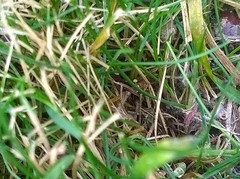
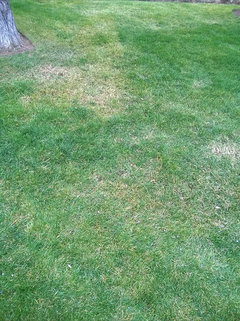
My concern now is several patches of the lawn looking like they are dying. We had 80 pounds of alfalfa in the shop we didn't want to keep over winter so that was applied around the first of October. The pellets were large, hard to spread, and have taken a long time to break down. Some of these patches have small areas of mold and pieces of alfalfa. We've had a little rain so the ground is damp. Could these areas be affected by the alfalfa, rust, or something else? Thanks for any help!

- 11 years ago
>>We had 80 pounds of alfalfa
To what square footage? Alfalfa won't generally cause an issue unless overapplication levels were hideous.
Visible decay organisms in the rotting alfalfa is pretty normal, and happens a lot when pieces were larger and/or application was very heavy. In one area where I intentionally dropped a lot of soy, it turned brick red before falling apart and finally disappearing. That can be an issue for covered grass bits, which can get sick, but it usually doesn't spread.
Rust tends to disappear once temperatures fall too low for it--I've also had a fair amount of rust outbreak this fall since it's been warm. Fortunately, for us it's also been dry so it hasn't been running rampant.
While a mild sprayed fungicide will take it out, unless the rust is damaging the lawn (possible but a bit unusual), ignore it for now.
jmcue
Original Author11 years agoSorry, applied to total 5,000 sq. ft. (lawn and small garden area). Didn't know if the small area that appears to be dying was related to the alfalfa. It seemed that area was somewhat matted with the pellet decay. It was broadcast by hand so may have gone on heavy in areas. Will keep any eye on it and the rust. Thanks!
- 11 years ago
80 lbs / 5 k sq ft = 16 pounds per thousand square feet.
That's a totally normal level of application, so I very strongly doubt there's any problem with that! (And we already know I always take the safest route, so you know I'm not being cavalier about it).
Even going heavy by hand broadcast (something I do myself) shouldn't be an issue at all, but as you noted it can mat down the grass a bit. Where that happens, you can usually scratch it up a little bit to get the grass to stand and the alfalfa (or whatever you're using) to settle.
Overapps of an organic are possible, but difficult. I mostly use soybean meal. In bad sections, I run over it with the spreader at 15 pounds per thousand, then usually take handfuls or double handfuls and spread them around in the area as well. Thirty per K? That's probably about right. Very tiny but very blank bits might get a whole lot more than that.
Then if there's any left in the spreader at the end, I often run over the really bad sections again...and now we're up to 45 per K of soybean meal in some spots. They're too small to generate any real scent and I never notice it, but it does help the bluegrass fill back in at jig speed.
The decay colors can be interesting, though!










jmcueOriginal Author