Software
Houzz Logo Print
thechinski

Advice on planned setup

10 years ago

Hello!

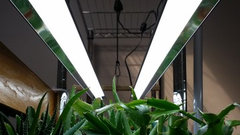
I have a 3 ft wide bookcase that I would like to fill with succulents/cacti, but it receives no natural light, so I have to use artificial lighting. It is about 15 inches high and a ft deep. Anyone with experience, would a fixture like this be suitable for year round growing? (adult plants)

I'm not necessarily going for such good growth as you would find in the middle of a dessert, but I have already filled all my windowsills, and even then the Welsh sun is hardly worth a whole lot. If I could get a few fixtures like above I could massively expand my collection, and perhaps even have healthier plants - half my collection are on North facing windowsills D:

If not the ones at the link I posted, how about some T5HOs? There just doesn't seem to be many 2ft T5HO options, compared to T5NO, but there were a few. Because of my height limitation I need low heat, and the depth of the bookcase limits me to only 2 tubes really.

If 2 T5s of any output simply won't do for all year succulent growth, what sort of thing am I looking at?

Thanks for any help!

Comments (9)

  • 10 years ago

    At the current exchange rate of 1.52 $/£, the price of your proposed T5 fixture is $68.38, which is a rip-off. Depending on the price of LED bulbs in your area, it might be better to use 4000/800 = 5 800 lumen ("60 watt equivalent") LED bulbs, which, at 8.5 watts/bulb, will consume 5*8.5 = 42.5 watts. I recently purchased such bulbs for slightly less than $2.50 each. The sockets also cost about $2.50 each and a 9 ft. extension chord (for wire and plug) costs $1. If you can do the same, your total cost will be 5*$2.50 + 5*$2.50 + $1 = $26 = £17.10. See photos of my setup for more ideas:

    http://www.general-cathexis.com/images/LED1.jpg
    http://www.general-cathexis.com/images/LED2.jpg
    http://www.general-cathexis.com/images/LED3.jpg

    thechinski thanked aruzinsky
  • 10 years ago

    Thanks both for the replies!

    I'd love to try Leds, but I keep reading different things about which ones to get, and what with it being my first go at artificial lighting, I'm just gonna stick with T5s, which seem a relatively safe bet.

    I don't know if it's because I'm in the UK, or just because I'm terrible at internet shopping, but those prices are the best I can find - but I was on eBay this afternoon, and found anew 2ft 4 tubes T5HO aquarium hood auction which I won for less than the price above, and it should fit pretty nicely in the space I have. It comes with 2 6500k bulbs, but also 2 "Actinic" tubes, which peak at 420nm, quite blue. I can't find much information about using these tubes for a non-aquarium purpose, but I presume I would need to replace them with more 6500k tubes?

    Anyway, thrilled to get my plants under some good light. Living in Wales, most of the year is pretty dismal as far as sun is concerned, so I haven't really seen my collection thrive before now, but maybe I can finally get some good growth, or at least beat my north facing windowsill growth!

    Thanks!

  • 10 years ago

    Hard to say how the bulbs will be, nm doesn't really convert to Kelvin. At least not like km to mi.

    The best way to check is a PAR light meter or spectrometer, but most people don't have either and they can be quite expensive.

    If new bulbs are fairly easily obtainable for you, perhaps you can test them out for a little while and watch your plant growth carefully.

    thechinski thanked ewwmayo
  • 10 years ago
    last modified: 10 years ago

    You do not need to replace the actinic tubes. It might even be slightly better for your plants if you replaced the 6500K with 3000K tubes because the combination of 3000K and actinic bulbs might produce proportionately less green light, in which case, an illuminated white surface would appear pink or pastel purple as shown in my second photo. I say "might" because I don't know how much green light your actinic bulbs produce. All unfiltered fluorescent bulbs produce some green light because it is part of the mercury spectrum but, in addition, your actinic bulbs might have a green phosphor.

    thechinski thanked aruzinsky
  • 10 years ago

    Thanks again both! It arrived today, and I'm super excited to get it all rigged up. I presume I need to introduce the plants to it as though it were summer sun? How long an adjustment period do you suppose they'll need? They are probably experiencing 'low' light at the minute

  • 10 years ago
    last modified: 10 years ago

    That's great news - congrats!

    Yes, you will likely need to adjust your plants to the increased sun. Depends on how low light they are in now and how long it's been (along with species).

    I actually just finished up building my secondary setup with 2xT5HO. They are spaced 5" apart center-to-center for a 12" shelf. Based on my measurements, if I run the lights sunrise to sunset it'll give me 19 DLI @ 3" away. This is equivalent to partial sun.

    Since these plants have been grown in rather poor light of maybe 3 DLI for one month, I will be start with my lights on just 5 hours at a time. Hopefully will increase this to 10 hours over the next several weeks.

    Side note: I'm mostly planning on 'maintaining/overwintering' with this setup and use it for my succulents that have lower light requirements.

    thechinski thanked ewwmayo
  • 10 years ago
    last modified: 10 years ago

    Nice, thanks! Is the graph you posted [here [(https://www.houzz.com/discussions/budding-succulents-under-lights-dsvw-vd~3376092)a flower power graph? I have one of them, and it measures about 40 in the middle of the light a few inches below, and then 20-30 around the sides - is this DLI rating? If so, how does that compare? From the graph you posted on the winter setup thread, that seems an ok amount, but not amazing. The reflector on this fixture is rather hopeless unfortunately, but I can do something about that probably. At least it should beat the 10 reading I get on my windowsill windowsill

  • 10 years ago

    It is a flower power graph! Exciting to see someone else using one. They actually have very meaningful measurements. Just that the interface is a bit simplified for users (maybe too simplified for my likes). Not many, if any, people here using them.

    Can you post your graph here for a typical day? Have you been using yours for very long?

    The light measurement is sort of an 'instantaneous' DLI if the light was like that the whole day. If you want your actual DLI, you need to get the average reading for all those numbers for the entire day. Note that the scale is logarithmic.

    For outdoor situations, I use the open source software Plot Digitizer to pick the points and get the numbers easily. I usually just roughly pick every hour of light in a day and average them in excel.

    A measurement of 40 should be alright. My secondary setup above gives 30 where my plants are and my primary setup gives 60.

    If you run your lights 11.5 hours (sunrise to sunset for my zone) that would mean your DLI is between 13 to 19 (from sides to middle of your lights).

    If your windowsill gives a reading of 10, that means you are getting at most a DLI of around 6 there, assuming that is the same brightness from sunrise to sunset. So realistically... it's probably more like 3 or 4.

    Totally off topic, what soil mix are you using and how accurate have you found the moisture meter to be in it? Just a little curious. =)

Sponsored