Software
Houzz Logo Print
lalala_gw

Front of bed help

11 years ago

We have been getting some advice from a landscape designer for our front beds. In one area she recommended a course of inkberry in back, nepeta 'walker's low' in middle, and either daylilies or liriope in front. I'm not thrilled about the front suggestions. I am worried that the daylilies will look messy, and liriope seems too corporate-office-park. What do you think? Can you suggest any alternatives? Perhaps something with broader leaves? It's a partly-to-mostly-sunny area.

thanks!

Comments (12)

  • 11 years ago

    I like designer's ides contrasting the loose habit of the walkers low with something more compact. However, I agree with you on the lirope . It is a great plant but has been overdone.

    There are smaller daylily plants that have nice grassy foliage when not flowering and bloom quite low. The ubiquitous Stella d'oro is one, but there are others as well (hopefully others will chime in with specifics).

    One thought is one of the carpet roses. A bit looser in habit, but I hear great things. There are some lower growing sedums/ stonecrop that might be interesting (I have not grown them).

  • 11 years ago

    Thank you! The specific daylily she suggested is Hemerocallis ‘Rosy Returns’. I don't have experience with that so if anyone has a specific reaction to that one, let me know.

  • 11 years ago
    last modified: 11 years ago

    Rosy Returns is a beautiful small reblooming daylily. It grows 12 to 18 inches tall. I don't have Rosy but I do have Many Happy Returns which is pale yellow and a relative of Rosy. I like the look and color of Rosy though and may just get some myself. In fact I have many reblooming daylilies in several colors and they are all about the same height and they all have slender arching foliage which I like the look of. It will have a flush of blooms--mine blooms in June-July but yours will be earlier. If you clip off the stem of the spent blooms below the foliage it cleans up the look and makes the plant rebloom but with not as many flowers as the first flush. Some of mine are still blooming. I may be prejudiced because I love reblooming daylilies but I'd go with Rosy Returns or maybe a combination of colors in reblooming daylilies.

    Daylilies are an easy to care for plant that is as tough as nails with no pest or disease problems. I've been growing them for 20 years and haven't lost 1 plant. The only problem is digging them up and dividing them every 3 or 4 years

  • 11 years ago

    I love Nepeta but make sure you give it lots of space. It tends to sprawl out a bit and you don't want it smothering your other plants.

  • 11 years ago

    She hit on contrast in leaf shape and texture. Are you really interested in perennials and shrubs? Are you looking for iron clad nearly no maintenance (you know you have to water and weed anyway.) Do you like things a formal, eclectic, cottagey?

    If you are interested in stretching boundaries a bit, there are far more imaginative plant choices out there. I'm sorry I don't have time to get into listing some right now but I'm sure others can fill in. OTOH she may have had good reason for her suggestions. In my experience, however, designers don't always have a broad knowledge of plant materials: i.e. cultivars, particular weaknesses, susceptibility to particular diseases or insects, the "real" (ultimate) size of shrubs and trees.

    We dont know the exposure and how big the space is. Both those factors may have something to do with the recommendations. A very small space is easily cluttered by too great a variety of plants.

    Thanks for including your zone etc. Saved a lot of questions!

    Marie

  • 11 years ago

    In place of the liriope, consider Phlox subulata, Campanula poscharskyana, or Veronica repens. In place of the daylily (which I think are way overdone), you could consider a coreopsis (avoid the threadleaf varieties if you are choosing one of the finer-foliage plants I suggested in the first sentance), or help a monarch by using the very trendy Asclepias tuberosa. Both are dependable re-bloomers.


    Another great combination for color and texture could be Heuchera and Carex. While these plants are often found in the shade section at your local garden center, there are varieties of both that thrive in sunny conditions....example, Palace Purple Heuchera with Carex 'Evergold.'

  • 11 years ago
    last modified: 11 years ago

    Marie put some of my thoughts into words, "there are far more imaginative plant choices out there." I don't know your goals, but I'm a bit puzzled that the designer seems to be using a rather formal layout (3 rows of one type of plant each) but using largely informal plants. IME inkberry (Ilex glabra) tends to be a bit loose-growing, without the density of many broadleaf evergreens, and is about as blah as any evergreen I've seen or grown. I'd think about something that has some other interest to go with the evergreen leaves: flowers such as some of the smaller (and smaller-leaved) Rhododendrons or Kalmia/mountain laurels or hollies that have ornamental berries. Both the daylilies and the Nepeta/catmint have times of the year that they don't look too ornamental to my eye and even at their best don't have particularly formal growth habits. Though I think they are fine when mixed with other plants, as a row of a feature plant, there will be times that either one will look so-so.

    I like Kirstin's suggestions of Heuchrea and/or Carex, Veronica (especially V. umbrosa 'Georgia Blue'), or some of the low Campanulas for the front row. Some other low plants that look good in my garden all season are a few of the Dianthus such as 'Greystone' (white spring flowers and dense silver foliage the rest of the year) or 'Brilliancy' (bright red flowers all summer along with silver foliage). I also like Kirstin's suggestion of Ascelpias tuberosa, but some others that would work well to accompany or replace the Nepeta include Baptisia, Amsonia hubrichtii, medium height Coreopsis, or Caryopteris with interesting foliage such as 'Sunshine Blue' or divericata 'Snow Fairy'.

  • 11 years ago

    Thank you so much for all the suggestions! I will look through them all carefully.

    Just a little context: Our house is raised up significantly from street level (retaining wall in front) so from the sidewalk, the garden is about 20 feet away from you at eye level, rather than ground level. No one will ever walk up close to that part of the garden because of the structure of the yard. That may have guided some of her choices. I find it really hard to predict what will look good in that space and have made a series of "interesting" choices that end up looking spotty, ratty, or invisible. There are lots of other things around the front of the house too, including three endless summer hydrangeas that are usually quite spectacular in midsummer (when not coming off a polar vortex winter). We have beds along the steps to the front entrance that include two azaleas, a fothergilla, montauk daisies, a weeping cherry, lilacs, geranium biokovo, and lady's mantle (and she's suggested some additions to that area as well). So I'm OK with some boring suggestions as long as they are consistent and look good. I have gardens where I can play with interesting plants in in other parts of the yard, so this area I want something relatively low-maintenance that looks interesting, provides some good structure, variable textures, and nice color.

    We currently have some mountain laurels that are really lackluster except for the three weeks a year when they're in bloom, so I am moving them somewhere else.

    Some follow up questions:

    Which small rhodies do you like best?

    I like the idea of heuchera but am worried about them being too expensive to fill the area...but if I reconsider them, what do you think of something like "berry smoothie"? The dark heucheras seem like they blend into the mulch too much.

    Which carex do you like?

    Which campanula?

    Thanks again!

  • 11 years ago
    last modified: 11 years ago

    H. green spice is vigorous and survived our horrible last winter well. After two seasons growing each could easily be divided into 4 good sized divisions. Look for a heuchera with villosa parentage for hot weather vigor. These cultivars (I.e. Brownies, caramel and several others are terrific.

    i.glabra....I've only seen one mass planting I thought looked good. Planted quite close together. Most thin out and spread out. Nothing can be lowerer maintenance than fothergilla .... why not repeat some of the plants you already have....that's an accepted design principle. You get flowers, fragrance, fall color, some suckering to increase size . I think you'll do more pruning for less reward with i.glabra.

    If money is a concern, buy smaller ones, use mulch and have patience. Or go out now and get ones on sale....fall is a great time to plant...you're zone 7? YOu'll be fine planting through the end of Nov or later

    Personally, I'd consider repeating the geraniums and lady's mantle using divisions from your stock. You could get 10 plants from a division of geraniums and three from a lady's mantle. Mix it up a little with some grasses, such as Hamlen or Little Bunny.

    Don't believe for a minute that day lilies are low maintence. Their foliage declines mid summer and has to be cut back. The dead flower stalks look crappy ; they need to be removed. And after the first big bloom there's a several week wait for another big re=bloom. In between and after its just sporatic flowers. Nothing wrong with interspersing daylilies with other plants....just dont expect one variety, even a so called reblooming one....to carry your garden through the summer.

    Or if you really want low maintence, go for Rhus Low Grow...a ground cover sumac that spreads about 6 or 7 feet....

    Or stephrananda incisa "Crispa" (mispelled, sorry)

    I am sure you could do a better "plan" yourself with help from the forum.

  • 11 years ago
    last modified: 11 years ago

    I'd love to see a photo or 3 since with all those other plants I have a hard time visualizing what will go well there, and things like window height, the change in grade, and whether this bed will be at the top of the wall or farther back will make a difference to what looks good there. (I was envisioning one of those pocket gardens in front of a town house that one looks down on . . .) Take one or two photos from across the street, one or two from the sidewalk in front of your property so we can see the entire front yard and garden, and one from where folks will most often be viewing this particular garden such as the front walk or the drive.

    I can make Rhododendron and Carex recommendations, but my plant palette is much more limited by being 2 zones colder than you and at the northern edge of evergreen Rhododendrons' range. What height are you envisioning for the Rhodies? You could probably find a bunch that work in your zone by looking at the Rhododendron Society's plant finder which allows you to put in multiple parameters for suggestions and/or by visiting a few good nurseries. I grow several Carexes, including 'Evergold' recommended by Kirstin and 'Ice Dance', a vigorous spreader, and like them both, but there are some gold ones like 'Banana Boat' that look interesting as well.

    One plant IME that looks good from a distance in a mass the entire growing season is Hydrangea paniculata, which has varieties that range in height from 3 or 4 feet to 8 feet tall. They all go through a flowering sequence of chartreuse to white to pink, though how long they stay in any of the phases varies. Take a look at these blog entries on Hydrangeas by Detroit area landscape designer Deborah Silver to get an idea of how effective they can be when used with evergreens. If you found Kalmias boring, you won't want the Ilex glabra which has to my eye less appealing foliage and no visible flowers with black berries that are virtually invisible. However, keep in mind that your designer isn't looking at the evergreens as stand-alone plants, so the fact that they are just green most of the season shouldn't be a problem. They provide green in the winter, and some like the Kalmia will give you relatively early flowers, but then are just background while the perennials are flowering. Most plants aren't truly 4 season plants, so that is why a mix of plants (evergreen and deciduous, flowering, nice bark) is beneficial in good design.

  • 11 years ago

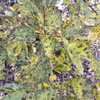
    OK, ha--I thought I was just asking about one plant selection! Here is a photo from last week. The areas in question are on either side of the driveway. I am standing on the sidewalk taking the photo. To the left of the door is a set of stairs coming up from the sidewalk; that's where all those other plants are that I mentioned. In front of the door are the ES hydrangeas which are bright blue in midsummer.

    Immediately to the right of the front door is is a hugely overgrown ilex 'steeds' which will stay there but be pruned back into shape in early spring. So the designer's idea is to remove everything else in front (currently: three kalmia, which you can barely see in front of/next to the 'steeds', an Annabelle hydrangea to the right of the driveway, a random holly, three weigela 'my monet,' and some sedum. All of that will be relocated. The beds are actually quite deep--maybe 10'--and will be slightly curved so there will be a bit less depth along the driveway.

    I think you can see why I am looking for something simpler and more structured than the mess that's there now! The inkberry, I think, will really just be a backdrop and won't be super visible on their own.

    We are planning on adding a small tree (river birch, dogwood, large japanese maple) near the right corner of the house.

    Thanks!


  • 11 years ago

    Since my picture didn't inspire any new comments, here is a picture with a few labels explaining the basics.