Software
Houzz Logo Print
gary_cotterill

Potting mix for containers

I have about 30 containers. How do I determine how much potting mix to buy to fill the containers?

Comments (35)

  • 11 years ago

    Ooh... lots of variables involved... how big are the pots, what are you growing (displacement for root space), and what type of medium are you planning on using?

    I'm sure if you give us a little more information, one of our members will be happy to give you a little help. :-)

  • 11 years ago

    I have about:

    1. 15 12-inch pots
    2. 10 10-inch pots
    3. 5 18-inch pots

    containing various varieties of shrubs.

    I want to replace ALL of the current pre-mixed potting mix (Miracle Gro Potting Soil) with a new pre-mixed potting soil (but not necessarily MG) or with Al's Gritty Mix.

  • 11 years ago
    last modified: 11 years ago

    To get a rough estimate, you also need the heights of your pots.

    Volume of a cylinder is 3.14 * height * radius * radius. Each pot is close-ish to a cylinder. Remember that radius is 1/2 of diameter. This gives you cubic inches for each pot (assuming you measure height and radius in inches). You can divide the sum of the volumes by 231 (cubic inches in a gallon) and you'll have an estimate of the number of gallons you need. Or divide by 1728 to get the number of cubic feet, which is a unit that large quantities of bagged potting materials are often sold in.

    Since most pots aren't strict cylinders, assuming you use the radius of the top of the pots, and since roots do take up space, this method will overestimate your needs to some extent, but its better than nothing.

    Daniel

  • 11 years ago

    I'll add - since 30 containers is more than you can in one sitting, and you'll also be learning how to mix and/or experimenting some with new media, I recommend starting out with enough ingredients to cover 1/4 to a 1/2 of your containers, you will undoubtedly learn as you go and will be happy to have the flexibility to adjust as your conversion progresses.

    The first time I made gritty mix, I screwed up in a number of silly ways, and ended up with almost 8 gallons of something that wasn't quite gritty mix and a majority of that is still taking up very valuable closet space while I think about re-screening parts or separating the parts out (yeah right, that sounds like fun). Many people do better their first try, but better to start small.


  • 11 years ago

    I did mine in Excel, but there is a handy calculator you can use to calculate the volume of your pots:

    http://keisan.casio.com/has10/SpecExec.cgi?id=system/2006/1223372110

    Don't forget that roots can take a bit of volume, depending on what plants you are growing. My pots are filled nearly to the top (which is a good practice overall).

  • 11 years ago

    haha I was just about to post a truncated cone calculator.

  • 11 years ago

    Buy a large back of small/medium bark chips. Look in Walmart.

    A large bag of potting soil (not moisture or garden soil).

    Some large bags of perlite.

    Mix them at about 1/3 each and fill the pots. I do this in a wheel barrow outside. Depending on the size of the root balls, you can add some Styrofoam peanuts or plastic water bottles, etc. to fill up the bottom 1/3 of the pots.I like styrofoam. I save peanuts and even large piece which are used in shipping packages (I just break them up in chunks.)

    Can you provide more info on what you are repotting? Are you growing these plants outdoors or in the house?

    Use your judgement as to how to much moisture you want the mix to hold. The potting mix becomes the peat which holds moisture. If you are growing plants which like it really dry, use less potting mix.

    For regular tropicals which will not be subjected to too much rain or water, you can just do 1/3, 1/3, 1/3.

    Works well.

    Jane

  • 11 years ago
    last modified: 11 years ago

    1/3 potting soil will give you are 1/3 more troubles. Start right. Make up a 5.1.1 and you'll have 2/3 less troubles....:-) (seriously... I'm serious and joking)

  • 11 years ago
    last modified: 11 years ago

    All of these are grown outdoors:

    Portulacaria afra – Mini jade plant

    Crown of thorns cactus

    Geraniums

    Lavender

    Lantana

    Bougainvillea

    Coprosma – mirror plant

    Impatiens

    Ornamental flowering plum (dwarf)

    Clivia miniata

    Prunus caroliniana 'Compacta' - Dwarf Carolina Laurel Cherry

    Crape Myrtle (dwarf)

    Star Jasmine Vine

    Sego Palm

    Dwarf Bottle Brush

    Duranta Erecta - Skyflower

  • 11 years ago

    Perhaps it might help if you did a little bit of reading on container soils before beginning your project, Gary...

    "CONTAINER SOILS - Water Movement & Retention"

    Once you understand the basic concepts of growing in the confined space of a container, the answers may fall into place for you.


  • 11 years ago

    ewwmayo,

    that does look more accurate than my method, for sure, but requires more measuring. :)

    Everyone else,

    OP specifically says (in his second post): "I want to replace ALL of the current pre-mixed potting mix (Miracle Gro Potting Soil) with a new pre-mixed potting soil (but not necessarily MG) or with Al's Gritty Mix.".

    Exactly what "Al's Gritty Mix" is is covered very well in many many other threads, most notably here: http://forums2.gardenweb.com/discussions/2842847/container-soils-water-movement-and-retention-xxii?n=315

    I'll just say, head over there for good info on al's gritty mix, if indeed that is your goal. Nothing described in this thread so far approximates gritty mix.


  • 11 years ago

    jodik :) i type slow sometimes.

  • 11 years ago

    LoL me to. I always live in hope that the people will read it slowly to :)

  • 11 years ago

    I may type a bit faster than some... but I freely admit that math and numbers are NOT my strong point! :-)


  • 11 years ago

    A pipe wrench? Crap, I was using my master pliers …. thanks al …


    *grin*

  • 11 years ago

    Did you all notice, Gary disappeared? I wonder why?

    Jane

  • 11 years ago
    last modified: 11 years ago

    Hi Jane__ny(9-10),

    The Gardener's Supply Company (www.gardeners.com) estimated I'd need about 12 cu. ft. of potting mix to fill all of my containers.

    (I've been busy going through about 1,400 photos I took in Eastern Europe. I had to identify the subject of each photo, chose the best photo of each subject, write a caption for each photo and create a slideshow consisting of about 200 photos).

  • 11 years ago

    Oh I thought you were sifting pine bark to make a 5.1.1.... ;-)

  • 11 years ago
    last modified: 11 years ago

    Gary didn't disappear...just has a life...and it's not the gritty or 5.1.1. either....so no need to wonder, Jane...

  • 11 years ago
    last modified: 11 years ago

    My life would be a waist without 5.1.1 and the gritties. Most therapeutic thing for me is sifting out those bad boy fines...:-)

  • 11 years ago

    fred

    I find it same sometimes. Love the gritty mix for many of my plants, and don't mind sifting.

  • 11 years ago
    last modified: 11 years ago

    Lol - Thank goodness you weren't just passing through, Gary, even though that's a regular and common occurrence. You returned just in the nick of time. ;-)

    Al

  • 11 years ago

    Every few years, I have a "need" to un-pot my plants, wash all of the old potting mix from the roots, and re-pot the plants in new potting mix.

    When I "settle" for "pre-made" potting mix, my plants don't like it. The mix has the wrong texture; it retains too much -- or too little -- water; and/or it allows nutrients to drain away; etc.

    A gritty mix should solve those problems.

  • 11 years ago
    last modified: 11 years ago

    Just musing in general, here .......... Even though you end up a measure more beholden to the watering schedule, the potential increase in benefits to your plants when using highly aerated and free-draining media is very significant. Unfortunately, people often compare the interval between required waterings of soils that offer significantly more potential to intervals of soils that significantly limit potential, then complain they have to water too frequently. Habits are first cobwebs, then cables. I mean, it's not like there isn't a choice. If a person demands extended intervals between waterings, they should be ready to A) accept the limitations imposed by those extended intervals and B) not deny they exist. Telling others they can enjoy watering intervals measured in weeks instead of days w/o penalty is a gross distortion of reality. It's sort of like insisting on driving 80 mph on the freeway and expecting to maximize MPG at the same time. Anyone can TELL you that you can expect the same 30 MPG you can squeeze out of a vehicle at 45 when driving 80, but we all really know that driving 80 comes with inherent limitations on fuel economy - just as a diminished air supply in the rhizosphere due to soggy soils limits a plant's ability to operate efficiently. That's just part of what people need to know if they are making decisions that impact watering intervals or how a soil is made. Denial doesn't change anything. End musing.

    Upthread a bit, Rooftop linked you to the thread that discusses how water retention works and what impact it has on your ability to provide rootzone conditions that are conducive to the plant realizing as much of its potential as possible. Yes, there are recipes there that provide good starting points from which you can incorporate the concept into your growing strategies. The gains you make through the understanding of that concept will always stay with you and benefit your growing experience. You don't need to use the recipes to embrace the concept; and, once you actually understand the concept, you'll pretty much know what the right decisions are. I guarantee that, if you understand the concept, you'll KNOW there are much better ways to increase water retention than by jamming up the medium's porosity with the peat or potting soil everyone is here to avoid.

    Al

  • 11 years ago

    Gary, you have a lot of work ahead of you. But in the end, its all worth it.

    Good growing,

    Jane

  • 11 years ago

    If the avoidance of work is the expected result, no one would want to grow or garden to begin with. Why bother?

    It's not only therapeutic to many of us, but we don't find it to be "work" to sift a little bit of material to get the results we want. Getting in there and getting our hands dirty is all part of the fun and/or relaxation we gain from the exercise.

    Al is 100% correct... once the concept of using a porous medium is understood, one can make adjustments in materials, ratios, etc... to suit one's own environment... one's individual growing conditions.

    Personally, I find the experience to be the exact opposite of work... and the resulting success can't be argued with.

    I'm not forever watering, and because I've actually used the concepts Al talks about, I can honestly say that the experience has not only brought me much joy in container growing, but it's also opened my mind and made me think more critically and logically within other areas of my life,

    Happy Gardening!


  • 11 years ago

    In the front of my condo, I have a small patio bordered by narrow planting strips in which several shrubs are planted. The plants listed above (dated October 27, 2015) are in about 30 pots located between the shrubs, on the concrete slab and on a 3-tiered plant terrace:

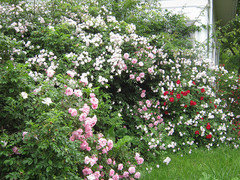
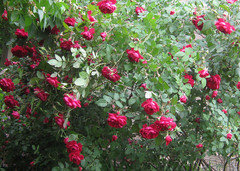
    In front of my condo is a 400 sq. ft. "common area" garden (belonging to the homeowners association). Over the years, I have planted about 15 rose bushes, other shrubs and a gazania groundcover in this garden.

    I found it enjoyably "therapeutic" to "get in there and getting my hands dirty" by pruning, weeding, fertilizing, weeding, trimming, weeding the garden about 4 times a year.

    After retiring in January, I pulled up the gazania groundcover, thoroughly weeded the garden, had the soil tested and incorporated the recommended nutrients into the soil.

    In May, I re-weeded, planted more roses -- I now have 25 -- and applied a 4-inch deep layer of bark mulch which has prevented -- thankfully -- all weeds from growing so, now, I spend my time pruning the roses and enjoying their flowers.

    Now, I need to concentrate on the potted plants.

  • 11 years ago

    Ooh, roses! You're so lucky to live in a climate that allows more choice in rose material, and no worry regarding grafted varieties, I would think!

    I also dabble in roses, but have to choose own-root roses that can survive harsh winters without babying them. Luckily, the industry has answered our call from the north, and there are some beauties available that do well in my zone!

    Unfortunately, we need a good bit of snow as insulation from the frigid temperatures and winds, and we haven't been getting enough within the past couple of years.

    Best of luck with your container endeavor! There are plenty of folks here who can answer questions quite definitively, with accompanying explanations and reasoning, about the concepts of growing within such confined spaces.

    Happy Gardening!

  • 11 years ago

    Re: grafted vs own-root roses.

    When I was re-doing my front garden, I wanted to re-tag all of my roses so I posted photos in the "Identify This Rose" forum.

    The responders said that some of the photos were of Dr. Hueys.

    I then dug down into the soil to tear off the Dr. Huey suckers but none of the scions remained (the Dr. Hueys had completed overtaken the plants!)

    I dug up those roses and ordered 5 bareroot Ch-Ching! roses from Edmunds Roses but they also are grafted onto Dr. Huey rootstocks so now I'll have to keep watch on those roses and remove any suckers growning from below the union.

  • 11 years ago

    Some of mine came from Heirloom Roses, many from other places... some are Bucks, some Canadian varieties, some are "old garden" or "heirloom" types... a few are French or German, I believe. I insist on own root because they are much hardier than their grafted counterparts, in my experience, and several will be okay even if they're only rated to zone 6... and I'm 5.

    Of course, some of that has to do with where they're positioned, what sort of protection they have. But I refuse to wrap, cone, or do anything except tie the wayward cane from whipping in the winds, and properly mulch, of course.

    I've also found that miniature roses... those sold as decorative gifts in small pots... are all own-root. Most do wonderfully planted directly in the gardens, forming lovely little mounds of color.

    Of course, I prefer those that continue to bloom throughout the season... but I make exceptions for a few. My favorites are heavily scented... there's a Therese Bugnet right by the mailbox... and another by the garage door who' name escapes me at the moment.

    The gardens here need some serious help... I'm getting to the point, health-wise, where caring for all of it alone is too much. But about a decade ago, I made about 8 acres of empty yard into a rose and perennial showcase... it was a labor of love. The Rugosas and others are still very dependable... the climbers and ramblers, as well. Last year's bad weather killed off a few shrub types and some of the more delicate ones... but I still enjoy it.

    The hips make wonderful organic jellies, too.

    I gave up keeping everything tagged... I pretty much know by location what it is, and certainly by the time it blooms I recognize it.

    It is a fun plant to play with... so many to choose from, and such beauty!

    There are actually a lot of companies that sell own-root roses now... a Google should give you a decent listing. And some companies have sales on a fairly regular basis... Heirloom being one, I believe.

    Some of my very favorites are the Bucks, and many of the old garden types... but I also love the odd colors, like Hot Cocoa, Green Ice, etc...

    I can almost smell them now... :-)

  • 11 years ago

    Last year, there was one Ch-Ching! rose in my garden.

    In January, I looked and looked and looked for its tag but did not find it.

    After I ordered the 5 new Ch-Ching! roses, I discovered the tag -- it was hiding in plain sight!

  • 11 years ago
    last modified: 11 years ago

    I can relate to that! :-)

    I've used so many different materials to make tags with over the years... and not many seem to weather well or hang in there when attached to branches, or stuck into pots, etc. The plastic ones become brittle after time, markers fade, and forget wooden stakes which just decay along with the mulch!

    I finally ended up, about 8 years ago, buying a roll of aluminium flashing and some suitable metal shears to cut pieces of it into the size(s) I wanted. I borrowed my husband's tool engraver and made some nice, serviceable tags.

    I drilled a small hole at one end with his Dreml tool on it's little drill press stand, then used long pieces of heavy gauge wire, more like some of the thinner welding type rod, (similar to your older coat hanger material), to bend into what are doubled loops at one end to hold the tag, and sink the other end into the soil next to the plant fairly deep.

    One could just buy those nice metal engrave-able tags, but they're very costly. The copper ones are nice, but again, they only come so many in one package and they cost an arm and a leg! I figured it would be better to make my own.

    I also use the welding rod-like wire to make stakes with loops that effectively hold the leaves and flower stalks of my Amaryllis bulbs more upright in their containers while they're blooming. Again, I can buy those... but the loops are always a little small for my application, or too big, or rather costly, and I end up having to cut off half the height, anyway.

    Most of the tags hung in there nicely... and many are probably still there, under what are now massive ramblers that have taken over fencing, or climbed the side of the house. On the west side, we have a massive Paul's Himalayan that has taken over part of the porch and a doggie door with an extension exit that was built onto the house to help mitigate dirt from paws and the entrance of cold winds, etc... and that moves right into a row of alternating Rugosa Rubra and Alba roses that run along a fenceline that contains a small herd of goats.

    The goats keep the roses trimmed on their side. :-) Those are the hips I use for making jelly with. They mix nicely with organic Fuji apples we grow elsewhere on the property. It's a farmette, you might say. Not big enough to label a full fledged farm, but not small enough to call a "city lot", either.

    My husband and I actually help care-take the property for its elderly owners, but we're reaching retirement, ourselves. We're very slowly paring down our material possessions and readying for a move to live with our son and his family. I plan on taking some nice rose starts with me, along with all the knowledge I've gained. We hope to live out in the country with our family, grow an organic garden and small orchard, and teach our grandchildren about self-sufficiency and living close to the land. :-)

    If you have the ability and tools, you may want to look around your local home center type stores, like Home Depot, Lowe's, or Menard's, and find items that will make better, larger, longer lasting tags for your roses.

    I had thought about going over the engraving work with brightly colored paint or some other permanent type craft paint pen meant for outdoor use... which might make the names easier to see or read... like in a white or bright yellow or other color, but I never got around to it.

    I'm sorry... I do get carried away. I love getting up early and using my quiet time to visit these forums while having my coffee.

    Happy Gardening!

  • 11 years ago
    last modified: 11 years ago

    I Google searched
    and searched for items I could use to identify my roses. I wanted something that was:

    • unobtrusive
    • more-or-less permanent
    • customizable
    • would stay with the plant
    • would
      retain the easily-readable info about the plant.

    I finally
    ordered:

    • a box of 50 stainless steel military dog tags (with pre-drilled holes
      through which a length of wire could be run then looped about the roses' canes)
    • a set of high-carbon
      steel stamps (with 1/8" tall letters, numbers and the "&"
      sign).

    Although the tags and the stamps
    were fairly costly, I wanted something that would fit my needs.

    My problem
    is that, in retirement, I tend to put off doing things -- or making them take
    much longer than they should -- so the tags are still in the box!

    (I really
    should just "Git-R-Done" then find a new project that I can delay).

  • 11 years ago

    I can relate to that, as well!

    Not only am I not getting any younger, I'm also fighting lupus and previous accident injuries that make some days better than others, and too many days not what I'd like them to be. The days of pushing myself beyond my limits are over, I'm afraid. As frustrating as that is, I won't quit doing some of the things I love... like gardening. I just go a little slower.

    Dogs tags are a great idea, though! If you made one every day during winter, when there's little else to do... oh, but wait... you are not stuck inside with snow outside. Hmm. But, you know, those stamps could come in handy for other projects, too... I might think of things I'd want to do with them, then tell myself I couldn't begin a new project until I finished the rose tags!

    I tend to procrastinate on some things, myself... so I know how that can be. I used to make jewelry, and do a lot of beading, so I have a little work table set up. It makes it easier for me to get to the tasks I need to do.

    Right now, it's stacked with clay pots I have to go through... figure out which to keep and how many, and what can go.

    I've even whittled down my potted plant collection... it just got to be too much. I surely can't haul a ton and half of clay pots and saucers to my son's house!

    And don't worry... you will always find projects to delay! That's the way of it, I think, as we get older. I do have a written list of things that require doing... and it's actually gratifying to cross things off as I get to them.

    The problem seems to be... that list grows faster than I can cross things off!

    Happy Gardening! (Quadra, pictured below.)

Sponsored
Columbus' Home Design Experts Specializing in Custom Cabinets