Software
Houzz Logo Print
gbehazinb

How to Prune Tomatoes for a Big Harvest

This might sound like an off season topic but now that there isn't much to do we can sharpen our skills. The following is taken from Bonnie's site.

Do you like to train your plants and check up on them almost every day?
If so, then you may be a natural tomato pruner. Pruning tomato plants
is an optional technique that some gardeners use to keep plants tidy,
manipulate fruit size, and even speed ripenin
g. There is one big catch: You should only prune indeterminate varieties, which produce new leaves and flowers continuously through the growing season. If you prune determinate varieties, you may reduce the harvest. (Looking for indeterminate varieties to plant?
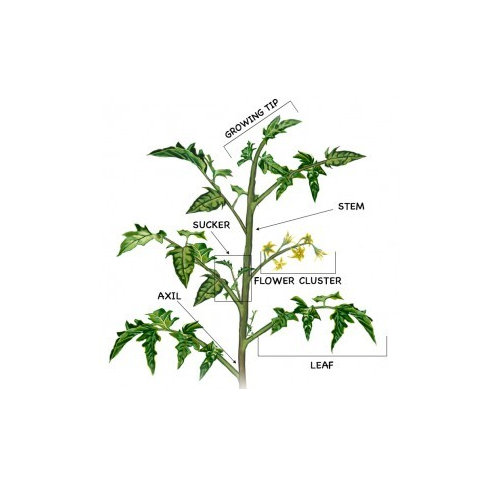
Do you know what the different parts of a tomato plant are called?

The Merits :

Pruning works best for plants trained on a strong vertical support,
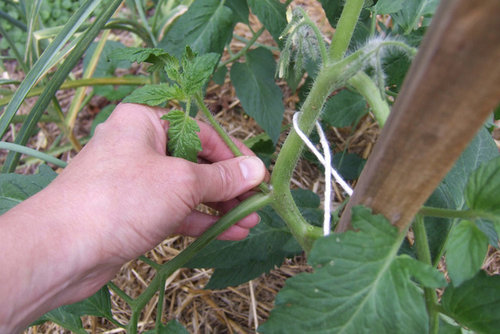
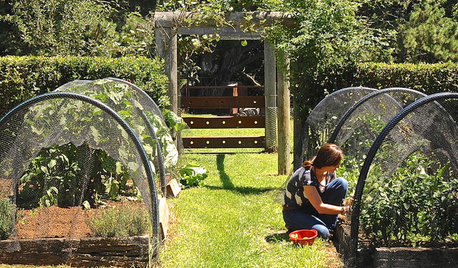
such as a trellis or stake (and string) like the one shown in the photo above. That
way, it’s easy to both see what you are doing and keep the main stems
carefully controlled by tying them to a single support. (Cages, on the
other hand, naturally gather all of the limbs and support them without
much help from the gardener, so there’s no need to prune — though you
certainly can if you’d like.) Either way, the key is to prune enough,
but not too much, so that the fruit receives both adequate sugars from
the leaves and enough cover from the sun. A word of caution, though:
Don’t prune tomatoes when leaves are wet, as doing so can help spread
disease. Here are some reasons to prune tomatoes:

– Improved airflow and less disease. With fewer
leaves, pruned plants are less dense, allowing more air to move through
the plants. The leaves dry faster after a rain, so they are less
susceptible to the diseases that need prolonged moisture to develop —
something that can be very helpful in wet climates. Plus, fewer leaves
make it easier to spot insect pests that might otherwise be hidden by a
thick canopy.

– Bigger fruit. Pruning at the right time directs
energy toward creating and ripening fruit instead of making more leaves.
Overall, you will probably have fewer fruit on a pruned plant, but it
will be bigger. And, since pruned plants can be put a bit closer
together in the ground because the growth is so vertical, you’ll have
room for additional plants to make up the difference in harvest numbers.

– Earlier ripening. When a plant’s leaves and
physiology have fewer fruit to take care of, that fruit ripens faster.
This can really help in short season climates, where getting a tomato
harvest is often a race against time, thanks to early fall frosts.

Early/Mid-Season

– Remove flowers until plants are 12 to 18 inches tall, so plants can direct more energy to the roots.

– Remove all leafy suckers beneath the first fruit cluster so they
won’t slow the development of the fruit. Suckers are the little shoots
that form in the spot (called an axil) where the leaf stem attaches to
the main growing stem. In northern regions, many gardeners go further,
removing all suckers as they appear. In warmer zones, though, experts
often recommend practicing what’s known as Missouri pruning, where you
pinch off the leaflets on the end of each sucker, leaving only the two
base leaflets in place. As these leaves enlarge, they help shade fruit
and protect it from sunscald.
Try to remove suckers when they’re small enough to pinch with your
fingers, so you don’t leave a gaping wound on the stem. If you do have
to cut them, use a sharp knife or pruner blade to make a clean cut as close to the main stem as possible without damaging stem tissue.

Late Season

– As the growing season draws to a close, tomato plants are often
still loaded with fruit. To speed ripening late in the season, remove
the growing tip of each main stem about four weeks before the first expected fall frost.
Called “topping,” this type of pruning causes the plant to stop
flowering and setting new fruit, and instead directs all sugars to the
remaining fruit. This way, the fruit will ripen faster, plus it becomes
more likely that the green tomatoes you pick before frost
will actually ripen when you bring them indoors. It may be hard to
bring yourself to do this, but it will be worth it if you wish for ripe
tomatoes! Of course, if you prefer your tomatoes to remain green for use
in frying and jelly, you can certainly skip this step.

FINAL NOTE: **********(sey)*************************************

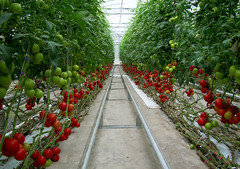
Recently I visited a commercial greenhouse with an area of 7 acres with over 70,000 plants (wow !!). They had the vine trimmed clean up to under the lowest existing truss. I saw dumpsters full of trimmed foliage that looked healthy green but not needed anymore. As the vines grow taller, they lower them such that the top end of the wines are at about 6 -8 ft from the ground and the lowest ripening clusters about 3 ft from the floor. This technique is only possible by stringing method and not with cage and stakes.


Sey

Comments (29)

  • 10 years ago
    last modified: 10 years ago

    I do not prune my tomatoes and I got a massive harvest this year. I would only consider pruning the "suckers" that are being shaded and close to the ground on the bottom of the plant. JMO

  • 10 years ago

    The operative words in the above are "if you like to train your plants...". I train my dogs but my tomato plants don't bark, mess in the house, or chase cars so they aren't big on being trained. :-)

    The claims of bigger fruit, earlier ripening, and the supposed benefits of topping are all debatable.

    Dave

  • 10 years ago

    Thanks Peter and Dave:

    The article said and I quote again :

    ""Pruning tomato plants
    is an optional technique that some gardeners use to keep plants tidy,
    manipulate fruit size, and even speed ripenin
    g.""

    we understand that some do it some don't.

    It also said :

    ""Overall, you will probably have fewer fruit on a pruned plant, but it
    will be bigger. And, since pruned plants can be put a bit closer
    together in the ground because the growth is so vertical, you’ll have
    room for additional plants to make up the difference in harvest numbers. ""

    Again, it is a different approach and technique in growing tomatoes.


  • 10 years ago
    last modified: 10 years ago

    This is how they do it in some commercial greenhouses.

    This is not my picture but the greenhouse that I visited, looked the same and operated EXACTLY the same way. They have carts that ride on the rails to tie, pick and prune.

    Sey


    NOTE about the picture above:

    As the ripe fruits are picked , the bare part of the stems are lovered and layered. Very interesting technique.

  • 10 years ago

    I pruned my tomatoes in September to make them ripen faster. I had very good quality tomatoes in October and I still have some. Pruning that late on the season have very much sense to me. I will do it again next year.

    I also like the idea of lowering tomatoes as they grow. Usually I have to prune the tops at some point with flowers and all, since they grow taller than supports. I have to figure out how to incorporate this technic into the growing process.

  • 10 years ago

    Antmary,

    There is an end-of-season pruning method called "Missouri Pruning". What you do is just nip the the tips of branches and any new flowers that won't possibly have a chance. So the top foliage stays to provide photo synthesis. This way the energy (nutrients) is directed to the existing fruits to grow bigger and ripen on time.

    I call pruning a "proactive" gardening. As a gardener I intervene rather than leaving everything to the mother nature and plants growth habit.

    WE THE GARDENERS !

    Sey

  • 10 years ago

    I was reviewing a bunch of posts yesterday and came across this one. The picture with the rails certainly looks convenient for a commercial grower, and I can see how, with the rail system, they might want to ensure that tomatoes to be picked are at a certain height. If you have a rail system in your garden, this might be for you.

    However, it seems shockingly unscientific to generalize results from such a system. Growers who are more than willing to reach high and low and do not have the pressures of picking on a railway car, may get a larger harvest with no pruning.


    I think many of us have been conditioned by advertising, where one sees a big shiny desirable picture and readily accepts the advertiser's conclusion that 'x' (whatever is in the picture) is the answer for you.

    Think for yourself.

  • 10 years ago
    last modified: 10 years ago

    Pruning is an "optional" method . Not pruning is also optional.

    So the gardener has a choice to do whatever she/he wants to do with her/his tomato plats.

    Sey

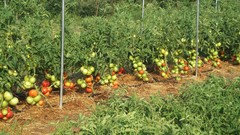
    This is another example , pruning in the field , no rail system


  • 10 years ago

    Sey - this latest pic is clearly of a cluster variety plant like Early Cascade or Premio or Celebrity 3980. Non-cluster varieties - which is by far the majority of varieties - don't produce in giant clusters like that whether pruned or not.

    Dave

  • 10 years ago

    Dave, the guy (MHP Gardener ?) says there were Big Beef.

  • 10 years ago

    I've seen his videos. I believe all he grows now is Big Beef.

  • 10 years ago

    My point has been missed, I think.

    No matter what variety this is, the focus is on the clusters of visible tomatoes, and the unspoken message being delivered is that the plant is pruned and here are all these tomatoes. What is not being addressed is whether not pruning could result in an even bigger harvest.

  • 10 years ago

    I use cages, and trim off the branches that are less than six inches or so off the ground. If part of a branch starts to grow too close to the ground I clip it short to keep the dirt off, and air flow on the main stem.

  • 10 years ago

    I prune to three stems and because I do, I can space plants 33% closer. As long as the pruning does not affect the yield negatively by more than 33%, then I come out ahead.

    Lucille, just because one opts to prune, does not make one a non thinker... maybe even just the opposite. Please don't call people names because they are not like you.

  • 10 years ago

    Nc, you are not reading what I wrote, you have invented something in your head and answered that something. Pruning is a choice, it should be an individual choice.

    Advising people to think for themselves is always good advice, especially when there is no question that advertisers pair pictures with their own conclusions, that is why they do it. Or are you saying that people should not think for themselves?

  • 10 years ago

    It has been said several times that pruning is an option:

    1: In the 1st post :

    "Pruning tomato plants
    is an optional technique that some gardeners use to keep plants tidy,
    manipulate fruit size, and even speed ripenin
    g."


    2- post dated Nov2, 2015:

    ""Pruning tomato plants
    is an optional technique that some gardeners use to keep plants tidy,
    manipulate fruit size, and even speed ripenin
    g.""


    3- in my previous post :


    Pruning is an "optional" method . Not pruning is also optional.

    =======================================

    This is a "FORUM" where different view points can be expressed. Nobody is an authority, nobody is making anybody to do certain things certain ways. We discuss and make up our own mind. As we have seen above, a lot of gardeners opt not to prune. That is their choice and gardening method and philosophy, which is perfectly fine.

    Sey


  • 10 years ago

    The problem is one of relevancy to the issue at hand (and objectivity). Posting such pics in a discussion about pruning clearly implies that it is the pruning that causes all that production. And that is very mis-leading if not actually false.

    One could easily post pics of UN-pruned tomato plants, and I have many times in the past and there are many of them on the web. But just because all the foliage has not been removed to expose the fruit doesn't mean all the fruit isn't there.

    There are numerous valid reasoning for pruning - constrained space is one of them. There just as many for not pruning. But to imply that it is pruning that causes such increased production (giant 10-12 fruit clusters that is genetically impossible for this specific variety without some other form of intervention), is not valid.

    So to add to what Lucille said, think for yourself, experiment for yourself, and don't believe everything you see on the web.

    Dave

  • 10 years ago

    I have always grown mine as single stem cordons, nipping out any apical stems continually throughout the season - inevitably, a couple will grow from under the soil level, leaving me with that dilemma - should I lop off all those developing fruits and a huge fat stem? I rather enjoy the routine nipping out and tying in, but have a clear limit where it all starts to fall apart - anything over 70 plants and it gets a bit iffy. Because I grow them on a scaffolding system, only 15-18inches apart, keeping tight cordons has always worked well...and with our short season, I generally stop them after 4 or 5 trusses at the most - this always seem to help with ripening. I might also remove lower foliage around late August to allow extra light and ventilation.

  • 10 years ago

    It would be interesting to see the results of side-by-side comparisons of the yields of two plants of the same variety, one pruned and one left to it's own devices. For several years we compiled yield data to help us determine which plants to grow, a lot of work but real data upon which to base our decisions.

  • 10 years ago

    Yes it would be interesting and some studies have been done. But most of it remains anecdotal primarily because of all the claims still floating out there about the evil of suckers and how removing them is required for a healthy plant.

    Unfortunately there would still be so many other variables involved that drawing any conclusions about the effect the pruning only had would be difficult. It would still be only the result for those 2 plants, grown in that particular soil, with that particular spacing and support, in that climate, with that nutrient and water regimen, etc. etc. etc.

    So the only way to know is to try a comparative study in our own gardens, try to replicate it at least 3 season in a row, and then draw out own conclusions about which works best for us in our garden. Been there, done that, got the T-shirt. :-)

    Dave

  • 10 years ago
    last modified: 10 years ago

    digdirt2(6b-7a No.Cent. AR HZ8 Sun-35) The problem is one of relevancy to the issue at hand (and objectivity). Posting such pics in a discussion about pruning clearly implies that it is the pruning that causes all that production. And that is very mis-leading if not actually false

    ------------------------------

    No, there is no objectivity. Posting picture is not evil. How a picture can be misleading ?

    Again, and again ..there are different views. If talking about the merits of pruning is misleading, talking about the benefits of NOT pruning can be also considered misleading. But I don't think there is any misleading issue here either way. Understand that we are discussing. The ultimate decision is with the individual gardeners. The buck stop there.

    Sey

  • 10 years ago
    last modified: 10 years ago

    "How a picture can be misleading ?"

    Even children realize that pictures can be deceiving, and most people realize that advertising is made up of pictures coupled with persuasion. I won't mention specific names but there are several companies with mail order garden catalogs that are famous, or rather infamous, for their garish pictures of overcolored flowers and oversized fruit to persuade sales.

    The decision, as everyone has said, is with the gardener. There are differing opinions about pruning and there are good reasons for doing it or not doing it. We get that.

    But posting photos of huge production in a discussion about pruning with the implication that pruning was responsible for that production and the same will happen for you if all you do is prune off those branches needs to be thoughtfully reviewed. Such pictures can be misleading.

  • 10 years ago

    Sey, I understand you are saying it is an optional technique, but it is still implied it is an optional technique that improves fruit size, ripening speed, and production, all of which, AFAIK, is unproven, and if it does work requires very careful consideration and timing. IME pruning branches only causes the plant to expend energy to grow more, and IMHO reduces canopy size for photosynthesis, slowing ripening and fruit size. Posting pictures of extreme production on pruned plants in a discussion does seem to imply it is the pruning that is causing it.

    That said I think it is great to discuss this topic! And whatever you are doing is working great for you for sure, and you should feel free to share. And I do think IMHO there are some merits to pruning, such as removing bottom branches which get shaded by the higher branches and are prone to disease being close to the soil. When trying to cram a sprawling plant into a tight space it is good to remove whatever branches aren't doing much for the plant.

    Are there any real controlled studies on this topic? I would be very interested to read them.

  • 10 years ago

    Peter (6b SE NY) Sey,
    I understand you are saying it is an optional technique, but it is
    still implied it is an optional technique that improves fruit size,
    ripening speed, and production, all of which, AFAIK, is unproven,

    ----------------------------------------------------------------

    You are right peter. When someone subscribes to a view, he has some degree of belief in that. There is no secret. I have been known in this forum for years as "pro prune". I certainly take a pro-active approach in gardening, whether it is tomatoes or roses, shrubs or anything else. Some gardeners like to have a wild natural setting and not disturb the thing. That is another style of gardening.

    All we can do here is debate.

    Now if you look at the opening post, I started this thread with some material from BONNIE's site. There are other advocates of pruning too.

    At the end of day , everyone does as he is pleased in his garden.

    Sey

  • PRO
    10 years ago

    I think some pruning is good for all tomato plants.

    Like keeping the floor clean. I tend to trim a foot or so up the base as early as is sensible, then typically there is a mid summer trim up and clean out. Keep the air flow going. Not much more than that.

    In early fall there is often another clean out of the more leafy bits that may be damaged, and nipping off any fresh blossoms that appear. Time to put production energy into what's ripening, not new fruits or damaged plant parts.

    At the end of fall a week or two before the last harvest I typically strip off most of the lower half of the foliage since most of it is starting to get fall worn anyway. And any branches that aren't currently producing fruit. A bit of early cleanup is nice. And it shows where any fruits are so the picking is easier for really stripping the plant down.


    This level of pruning seems to make my plants happy, I always get good crops out of a variety of tomatoes.


  • 10 years ago

    there was a book written about world record tomato production. it was from a normal person who loved to grow tomatoes. He shows pictures in his book of I think it was Big Boy tomato that if my memory is still working correctly he grew like 2400 pounds of tomatoes off 1 plant it was gigantic. He obviously proved beyond a doubt that not pruning can produce the most tomatoes largest yield off one plant. He used tons of organic compost and used a giant scafolding to support the branches. I think it went over 12 foot tall. I think he grew down south in Kentucky. Maybe someone else knows the name or author of the book.


    good soil increases production. lots of sunshine and room to grow. but pruning does not increase production. It makes no sense. it is like cutting off ones arms. you can not produce more with no arms. common sense. I NEVER prune a tomato plant. the only "pruning" I do is removal of ripe juicy tomatoes for my eating pleasure.


  • 10 years ago
    last modified: 10 years ago

    What appears to happen (to me, in my ignorance) - there are certain limiting factors - soil, nutrients, light, heat,water, length of season and genetics...and these, with the exception of genetics, are fairly flexible. Given optimum conditions, a plant will produce a certain amount of crop (calories) but the variables are so...well, variable, that it is a hopeless and not even very helpful comparison to faff about pruning differences. We can certainly affect the size of fruit/blooms by fiddling around with dominance issues/sap flow/pruning and this might affect the eventual number of fruit...but ultimately, it comes down to calories in/calories out. Certainly, yield is not the thing going through my mind when I prune my tomatoes - it is all about being close to my plants, aware of their needs and keeping it from falling into chaos.

  • 10 years ago

    I would think think that pruning could allow the plant to be shaped to take more advantage of sunlight. FWIW that picture of the Big Beef above sort of illustrates that. If not for pruning, those fruit would be buried in a mass of leaves. Of course, the fruit don't need the sunlight, but still ... One could argue that a plant might be more productive if it doesn't waste energy making leaves that never see sunlight.

Sponsored
Peabody Landscape Group
Average rating: 3.5 out of 5 stars8 Reviews
Columbus' Reliable Landscape Design & Contracting