

Is Crowding Plants Always a Mistake?
I have to say that I've very often been, and still am, guilty of this. My question is this: If plants each have an adequate water supply, are mulched and fertilized properly, and are snipped back so that they don't overlap each other too much, is it really a mistake to place them closely together? There's always the temptation to have as many roses as possible that really appeal, and this forum and the regular rose forum are both great enablers. I have two areas where I know I've planted too closely for the size that some of the roses will eventually attain, but could not resist having Duchesse de Brabant, Mme. Antoine Mari and Baronne Henriette Snoy.
I'd love to hear your opinions, either for or against, and why you feel the way you do.
Comments (29)
 11 years ago
"Always" very often determines the answer, Ingrid. Very few questions are "always" right or wrong. If the resources support the plant; if they can be permitted to grow to the size allowing them to sufficiently feed themselves; if they can be provided sufficient air circulation and light to support themselves and remain healthy and if you can move around the plants easily enough to maintain them without too much blood loss and injury, then I would say they aren't overly crowded. If any of those answers are found to be "no", then, yes, they would appear to be too crowded and suffering because of it.
 11 years ago
Hey Ingrid--
I totally do this. I don't recommend it, but I keep doing it anyway, for exactly the reasons you mention. There are so many yummy roses in the world, and if I don't plant them, who will? (Other than all of you on this forum plus lots of other people. But still...)
Our Mutabilises (Mutabili?) are happy as a fairly densely planted hedge, but in general our prettiest beds with the perkiest roses are the ones where each shrub gets a little breathing room. Our saddest bed is too narrow, too tightly packed, and incessantly attacked by weapons-grade Bermudagrass, which seems to suck down all the nutrients and water meant for the roses. We're going to inflict some violent remediation on this bed, including ripping out the duds and more than doubling the width, but I suspect we're also going to... plant more roses. Whatever. It's healthier than a heroin addiction.
Related Professionals
Ocala Landscape Architects & Landscape Designers · Cambridge Landscape Architects & Landscape Designers · Plainfield Landscape Architects & Landscape Designers · Minneapolis Landscape Architects & Landscape Designers · Bridgeport Landscape Architects & Landscape Designers · Gary Landscape Contractors · Portland Landscape Contractors · Shreveport Home Builders · Charlotte Home Builders · Marietta Home Builders · Charleston Home Builders · Akron Home Builders · Riverside Home Builders · Kalispell Home Builders · Scottsbluff Home Builders- 11 years ago
I tend to plant too thickly too, and with vigorous roses that don't take well to heavy pruning, I think it's a mistake. I find I tend to underestimate how big roses will get, having little experience of them when really well grown.
Having said all that, in my garden, not necessarily in others', I think thick planting of many kinds and sizes of plants is a good idea. We have a heavy fertile soil, once it's been adequately amended, so don't need to worry about nutrients, and the same is true for water. Our big garden is so open to sun and wind, and our summer days are so long, that plants do better with some shade and windbreak, and this can come from close planting. Also, since we have a fairly deep soil and our lack of irrigation encourages plants to root deeply, I don't worry about other plants' sucking away water from the roses: I think their roots access different zones of the soil. Low-growing plants shade the soil and compete with weeds, and more plant growth means more moisture in the air in dry weather, and more organic detritus to feed the soil. So, for all these reasons, I plant and plant and plant. Gardeners with different conditions, with shallow or infertile soil and limited water, or with summer rain producing vigorous growth, or with structures or trees and shrubs blocking wind and shading the garden, may have to garden quite differently.
 11 years agolast modified: 11 years ago
What Kim said.. I also tend to underestimate final sizes (not only in roses) and plant too close for comfort. I do dislike the one plant here and one plant there way of planting but that's just a matter of taste. However I have found out that planting too close means too much shade which invites attacks from bugs especially scales. Cottony cushion scale can be a serious problem here. So close but not too close is my ideal which I seldom attain..
- 11 years ago
I had a client who was a compulsive shopper and this included her garden. The underlying soil here is awful red clay. Her garden had a number of large trees, numerous deep-rooted ground covers like lily-0f-the-valley, and anything else that had ever been sold, including roses. She did keep it well-watered and well-mulched, but I doubt there was a centimeter between any two root systems or even roots and in places there were root masses several inches thick. I kept waiting for the whole garden to throw up it hands and die, but it never did. However, the roses did struggle thru the root masses. They would start getting spindly and I'd have to go in and clean out around them. They'd then flourish for a few years until the overcrowding strangled them again.
I think roses are like cats. You can crowd in a lot of them provided each one has its own space and sufficient attention to feel special.
- 11 years ago
Of course, the answer is "it depends". I think climate conditions might be the main issue - if it is where there are warm and humid summers, crowding might make disease more likely. However, people have been planting rose "hedges" for years, and those roses are close together. Austin recommends planting his roses in threes planted close together, and so on.
Another main issue, of course, is taste/personal preference, and your willingness to put up a messy explosion of roses, rather than elegance.
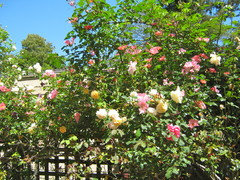
Personally, I love the effect of large roses growing over and through each other. Also, I am a very lazy gardener, and growing them that way is a good excuse for not grooming them separately. My favorite look is rose chaos. Without planning, some lovely effects sort of plan themselves. Here are some pictures of rose chaos in my garden:
Here are Iceberg, Buff Beauty, Summer WIne, and I think at least one bloom of Duet:
Here are Duchesse de Brabant, and Cecile Brunner
Jackie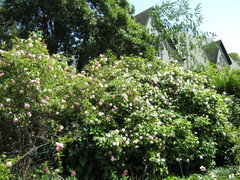
- 11 years ago
Like Jackie, I love the look of roses growing through each other (love the term "rose chaos!) and also of perennials jumbled up in the mix. So I do tend to plant closely. One big advantage I have found in doing this is its one way of shading out weeds! I don't tend to have a lot of trouble where I am with disease - I do get some blackspot in July on some roses, but they mostly seem to shake it off and are fine when the weather cools off. In my experience the main danger of planting closely is that if one of the plants is small, it will get swamped by the bigger, more vigorous plants. Through bitter experience, I have learned that if I am going to add a new rose into one of my already crowded beds, I MUST grow it on in a pot for a while until its big enough to compete. If I do this, it generally works out fine. And I think you also have to be careful that you don't close plant a naturally smallish rose with a true thug. But otherwise, at least for me, it seems to work out. Jackie, your roses are beautiful!
- 11 years ago
I think it is always bad as air circulation is very important. Do I let it happen? yes. Do I at least prune once in a season or two to correct overcrowding? another yes. Avoid it if you can
ingrid_vc so. CA zone 9
Original Author11 years agoYour responses are all spot-on. I haven't planted anything insanely close together, but enough to give me pause for what the future might bring. In my case I think eternal vigilance is the answer, and the willingness to snip when needed, move some roses or discard any that fail to perform. Jackie, I love your look and it's completely right for your tall house and style. Obviously the roses are happy as can be. The best way it seems is to let the plants tell you whether they're thriving or suffering, and to act accordingly.
- 11 years ago
The very heart of the definition of crowding to me is when the plants aren't doing well. Otherwise, they're just closely planted. ☺
ingrid_vc so. CA zone 9
Original Author11 years agoYes, closely planted sounds so much better than crowded. It says lushness and abundance, and color and scent. One simply (or not so simply) must keep them on the right side of that dividing line. I like your comment, fduk.
- 11 years ago
I like very much the idea of "closely planted",but for me it's still a struggle to understand. My site is so open and at times windy,yet I have some disease issues at times. But I think these may be more due to overly poor soil,and under-nutrition ; this year I have begun putting down my organic fertilizing material NOW, because I have a suspicion that some (many, most?) of the disease probs in spring are due to the fact that the plants are putting out so much energy on blooming and growing, and the stuff I put down in say, March, hasn't had enough time to get to the roots of the plants when they do their big Spring Thing.
So many plants are still so small! and I still have such a "sea of mulch" thing (in the GOOD spots!!! in the "normal" ones it's weeds and wild ,tall grass). And, yes, I too like fduk's comment...if only the "not doing well" in my garden could be assigned simply to overcrowding,lol!!!
- 11 years ago
Bart, being so open and windy, it is entirely possible your disease and failure to thrive issues might be due to the stresses of enduring the extremes of your site and not so much the lack of nutrition. By all means, put whatever you feel they may need down when you feel best, but perhaps, some of the issues may be water stress. Not necessarily that you don't apply enough, but that the plants can't recover what they expend dealing with the windy exposure. Roses can be standing in water and still wilt due to excessive transpiration. They sweat more than they can drink. Roses which have endured sufficient periods of that kind of stress will fail to thrive. I've encountered it many times with both potted and in-ground plants. It often takes a long period of almost over watering those to produce the response you think you should be getting. You might also spend a bit of time preventing the worst offenders from flowering to force them to produce more plant mass instead. I think it may surprise you the improvement just a season of such "intervention" can provide.
ingrid_vc so. CA zone 9
Original Author11 years agoI used to think that at least some of my problems were due to my poor soil, and I'm trying to amend it as much as possible. However, after having seen a vast improvement after installing a drip system, I came to realize that a lot of the water I was spraying on them with a hose was almost useless, and when I dug down through the soil the day after watering in many places it was bone dry. Now the soil seems moist under its mulch of leaves, and all the roses put out new growth and blooms beginning about two weeks after the drip system was put in. I still have an area of closely planted roses that don't have drip, but each plant has a fairly large basin under it and after watering overhead with a hose in this area I then place the hose which has been turned on just a bit under each rose so in essence that is also drip watering. I ruthlessly took off every single bud as soon as I spotted it for the better part of a year and those plants are looking much more robust now. A very few that I'd like to have grow larger, all tea roses, I still take off the buds, but everything else is now putting out new leaves and buds. It was worth waiting for.
 11 years agolast modified: 11 years ago
I have a small suburban lot and not all that much area that gets adequate sun so I tend to squish as many in as possible, lol. I can't tell you if it hurts them or not as I've never seen them grow in more space but they do seem to grow and bloom for me all season even crowded together as they are. I do water a lot and feed them regularly and I hope that is what keeps them happy. I don't think they really mind touching each other as much as we think. As for air circulation, well, I think even if each one was 6 feet apart I'd still get BS anyway. I live in a very high pressure area and it's just gonna happen no matter what I do. You learn to deal and live with it.
I know that with a lot of the annuals and even some perennials that if you want that full lush look you have to throw the rule book out the window. If you plant them the 8 to 10 to 12 inches apart they recommend they NEVER fill in and look beautiful. Instead you get that little patch here and a little patch there look that doesn't grow together ever. I watched a landscaper do a neighbor's yard one year. He didn't separate the plants at all. He put entire flats of impatiens in almost as is to fill out the garden. It was gorgeous all summer long.
- 11 years ago
This is a great thread! The water issue is a sore, sore spot for me. My plants have to rely on rainfall and what I can collect. My recent project of mulching has it's good side and it's bad side,for whilst there are some areas of my garden where I've managed to create water-retaining soil,other areas are still pathetic. The plants all seemed to be very grateful for the mulch during the summer, but now I'm finding that in some areas the rain did not manage to get through the mulch to the soil.Like Melissa, I only water newly planted things; after the first year they are on their own, because I just don't have enough water ,and my garden is so big. So in certain cases, lack of water could well be an issue. But I think lack of nutrients does come into play, too.The reason why I think that the disease issues that bother me are due at least in part to mistaken timing of my fertilizing program is that they manifest themselves as the spring flush starts (soil still moist from fall and winter),then disappear during the summer(soil all dried out). That is, the plants look great as they leaf out, and as the buds emerge, but once they begin to open, some plants get sick. After flowering,they re-foliate, and remain more or less healthy,in spite of the lack of supplementary watering.. This seems to me to indicate that they aren't recieving enough nutrients to help them achieve flowering and maintain good health at the same time. I 've been a slow learner I think. I used to apply granular fertilizer, for example,and it's taken me a long time to realize that what I really need is Organic Matter A-Go-Go. I am also noticing that, whilst the plants do love alfalfa hay, manure, and cracked corn,they really seem to be happiest when they also get mixed organics like bags of leaves, grass clippings, etc. There are certain areas of my garden where the "soil" is so bad, it seems to be like a kind of lifeless sand-you know the way very old, exhausted potting soil gets?-sort of like that. I wonder if in these areas some of the stuff is just decayed building debris!!!
I've dragged in bags of heavy red clay; good in many ways, but again,I was too skimpy with the o. matter. So it's a mixed bag, really. I will try the "over-watering" if I can with some stragglers,definitely will try the de-budding on these.I wish I could have an automatic watering system; I think that roses really like getting "deeply dripped".
Seil, thank you so much for the comment about the landscaper!!!
ingrid_vc so. CA zone 9
Original Author11 years agoseil, I've naturally seen pictures of your garden and everything looks beautiful, and I think part of the reason is that everything being close together gives that feeling of lushness and abundance that equates with beauty. When you see garden pictures in rose catalogs there is never that look of one plant here and one plant there for a good reason.
bart, I'm sorry about your water issues, that has to be difficult to deal with. You mention organics and I tend to agree. There is always a large plastic bowl in one side of my kitchen sink which catches rinse water but also fruit and vegetable peelings, fruits or vegetables that are past their prime which I cut in smaller pieces, coffee grounds and anything else of that nature. A few times a day the bowl is full and I empty the bowl under whatever rose I think happens to need it. If nothing else I'm not wasting anything and I have to think it's of some benefit.
- 11 years agolast modified: 11 years ago
Bart, building a rain collection system of some sort may be an expensive proposition which you may or may not be able to afford or construct, but it could prove invaluable if you did. That could in turn be connected to an automatic irrigation system involving a pressure controled pump and piping. Your average yearly rainfall would be the indicator about how much water you could collect per unit of collecting area.For example if you have an average of 800mm rain then 1 sq. meter of collecting area would ideally collect 0.8 cubic meters of rain water. 50 sq meters of collecting area would collect 40 cubic meters of rain enough to water many roses through the summer assuming you could store that amount.
Alternatively, with much less but not inconsiderable upfront expense, one coud install large plastic tank(s), to be filled with irrigation water bought and brought in with a tanker vehicle. These would in turn be connected to an irrigation system.
- 11 years ago
I can't afford all that, Nik,just like I can't afford to fence off my entire property to keep the hunters out. I have my big plastic tanks and collect rain water with them, and I can bring in about 200 liters with my car. Right now I have four 1000 liter tanks, plus one 750 liter tank,plus several other barrels,most of all of these are full. But it is by no means enough to keep the entire garden watered,and it took a long time to fill the tanks, and a lot of work (bringing in the water). I have this saved up for emergency. But it just would not be sustainable to keep my garden watered the way people with suburban gardens do.
- 11 years ago
..I do think crowding where roses are concerned is a collector's error... although in the wild everything gets crowded, but if a designer cast a once over at my garden, they would be horrified by my planting arangements....
...I have a very few roses centred 1 foot apart, others 2 foot, but the bigger shrubs 4 foot or more... it does depend on location and variety and just how one is growing it... I mean, if you have a boundary fence, you may plant a rose against that fence, and your neighbour the other side may plant one too... both may be little more than the fence apart but they seem to grow alright... so I figure.... let them get on with it, as I will know soon enough all the mistakes I've made...
...then, I have to hope, I'll come to my senses and plant something more reasonable.... if this was a designer's forum,, you wouldn't see me for dust I'm afraid...
- 11 years ago
Bart,
When you say; "The plants all seemed to be very grateful for the mulch during the
summer, but now I'm finding that in some areas the rain did not manage
to get through the mulch to the soil." do you mean that the water ran off due to the mulch forming a solid surface? If so then I would go all over the garden forming bowl type valleys in the mulch. That way when it rains the water fills up the bowls instead of running off. Worth a try and the only cost would be your time and effort in forming the indents in the mulch. I've never done this as I have a drip system so it's just a shot in the dark.... lol ingrid_vc so. CA zone 9
Original Author11 years agosummers, what a glorious mixture of roses and other plants.
- 11 years ago
Toolbelt, I am not sure what is actually going on. The areas where the rain doesn't seem able to penetrate the mulch are the areas where I haven't worked or amended the soil,but these same areas are also the ones that i only got around to mulching once the summer sun had basically dried everything out .Yes, the idea of digging bowls in the mulch seems to me to be very good as a temporary solution. Eventually i hope to work these areas enough so that the soil will be more absorbent. I don't see how the rain couldv'e just run off,yet there WAS some pretty heavy rain, and i would''ve thought...
- 11 years ago
Bart, If you search around I think you will find confirmation that mulch does form a top layer that causes water to run off. I
can't do much work in the yard/garden anymore so having a drip system
really works for me. Going on 18 years now with the system.  11 years ago
Thanks Ingrid. :-) Can't order a lot of roses next year, yard is pretty much full......and I have to fight against animals to keep roses alive. I lost my SdlM in a pot, something ate the whole rose (12" band), there was nothing left, I just ordered 2 month ago. Jeri should be happy to hear this, all the old garden roses in pots got chewed on by some animals but her Secret Garden Musk. They were stored in a garden shed for a few days during the frosty weather.....
- 11 years ago
O, yes, toolbelt, i know what you mean exactly.I think that the soil beneath the mulch has to be receptive to the rain in order for the mulch to really "work"
As I said before, a drip system isn't do-able for my garden
- 11 years ago
I try to plant for the 'expected' size and growth for my roses. The problem I have is that the roses I've purchased haven't read what their 'expected' size is supposed to be. I search the web, I search the forums and end up crossing my fingers. Sometimes it works, and sometimes it doesn't. My feeling is that the plants in my yard are on wheels; and subject to being moved at any given time. LOL
- 11 years ago
Hah! Gryhwk, how very right you are, lol! Two prime examples for me are Magic Meidiland and Lavender Pearl. MM was supposed to be "16-17 inches tall and 16 inches to 3 ft wide"; LP "spreading to 4 feet". In my garden, both have decided to act like ramblers! I love them both dearly but have to regularly hack them back at least somewhat so that they don't grab and puncture my poor friends and family when they visit the garden! (But that said, they both make really beautiful ramblers).







summersrhythm_z6a