Software
Houzz Logo Print
jsbeckton

Pruning Needed (pictures)?

10 years ago
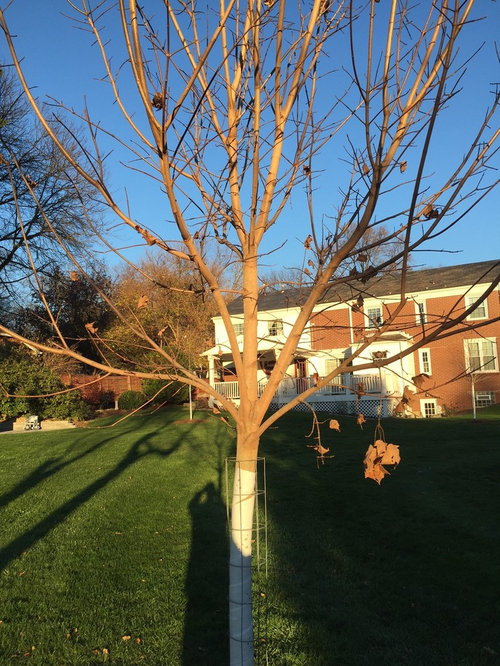
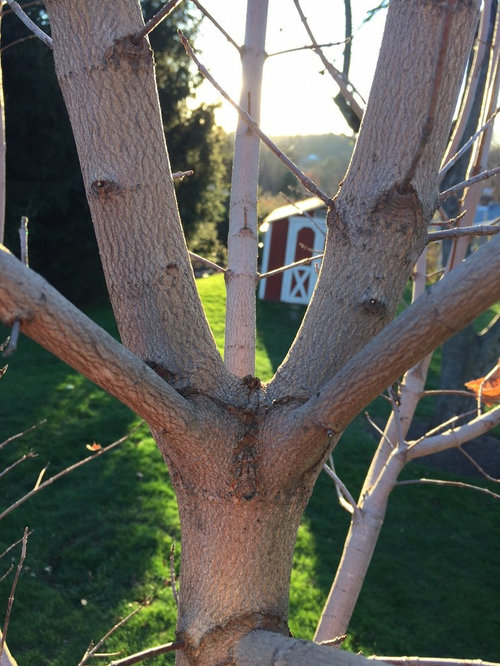
just planted a 2" caliper Green Mountain Sugar Maple and am trying to decide if it will require pruning. The lowest branches are currently about 4' off the ground and one is pretty big. I plan to prune all of those as it grows.

There seems to be a pretty big split about 7' off the ground that I am concerned with because this is about where I will want the first branch(s). Not sure if the split wide enough to be OK or not? This shows the low branches as well as the split I am talking about:


This shows the split close up from the other side:

Would be easy to remove the smaller two but the bigger ones account for a large portion of the canopy.

I was also thinking I would just not do anything for the first year or two u til it gets established.

What at do you guys think?

Comments (10)

  • 10 years ago

    That"s the way every maple I've seen grows. All the maples in my yard are just like that. Just like someone else on this forum says, if the branch is in your way remove it. If you want to prune it, it wouldn't hurt to cut a branch or two off now, wait a month or two then remove one or two more. I do this all throughout the year on hundreds of differnet kinds of trees. Heavy pruning (fruit trees) I used to do it around January or February. Good luck and keep the forum updated.

  • 10 years ago
    last modified: 10 years ago

    Just my opinion, but sugar maples usually grow like that in the open -- large ones on my lot do it. Bottom line to me is you could do more damage trying to "fix" it than would ever occur naturally. Sugar maples have tough wood that's difficult to split. You might cut some/all of the minor (smaller) limbs at the branch collar, but trying to cut one of the major ones would require VERY careful/skilled cutting to avoid damage. Using a chain saw on that would be WAY too coarse -- use a small hand saw.

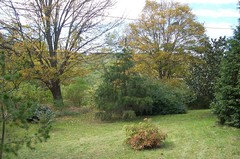
    The only trimming I did on my large yard S maples was cut off the crossing limbs that physically rubbed against another branch. See them below:

  • 10 years ago

    You're right, Tom, subordinate pruning can eliminate the potential of damage caused by trying to cut at the trunk, tho I don't think there's much chance of damage by carefully cutting off those smallest branches on the trunk.

  • 10 years ago
    last modified: 10 years ago

    Oh, there's a lot more to it than that. By using subordination cuts, one can help the tree to maintain apical dominance-or whatever degree of same is possible-for far longer into its life. One can aid the tree in producing branch collars/branch bark ridges, where none would form otherwise due to codominant stems, hence better (much better!) wound closure, one can set the architecture of the tree to be the best and strongest it can be, thus prolonging its useful life in the landscape. I only wish more tree peeps would begin to understand just how very unnatural it is for a lone sugar maple (or other shade-tolerant tree species) to be standing alone in a yard or streetside somewhere. Sure, the tree "knows" how to grow in such istuations, but again, it may do things that tend to limit its useful life, things that lead to poor branch junctions/unions, V-crotches, included bark, the whole gamut of poor structure.

    While some have said "every sugar maple looks like that", what I see is a developing basket case-both literally and figuratively-that "basket" of branches starting so very low in the crown. Of course, we all see trees like this all the time so to some extent, it's become "normal".

    +oM

  • 10 years ago
    Great info, I will look into that. So does this look like something that "should" be corrected or something that "could" be corrected? I saw some stuff saying that V shape is bad but U shape is ok, especially if there was evidence in the U of good wrapping around each branch. Not knowledgable enough to call this.

    In my research for my trees I had read so much stuff about some trees generally needing more pruning than others, with the Autumn Blaze tending to be a problem tree but now that the leaves are down that tree seems to have a better structure than both my Red Sunset and Green Mountain!
  • 10 years ago

    next time.... spend some time... selecting a specimen... that is more what you want .... took me a long time to learn that ...


    frankly ... having a two leader maple is not all that big a deal ... and since its already at the height you want... what is the real problem????


    i would.. in a year or two.. start limbing up the rest ...


    and i would remove one of the four at 7 feet ...... now ... and the other in a year or two .. leaving the two ... subject to these peeps arguing about the proper time to prune ....


    ken

  • 10 years ago

    JS, you know more than you think you do. You're exactly right in thinking that 'Autumn blaze' is a cultivar requiring much work to do the things I outlined above. Great tree-just not a plant-it-and-forget-it kind of thing.

    As for this sugar maple, it's OK how it is but if it were mine, I would investigate subordination pruning and see if I couldn't help it develop better structure. True, a U-shape of branch junction tends to be quite strong and a V, not at all. But that's not the end of the story.

    Don't panic though-there's plenty of time here to adjust things. And one more point I wish to make about subordination pruning of young, open-grown shade trees: It does not and will not make the tree look "better" to the uneducated eye initially. In fact, there's a certain chopped-up look to a correctly subordination-pruned tree that sends some folks into a tizzy. Again, we're not trying to make a mini version of a full-grown tree with this technique. We're working the tree over to help it remain in the landscape for as long as possible, with no split-out limbs, no codominant stems fighting each other for dominance, that sort of thing. And while many years ago I instinctively understood the concepts behind this, it was only much later, when two young arborists who had actually studied under Gilman, came onboard our crew that the whole process was fully fleshed out. The key idea is to look at the tree, recognize what are temporary branches and which are "permanent" scaffold branches, then act accordingly. I remember one day many years ago, working with one of those guys. He was removing a portion of a lower, temporary branch, and the bark tore a little bit. While I was initially alarmed, he explained that in that case, it didn't matter one bit, that being a temporary branch. There is no way a column of decay was going to race down that branch, into the main trunk, and cause issues, in the fairly short number of years before the whole thing came off. Perspective really matters!

    +oM

  • 10 years ago
    Thanks! Great info, I will definitely be looking into that to hopefully get the best structure I can. I actually went to the nursery and looked at about 50-100 of each type of tree and quickly found that the ideal tree isn't that common. It takes some care over time to get that ideal structure with these open field trees. I plan to be here for 30-40 years so it's certainly in my best interest to think long term.
  • 10 years ago

    Quite right. What's more, some nursery practitioners, in a vain attempt to do exactly what should not be done-try to make the little baby tree look like a mini version of a full grown one-practice barbaric things like topping...you know, to "make it bush out" and other travesties. All such abominations only delay and frustrate the attempt to set a good, long-lasting structure. Your tree may well have had this done at some stage in production. So, young trees left to their own devices are what are known as "whips". A whip typically has no or few side branches. And this set some folks into a tizzy, again complaining that "it doesn't look like a tree", when in fact, that is exactly what it looks like, young tree programmed to reach for life-giving sunlight. Along comes some fool with a loppers, snap goes the top, and all apical dominance is lost. Now, the tree responds by pushing out all its side branches....but it's only five feet tall, if that. Way too soon to be worrying about side branches. All the sunshine that's going to be hitting the tree from every angle will take care of that in due time. But it's hard to turn the big ship that is the nursery industry around. Still, far too much of this nonsense going on.

    +oM