Software
Houzz Logo Print
coreyhg

Fiddle Leaf Fig Troubles...

10 years ago
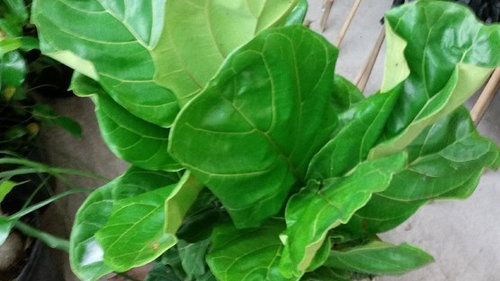
Hello all, I've recently moved into my first apartment and it has south west facing windows. Perfect for many different types of plants! Now that I had the space and necessary light requirements for houseplants, I decided that I would act on my obsession with plants and take on the challenge of having a few (or 25 give or take a few succulent propagations...) to take care of. Since I began taking interest to collecting and caring for plants, I stumbled upon the fiddle leaf fig tree and I instantly fell in love with it. After many attempts to find a fiddle leaf fig tree supplier I finally found one at a local discount fruit store by chance. I immediately scooped it up and brought it back to my apartment. I have a tendency to over-love my plants... None have died, yet, however my jade has warned me to leave it alone. I went about over-loving the fiddle leaf fig in a similar manner. I gave it tons of attention in the form of watering it once a week (as per suggestion). I wanted to see it grow tall so I decided to pot up.. into a 13 inch pot... Way too big for this little guy, unbeknownst to me. It had been losing leaves before this (maybe 3 or so) but I thought that could have been from the stress of the car ride (it fit safely inside my car). Since potting up, it began losing leaves at an accelerated rate. About one a day. First a dark brown, almost black, spot would form on the leaf and then that spot would turn lighter brown and crunchy. Eventually it would fall off after enough of the leaf was damaged. I looked at so many different sites and forums (including this one) to try and diagnose this. I fixed the draft, the humidity, the possibility of direct sun, I flushed the soil, but I didn't fix my over-loving. I decided that my over watering is the last variable to check. So I pulled the little guy out of the oversized pot (none of the roots grew into the excess soil around the original root ball) and I noticed that the roots were brown (not a good brown) and soft and very easy to break... Root rot? I decided to keep the plant out of the pot so that the root ball with the original soil it came in was exposed to air so the roots can get some oxygen. I guess my questions are:

1. Is this root rot?

2. If it is root rot, should I prune the roots? And if so when? After the soil is dry or while it is still moist?

3. Is there hope for this little guy? I'm very willing to do whatever it takes to bring it back to full health.

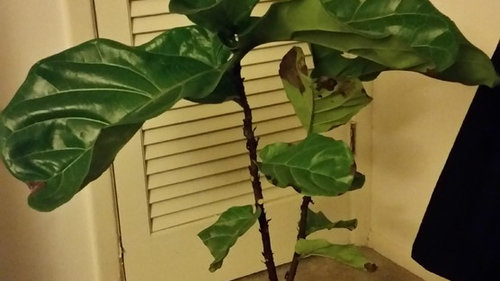
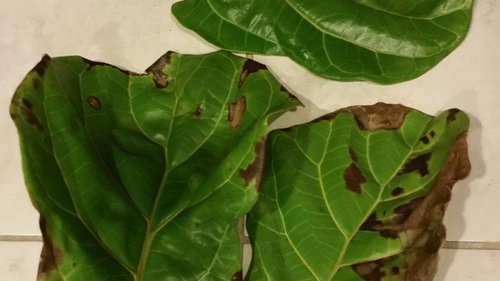
Please find the pictures attached as they may be helpful to see the progression.

Thank you all in advance for your time and helpBefore:

After:

Leaf Samples:


Comments (14)

  • 10 years ago

    You're sort of between a rock and a hard place. If you don't clean up the roots and cut back to sound tissue, the rot is likely to progress. If you DO cut back to sound tissue, it will represent a considerable amount of stress at this time of year. Symptoms are classic for over-watering and/or root rot.

    If it was my tree, I'd do a full repot and rid the plant of the rot before putting it in a soil that allows you to water correctly. Where do you live?

    Al

  • 10 years ago

    I live in Pennsylvania. So we're just about to start the winter. I get good light into the apartment though. Typically all afternoon and some late morning. What type of soil would you recommend to use? Right now I have it around 4 feet from my south west facing window. Do you think I should put it directly in front of the window to give it a bit more energy so growing the roots back will be easier for it?

  • 10 years ago

    Yes. Move it closer to the window - maybe half way there for a week then right in front. Turn the plant 90* clockwise or counter clockwise (just remember which) every other day. There are people who say they approach growing holistically, but then tell you that light cures all ills. That reasoning epitomizes cognitive dissonance because it holds forth two contradictive ideas simultaneously. If lack of light is the factor most limiting your plant, then more light is the only thing that will help it grow better. If your plant suffers a nutritional deficiency or it's too cold for the plant, more light won't do anything to benefit the plant; and of course, if low light is the most limiting factor, making the temperature and nutrition and every other cultural condition perfect can't make up for the lack of light.

    If you do the repot though, you might want to temporarily keep it in the light it's acclimated to at least until it starts pushing new growth - THEN start moving it toward the light source.

    How large would you say the pot the plant WAS in might be? If it's not much more than a gallon. I'd be willing to send you enough 5:1:1 mix to do the repot. What you need to do (repotting and pruning back to sound root tissues) at this time is risky, but not to act is even more risky. Let me know what you think about that idea, and what your thoughts are on how you think you might like to move forward - just in general. Even if you had a perfect medium in hand and ready to go, it doesn't mean automatic success, but it increases the chances of success considerably in comparison to anything you're likely to find off the shelf. I'm on a short vacation so I can cook my butt off for TG, and not going back to work until next Tue or Wed, but I could send it out via USPS Priority.

    Al

  • 10 years ago

    Sorry! Thanksgiving was hectic, as always. Didn't get a second to sit down at a computer until now. Just checked on the plant and one leaf fell off on its own and upon checking the other leaves two more leaves fell off.. The pot it was in before is a 10" pot with a volume of 2.36 gallons (according to the bottom). Since that's a bit more than a gallon I could make the 5:1:1 mix if you're willing to tell me the recipe as I am interested in repotting the plant. I would rather repot than risk letting the root rot spread. Is it a potting mix that you typically use for general purpose repotting? If so, knowing the recipe may be beneficial for my other plants. I mentioned I've read a few forums and articles and it seems as if you are interested in optimizing the health of your plants then using the potting soil directly from the bag isn't the way to go. Adding other components (perlite being a common one I've seen) is ideal for increasing drainage or oxygen in the soil. Hope you are having a nice and relaxing vacation!

  • 10 years ago

    It was a nice vacation, and I was blessed with days warm enough that I could spend them comfortably outdoors in just a sweatshirt. Of course, 20* and a stiff wind is warm enough for me and just the sweatshirt; so as long as it isn't pouring rain or a howling blizzard, I'm good. I spent most of the day cutting back trees being grown in raised beds for future bonsai applications.

    Perlite doesn't do much to increase drainage or aeration unless you really add a LOT of it. If you imagine a pint of peat and a pint of perlite mixed together, in your mind's eye you can 'see' that there is enough peat (or potting soil) to completely fill ALL the spaces between the perlite particles with peat or potting soil. So where does any notable advantage come from? Now imagine a mix od 80% coarse perlite and 20% peat or potting soil. NOW you can 'see' there ISN'T enough peat or potting soil to fill all the air spaces, and NOW you start to see a significant advantage in drainage and aeration, as well as a significant reduction in the height of the perched water table. Perched water is water that 'defies' the law of gravity and stays in the soil when the soil is comprised of a high % of fine material.

    I'll leave a link that has soil recipes toward the end of the original post, but it's not the recipes that are particularly valuable. Much more important than the recipes is the explanation of the concept that I touched on above when I talked about particle size and water retention. Understanding that concept probably represents the largest step forward a container gardener can take at any one time.

    Click me to go to the thread.

    Al

  • 10 years ago

    Always such a fantastic wealth of information. Thank you so much for this info! And it actually makes sense to me! I purchased everything for the 5-1-1 mix (and I got a 3/8" wooden dowel) except for the pine bark. Home depot didn't have that.. I do have orchid potting mix though (the bark, not moss). Could I use the dregs and dust at the bottom of that bag? Come to think of it that may not be enough.. do you think I should keep looking or can you suggest a different medium or way to obtain the bark? Also after reading that post you linked (and a few others from you) I've been thinking of putting a wick in the drainage hole of my pots (cotton?) to drain the PWT. Since the plants are indoors now and I can't just have the wick hanging below the pot and draining on the floor, can I put potting soil in the saucer for the pot and put the pot directly on top (with the wick in the drainage hole)? Or is that overkill and all I would need is a wick that leads right to the saucer? Thank you again, your help is invaluable!

  • 10 years ago

    And I just realized you suggested a 1/4" dowel... back to home depot...

  • 10 years ago

    Don't worry, the 3/8 dowel will work just fine. No need to get another.


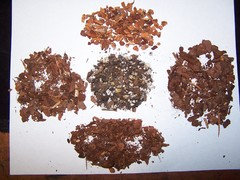
    The piles at 3, 6, and 9 o'clock above are all from different sources/packagers and represent excellent examples of what to look for. It could be used 'as is' for the 5:1:1 mix and/or screened for the gritty mix. The pile in the center is a dry 5:1:1 mix, and the fir bark at 12 is about perfect if you're thinking 'gritty mix'.

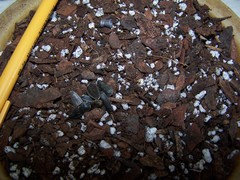
    Here's another picture of the 5:1:1 mix made from a bark product that's a little too coarse, but I really like it like that. The need to water more often means your soil doesn't have an inherent reservoir of perched water to limit root health.


    If your pots are small enough, you can water thoroughly at the sink & then tip the pots at a 45* angle to help rid the soil of excess water. That trick works especially in conjunction with a wick through a drain hole in the bottom at a side wall. You can also hold small 'just watered' plantings over the sink and move them down then sharply reverse directions to upward. The water in the pot will want to maintain its downward direction and will exit the pot - VERY effective.

    More about dealing with excess water retentiopn here (click me).

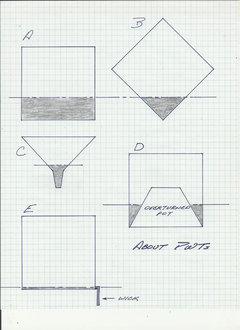
    Here's a picture that helps illustrate several ways you can deal with excess water retention. I think they're pretty much self-explanatory.

    I wouldn't feel as though it's imperative that you stick to a crash program that culminates in having everything you need to make the soil(s) in the very immediate future. You risk letting frustration sour you on what should prove to be a significant jump ahead in your container growing abilities, so just keep learning and watching for an appropriate source for pine bark.

    BTW - where do you live? You might consider adding your zone and a large city near you (like my 'tapla mid-MI z5b-6a'). It will make it much easier for others to tailor advice that includes geographical considerations.

    Questions?

    Al


  • 10 years ago

    Thank you so much for all of this fantastic information! I live in the suburbs of Philadelphia (zone 7a-7b). I'm still trying to figure out how to change it on my username... I cut back the roots (didn't look as bad as I thought they would) and repotted it into the 5-1-1 mix. I also put an upside-down plastic Tupperware container at the bottom of the pot (didn't have a pot to spare at the time) to reduce the perched water. I watered it with fertilizer and then moved my fig a bit closer to the window to give it a little extra post repot energy.

    I have to compliment you with the 5-1-1 mix design. It's VERY airy! I could imagine it would be very easy for the roots to get oxygen. Also it really seems like this soil couldn't be collapsed even if I tried! This will absolutely be the new soil for my other plants, especially my succulents and cacti.

    Thank you for all the help, Al!

  • 10 years ago

    You're welcome. Good luck!

    Al

  • 10 years ago

    I saw the notice that you'd posted to your thread, but I've been super busy with Christmas preparations and family stuff. Thank you for the kind words - much appreciated.

    Any exudate from the severed stem isn't usually a significant issue indoors. It CAN be an issue though, especially outdoors, if pests take a liking to the sap and decide to hang around. I'm glad you like the new mix. I'll take a shot at changing your perception though. Because there is much greater potential for plants to realize more of their genetic potential in soils that require more frequent watering while providing a healthier home for roots, the watering interval you are now working with would be the more appropriate standard by which to judge other media. Using a medium that is inherently limiting because of excess water retention as the standard by which other media are judged is like choosing a car that gets 20 mpg but has a 50 gallon tank over a car that gets 40 mpg and has a 20 gallon tank because it will go farther on a tank of gas. ;-)

    Let's talk before you start repotting the succulents. I think we can do even better than the 5:1:1 mix for those.

    Have a Happy/Prosperous New Year.

    Al

  • 10 years ago

    Thank you, Al. With that in mind I have A LOT of repotting to do in the spring as it seems like the only plants which are in good growing medium is my FLF and orchids! I don't mean to ask yet another question but it seems that as of my last post my FLF is developing yellow spots. After the leaf has a yellow spot for awhile the spot turns brown from the middle of the spot outward. This surely can't be overwatering again...? I used the wood stick method and I only watered when the soil was not saturated.

    I hope you had a fantastic Christmas and have a happy new year!


  • 10 years ago

    Christmas was wonderful, and the interim between the Holidays has been relaxing, even if very busy - thank you.

    W/o a picture, it's hard to say what might be happening. FLFs don't necessarily exhibit immediate symptoms of the limitations they're suffering today. Sometimes the symptoms don't show up until many weeks after what caused them. I suggest you stick to the tried/true basics.

    Monitor your watering carefully

    Flush the soil at regular intervals and at that point immediately take steps to reduce the amount of water the soil can retain (unless they're already in a soil you don't need to worry about)

    Fertilize after each flushing with an appropriate fertilizer

    Keep the plants in very bright light and keep them between 70-85* if possible

    If you do these things, the plant will settle into a healthy growth pattern and you'll end up with an attractive specimen.

    Al