Software
Houzz Logo Print
lenphillips75

Bare root trees

10 years ago

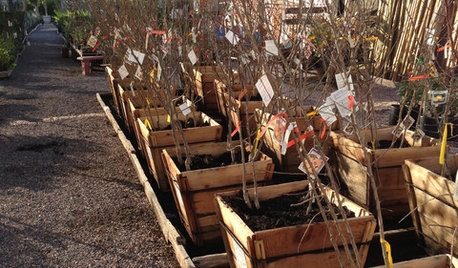
I have noticed in several discussions about tree planting that people have a fear of bare root trees not surviving. I have planted thousands of trees, most of them are 1-1/2 to 2 inch caliper bare root and the survival rate is over 90%. I have written out all my tips for those who are interested. http://gibneyce.com/7-read-about-bare-root-trees.html#Tips

Your comments would be appreciated.

Comments (15)

  • 10 years ago

    I love planting bare root.

  • 10 years ago
    last modified: 10 years ago

    Bare-root is far and away our primary format, the "our" in this sentence being the medium-sized municipality I happen to work for. We've done and still do everything else too, but bare-root is not only the most cost-effective, but quite likely the most successful in terms of outcome. One obvious caveat is that this operation must be performed while the plants are dormant.

    +oM

  • 10 years ago

    IME, most of the 'issues' folks encounter with planting bare root is that the stock itself was not well prepared or maintained. I think 95% of the problems occur when the plants have not been properly harvested/stored by the grower or, more likely, once it hits the retail end of the sales channel. Maintaining proper temperatures and humidity and adequately protecting the root system from exposure to air or dessication before it gets to the planting stage is pretty critical to success and that is often very hit or miss, depending on where one sources the stock.

  • 10 years ago

    Agree with Gal's comments, and am reminded of one area where we have had difficulty in recent years-that of bare-root elms. For some reason, early survival across a wide spectrum of primarily Asian hybrid elms has been poor. These same tree types have no difficulty with our conditions once established. My best guess-this based only on research papers I've read-is that perhaps the stock is coming in with low starch (energy) reserves in the root systems. Why this should be so only with elms I don't know. But even with this problem, I still consider bare-root the preeminent format for transplanting trees.

    Containerized stock as well as B&B have one notable advantage over BR, that being that such stock can be installed all through the growing season, not just when plants are dormant. But that aside, the bare-root holds all the advantages IMO.

    +oM

  • 10 years ago
    last modified: 10 years ago

    Timing and prep. is a bit critical - I have had the unedifying experience of watching our local council 'planting' perfectly good bare roots trees in highly compacted ground in late April - well on their way into leafing out - a fail always destined to happen...but in general, this is by far and away my preferred method of planting (although I have to speak out for direct seeding too). Am bang in the middle of bare-root planting time right now - will carry on till after Xmas (and beyond if I don't shift fast enough)

  • 10 years ago

    My secret to success was telling the person planting the BR tree that every 30 seconds the tree's roots are exposed to wind and sun, cuts the life expectancy in half. While you and I know they can survive for up to 15 minutes in the sun, the contractor follows my direction and keeps the roots covered ALL the time.

  • 10 years ago
    last modified: 10 years ago

    Tolerance to air exposure varies with the species, over a wide range from little tolerance to being able to grow away well after perhaps months out of the ground.

    At garden centers here displaying bare-rooted stock in sawdust I often see random specimens pulled up out of the sawdust and left exposed to the air by shoppers. But bare-rooted woody plants should be expected to have reduced top growth the first growing season after planting anyway, as these are essentially big cuttings that already have part of the root system present.

  • 10 years ago

    yeah definitely much cheaper

  • 10 years ago

    What's the point of the question? To talk about how to handle bare root plants? To get a pat on the back?

    I love bare root. I do as much as I can bare root. I bought two refrigerated trailers just for that purpose. I built a Missouri bed twenty years ago.

    I refuse to sell bare root. It's expensive to maintain, expensive to clean, expensive to handle/store/clean all the other things required, and warranty costs are exponentially higher than container or b&b. Cheaper? no way, not for me, not for sales.

    Now landscape, that's different. Field planting, that's different.

    My honest opinion? I'm glad I don't have to take the test part at the end, because there is no way I'd pass it. No. Way. Could I pass it? I could pass it drunk, because I can tell you the answer you want, why that answer is right, why it's wrong, and in what circumstances it's either right or wrong. But I'd not be able to bring myself to do so. I would like to take that test, in printed form, with a red pen. Not so sure whoever got to grade it would appreciate it.


    Who are you? By that, I mean, what do you do for a day job? Are you a writer, an editor, a lab technician? Who wrote this? You're listed as editor, not writer, so what's your part in this? How'd someone write an article about bare root trees, and cite Whitcomb, but not Bailey Nursery? You cited Forrest Keeling (which is the same as citing Whitcomb), and the same as saying you want people to use container grown stock, but only if it was grown in a certain type of container, and then, only if it's the right brand...but that's a different discussion. Why cite proponents of branded products of a different method of growing (container), if the purpose of the article is to promote bare root? And how could an article be written about bare root trees without contacting one of the largest bare root growers?

    There's a hodgepodge of information here. You're not an industry pro...not even close. Not a criticism, just an observation. You've talked to people who have based their business model on CONTAINER growing. So why not someone who has based their business model on bare root growing? This is an article focused on community forestry, city forestry, urban forestry, so being heavy on that is expected. I expect the case study.

    So tell me about that purchasing. You actually go to a nursery, pick out plants from the field at random, and they dig them for you? Because I'd love to see the diggers used where I buy trees be so selective. You've described different process than I'm used to...but what do I know about this? Now b&b diggers, depending on how the field was planted and the harvesting schedule, you may be able to do that. Bare root?


    An actual citation of ANLA nursery stock standards? That's not something you run across every day. So you get bonus points there.

    Did you really recommend bare rooting a B&B tree, after citing the difference in root mass of B&B stock compared to bare root stock? Here's the deal, and realize I grow b&b trees...IF I WANTED THEM TO BE BAREROOT, I'D HAVE GROWN THEM THAT WAY! !!!!!!!!!!!!!!!!!!!!!!!!!!!!!!!! !!!!!!!!!!!!!!!!!!!!!!!!!!!!!!!!!! !!!!!!!!!!!!!!!!!!!!!!!!!!!! Emphasis intended.

    The above is part of the hodgepodge of information I run across. There's good, information about the advantages of bare root (root mass). There's extensive coverage of the Missouri system. There's Whitcomb's progeny and grow-bags. It's like someone attended a few seminars, read a few promotional brochures, and cut and pasted them into an article. Then there's the recommendation, buried in an article on the advantages of bare-root planting, to bare root b&b stock. If you want bare root stock, BUY IT! !!!!!!! If you want to kill a tree, bare root a B&B tree.

    Air spades are cheaper to dig a tree than typical diggers? For a tree where, according to the steps outlined, you start by using a back hoe, and a forklift for moving the tree? I'd like to see the accounting on this one. And you can use an air spade...in any weather...with not even noticeable wilting? And winning lottery tickets will grow on the next seasons' leaves? Even the developers of the Missouri gravel bed system won't make that claim. The wilting, I mean, not the winning lottery tickets.


    Did you really write an article about the advantages of bare root stock, and use sycamore as an example of trees that do well in urban environments? No discussion of sweating? Transplant shock and establishment period? For that matter, you also stated that staking was not required. For trees planted from bare root stock in the 1 1/2" to 2" size range? For trees dug with an air spade?

    Don't get me wrong...sycamore can do well in urban environments...IF you are patient and allow it to go through the awkward stages of establishment. But that's another article. Trees that do well in urban environments is not the subject of this one. Ease of establishment from bare root planting is. So how does sycamore get mentioned?

    For that matter, let's start at a little more basic level. Urban conditions that trees have to deal with a repeated theme of the article. So where was mention of the program that sought to recognize trees that have thrived in urban situations for decades, to propagate them, and make those trees available for planting again?

    Direct citation: Trees raised in any of the containers mentioned can be planted directly from the container.

    The quote is immediately after a list of all the various attempts that have been made to create containers or growing systems that reduce or eliminate circling roots. And it's completely wrong. Circling and girdling roots are not the result of container growing. Spending too much time in that container is...And every container you can grow a tree in can create the problem.


  • 10 years ago

    Every year, various friends will gleefully regale me about this or that tree they have bought from one of the supermarket discounters for mere pennies, (around $7) scoffing at my dubious head shaking, even claiming I am just being 'snotty'...and the like...but why? I simply cannot see the logic in saving a few pounds - we are talking about the equivalent of $10 or so difference, to buy a decent bare-root from a proper nursery for a tree which will stay in place for a couple of decades! I will happily buy a bargain perennial from Poundland and the like...but a tree?

    lenphillips75 thanked User
  • 10 years ago

    Where you looking for input Len? I like bare root too, but I mostly produce my own. I should add that I have only a 75 acre woodlot, so I don't produce a whole lot each year....a couple of hundred. I'm 5 foot 2, so bare root is MUCH easier to carry, so that's what I do. Sometimes I start small trees in 2 litre pots and bare root them for transport, other times I use a raised bed with some sand and bark bits in it to make the soil looser....and easier to get off the roots.

    Our soil here is the Charlottetown series, lots of clay, but rich. For me, digging the same day I head for the woods solves a lot of problems. I have a few hens, so I save the plastic bags the shavings come in, and put wet shavings, then a bunch of small trees, then more wet shavings, till I get what weight I can lift into the back hatch of the car. I take a bucket too, so I can can carry each tree in a bucket of wet shavings, when I hit the woods. I do have good luck with bare root elms, but that's because I dig and plant all the same day....I suspect low carbohydrate reserves is right on, as far as failures of new elms. My woods is wet too, so as long as there are no leaves yet, or they have already shed (fall), the bare rooted ones do fine. It seems to be as much about how the trees are handled before you get them, or how you handle them if producing them yourself, as the method used to produce them. Chicken manure, shavings, sand, clay soil, bark bits and a lot of years makes really mellow soil...easy to get all the roots when you lift trees.

    lenphillips75 thanked jocelynpei
  • 10 years ago

    Jocelyn, do you undercut your trees at all? I have been in the process of moving fruit trees from my allotment, doing it over 2 years with an undercut the first year to break big taproots and get a more fibrous root system. Much of this is new to me (I have a minuscule, by US standards, little wood and am very keen to raise my own trees in nursery beds (rather than pots which I have been doing). I don't mind sprouting the seeds in a pot but would really rather transplant the first year into the native soil they will be growing in for the rest of their lives. How long do you grow your trees before lifting? Raised beds the way to go?

  • 10 years ago

    Because my soil is pretty loose, I don't need to undercut. If your soil is different, you might. I grow them till I think they might be getting a bit heavy to carry...so depends on the species. Elms can be more than 3 feet at 2 years, and more than that is hard to carry. Oaks and chestnuts are slower, might leave them home for 2 or 3 years. One thing, if the soil is loose, and you are ABLE to get all the roots, you will be digging a BIG hole in the woods. What you see on the top is usually SMALLER than what is under it (roots) Roots can be coiled up for transport, and straightened in the planting hole/trough, depending on their shape. Butternuts are best moved small, at one year.

    I'm in Canada, by the way, not the US.

  • 10 years ago

    Forgot, raised beds, umm, well, I'm actually building one now. As I age it gets harder to bend over, grin. I didn't have raised beds before, but now it's getting a bit hard to bend over in the mornings. Depends on you soil, I guess.