Software
Houzz Logo Print
xentar_gw

Growing European Elderberries in Florida?

10 years ago

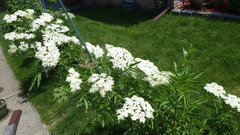
I tried to grow European elderberries a few years back in the Florida lowlands, USDA zone 8b, and none of them made it, although I do have a lot of American elderberries, like Johns, Adams, York, hybrids, and wild Florida seedlings growing and producing. I suppose it's possible that I just had bad luck, or we had bad weather that year, or I planted them in the wrong spot or something. What is strange to me is that a google search about European elderberries in Florida, or even the south, doesn't seem to give me much information. I'm considering trying again in the spring but would like to know if anyone else here has any experience with growing these here. Thanks

Comments (12)

  • 10 years ago

    Thanks for the info. Yes, I've heard it can be used as a pesticide but hadn't tried to make any from it.

    I think I asked this question a few years back, regarding European elderberries, and I don't think anyone knew whether or not they'd grow in the southeast. I'll take that as a bad sign but will attempt to grow it one more time before giving up.

  • 10 years ago
    last modified: 10 years ago

    I do not know, you might try putting the seedlings in the refrigerator for 6 weeks, that might help give them their necessary chill requirement. If a young seedling does not get its necessary chill hours, it will be very reluctant to leaf out and may not survive.

    Elderberries can be grown in Florida, but the European variety may not do so well there.

  • 10 years ago

    Wondering why you are looking for the European strain. Are you not happy with Canadesis?

  • 10 years ago

    I suppose the biggest dilemma I have, in regards to elderberries, is that I've not found a plant with large enough berries to justify planting a whole row, or multiple rows of them. Right now, I consider the elderberry plants I have in-ground nothing more than novelty plants. The 'adams' elderberries are about twice the size of the local wild seedlings, but even then, it takes several hours to clean/sort enough berries to make a single batch of jam. I'll probably try Bob Gordon, Wyldwood, and Nova cultivars next year.

    Another issue is the massive amount of suckering on American elderberries. European elderberries are said to be more tree-like and don't generally sucker, or at least don't do it as much.

    I suppose none of it matters if European elderberries won't grow here. I like to experiment though. So, will try one more time..

  • 10 years ago
    last modified: 10 years ago

    I think it's worth trying again. If the Americans grow I don't see why the Euros will not? I'm not sure berry size would be any bigger? I myself freeze the cluster, and they fall right off. Also I remove seeds and all, so any stems left over will be removed too. I only grow Euros for now. Last year I added some new Euro cultivars

    http://noursefarms.com/category/elderberry-plants/


    I see they are limited to zones 3-7 so maybe they will not grow for you.

  • 10 years ago

    There are a few nurseries in USDA zones 8a to 9a that are selling European elderberry plants, but all seem to be on the PNW. The trouble with classifying USDA zones to plants is that many have different information. Some are claiming elderberries (including European) are fine up to USDA zone 10, although the general consensus is that it's (American elderberry) a zone 8 plant. However, I'm in a shifting zone, one that moves from 9a to 8b every few years, and even on 9a years, American elderberries still fruit well. I would suspect that, if European elderberries wouldn't grow here, it's not just about chill hours but also the huge amount of humidity and rainfall we get. I don't know how European elderberries handle flooding rains as compared to American elderberries.

  • 9 years ago

    Read on line artilcle: Eureopean Elderberry/ uncommon fruit. I asked on Garden Web recently about growing Samyl and Samdal and got nowhere. I also have found nothing online and got no help from Norse, where I bought them. The article appears to indicate that it is probably a soil/ nutriant problem and they havent really discovered. The article discusses problems they had also. I have lots if American Elderberry growing, but same as you, I cant seem to grow European and I live in zone 5.

  • 9 years ago
    last modified: 9 years ago

    I have Samyl and Samdyl, and they are fantastic! Grow like weeds. The 2nd year they produced about 2-3 pounds per plant. Really awesome plants that are all flower. . They are by far the most productive elderberry I have seen.

    I grow them like fall bearing raspberries. In late fall i remove all the canes, and let new ones grow during the season. Keeps the plant very small. Here they are 2nd leaf. All 2nd year canes are removed to the point where they have new canes growing out, or completely removed if no new canes are on 2nd year canes.

    I never go here much, as a much better fruit site exists.

  • 9 years ago

    Can you tell me your soil ph, type of soil and fertilizer you use? Have you been able to grow bkueberries, or have you tried in the same area?

  • 9 years ago
    last modified: 9 years ago

    You know I have only one American type, and it doesn't do well, go figure? Who the heck knows?? I'll tell you all I can. It is between houses so it only receives about half a day, maybe slightly more of sun. In ground, we have a clay loam with a pH of about 6.5. It is very nice soil. Every spring I put bagged composted manure around it. I put a small amount of Dynamite control release fertilizer. And once a month use an organic. Usually Holly-Tone. I fertilize my grass with Milorganite, so it probably takes that up too. It is now approved for garden use, but I only use it on my grass. I grow over 20 different fruits and veggies. Not worried if some gets in the garden.

    I mulch with leaves or straw, but often I scatter it with the lawn mower. It needs more right now. I should clear more of the grass around the plants. If I left the 2nd year canes I could probably get a bigger yield. But I'm good with the 5 pounds or so I get.

    Going back to the subject of this thread, the thought came to me that maybe in Florida it's nematodes, as the state is notorious for having them. The kind you don't want. Maybe that was covered already? I heard tomatoes are hard to grow there because of the nematodes, and maybe elderberries are susceptible to them? I don't know? Some plants are not.

    I cannot grow blueberries in my soil. The west side of the state is all sand and that is where the pH is low and they grow them. I'm on the east side. I do grow blueberries but in containers, and raised beds filled with pine bark and peat. I use sulfuric acid to lower pH of tap water, but usually use rainwater (pH of 4.7) for my blueberries. I have 10 plants. Most of the other elderberries I grow are ornamental. I grow a variegated euro, Black Lace, and Black Beauty. All do very well here in ground.

  • 3 years ago
    last modified: 3 years ago

    Never really thought about nematodes, but in the last few years, we've seen that certain varieties of mulberry actually don't do well in Florida soil because of them, and they need to be grafted on nematode-resistant rootstock. I think Illinois Everbearing is considered one of the rootstocks for them.


    I think it's a good idea to try to grow them (European elderberries) in containers and see if there is any difference between in-ground and container grown.