

"Smith's Parish"
I'm trying to figure out how many 'versions' there are of the Bermuda Mystery Rose, "Smith's Parish". Is there a widely variable 'Smith's Parish', a usually red/pink "Smith's Parish Red" and a usually white/cream "Smith's Parish White"?
I ask because I have a white/cream mystery rose that I think looks a lot like "Smith's Parish", except for those color variations. My rose is always creamy white (sometimes the buds are on the pale yellow side of cream), and often has pink tinges, but it has not ever been as variable as the "Smith's Parish" that has red stripes, and sometimes sports to solid pink or red.
HMF lists "Smith's Parish" and "Smith's Parish White" as synonymous, but it seems plausible that there might be a stable white variant of the rose if there's a stable red variant?
Thanks for any help you can provide,
Virginia
Comments (46)
 10 years ago
There's a stable pink version -- 'Grandmom Schmidt'. And there is 'Red Smith's Parish.'
I don't see any reason why any of the other colors and flower forms might not have stabilized.
You should note that there is a distinct variance in flower form/petallage from one color to another. SEE:
http://www.helpmefind.com/rose/l.php?l=21.45582User thanked jerijen
User
Original Author10 years agoThanks, Jeri- I did look at the HMF photos, and yours in particular. The varying flower forms are consistent with what I've seen with my rose, but I haven't seen the color variations.
I don't now recall what had me looking up "Smith's Parish" earlier today, but my first thought was that the habit and foliage looked very familiar. When I started looking at the flower, there was a similar variety of flower forms, and the red stamens especially caught my attention when I noticed them in a few photos.
If "Smith's Parish" and "Smith's Parish White" are identical, as HMF has them, then that's not what I have, but I do think they're closely related. If "SP" and "SPW" ARE different, I think I may have finally found an ID (even if it isn't the original ID!) for my mystery white rose:
https://www.flickr.com/photos/87333171@N08/albums/72157651118412371
Do you see a resemblance to your rose, or is just my mind playing tricks on me?
Thanks,
Virginia
Related Professionals
Athens Landscape Architects & Landscape Designers · Ashland Landscape Architects & Landscape Designers · Elkton Landscape Architects & Landscape Designers · North Adams Landscape Architects & Landscape Designers · Lancaster Landscape Architects & Landscape Designers · Honolulu Landscape Architects & Landscape Designers · Victoria Landscape Architects & Landscape Designers · Somerset Landscape Contractors · Sacramento Landscape Contractors · Amarillo Landscape Contractors · Saint George Landscape Contractors · Olympia Landscape Contractors · Bainbridge Home Builders · Bartlesville Home Builders · Chula Vista Home Builders- 10 years ago
I don't know for sure -- but it is charming.
How big is the plant?
Because, "Smith's Parish," here, is as big as a bus. User
Original Author10 years agoIt's hard to say since the original plant is in a large pot, so that will obviously limit its size. That plant is at least 15 years old (and probably older); I'd guess it's about 6' tall, and 4-5' wide. I have two young plants from cuttings, and they are vigorous, and remarkably healthy here. I didn't see any prickles in the photos, and my plants have very few thorns, but there are some and they are hooked, and, as described in the HMF references, pale when young. Also the prickle at the base of the leaves is pretty consistent with the description I read.
I also found this sentence in the references, which I'd previously missed:
"However, in the Bermuda Show, this variety was divided into ‘Smith’s Parish Red’ and ‘Smith’s Parish White’, the former being almost entirely red while the latter, seen in many gardens across the island, invariably had a small touch of pink on its otherwise white blooms. Sometimes this took the form of a narrow petal edge, at other times just a sort of beauty mark that can appear anywhere on the bloom."
Neither of those descriptions describe the variable rose with five different colorways, so I am inclined to think- unless informed otherwise- that there must be multiple versions (I had no idea of the "Grandmom Schmidt" variant until your mention of it above). I wouldn't say that the small touch of pink is invariable with my roses, but it is there on most blooms.
My rose is fragrant, but not strongly so. I can't always detect it (allergies), but when I can it smells more 'fresh' than sweet.
Thanks for the valuable feedback,
Virginia
 10 years ago
The blooms kinda remind me of my 'Rival de Paestum' -- have you investigated that as a possibility?
:-)
~ChristopherUser thanked AquaEyes 7a NJUser
Original Author10 years agoThanks, Christopher-
I think I must've looked at every white Tea or early HT listed on HMF at least once! The 'RdP' blooms in the photos I've seen only rarely show stamens, and they aren't red. Also there is a lot of purplish-red new growth with 'RdP', and my rose doesn't do that; a slight bronzy tint to new growth on occasion, but otherwise it's all green, all the time. The stems are a light green, but they often have a glaucous coating that gives the green a slightly blue cast.
A lot of those photos show a petal formation that looks almost zinnia-like; I've seen nothing like that with my rose. Some of the photos do look more like my rose, though, so maybe there's more than one rose in commerce as 'RdP'? Hard to say, but it does look like a lovely rose.
Thanks,
Virginia
User
Original Author10 years agolast modified: 10 years agoI happen to think these photos are remarkably similar, except for the coloring of the petals:
https://www.flickr.com/photos/87333171@N08/15605758060/in/album-72157648067994192/lightbox/
and
http://www.helpmefind.com/rose/l.php?l=21.158885
Yes, no, maybe?
Virginia
- 10 years agolast modified: 10 years ago
I'm on my computer now, so I can see the pics larger than they were on my phone when I responded earlier.
Virginia, are you sure the stamens are red? From what I can see in your pics, the red parts look like stigmas.
Here's another one to investigate -- 'Mrs. Herbert Stevens'.
:-)
~Christopher
P.S. It also resembles a less-double 'Snowbird', doesn't it?User thanked AquaEyes 7a NJ User
Original Author10 years agolast modified: 10 years agoMy bad- I thought I had two-tone stamens, but that one-day botany class I took this fall must have not been sufficient.
Are stigmas and styles the same? I found this sentence in a brief article about "Smith's Parish":
Blooms are cupped, becoming flat, with deep red styles contrasting strongly with the white petals and golden stamens.
http://rosesinbermuda.com/?page_id=142
Christopher, I think both of those roses are a good bit fuller than my rose is, and far less inclined to show off any of their "naughty bits". And I think 'MHS' also tends to have purply-red new growth...?
Here's another compare and contrast, since you seem unconvinced that my rose is "Smith's Parish White":
http://www.helpmefind.com/rose/l.php?l=21.157438
and
https://www.flickr.com/photos/87333171@N08/18127228043/in/album-72157648067994192/lightbox/
Thanks,
Virginia
 10 years ago
It looks like you're right Virginia to me, but I am by no means an expert...far from it. They are very similar and I see what you are talking about with the stamens. I also see a little pink on your blooms :)
User thanked Alana8aSC- 10 years ago
I'm not convinced there are more than two forms of SP, although I've not seen a live specimen of "Grandmom Schmidt". Photos on HMF look right for a "typical" RSP. 'Red Smith's Parish' is normally pink, especially in hot weather, developing true red only when we have chilly nights. So I've wondered if those two were the same rose, just being grown under other conditions. Regular SP has every variation possible from pure white throughout, through all gradations of red and pink, all the way to totally red. But on any given day, most of the flowers will be plain white, with the occasional red stripe on perhaps one in 50 flowers (very rough estimate). Occasionally, there is apparently some weather event that changes that -- last March, we had bizarre picotee-types, unusual shades of pink, etc., on an entire hedge of them on our campus. By the next growth flush, they were all back to "normal" -- mostly white.
Jeri, do you have access to Grandmom Schmidt? That's one I'd like to grow for comparison. And do you know if Jim had reason to think it was not RSP? I realize one should not doubt Jim Delahanty's judgment lightly.
As far as I know, all of the versions in the U.S. came originally through our garden, started from a cutting from Lorna and Bill Mercer's plant in Bermuda. It was a plant that Bill had been working to select for always-pure-white, but it didn't work. He said he could not prevent the red from showing up. On the other hand, I've wondered if our versions have less tendency to stripe than do the average Bermudian plants, which have not been selected in that direction. 'Red Smith's Parish' shows up on almost anybody's white plant, sooner or later, and can be propagated from that stem, but the registered one also came from our garden in that manner.
Virginia, if you plant never makes any red or pink on the petals, I have to wonder if it's the same. That's a type I've never seen. Do you grow Smith's Parish? It has very distinctive foliage -- recognizable in a mixed garden from 50 yards away. Healthy looking, but always a distinctly more yellow shade than any surrounding rose.User thanked malcolm_manners - 10 years ago
...on the Roseraie du Desert site, there is a photo of Fortune's 5 Colour showing both colours on the same plant...
...Mr Hook notes for Smith's Parish that it is ''very similar to''.... the above rose...
User thanked User - 10 years ago
The problem with Fortune's 5 Colour rose is that, as far as anyone knows, all of the extant plants of it in the world can be traced to a renamed Smith's Parish. So we really have nothing to compare with.
I've just uploaded several new photos of odd variants of Smith's, in our gardens, to HMF.User thanked malcolm_manners User
Original Author10 years agoYes, Alana, almost all of the flowers have a pink tinge to them, even if just a little. No red striping, though, or solid-colored flowers in pink or red. The 'parent plant' of my two plants belongs to someone else, and I'll ask that gentleman if he's ever noticed a pink, red or striped flower on it.
Dr Manners, I appreciate the info about "Smith's Parish" in the U.S. I wish I knew the provenance of this rose; the rose from which I got my cuttings lives on Johns Island, near Charleston. The lady who planted it is now deceased; she died about 12 years ago after a long illness, which is why I think the plant must be at least 15 years old, but probably older. I believe that she an a gardening friend used to do some rose rustling in this area. When did "Smith's Parish" make its way to the U.S.?
Is it possible/ likely that the variegation/ sporting tendencies of "Smith's Parish" are virus-induced? I know that viruses are responsible for much variegation in the world of flowers, but I don't hear much about it with roses.
Charleston and Bermuda have historical ties going back to colonial times, and it seems likely that roses that were imported to Bermuda would also have come here? I'm wondering if my rose and "Smith's Parish" might have the same source, but it started to sport only in Bermuda?
I don't grow "Smith's Parish", but the foliage on my plant is very distinctive, and although I've been looking for a match for more than a year, I never saw anything close until I looked at photos of "Smith's Parish". The leaves and stems on my plant are a default light, bright green, but the stems often have a slight waxy coating that can give them a blue-ish sheen; not all stems have that, so I do get a subtle two-tone effect sometimes. I haven't read that "Smith's Parish" does that, so it would be interesting to hear if it does. The foliage is similar, but it's the habit of the plants that make me think they are the same or very closely related.
The rose is quite easy to propagate; if you have any interest, I'll be happy to try to root one for you.
Thanks again,
Virginia
- 10 years ago
'Smith's Parish' was sent to the Huntington in 1987. I'm not sure if that one survived or if it was distributed at all. We imported in 1988 and have distributed it widely. Ruth Knopf (Sullivan's Island) would have acquired it from us very soon after it was released from Federal Quarantine, in 1990 or 91, and it likely spread around the Charleston area rather quickly, since Ruth is a great believer in sharing one's most precious roses.
User thanked malcolm_manners User
Original Author10 years agoThanks, Marlorena-
As Dr. Manners said, it looks like some folks were quick to jump the gun when they decided that the Bermuda Mystery Rose, "Smith's Parish" was definitely (not just possibly) the long-lost 'Fortune's Five-Color Rose". If you look at HMF, there are two separate records for "SP" and 'FFCR', but the photos at both records are all of "Smith's Parish", so far as I can tell.
It would be cool if "Smith's Parish" could be shown to be Fortune's rose, but there isn't any evidence except that both roses are/were extremely variable.
It's fairly common to see that kind of variability on camellias, as you know- you grow 'Lady Vansittart', and have probably seen a fair amount of variability in terms of bloom color and shape. Some camellias are fairly consistent, and at the other end of that spectrum is 'Betty Sheffield' which has many famous sports.
The tendency to sport is much less common in roses apparently, but it does seem possible that if a rose can have color freaks once (as with Fortune's rose), it could happen again independently with another rose. Or they could indeed be the same rose...
Thanks again,
Virginia
 10 years agolast modified: 10 years ago
Your rose reminds me much of my Margaret Merril. Some of the photos on HMF show her more pink but mine are white with the pinkish stamens and pink stigmas.
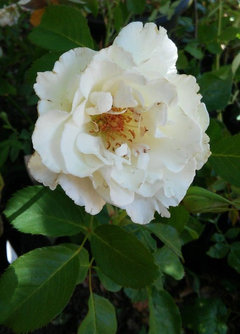
The foliage looks the same too, with the slightly ragged edges and the wide stipule (in 26F weather).
And the long thin prickles:
Margaret Merril is very fragrant. Hope this helps. :)
AnneUser
Original Author10 years agolast modified: 10 years agoThanks, Anne-
I can see a stronger resemblance to your 'MM' than I've seen in other photos, but 'MM' has a more 'organized-looking' flower where mine is more muddled. Also the pink is more pronounced and consistent; with my rose it is less of a blush than variable smudges showing up here and there. In most photos I've seen it looks like 'MM' has glossy dark leaves, and my plant doesn't.
I'd say my rose has a pleasant scent, but definitely not strongly fragranced.
The stipules are similar, and the leaves are similarly serrated; the prickles on your plant look straighter than those on my plant, but similarly colored.
As far as I can tell, 'Margaret M' seems to have a fairly upright habit while my plant is rather sprawly, almost vine-like, but not showing any climbing tendencies, if that makes sense.
Your photos are great, and that's a lovely rose- I'd say that 'Margaret' has found a good home with you!
Thanks again,
Virginia
- 10 years ago
Someone above asked about virus and color break in roses. Yes, that's common in camellias, tulips, orchids, and other flowers. But the viruses that cause common rose mosaic in roses don't seem to cause that effect. (That doesn't mean there couldn't be some other, as-yet-unknown virus that could do it to a rose, but not demonstrated). Ralph Moore once stated that breeding from the striped Gallicas didn't pass the striped genes, since it was viral, and heat therapy would remove the striping. But we heat-treated Camaieux (known to have mosaic) to test that out, and we ended up with a mosaic-free plant that was just as striped as ever. So to date, I've not seen any evidence of the situation being viral. In any case, I don't think that's possible in 'Smith's Parish', since it tests free of every virus ever tested for, and the striping comes and goes on it. I think it's likely a transposon, along, perhaps, with some epigenetic signalling, that is turning on and off some gene in the pathway to the red pigment. I must remember to put some petals under a microscope when I see the pale pink color -- is it a deeper layer of red under white? Or less red pigment in all the cells? Or a few individual true red cells among a sea of white? Or what is the nature of that intermediate color to the naked eye? I don't know that anyone has ever looked into that, and it should be easy enough to do.
User thanked malcolm_manners User
Original Author10 years agoThanks for the info about viruses and color breaks. It does appear that if there's a viral component, it must not be one of the viruses that commonly affect roses. That's interesting that Ralph Moore thought the striping in Gallicas was virus-induced. If the striping tendency isn't heritable, a virus would certainly be a likely suspect, but the heat treatment experiment seems to contradict that theory.
As I mentioned above, my rose does consistently have pale pink markings; smudges, stripes and such; if you look at the Flickr photos, you can see the pink tinges.
The soil here (and on Johns Island) is acidic loam; do you think that a lower soil pH could have a 'muting' effect on the variegation of "Smith's Parish" so that the vivid red stripes/ markings are less colorful? I believe that Bermuda, much of Florida and Jeri's garden all are fairly alkaline, yes?
It is certainly possible that Ruth Knopf was the local source for my rose; it's even possible that she knew (and shared roses with) the lady who planted the Johns Island rose that's the 'parent' of my roses. There's so much I don't know!
Thanks again,
Virginia
- User thanked roseseek
- 10 years ago
Yes ma'am. Margaret had an intense scent in Newhall where it was hot and usually dry.
- 10 years ago
Here, no one who sniffed it could ever smell anything. And that was years ago, when our climate was dependably damp, and almost always cool.
- 10 years ago
I've received two notices you've posted to this thread, Virginia, but neither of your posts shows in the thread. Odd...
User thanked roseseek User
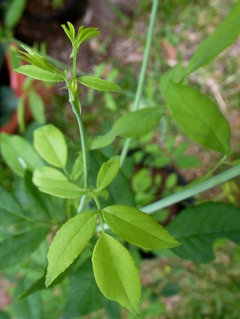
Original Author10 years agoHere's a photo I found stashed away in an old GW post from last year; I was just trying to see if I could move the photo from one post to the other, but then realized this photo actually shows the glaucous stems I'd mentioned earlier. You can see how smooth and supple they are; that coating comes off if rubbed, and the color underneath is closer to the yellowish green of this new growth.
User
Original Author10 years agoSorry, Kim (and anyone else following this thread). I was trying to run a test post, and didn't think about your getting 'notified of an update' if I deleted the duds.
Mea culpa, mea culpa, mea culpa...
Virginia
 10 years ago
As I understand it, 'Smith's Parish' is a chimera, an organism made of more than one type of cell. I've had some chimeric azaleas (Japanese Satsuki types) which will produce different flowers depending on which branch is chosen for growing it from cuttings. I was told not to take the pure white-flowered branches for cuttings as they would not have the mixed colors so desirable in those varieties. As shown above "Smith's Parish" has a unique appearance. It's the only plant I've ever seen which grows its peculiar way. It's almost disease free and quite a great grower, even in pots as mine are.
User thanked Mike Reisman - Zone 8(b) Central S. CarolinaUser
Original Author10 years agoMike, in Dr Manner's first post to this thread he said:
"As far as I know, all of the versions in the U.S. came originally through our garden, started from a cutting from Lorna and Bill Mercer's plant in Bermuda. It was a plant that Bill had been working to select for always-pure-white, but it didn't work. He said he could not prevent the red from showing up. On the other hand, I've wondered if our versions have less tendency to stripe than do the average Bermudian plants, which have not been selected in that direction. 'Red Smith's Parish' shows up on almost anybody's white plant, sooner or later, and can be propagated from that stem, but the registered one also came from our garden in that manner."
I can't speak to "Smith's Parish" being a chimera, but it does seem from the above that it's not so easy to select for pure white. Which makes sense, in a way, since I'm not sure I've seen any blooms that actually are 'pure' white; I look closely at my photos, and I can see faint streaks/tinges of pink in all of them... (I am, of course, assuming that my rose is "Smith's Parish" or some version thereof...)
Thanks,
Virginia
- 10 years ago
Virginia, if I may ask, what part of South Carolina do you live in? You can e-mail me if you'd like at Moreviolas at G mail dot com.
- User thanked malcolm_manners
User
Original Author10 years agoHi Mike-
I'm in Charleston. Are you in the upstate (in Central) or are you in the central part of the state?
It looks like we may be getting freezing temps here this week, but meanwhile we are supposed to have record highs tomorrow- 78F, I think... Last year I had my plants 'ready' for the early freeze, but this year I've been slacking off with the winterizing... I hope you are more prepared!
Virginia
User
Original Author10 years agoDr Manners, the foliage and habit were what grabbed my attention when I first took a good look at the "Smith's Parish" photos. They 'clicked' right away. Once I mentally erased the striping, etc., the flowers also looked the part, and when I saw the red stigmas/styles, I felt sure that my rose belonged to this family somehow.
Thanks for having a look at my foundling,
Virginia
- 10 years ago
Virginia, We are having some very weird December weather that's for sure. I hope we don't stay cold longer as a result. I hope you can get a confirmation on your foundling. I think that the flowers and foliage look very similar to "Smith's Parish" to my eyes. I'm also trying some more China/Gallica hybrids this year and will let you know how they fare :) If they will all do as great as Orpheline de Julliet I will be so thrilled!
User
Original Author10 years agoAlana, I'm looking forward to seeing photos of your new roses. Your 'Orpheline' is lovely, so if the newbies do as well, I think you'll be sitting pretty.
My mystery white roses were the first I grew from cuttings, and it will be fun to keep an eye out for any striping or other sports, but even if they don't show up, I still feel pretty confident that my rose is in that same family.
Thanks,
Virginia
- 10 years agolast modified: 10 years ago
As far as scent in Margaret Merril, it is the reason I chose the rose walking by it at RVR. The scent was on the air. It is very fragrant to me, in our dry summer climate. It is also very upright, as Virginia said. A very healthy and satisfactory rose for me. I just received a Smith's Parish from Burlington's and am looking forward to planting it in the Spring.
User thanked Anne Zone 7a Northern CA - 10 years ago
I had Margaret many years ago as an own root plant from a friend's British imports. It occupied the intersection of three paths and grew to over six feet tall by about the same diameter. The foliage and scent were gorgeous, but the petals fried quickly in the all day sun it had to endure. The plant itself was magnificent there. IF I could find flowers at the right stage and add them to bouquets, it was wonderful. Most of the time, I couldn't. It definitely liked that climate. It was particularly fun because of the name. "Margaret Merril" was the ficticious Oil of Olay "Beauty Consultant". When Harkness chose the name, they were required to find a lady with that name and obtain her permission to use it before they could be permitted to name the rose "for her".
- 10 years ago
I bet the Margaret Merril they found was thrilled to give her permission and have a rose named after her, in a roundabout way!
User
Original Author10 years agoHa! I was looking at the HMF references for 'Margaret Merril', and apparently Oil of Olay/ Harkness found three ladies of that name. I do hope they were nice people to have such a good rose named for them...
Virginia
User
Original Author10 years agoI am reviving this thread in order to provide an update: the gentleman from whom I got my cuttings for this plant told me that his rose used to have red stripes, but they became scarce over the years, and by the time I saw the rose it had been many years since there were any red stripes. My two plants are also- as mentioned above- free of the red stripes and sports, but are almost always tinged with pink to some extent.
I also need to know how much space "Smith's Parish" is likely to need; I have a spot near the house that's about 8-9' wide. Is that enough room? The phrase Jeri used, "big as a bus" is a bit worrisome...
Thanks in advance for any particulars!
Virginia
- 10 years ago
Virginia -- Not pruned, it is HUGE. Maybe 8-10 ft. wide?
It's hard to be more specific, because it has flung itself up a hillside, and entangled itself with runaway iceplant, but it is a BIG PLANT.
I'd say you could keep it smaller by pruning -- but we used to prune it. It is not dismayed by pruning -- it just doesn't care. It will grow back up to its desired size, what ever you choose to do.
User thanked jerijen User
Original Author10 years agoI think I'll chance it. After all, how can I learn from my mistakes if I don't make any?
Thanks,
Virginia
User
Original Author10 years agoThe plant from which I got cuttings has been in a large pot for at least 12 years, so I already knew it wasn't a prima donna. It's good to know that it can be kept smaller than I plan to grow it, though.
Thanks,
Virginia
- 10 years ago
Malcolm's right. Prune it lightly -- Prune it hard -- Don't prune it at all . . . the rose doesn't care.
User thanked jerijen







malcolm_manners