Software
Houzz Logo Print
nannykins8

QOTD

10 years ago

We haven't had one for a while and today while I was working on a top, this came to mind.

What is the part of making a top that gives you the most trouble?

My Waterloo is borders. Try as I might, I always seem to have a few ripples. I measure and measure, cut to size, sew on carefully and lo, and behold, there are a few waves. Grrrr....

What causes you to pull your hair?

Comments (17)

  • 10 years ago

    Like Sharon, I dislike the sandwiching. I love the piecing, binding, then the quilting. The only thing about piecing that drives me crazy is when I'm quilting and find an opening in one of the seams. I try to inspect as I go but I invariably find at least one.

    nannykins thanked User
  • 10 years ago

    Sashing! I am sashing challenged! So I mostly don't do quilts with sashing anymore - and I'm ok with that. Just remembered that the Sylvia's Wedding Quilt Sampler involves sashing.......hmmmmm.....I'll have to psych myself up when I get ready to start making that quilt.

    nannykins thanked trouzernc
  • 10 years ago

    I've never been good with the actual quilting. If I could afford it, I'd send all my tops to the LA quilter.

    nannykins thanked day2day
  • 10 years ago

    Cutting! It's my least favorite part (I find it boring). I always press too hard with the r. cutter then my ruler slips. I really need to work on being more accurate with that first step!

    Donna

    nannykins thanked msmeow
  • 10 years ago

    The part I like the least is squaring up the backing and loading it on the frame. When I win the lottery, I will send all my quilts out to a LA quilter. Till then, I am stuck doing it myself.

    Linda OH

  • 10 years ago

    Donna, there is a product called Guidelines Grip Strips that I couldn't do without. They are 1/4" strips of clear vinyl that adhere to the edge of your ruler and really grip the fabric to prevent slippage while cutting. I used to have the same problem before I bought them. I think they're wonderful. You can buy them on line from Jo-Ann Fabrics and probably Amazon too.

  • 10 years ago

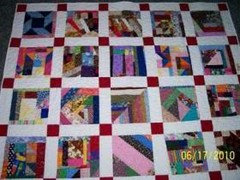
    On sashing: If using a cornerstone, sew the blocks together like a D9P and then cut normally. The 4 spot block should be twice the size you want the sashing to be and the length of the block. I did this quilt using that method. If you don't want cornerstones, make the center block the same as the 4 spot blocks. If it matters how the main blocks end up, there's a tutorial (somewhere) on laying out the D9P.

  • 10 years ago

    Lois, I have looked at those Guidelines on their website and wondered if they are really the "miracle tool" they claim to be! LOL I will check them out again. I know my poor vision (I have almost no depth perception) and a cutting table that is too tall are other issues.

    Sharon, I just can't visualize using the D9P method for sashing, but it looks like it works well! I'll have to find that tutorial. :)

    Donna

  • 10 years ago

    Donna, Practice on something small that the blocks to be sashed don't have to be all one way.....just to get the feel of how it's done. Here's one way of doing it. http://www.joscountryjunction.com/disappearing-nine-patch-tutorial/ My main blocks were larger so made the sashing blocks narrower which made them more of a rectangle.

  • 10 years ago

    Cutting the backing fabric and sandwiching. I enjoy the cutting, piecing ,sewing the top and then I go into major stall mode....I get myself challenge on the backing; however, I find it a tad easier when I don't piece the backing and just use one large piece of fabric. Also, I never seem to have enough pins for sandwiching, so I do basting and pinning...hate it.

    I enjoy the quilting as long as the quilt size is not much bigger than a lap, otherwise it's a bear to get work thru the throat!

    All in all...still love this hobby and wish I had more time to spend on it!

    V.

  • 10 years ago

    Valarie, have you ever tried the Elmer's School Glue basting technique? No more dodging pins as you quilt. No puckers. Sandwiching was my least favorite part of quilting until I tried my friend Elmer. Just be sure to use the washable School Glue, not the regular one you have laying around the house somewhere.

  • 10 years ago

    Lois, what is the secret with Elmers? I tried it once,but not with much success...how do you do it?

  • 10 years ago

    My least favorite part is piecing the backing. By the time the top is done, I just want to get on with the quilting, not messing with the backing. I love the elmer's glue method. I don't work well on my knees so a larger quilt can be a challenge. If the quilt is small, I do in in sections on my island. For a queen quilt this summer, I sandwiched on a large foam board on top of my porch dining room table. I glued in sections and it came out quite good. I don't remember any puckers when I quilted. The only problem is if you get the glue to close to the edge and then try to hand sew the binding, you can't get the needle through the glue. For the queen, I machine sewed on the binding so I had it done in time.

  • 10 years ago

    I like just about every part, but sometimes a particular fabric will give me problems. Some are thin and stretch when cutting, some are stiff, some just don't like being quilted. If I have to pick a least favorite, it would be squaring up after quilting.

  • 10 years ago

    Val, I have hardwood floors in my living room so I use them for the glue basting. A large table or island would also work if you do it in sections. I tape the backing to the floor, right side down, pulling it taut. Then I smooth the batting over the backing, taking out any wrinkles. I fold the batting back at the center and apply the glue to the backing. I use it straight from the bottle, drizzling a steady thin stream back and forth about 3-4" apart. Then I spread the folded batting back over the glued backing, smoothing it flat. I fold back the other half of the batting and glue. Then I repeat the process with the quilt top using another layer of glue. I let the sandwich dry for a few hours or overnight and then it's ready to quilt. The dried glue has never gummed my machine or failed to wash out completely. I use a wash cycle that's meant for sheets that uses plenty of water. This method really works well for me. I hope it will for you too, but remember, use only Elmer's School Glue. It's even available at most grocery stores.

  • 10 years ago

    Thanks Lois! That was helpful. I think where I made my mistake is not allowing the glue to dry completely and perhaps a little too much glue. I have a flat door sitting on two saw horses for my sewing table, it should work fine for this purpose. I'm going to give this another go!

0
Sponsored
High Point Cabinets
Average rating: 5 out of 5 stars21 Reviews
Columbus' Experienced Custom Cabinet Builder | 4x Best of Houzz Winner