Software
Houzz Logo Print
smudgedhorizon

Heavy clay drainage issues

10 years ago
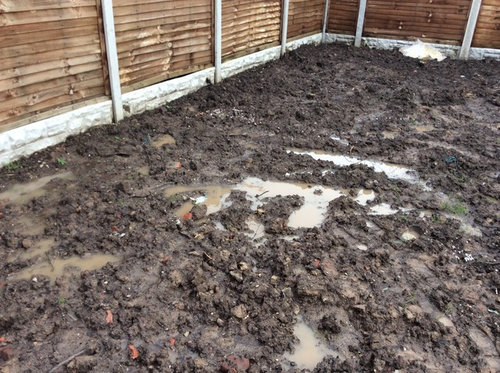

My garden measures 30ft x 30ft. It is very heavy clay, and currently a waterlogged wasteland. I've literally had standing water for weeks on end now, and even when there is no visible surface water, it is boggy and you sink if you try and stand on it!


I actually had land drains installed by a landscaper on the 17th December, to hopefully fix the water logging issue. It hasn't. There is still standing water and the ground is still boggy, I'm devastated as it was so expensive and seems like it's been a complete waste of money, which we didn't have much of to start with!


I have no idea how best to proceed now. I just want a garden where my kids can play on the lawn without it being a sinking mud pool that you need wellies for 90% of the time, & I want to be able to plant shrubs and plants (unfortunately I adore acers, which hate wet feet!) without them drowning.


From my limited understanding of things I have been considering these 3 options -


1) excavate 12" of clay from the entire garden (pretty much to the top of the drains) and replace with 12" of better topsoil, which will then (hopefully?) drain freely into the installed land drains. I'm not sure how trees with deeper roots would fare though?


2) add 10-20 tonnes of compost (and/or grit?) and rotovate into the top 6-12 inches of clay, to hopefully improve the drainage so it can freely drain into the land drains below.


3) raise the entire garden above the waterlogged clay - potentially add a layer of gravel/hardcore straight onto the clay as a drainage course and then add 12-24 inches of topsoil on top. Or can I just add topsoil without a gravel drainage course?


I would love any and all advice and opinions here - which option do you think is best? What are the pros and cons of each choice? Is there an option I've not considered?


Thank you so much for your time.


This is it currently. No rain for a few days and still so wet. It bakes solid in summer too.


Comments (12)

  • 10 years ago

    Am I right in guessing you're in the UK?

    We have had unprecedented rain and I feel for you. Even normally well drained areas are saturated.

    Looking at the fence is this new build? Have the builders messed up the ground (soil and drainage) and removed the topsoil? It looks as if you have bits of broken bricks and other rubbish in there too. Machinery has probably compacted and messed up the ground too. I'm suspecting that the drainage problem is due partly to the amount of rain we've had but mostly is a superficial problem due to the soil compaction and destruction of soil structure. Have you tried making a few holes with a crowbar to see if the water drains once you punch through the clay?

    I've never had to deal with this kind of situation but I know it's common. Have a look at section 2.

  • 10 years ago
    last modified: 10 years ago

    I generally agree with floral. That was my first question also... where are you? I live in an area where our clay soils stay moist all winter. I'm on a slope though. I was thinking... if you are okay with having 1 or 2, plant a type of tree that doesn't mind wet feet. Willows come to mind. They will use and transpire a good deal of ground moisture, and their roots don't mind clay too much.

  • 10 years ago

    I'd still grow them until they were getting too big for the space. The upsides outweigh the down, and are cheaper than hiring contractors.

  • 10 years ago

    I still disagree - they'd be totally inappropriate for a back garden in the UK - if that is where the OP is.

  • 10 years ago

    Well then, that's different lol. Appropriateness is definitely a British thing for sure!


    Is there a UK planting that could accomplish a similar purpose more appropriate to the conditions?

  • 10 years ago

    I agree with floral,thirsty trees are not a solution,that's simply adding additional trouble. I have suggestions, by far the best one is asking for the money back spent for drains or haveing landscaper finish the job of draining the garden. Lesson here is don't tell contractors what material and method unless you are knowledgable on the subject. You pay them them to" make my garden drain" not "install drain tile". Option 2 combined with part of option 3 sounds like a plan "IF" the tile are sloped and freely empty. Re; Option 3. Option 2 will raise the entire garden above the waterlogged clay. Adding a layer of gravel/hardcore straight onto and surounding the tile then cover with silt cloth then option 2 should alow drainage. If landscaper failed to install gravel and cloth above tile there's no suprise it doesn't drain. Does the tile run to daylite? If tile daylite's,have you looked for water flowing out while soil is waterlogged? It should be if properly installed. If water flows from tile they are doing their job but there might be a spring or waterline underground making it impossible to dry area out.

  • 10 years ago
    last modified: 10 years ago

    That is one scary picture.

    My opinion is that #2, adding OM to clay, will not be enough as both materials will hold water.

    #3 will get you gravel packed down into a matrix of clay eventually as the soil gets worked and trod upon, only averting the problem for a while.

    My suggestion, as almost always, is to add an enormous amount of fine sand from a crushing operation verses sand from alluvial/sedimentary sources, if feasible. The sharper crusher sand does not pack together as tightly as the water-formed sand. You need scads of sand so it's structural benefits aren't overwhelmed by the clay.

    THEN add your quarter meter of OM and mix everything, clay and sand and compost, well.

  • 10 years ago

    Removing 12 inches of that clay and replacing it with something called "topsoil" will not solve the problem, even with drains in the soil. Really good "topsoil" (if you can find it) will be a mix of about 45 percent sand, 25 percent clay, 25 percent silt, and about 5 percent organic matter. While the "topsoil" would drain well the clay underneath would not and thje4 "topsoil" would end up just as saturated as the clay.

    Adding organic matter, compost or whatever other vegetative waste you can, will, eventually, open up spaces in the clay and allow the water to drain. Adding sand, or grit, is not a good idea unless you are ready to work in 45 percent by volume, a lot and that will raise the level of your soil considerably.

    For a garden raised beds would be very appropriate here because you could get growing much sooner. That does not, however, solve the problem of a play area for the children.

    kimmq is kimmsr

  • 10 years ago

    I have questions.

    Is that a stone or concrete wall at the bottom of the fence?

    Where would the surface of the ground slope towards - i.e. is the whole area flat including your neighbors or is there a slope?

    What I'm getting at is, should there be some drain holes in the base of that fence to allow water to run off? Because it seems like it's just pooling because it has nowhere to go.

    How were the drains constructed, and where do they drain to?

  • 10 years ago

    All valid concerns Tox. Wouldn't you agree all should have been addressed by landscaper if he expect's to be paid?

  • 10 years ago

    I would say so.