Software
Houzz Logo Print
immortal_sage

Necessary(?) Granite Seams

10 years ago
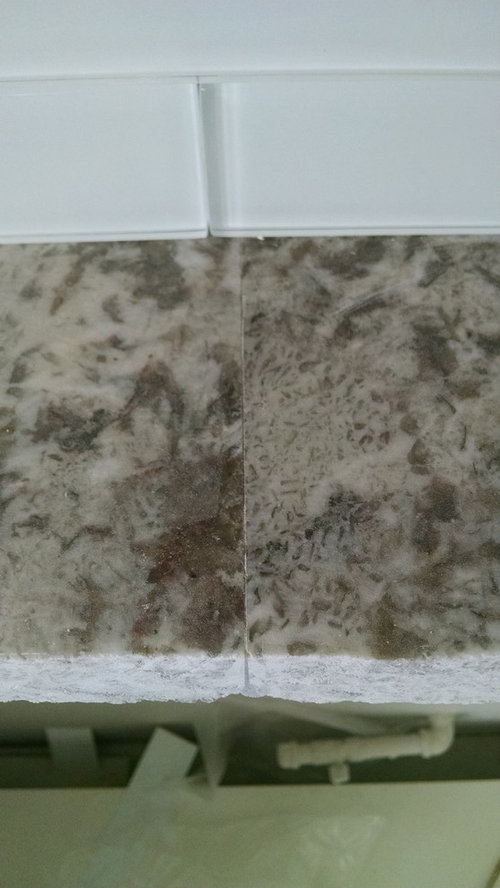
My builder placed a seam in the middle of the cooktop and the two slabs aren't well matched, so it doesn't look good. This section of counter top is not longer or wider than the slabs from which it was fabricated. The adjacent island is the same length and is twice as wide and was done with a single slab. So strictly from a dimensions standpoint, the seam was unnecessary. I complained about the seam and was told that it was done because it's stronger to have a seam through the narrow (4.5") sections required to have a cooktop in that position than it would be to do it seamlessly. From what I've read elsewhere, this seems like a lie to cover up a cost cutting move. Is there any truth to the statement?

Comments (25)

  • 10 years ago
    last modified: 10 years ago

    The kitchen came standard with granite. We paid to upgrade the granite to the most expensive level the builder offered (because we liked the pattern better) and replaced every counter top in the whole house with granite (3 bathrooms, and laundry room). The pricing for all of this was set by the builder, so any cost cutting here isn't saving me anything. I'm certain it would have required an additional slab to complete the job without the seam, which is also I'm sure why they did it, but they're telling me it's for strength reasons. I'm frustrated because I would have gladly paid the difference as I'm sure it would have only been ~$250 or so for a portion of one more slab.

  • 10 years ago

    My entire sink run is 3cm Carrara marble with no seams. The sink is 45 inches long. So I'm inclined to agree with you that the seams were not necessary for strength.


    Chewbacca Wookie thanked Nothing Left to Say
  • 10 years ago

    @crl_ Beautiful sink install :). The counter where my range was installed is very very similar to what was done for your sink only the narrow portions aren't as narrow. The overall length of the counter is comparable too.

  • 10 years ago

    Do you know if the builder used slabs or prefab granite? If it was slabs, it is highly unlikely you're builder could obtain a partial slab. Most slab yards only sell full sizes and they are all relatively the same dimensions, so someone has to pay for the full slab. Also, 250 slabs of granite are not common. Whether your builder charges you for the unused portion is a detail usually determined at the time of contracting. If prefab, there may be more flexibility. How long is the run of counter top with the seam? If I recall correctly, most prefab granite is only 8 ft long, which would be another reason for the seam.

    Chewbacca Wookie thanked rjknsf
  • 10 years ago
    last modified: 10 years ago

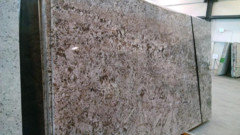
    @rjknsf It's not prefab, it was cut from slabs which were about 7'x12':

    We weren't quoted any cost for unused granite - just a cost to upgrade. It should be noted though that this is a very large builder (they have maybe 100+ houses going up currently, so the unused granite would likely have ended up in a spec house elsewhere). I'm basing the $250 mark off of how much we paid to have similar sized counters added elsewhere and this was of course an upgrade cost, not inclusive of the entire slab, so you're definitely correct there.

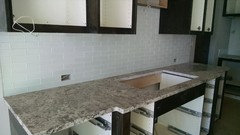
    The counter run can be seen here on the left:

    It's exactly 9' long, but the slabs are 12' long.

  • 10 years ago

    Mostly I'm trying to get at whether this was a cost cutting move on the part of the builder/installer, or is there legitimacy to their claim that it's for the strength of the counter install.

  • 10 years ago
    last modified: 10 years ago

    It was probably cost cutting. But also it looks to be on the back of your cooktop, right? How's the seam on the front! Are you okay with that one? You will barely see the back seam once your cooktop is in. No way is a seam needed for strength. That sounds like BS to me.

  • 10 years ago

    That rules out a few non-cost cutting reasons for the seams.


    I am not an GC or expert so I can't be certain. In terms of how this might save costs, I can think of a few ways:

    -seam means two pieces that weigh less which means fewer workers to lift each piece and easier to transport

    -seam allows for use of a remnant builder already had. Possibly he got away with 2 slabs + a remnant, rather than 3 slabs

    -Seam means less complex fabrication which reduces risk of breakage or damage to full countertop during the fab process


    Did you look at your quote or contracts to see if seams were mentioned and how they would be addressed? I recently received a few quotes for a fabrication job and I noticed that most specified that seams would be discussed in advance and approved by the customer.


    Is it possible to share a photo of the area that shows the cut out and the seams? I agree that the fabricator did a poor job matching up the patter.

  • 10 years ago

    @Navy Momma The seam at the back is worse than the one at the front. The front one was done well. Here's what the front looks like:

    It's less whether or not it was done well and more that it was done at all without asking and that the justification is strength and not cost.

    @rjknsf The risk of breakage is a factor, but honestly it looks like it was placed and then cut on-site rather than cut elsewhere (the cutting is very rough), so I don't think that's that case here. Unfortunately, I only have close up shots of the seams and far away shots, not one of the whole cutout up close.

    The quote doesn't say much of anything:
    Granite - Kitchen, Level 3 from Level 1 - $620
    Nothing at all is mentioned anywhere about seams and I'm sure I'm probably screwed on this, it just seems like kind of a scummy way to cut costs. And as you mentioned I really wish it had been a discussion rather than something that was just done.

    Long story short I think I have my answer. The strength argument is probably bullshit being fed to me to make me go away faster.

  • 10 years ago
    last modified: 10 years ago

    If you are building with a builder and not doing a custom project, they are not generally going to involve the customer on small (to them, not you) decisions such as seam placement. My MIL just built a home and she had many similar issues in her house- small details that she would have chosen to be done differently but she wasn't asked or involved and didn't necessarily know to question. The "level" grading of your granite tells me this Builder just does everything as a package to you but on his end he's goi g to keep his costs as low as possible and somehow this saved him money. Yes he's feeding you BS because he doesn't think you will question him.

    Chewbacca Wookie thanked Navy Momma
  • 10 years ago

    As Navy Momma said, it sounds like your home is basically a spec house that you get to chose the finishes on. Even though you consider it to be building a home custom for you, the builder doesn't see it that way. I know, we lived through this type of build almost 2 years ago. Most of the people in our development picked their granite from the small samples the selling agent had in the model. We went to the stone yard and picked ours out. When I told the realtor I wanted to place the templates on the slabs, she claimed that she'd never heard of anyone doing this before. Guess no one else had found GW! It's a good thing we did go down to do this as our original slabs had cracks and they had replaced them. I'm sure they were thinking we'd never notice had we not placed the templates.

    I ended up being a thorn in the side of the builder, but I got things done the way I wanted. Stand up for what you want. It's your good money that is paying for it. Good luck!

  • 10 years ago

    Of course, this is your house, not mine, but I'm pretty sure I could live with those seams. The one in the back will hardly be seen, and the one in the front isn't bad at all. I have one seam that runs through my sink, so it's front and center and where I stand dozens of times a day. My quartz pattern is more mottled and uniform than your granite but honestly, I don't even notice it.

  • 10 years ago

    @nhbaskets Yeah totally get that. We ended up changing a lot more than finishes, we did major rearrangements to the interior of the house, bumped out an exterior wall, and did the standard finishing stuff. We're about $70,000 in upgrade costs off of what the spec house would have been, so it's not exactly a spec house anymore, but yes that's certainly where we started.

  • 10 years ago

    The good news is that you're not going to notice the back seam in a week or so, but I'm with you - I hate being lied to. Especially by people who think they're putting one over on you.

    Chewbacca Wookie thanked suzanne_sl
  • 10 years ago

    If you don't mind, could you take a picture further back so we could see the whole opening, including the seams? I can't tell what that white seam is in the first picture.

    It would seem (pun intended) to me that a seam does not make the stone stronger.

  • 10 years ago

    From what I've read here over the years from the few fabricators who posted regularly, they run the risk of breaking the thinner connecting stone when they transport it into your home. Instead, they cut it and give you a clean seam. That would also be a stronger seam than if the granite broke and they had to repair it.

    You can find photos where the granite around a cut-out is all steel-rodded and being carried in by a half a dozen men, but you pay for that level of service.

  • 10 years ago

    @suzanne_sl my thoughts exactly.

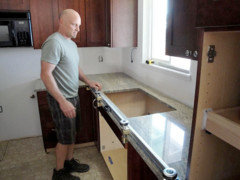
    @weedmeister I don't have a perfect shot, but maybe this one will help:

    It's a little too far back to see the seams well unfortunately. The white area in the first photo is from the on-site dry cutout they did.

  • 10 years ago

    "...they run the risk of breaking the thinner connecting stone when they
    transport it into your home. Instead, they cut it and give you a clean
    seam."


    Alternatively, there is this thingy whose purpose is to keep the thinner bits from breaking:

    It's essentially a brace. Once the granite is placed they take it off to use on the next job.

  • 10 years ago
    last modified: 10 years ago

    Yes, that's what I mean. If they're transporting it like that, there shouldn't be a reason why they can't put it in in one piece. But we're not fabricators so our opinions are just that.

    But I think the customer is responsible for the risk, right? They break it, you buy it.

  • 10 years ago

    Thanks for sharing the brace thing. It seems good. I saw in another post that it is quite an expensive piece of equipment. If I were a fabricator, I would definitely have one. If I were having a counter installed with a thin section, I would specifically inquire about whether the fabricator has a brace like this.

  • 10 years ago

    Risk is apportioned in the contract but typically, the fabricator is responsible until it is installed, assuming they are the one moving it. Regardless of what the contract says though, I think many fabricators have tried to shift responsibility when mishaps occur.


    Fabricating stone seems like a high risk business. Especially because all of us on GW insist on having 500 + pound countertops that are 10 feet long and have right angles :)

  • 10 years ago

    My marble slab shattered when they went to fabricate it. My gc ate that cost and bought a replacement.

  • PRO
    10 years ago

    " I complained about the seam and was told that it was done because it's stronger to have a seam through the narrow (4.5") sections required to have a cooktop in that position than it would be to do it seamlessly."

    This is complete BS, but, that said, your seams are excellent. When your cooktop is installed, you'll hardly notice them.

    Chewbacca Wookie thanked Joseph Corlett, LLC
  • 10 years ago

    Those are some of the best looking seams I have seen on this board and the pattern match in front is amazing. Count your blessings. No one will notice the back once the cooktop is installed.