Software
Houzz Logo Print
smashnelson

Newby needs advice please

10 years ago

I'm planning to build a raised garden this weekend (our first), and was all excited to get our first harvest, but from other posts I've read, if the soil used is straight from the store bag, the soil is not sufficient to grow much of a garden. We will be starting a composting bin soon. Would it be better to start composting now to start gardening in the fall, or go ahead and try to get a garden going now?
I'm planning to build a 4x12x12 raised garden. From what I've read in other posts, I understand that it's better to not put anything under the garden (definitely not plastic) but rather put the new soil on top of the existing dirt, is this correct? And does it matter whether the garden faces North-South or East-West? The back yard faces East, and the South wall, the neighbors tree, and our house would provide afternoon shade starting around 2:30 or so. Does this sound ideal? I'm afraid the Northeast corner would be too brutal. Any and all advice is welcome. Thank you!

Comments (9)

  • 10 years ago

    iandyaz, thank you. About four years ago we had somebody quote us $250 to build a bed 3x10x12 and she was going to fill it with 30 ft.² of soil, so I assumed I would need to do the same with this bigger bed. So, if I'm mixing with native soil, would you recommend I not go as high on the sides since I'll be digging down into the soil? And going this route, we could go ahead and plant and expect decent results?

  • 10 years ago
    last modified: 10 years ago

    You can still go as high as you want provided you have enough soil. I'm always planting trees or some other plant in another area of the yard so I will usually have excess soil from these areas to use in my raised beds. I rarely make raised beds nowadays, and when I do, I don't go very high. I'm doing one this year for an attempt at a ground blueberry.

    My first bed was about 3 feet tall and I found there was no good reason for me to do that. If your ground has a lot of caliche in it, or is very salty these are good reasons to make raised beds, and I would avoid that type of soil in the bed.

  • 10 years ago

    After reading your response I read about Singh Farm in Scottsdale off the 101 & Thomas on another post this morning regarding where to get compost, so the boys and I took a trip down there. We talked to Ken, the owner, and he gave us a ton of great information. We're not going to raise the bed per se, but dig, till, and turn the soil for a few weeks to a depth of about 12-18", mix in some compost (1 to 1 parts), and plant in about 3 weeks once the soil is prepped and ready to go. Thanks again iandyaz for your great advise and information; it's greatly appreciated.

  • 10 years ago
    last modified: 10 years ago

    One thing to consider is the summer heat. Some folks plant now because of it. Don't overthink how to do the soil; many many methods work and you may find watering to be more important.

    That farmer advice (to me) seems like overwork and overkill, such as the advice to let things wait for three weeks, but then again I'm dealing with an established garden here.

    If you end up building a raised bed, you don't have to fill it to any particular depth. You could add four inches of organic matter (OM), dig that in, and add more next season. Unless you're avoiding ghastly soil conditions, raised beds are more about control than fertility.

  • 10 years ago

    The strongest argument, imo, for in-ground vs raised beds is watering. In-ground beds retain moisture MUCH better than raised beds because the heat penetrates the raised beds much faster. Dig in that good organic matter, transplant the veggies, lay down a soaker hose then mulch with dried leaves or straw.

    If your soil needs to be broken up, plant okra. The deep roots help aerate the soil. If you wait too long to plant, the 100's will be here and depending on what you are growing, you may be too late. Tomatoes should be planted now. Good luck and keep us updated on how the garden grows.


  • 10 years ago

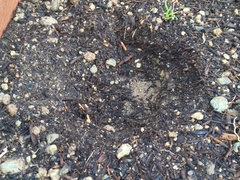
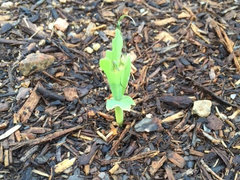
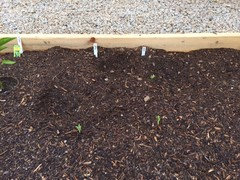
    A quick update regarding the garden: We used a pick-axe and dug the soil to about 12" or so, and mixed in 3 large bags of compost from Singh Farm. We did this over the 3 day weekend in February for MLK/Presidents Day weekend, and planted our garden the following weekend. We planted spinach, beets, cucumbers, carrots, spring lettuce, Bibb lettuce, corn, and watermelon, and transplanted orange and green peppers. The garden is doing ok, but twice now I've come across these holes in the garden that are almost perfectly round, and about 2 inches deep or so. I thought maybe it was quail digging for seeds, but don't see any tracks, and the tops of the corn, beets, and spinach are being chewed on/eaten, so I'm not sure what it is. Maybe a bunny? But I haven't seen any bunnies around our house in the last 4 years, and I don't know that bunnies dig? I'm attaching a few photos for reference; if you have encountered this before I would appreciate some feedback as to what this critter may be. I've made a few adjustments in the yard this weekend, blocking a couple holes in the wall. If this continues this week, I'm thinking it's the birds. If not, bunnies. Hopefully I can refrain from having to go get chicken wire. Anyway, that's the latest. If you have any ideas I'm all ears.

    And one last question: It has been 3 weeks since we planted and the watermelon is not showing anything. How long does it take for watermelon to sprout? I'm questioning whether anything is happening. The package said 90 days to maturity, but we're almost 1/3 of the way there. Do you think I need to replant them tomorrow? Thank you all!

  • 10 years ago
    last modified: 10 years ago

    Congrats on the garden, looks great :)


    Do those holes look like they do in the picture when they first appear? It kind of looks like the ground sunk in from air pockets in the ground below it. I've had problems with birds digging through my containers (they killed all my cactus seedlings last year) and I used scare tape to keep them away.

    I find chewing marks on seedlings are usually caused by slugs, grubs, or caterpillars that come out at night, but it could also be rodents. You can go out with a flashlight at night and see if you can find anything eating the tops.

    As for the watermelon not germinating yet, I'd wait a little longer if the nights have been cool around your area. They like warm nights. I know we've had a few 45-50 degree nights around here and most cucurbit seedlings will grow very slow at that temperature (if at all). They'll be fine but delayed a little if that's the case.

  • 10 years ago

    Thanks, iandyaz. The holes do look like this when they first appear, so it probably is just the soil settling. A lot of my workmates had their ideas, but none of them mentioned settling soil. One guy thought it might be a gopher, but I think he's just a big Chaddyshack fan. :)

    The tops of the spinach and corn look better after the weekend. The corn is really starting to grow quickly now, which is exciting. Per your advice I'll leave the watermelon alone for another couple weeks as the nights have been in the 40's off and on these last few weeks. Thanks again!

Sponsored
Whisler Home Improvement
Average rating: 5 out of 5 stars9 Reviews
Franklin County's Committed Home Improvement Professionals