

Molasses
After digging through the archives, I didn't find the answer to one of my questions concerning use of Molasses in the garden. While I still haven't come up with it in powdered form, I did grab a gallon of liquid, figuring I can dilute and spray.
My question is, is there an ideal soil temp that it would be most beneficial for microbial growth?
Comments (35)
 10 years ago
I did an experiment last year with molasses. I filled a 50 gallon stock tank half full of water. Added four 5 gallon buckets of fresh manure and one whole bottle of molasses. I stirred it a little for a few days then dipped the liquid out with a bucket to apply to the garden. The area I applied it to grew some VERY nice turnips. The ambient temp was about 80°. However, the tank was in the shade to avoid UV.
I'm thinking about doing it again in some of our new plots. They need all the help they can get.
Johnny
- 10 years ago
I was just reading about rhizobium and azotobacter.
----
"The decomposition of cellulose as well as the sugars in the decaying
plants provide Azotobacter with the necessary energy material and enable
it, and other microörganisms, to fix an appreciable amount of free
nitrogen. Phosphates and potash are also necessary."
"Wood chips are a good source of energy material along with green manure plants" Wood chips contain everything necessary for Azotobacter to improve the nitrogen content of soil.
2% organic matter is the threshold for fixing nitrogen.
http://soilandhealth.org/wp-content/uploads/01aglibrary/010160.Pieters.pdfBio fertilizer anyone?
Related Professionals
Dover Landscape Architects & Landscape Designers · Petersburg Landscape Architects & Landscape Designers · Pullman Landscape Architects & Landscape Designers · Gulfport Landscape Contractors · New Haven Landscape Contractors · Chicago Landscape Contractors · Amherst Landscape Contractors · Yuba City Landscape Contractors · Tampa Accessory Dwelling Units · Bloomington Accessory Dwelling Units · Hopkinsville Accessory Dwelling Units · Muncie Accessory Dwelling Units · Beatrice Accessory Dwelling Units · Santa Maria Accessory Dwelling Units · Bend Accessory Dwelling Units- 10 years ago
I'm sure there probably is an ideal temperature but haven't ever seen one, or don't remember it if I did. When I add dry molasses to soil, I do it before the planting period, so anywhere between January and April or May. If I am using liquid molasses, I use it whenever I feel the need, so even in summer, but I do like to let it percolate in the shade to make molasses tea just like Johnny mentioned.
okoutdrsman
Original Author10 years agoVery interesting link, Johnny. I'll have to bookmark it and refer back to it as I go along. Way too much for my feeble mind to digest in a short time!
Reading through the nitrogen section I'm starting to see what may be a peak temperature provided the necessary elements are in place.
When it warms a little more, I'll do a bioassay on the manure that I'm wanting to use for tea and to add to some of the areas in my garden. Until then, I've been using fish emulsion and molasses in water.
I should have probably posed my question a little differently. What I'm really curious about is if there is a known 'breakpoint' temperature where the microbial activity shows a marked increase. Now, that I think about it, the approach you are using, Dawn, pretty much pretty much negates the need for a definitive answer to that question. I am curious, what the indicators are that cause you to feel the need for followup applications?
There are still a couple of local places I need to check with and see about ordering dried molasses. I feel like it would work better for a general application over a larger area. Until then, I can buy gallon jugs pretty reasonable and I suspect they will go a long way in diluted form.
 10 years ago
Spring-like temperatures, I'm assuming.
Apologies for not reading everything, but I'm responding to original post. When studying worm tea, I read that the optimal temperature range was spring-like temps, meaning between 72 degrees and 86 degrees for the greatest microbial activity effectiveness.
The worm tea brew included molasses and fish tank air bubblers. Visual evidence (foaming) of exponential growth of good microbes in the tea was evident immediately following addition of unsulfured black strap molasses with bubblers for an hour. Basically, when I put the molasses in the tank, they exploded in population. It's impressive.
From the time one yanks the bubblers from the compost tea bucket there is a two minute window to apply the tea to plants and garden soil in order to have the most good bacterial life still active when you fertilize or drench the soil. (These microbes can die immediately without air.) This is something many gardeners have speculated. I apologize, but I do not remember the source of this info.
My comment is mostly not relative to answering your question. I'd like to point out how I realized this stuff is delicate and hard to control.
What I learned, if I keep things as close to the ideal climate as possible, microbes will rebound on their own when nature brings about the right temperatures. Adding mulch in extreme temperatures will help keep more good microbes alive as well as maintaining proper moisture levels. When spring arrives their numbers will grow even more.
In short, I'm writing upon the lines of Okiedawn's commonly inferred garden principle: To do our best and trust nature for the rest. It is very fun to speculate how we can make things better, tho.
Blessingsbon
okoutdrsman
Original Author10 years agoThanks, bon! It sounds like brewing the worm tea is very similar to wine making. Different active critters, but similar needs as far as temps and oxygen.
- 10 years agolast modified: 10 years ago
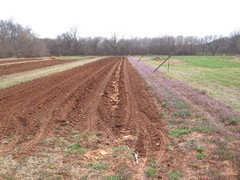
I can't afford to amend the whole 12,000 sq ft bed, so here is my plan. I used a middlebuster to create shallow ditches. I put fill sand and manure and a little urea in them. I'll soon cover them with my row hipper which will also create raised rows right above the good stuff.
We expect a few tons of green beans and okra.
As an afterthought, I wish I had a few tons of wood chips and 100 gallons of tea.
No, I did NOT have any adult libations today. I can make a crooked row while completely sober.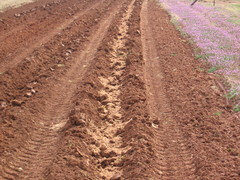
- 10 years ago
Plants grow just as well in crooked rows as in straight rows. I couldn't make a straight row if my life depended upon it, so I just don't worry about it. Well, I could plant a straight row if I hammer in stakes and run string between them and plant right along the string, but that's more work than I am going to do. Since I plant in staggered rows in blocks in raised beds and not necessarily in observable rows, all my plants grow together in one big mass of greenery over time. By the time the plants are half-grown no one can tell they weren't planted in straight rows within the blocks in the raised beds anyhow. I guess straight rows are more important if you are cultivating mechanically, but they don't matter so much to me with my little hand tools cultivating the soil in the raised beds.
okoutdrsman
Original Author10 years agoI started a comment last night that started with the same statement about the plants not caring. After working in the garden and greenhouse most of the day, and then went fishing. Guess I was too worn out to hit 'submit'!
My in-ground plants in the front garden get the stake and string method, but even then the rows aren't perfect! On the main garden, my string has springs off a trampoline, on each end. That serves to tension and allows me to hook to the 2"x4" welded wire fence. The fence is marked on 4' spacing. When I deviate from the the 4', it's simple math to switch for say, tomatoes or sprawling crops like squash. I know it sounds a little OCD (well, maybe a lot!), but it makes for simple and speedy row layout. It comes in really handy when using the Earthway, which seems want to dart around like it's consumed too many adult beverages.(big grin)
okoutdrsman
Original Author10 years agoDawn, are you using your Garrett Juice as a foliar spray or do you apply it to the soil?
 10 years ago
Howard Garrett was one of the best I heard this weekend. I didn't know who he was but his name sounded so familiar. So then I searched his name plus dawn in the OK forum Worked like a charm.
- 10 years ago
Bruce, I've used in multiple ways. It depends on what I'm trying to accomplish with it. You can even add a little orange oil (I always have a quart bottle of Medina orange oil in my kitchen cabinet under the sink) to it and use it as a fire ant drench. In general, think of Garrett Juice as a ramped-up compost tea or plant tonic and use it accordingly.
Kim, lol. When I lived in Texas, I always listened to his radio show, occasionally saw him on TV, read his newspaper columns and bought/read most of his books. I don't keep up with him as well since we moved here, but he is greatly responsible for me trying as hard as possible to garden the natural way. Nowadays, since I'm not hearing his radio show or reading his columns as much, I just visit his website occasionally to keep up with what is going on in the organic world, particular since Organic Gardening magazine has been reinvented as a lifestyle magazine, giving us one less source of organic gardening news/know-how.
I have to admit that after spending 10 straight days in the garden (well, yesterday it was only 1/3 of a day) I am toast, dead meat, etc. and can barely keep my eyes open. I'm happy we are expecting rain here because this gardener is too tired to garden. I'm almost too tired to type these words. Usually I'm not this tired until the end of March! In our yard, the willow trees down by the pond are leafing out, the first peach is going to bloom tomorrow, and the blue star grass is blooming. Everything is roughly a month ahead of schedule.
Dawn
- 10 years ago
I took a 2 hour nap in my garden shed today. Woke feeling good.
We planted almost 5,000 row feet today. We wanted to get it in before the rain. Spinach, beets, carrots, snow peas, and others I forget. We will have to fill out our garden log tomorrow.
Johnny
- 10 years ago
Johnny, If my husband or son arrived home and found me sleeping in the shed, they'd be worried I was losing it. (grin) I find it hard enough to sleep in bed at night during planting season. I am like a little kid on Christmas Eve---so excited about planting that I wake up seemingly every hour, wondering if it is time yet to get up and go outside and plant. After all these years of gardening, it amazes me that gardening still so enthralls me that I can't sleep because I'm so excited that it is planting time.
I did everything I could in the garden in advance of the rain, so I am pleased. We have gotten over an inch of rain so far, but our temperatures are dropping and now we're in the 30s. I guess I'll go outside in a minute or two and move the flats of warm-season plants indoors to the light shelf. I wanted them to sit out as long as possible so they could be watered with real rain instead of water from a hose.
I guess I'll spend the rest of today potting up tiny baby tomato plants. I want to be ready for them to go into the ground when the time is right.
Truthfully, I needed for it to cool off and rain so I'd take a big of a break from the long days in the garden. These next couple of days promise to me just bad enough outdoors (cold and windy even after the rain moves on eastward) to keep me indoors, so surely I'll feel rested and ready when the nice weather returns.
I hope you get enough rain up there to encourage the seeds to sprout. Our soil here was so very dry that water was beading up and rolling around on the soil surface, so I pre-watered every planted bed with the water hose yesterday afternoon in order to make the surface moist enough that the rain would soak in instead of running off downhill. We really needed this rain so I am relieved it is here.
Dawn
- 10 years agolast modified: 10 years ago
Dawn,
That is one of the reasons I like raised rows perpendicular to the slope. The raised rows slow the runoff thereby preventing erosion and encouraging water to soak in.
My favorite time is watching the baby plants come up. It just amazes me. It is like getting to watch the miracle of life over and over.
Johnny
 10 years ago
Me, too, Johnny, newly sprouted seedlings are my favorite gardening thing, except, maybe, for a big Cherokee Purple on a BLT.
- 10 years ago
I agree. I don't even care if they are just volunteer annual flowers or herbs. I love seeing them pop up out of the soil and I always try to find a place to move them to if they're somewhere that they cannot stay. This week my cup runneth over with fennel and dill seedlings coming up in a couple of places as thick as grass. I"m going to dig them and pot them up tomorrow so they can make a little growth before I put them back in the ground somewhere else. I saw a tiny tansy plant along the fenceline yesterday and was so happy to see it. It's the first tansy volunteer of the year, and it can stay where it is because it is in between two fairly widely spaced tansy plants in that area. Tansy can be invasive, but I still enjoy seeing the young seedlings. After all the rain we had last year, I'm amazed the tansy survived,and even more amazed the seeds didn't all wash away. My next favorite thing is when I notice baby tomatoes on the plants early in the season. I don't actively search the plants daily for signs of fruit forming, but when I notice them, it's a red-letter day. Really, if I start listing all my favorite things about gardening, it would end up being a long list.
- 10 years ago
Dawn and Amy,
I ate some of my sweet corn and Kennebecs I canned in 6-2014 for supper.
Those potatoes tasted SO good. I used cultured organic butter, salt and pepper.
Icing on the cake!
Johnny
- 10 years ago
Johnny,
That sounds superb!
We have switched to a Irish butter called Derrygold that is not quite totally organic but very close to it. The cows that produce it are largely pasture-fed, but do eat some cattle feed some years during the coldest part of the year if all the stored hay runs out. It is, quite simply, the best butter I've had since my childhood (you know, back when butter tasted good). I am not this picky about many things, but since we started eating Derrygold, it is the only butter I'll buy and eat.
Being as picky as I am about growing healthy produce as organically as possible, I want the butter I use on our produce to taste as good as possible. I think the older I get, the pickier I get, but in a good way because my pickiness is all about better-quality food nowadays.
We do not purchase and eat 100% organic food, but over time, the amount of organic food in our diet is steadily increasing.
Dawn
- 10 years agolast modified: 10 years ago
Dawn,
After living in Europe for 9 years and gardening for many years, I am something of a food snob. AND, I'm not ashamed to admit it.
I went to the same little restaurant for lunch every day while living in a small town in West Germany. I always ordered filet mignon or chicken cordon bleu. One day the chef came through the swinging doors from the kitchen with a clever in his hand. He said "who is asking for ketchup to put on my filet mignon?"
I raised my hand and tried to smile. He saw I was American and let it slide, grudgingly. I volunteered that I grew up in beef country and knew what I was doing. I was tempted to run out when he glared at me. That was a big clever!
Johnny
- 10 years ago
Johnny, I'm glad you understand about the importance of imported European butter. (grin)
I first found it in a German grocery store in Muenster, TX, where we purchase beef (because their slaughterhouse is behind the store and the beef and other meats are superb) and I bought it because I was curious about why a little German store in a small Texas town would bother to carry imported butter from Ireland. As soon as we tasted it, I knew why. A few months later, I discovered that CostCo was carrying not only Derrygold butter, but Derrygold's Dubliner cheese as well so I started purchasing both of them there. We shop at CostCo weekly because it has a huge selecion of organic food, dairy products from cows not treated with bovine growth hormones, and other healthier choices that appeal to us.
I'm glad you survived your encounter with that European chef!
When our son became a professional firefighter, one of his co-workers at the first station he was assigned to was a guy who had been a trained chef. You wouldn't believe how good the food was at that fire station and our son learned a lot about cooking great food from his co-worker. Actually, many firefighters are great cooks since they work 24-hour shifts and have to prepare many of their meals at work, but my son's station was the first one I knew of where chicken cordon bleu was a regularly-featured menu item. They do not always eat that sort of food as sometimes you barely have enough time in between calls to throw together a quick meal, but they do eat some great meals when they have the time to cook them.
Dawn
okoutdrsman
Original Author10 years agolast modified: 10 years agosoonergrandmom, Tractor Supply has it. May have to ask or just look in the area, they have deer feed in. If memory serves, it was $10-12 for a gal. It does contain propionic acid as a preservative. No sulphites as near as I can tell.
I am fairly familiar with the use of sulphates and sulphites as a preservative or sterilizing agent, but the propionic acid was a new one. Guess I better do a little research?
- 10 years ago
Thank you. I thought I had seen in once at Atwoods, but when I looked I couldn't locate it again. Tractor Supply is closer to me, so I'll have a look.
okoutdrsman
Original Author10 years agolast modified: 10 years agoNot liking the looks of propionic acid. Not thinking anti-microbial is what I need!
okoutdrsman
Original Author10 years agoPropionic. Seems autocorrect has an issue with that one and I failed to catch it on the second comment!
okoutdrsman
Original Author10 years agoAfter waking up at 3:00 with a case of the 'wide awakes', I decided to dig a little deeper an find out a little more about this stuff. After reading MSDS from a couple of the chemical companies, I decided to see if there were any reports of testing in soil. After all, MSDSs are generally only concerned with the direct contact with humans are based on higher percentages of concentration than we are likely to see. And since we trust big chemical companies so much, I figured anything I read there would be highly skewed.
It appears propionic acid occurs naturally in human and other mammal digestive tracts. And many plants produce it naturally in the root structure. One of the test results I read indicated it reduces heavy metal uptake into the plant. Another test indicated it only reacted in soil with a PH of less than 5. It went on to discuss conditions in soil with a PH greater than 8. At that point, I went on another article.
It's also present in fairly high percentages in fish emulsion used as fertilizer.
One of the more interesting discussions I read was from 2012 on the Tomatoville forum. http://www.tomatoville.com/showthread.php?t=22138&page=2
I wrote and deleted a rather lengthy opinion based on my short stroll through the internet, but decided it would be better if everyone reads and draws their own conclusion on whether this is safe or unsafe to use in the garden.
I do have about 4 gallons of tea brewing. We will see how it acts and at that point I will decide whether to use it or not.
okoutdrsman
Original Author10 years agoWell, the tea seems to be active. Since I'm fairly new to using them I'm not entirely certain what that means. Am I correct in assuming it's similar to other fermentation processes?
- 10 years ago
Yes.
And, by the way, if you want to catch those pesky moths whose caterpillars become cutworms, just leave some molasses tea in a bucket under your outdoor nighttime security light. They flock to it and drown. So do June bugs. Guess how I learned this? (grin) One more use for molasses tea.
- 10 years ago
I bought a portable bug zapper cheap at walmart. Have you seen the crazy woman in my neighborhood chasing white moths with a pink badmitten racket? She is NOT fast enough. The grandson was crushed that he couldn't play with the toy.
okoutdrsman
Original Author10 years agoUgh, cutworms. Some years are worse than others, but I always have problems with them! I will have to try using the tea trap. Might even check with the neighbor and see about putting one by the neighbors yard light, too.
I'm trying to grow some four o'clocks for the june bugs. Somewhere, I read they are attracted to them and I guess they contain a substance that is toxic to them? I've heard the plant can be invasive?
- 10 years ago
My experience is that 4 o'clock reseeds readily. But that can be a good thing. Most any plant, except Bermuda and stickers and maybe just a few others, that takes care of itself in an Oklahoma garden is a keeper!
- 10 years ago
Four o'clocks are highly invasive and I grow them anyway.
As Scott noted, anything that wants to grow like mad in our weather conditions and that is low-maintenance is worth having. The great thing about four o'clocks is that they won't die on their own and you certainly cannot kill them.
Mine mostly grow outside the fenced garden, and even the deer don't eat them. Neither do the voles. That gives me an idea. Maybe I should plant more 4 o'clocks closer to the garden fence to discourage voles from tunneling under the fence.
I simply adore the scent of the four o'clock flowers at night, and will walk outside in the evening just to inhale the delicious aroma. Four o'clocks reseed vigorouslyly and the little four o'clock plants pop up in my garden a lot once the soil temperature reaches the right range. (It isn't there yet, but I saw daturas popping up yesterday, so the soil is getting prety warm.) I consider the time spent weeding out four o'clock seedlings to be a small price to pay for having an ocean of four o'clocks growing between my garden fence and the pecan tree in the front yard. It is an area that is generally too shady for grass, so the four o'clocks grow and spread like a gigantic ground cover. In our situation, they are the perfect plant for that spot and they are happy there, so they spread out and cover an increasingly larger area every year.
I've often wondered if the large number of four o'clocks and daturas I have in and around the garden are why my tomato plants seldom have hornworms. Even when I have grown 300-600 tomato plants a year (in my earlier years here, when I was experimenting with many different varieties), I may see perhaps 4 to 8 tomato or tobacco hornworms in the garden a year, and some years I don't see any hornworm damage to tomato plants at all. You'd think that with a large number of tomato plants, there would be a large number of hornworms, but that's not the case here.
In fact, both yesterday and the day before, I found a couple of the younger instar brown hornworms in the garden, and just shrugged. I don't know what the poor things will find to eat because there's nothing they like up and growing in the garden itself yet, and it is doubtful they'll find the tomato plants in their containers on the patio which is a long way for the hornworms to travel.







Okiedawn OK Zone 7