Software
Houzz Logo Print
johnaberdeen

North Pacific Warm Blob is Dead

10 years ago

I posted this on the Cloudforest Gardener, Palms and the Tropical Look forum, but thought that people on this board who have enjoyed two warm winter in their gardens might like to know that we will be heading back to normal or cold winters now.

http://earthsky.org/earth/warm-blob-is-
... IA.twitter


For us gardeners who plant on the edge that
means back to colder winters. I guess the strong El Nino broke it up. Maybe this
is why the NWS is predicting next winter to be normal or colder than normal.


For those that like to fish for salmon and steelhead, this is good,
since there will now be food in the North Pacific for these fish to eat and
survive.

Comments (11)

  • 10 years ago

    Bummer.


  • 10 years ago

    Intriguing. We've only been here for two years, so I guess I don't know what a normal winter looks like...

  • 10 years ago

    Gardengal is right, you can count on gray skies, lots of rain, and wind can be counted on from October until about the first or second week of July. From that point on it is bone dry until the next October. If you are lucky. We are now starting to see rain and wind storms in August and September. We use to only have them once or twice a season in the fall and early spring. I think this year we have had more than a dozen or so.

    As a kid I remember cold and lots of snow in the 1950's. We ice skated on the local lakes and even drove cars out onto them since the cold lasted enough to form ice thick enough to hold a car. The Chehalis River use to freeze thick enough to walk out on it until the tide turned and the ice fell. But the last time I saw that was 1962 when we had an Arctic storm that got down to -6° F in Montesano Washington. When I lived in the Bellingham/Ferndale area from 1975 until 1980 the Nooksack River would freeze over every year. In the spring I watched the ice flowing out of the river into Bellingham Bay. I have been told by friends still living there, that the Nooksack hasn't frozen for many years now.

    In the 1980's we had several month long very cold freezes. 1982, December 1st it got down to 4°F and stayed below freezing both day and night until January 1st. I lost my collection of Butterfly bushes that year. I had white to dark purple flowering bushes. Dan Hinkley said they are hardy to about 0°F, I believe him after that storm got through with mine. We had several other minor Arctic outbreaks between that storm and the last two Arctic storms, 1989 and 1990 that were into the single digits and lasted a month long. The last single digit storm was 1998, I had just moved to Issaquah. It only lasted two weeks. All other storms since then have only lasted two weeks at the most and were only down to the mid to low teens in the Issaquah area.

    So the NWS saying we might get colder than normal might mean that we will probably have a Arctic storm or cold event that will take us down to the mid teens for two weeks. But don't be surprised if we don't go much further down and last much longer. It has been a long time since we have had such a storm, we might be over due.

  • 10 years ago
    last modified: 10 years ago

    Very interesting - thanks! We're just south of Seattle on the water tucked in the back of an east-facing cove with a steep rise behind us to the west and surrounded by tall trees on three sides. So we're fairly well protected from most windstorms.

    Our temperatures seem to be more moderate than the surrounding areas, probably because the bottom of our garden is on Puget Sound. We're often 10 degrees warmer in the winter and 10-15 degrees cooler in the summer than the middle of the island, which is 10 minutes drive from here. When you factor in the solar mass from our terraces, we really are our own microclimate. I think we got at most one frost this winter. I got broccoli straight through the winter, and my hollyhocks were still blooming in January. I sometimes wonder if we're more Zone 9a, despite the maps generally showing this area as 8a/8b

    It'll be interesting to see what future years bring, weather-wise. All I have to guide me is looking at what plants survived the 20 years of neglect before we bought this place.

  • 10 years ago

    If you live right on the Sound, it is very likely you are in a z9 situation. It is the temperature moderating influence of a large body of relatively "warm" water that is providing that milder situation. I too live adjacent to the water in the Kitsap area and have noted both milder winter temps as well as cooler summer temps just by my very close proximity to the water. Plants that would normally die back each winter at my Shoreline property - digiplexis and melianthus - have remained full and green (the melianthus is absolutely lush looking) all winter long here in Indianola and some tender succulents have survived outdoors without issue.....as long as I can protect from the nearly constant rain we have experienced!

    This warmer zonal characteristic has a very narrow profile - you really need to be right ON the water to appreciate its benefits. Even a block further inland can have a colder aspect in winter and a slightly warmer one in summer. I take it as an excuse to grow some less than reliably hardy plants for this area - pittosporum and eucryphia to name a couple - which so far, after 5-6 years, are doing fine. Also, some of the largest hebes I have seen in this area are located in properties very close to the water.

  • 10 years ago
    last modified: 10 years ago

    Again, Gardengal is right. I know people who live within a stones throw of the ocean whose melianthus, fiber banana (Musa basjoo), and Austrilian tree ferns have kept their leaves in the last two winters. In a normal winter their leaves are killed by late winter put the plant survives. In those past bad storms I told about, I have seen parts of the Sound and Hood Canal frozen over. In those days people who lived along the water lost or had damaged plant.

    When I moved to Aberdeen a few years ago I wanted to live in the down town area of either Hoquiam or Aberdeen which are 9a zoned. But my wife is scared of the big earthquake and the Tsunami
    that it would cause so we had to look for a place above fifty feet. We bought a home on a hill at 300 feet above sealevel, which is just into the zone 8b. It is warmer than Issaquah where we were living. Issaquah is also labeled as zone 8b but its average extreme low is 16° while my Aberdeen house average extreme low is 19°. I have seen 17° since living here, but saw 8° in Issaquah.

    So living along the water has a benefit of being able to grow tender plants that can handle cool summers. Enjoy it and hope we don't have a big earthquake within our life time.

  • 10 years ago
    last modified: 10 years ago

    Thanks so much! I'll expand my plant selection a bit and start looking into Zone 9 plants. I have a Meyer lemon in a pot that actually seems to have kept its blooms this year. If I could figure out a way to keep it from drowning I'd put it in the ground. My snapdragons seem to have survived the winter, too.

    I'm not a fan of tsunamis myself - my husband's stepbrother was caught in the Indian Ocean tsunami - so unlike many of the other homes around here ours isn't actually on the water. Our garden sits between our house and the sound on a fairly steep hill. We would likely lose our garden in a tsunami, but our house is about 50' above the Sound.

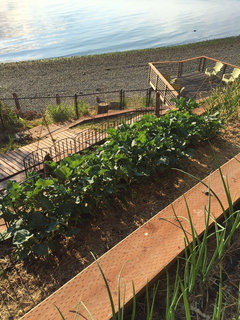
    A view down across several terraces to the water. The house is a couple terraces higher.

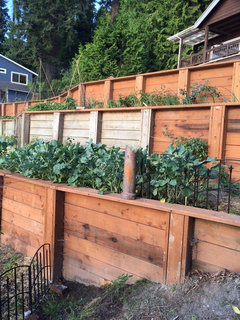
    Looking up. You can see the broccoli and onions repeated in both pictures. My house is the brown one on the right.

  • 10 years ago

    Yes, the tsunami risk inside Puget Sound is much less than it would be along the coast. Even a hefty earthquake along the Seattle or Tacoma faults is unlikely to cause significant damage (the faults are not significant enough to trigger the "big one"). There are various simulations to indicate the impact in various locations around the Sound but most locations would only see the equivalent of a VERY high tide while some others would see a surge of one and a half meter to as much as 3 meters in specific locations........not all that overwhelming, all things considered :-) We are probably much more likely to see significant landslides associated with a Puget Sound based quake but they too have the ability to generate seiches or tsunamis.

  • 10 years ago

    What I have read in the last 1,200 years, the last being 1949, earthquake generated waves in Puget Sound maximum height is around 15 feet, either from the sudden rise of the sea floor, landslides above the water and below the water. Even at high tide most people wouldn't have to worry about their homes. Maybe their gardens like Pugetsoundgardener.

  • 10 years ago

    But past conditions isn't what we are facing now.