Software
Houzz Logo Print
qcngn

Coffee Grounds

How many here use coffee grounds in their containers, raised beds and compost bins/piles ?

I've been using them going on 2 years now and get a 5 gallon bucket of them every week from work and add it to my soil in all of my fruits , vegetables and herbs. And I use allot of it in my 80 gallon barrel composter that gives me soil to use every 6-8 weeks.

Comments (12)

  • 10 years ago

    I do our own in compost pile and when I remember, ask coffee shop for theirs. And when I'm REALLY lazy, just dump directly on nearest flower bed

  • 10 years ago

    Great Houzz digested my comment. So here it goes again.

    Coffee
    grounds as a plant medium is not a great idea. As far as I can tell it
    is a folklore. No studies can be found to support it. But you can find
    studies to illustrate that it does the opposite - stunt plant growth. It
    has some toxic substance (for plants) and its high carbon content robs
    nitrogen from soil.

    Better to compost it well. I use coffee
    grounds from Tarbucks (can you tell I do not like their coffee) and our
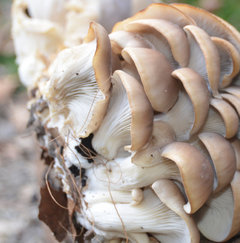
    own and make 1-2 gallon plastic bags inoculated with oyster mushroom
    spawn. In a month or two I get one or two flushes. Some of the spent
    grounds goes to inoculate the next batch and the rest goes into the
    soil. Great fun too.


  • 10 years ago

    FULL REPORT

    The following information was developed for Sunset by Soil and Plant Laboratory Inc., Bellevue, WA.

    Summary: Use of Starbucks coffee grounds in amending mineral soils up to 35 percent by volume coffee grounds will improve soil structure over the short-term and over the long-term. Use of the coffee grounds at the specified incorporation rates (rototilled into a 6- to 8-inch depth) will substantially improve availabilities of phosphorus, potassium, magnesium and copper and will probably negate the need for chemical sources of these plant essential elements.

    The nitrogen, phosphorus, potassium "guaranteed analyses" would be as follows for the coffee grounds:

    Nitrogen: 2.28 percent
    Phosphorus: 0.06 percent
    Potassium: 0.6 percent

    Available nutrient levels: The pH or reaction of the coffee grounds is considered slightly acidic and in a favorable range at 6.2 on the pH scale.

    Salinity (ECe) is a measurement of total soluble salts and is considered slightly elevated at 3.7 dS/m. The primary water-soluble salts in this product are potassium, magnesium, sodium and chloride. The potentially problematic ions in sodium and chloride are each sufficiently low as to be inconsequential in terms of creating problems for plants.

    The availabilities of nitrogen, calcium, zinc, manganese and iron are quite low and in some cases deficient. Thus, the coffee grounds will not supply appreciable amounts of these essential plant elements when used as a mineral soil amendment.

    However, the availabilities of phosphorus, potassium, magnesium and copper are each sufficiently high that there will be a very positive impact on improving availabilities of these elements where the coffee grounds are used as a mineral soil amendment. The coffee grounds will negate the need for additional sources of phosphorus, potassium, magnesium and copper when blended with mineral soils.

    In summary, the available plant essential elements which will be substantially improved where the coffee grounds are used as a soil amendment, include phosphorus, potassium, magnesium and copper.

    Total nutrient levels: Each cubic yard of these coffee grounds contains a total of 10.31 lbs. nitrogen, of which 0.01 lb. (0.09%) are available. Thus, even though available nitrogen is considered deficient in this product, there still remains over 10 lbs. of total nitrogen per cubic yard of coffee grounds. Thus, nitrogen is primarily bound in the organic fraction and is unavailable to plants until soil microorganisms degrade the organic fraction. Through this process, the nitrogen is converted to plant available forms. Over the long term the coffee grounds will act like a slow release fertilizer providing long-term nitrogen input which can then be utilized by plants.

    Nearly all potassium and all magnesium are in the available forms. This means that immediate availability improvements for these two elements will take place when the coffee grounds are blended with mineral soils. About half of the copper and calcium are in their immediately available forms.

    All other plant essential elements are primarily bound in the organic fraction and will thus be subject to slow release over time as soil microbes continue to degrade the organic fraction.

  • 10 years ago

    Nick interesting chemical analysis but does not include a study on plants. The cynical in me suggests Starbucks paid for the chemical analysis so that they can get rid of their waste more easily. But there are a few studies on plants out there and this topic has come up before in gardenweb too. When I get back home I will look for them. But in summary, it can reduce seed germination and it can have toxic effect on root development resulting in stunted growth. Some plants are more susceptible to it especially in containers where there are no or not enough micro-organisms to break it down. For the same reason it is a good weed controller and has the ability to mitigate certain soil pathogens too. For the same reason it is also good base for mushroom culture too.

  • 10 years ago

    The majority of my grounds are now going in my compost and not as a topping anymore on my plants and trees. I look forward to your next post on the topic ToC.

  • 10 years ago

    Hi Nick, thanks. These kind of discussions are quite helpful to periodically remind ourselves what is the state of the art. I looked around my saved links and did a bit research and this is what I could gather.

    After reading them again, I think the common story is of a cautionary nature because of coffees special contents that can be beneficial or not depending on the angle. Basically, I gather that composting it prior to use or using it in moderation in the yard is acceptable.

    Gardenweb links discussing effectiveness of coffee grounds:

    growth inhibitor properties: Here someone links to a non-existent page on allelopathic properties of coffee. The term allelopathy is what I was looking for. Basically, coffee's caffiene and some phenolic contents have an adverse effect on germination and subsequent growth.

    Another one that is an interesting read on various gardeners observations including some negative and positive takes on coffee grounds.

    This discussion mentions the allelopathic effects (by Al whom I trust a lot) and his thoughts on its effects in containers.


    On the web I found a few interesting ones.

    This one on sustainable gardening, Australia found that beyond a very small amount growth response of certain plants was hampered with the addition of coffee grounds. The speculate that it could be because of phytotoxic effects of coffee ingredients.

    This one from WSU has some interesting observations. That in low doses in the yard it may be beneficial in more ways than plant nutrients. Interestingly they also mention that not expect coffee grounds to make compost acidic. I believe this because it hard to change the acidity/alkanity of soil (I mean yard soil) by adding something. In the short term it is possible. But in the long term, the Ph is decided by many other factors.

    There are other papers that studied effect on germination and found to adversely affected germination rates of some very specific plants they selected.

  • 10 years ago

    What is PPO, Al? Thanks for explaining this again.

    Nothing scientific but I did one experiment before on a rose vine. I forget the variety but it produces abundant salmon coloured roses all through the season. So one spring I mixed in some coffee grounds. For the first two months it sulked producing a few roses. Near the end of the season it suddenly took off producing man large roses. In retrospect, I think the coffee must have affected its initial growth and then it decomposed enough that it actually helped the plant later.

  • 10 years ago

    Polyphenol oxidase.


    Al

  • 10 years ago

    Isn't there ample tannins in aged pine bark?

    and how much caffeine are we talking about? :) it's hard to numerate afaik

    few wks ago I had a beans going stale so I ran half a kilo coarsely thru the grinder... and used some as a mulch for coriander seeds. Yeah freshly ground beans, never been brewed = caffeine full whack, unextracted

    they've sprouted after 2wks (phew)

  • 10 years ago

    I make coffee in a one-cup French press, and frequently fling the spent grounds out into the back garden beds during cold or rainy weather, to avoid having to put my shoes on and take it out to the compost. I figure that small quantities like that, spread out, aren't going to have much of an effect on anything. Putting them in container plants doesn't seem like a great idea. I like the idea of supplying nutrients with a more controlled source, like Dyna-Gro.

    For composting, coffee grounds are great. Last year I made a deal to get 5-gallon buckets of spent grounds from a local coffee shop to use in early spring when I've got tons of low nitrogen-to-carbon ratio stuff like oak leaves but not much green matter yet. The grounds help the pile heat up and speed the process.


  • 10 years ago

    Tamiya: Apparently not all plants react to coffee in the same way. May be you can update later on to see how the coriander fares. Coriander is also a tough seed. Every year in late spring we get tons of it just from the fallen seeds from previous season. Some patches of plants even make it through the winter.