Software
Houzz Logo Print
liz5572

Shrub ID help? Want to prune...

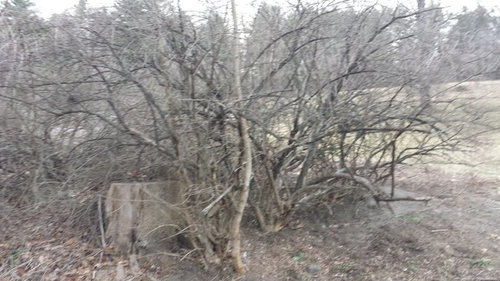
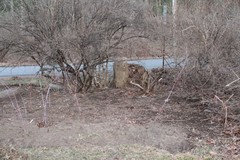
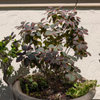
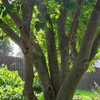
Can anyone help ID this shrub? It looks like an overgrown
serviceberry but not sure? Multiple trunks from the ground, cluster of
3+ large shrubs in one area. Unfortunately no leaves on the tree to help
ID.

Any recommendations for pruning/cleaning up?

Thanks for any help.

Comments (42)

  • 10 years ago

    Closer view needed

  • 10 years ago

    id start with what looks like a tree in front ...


    google the term REJUVENATION PRUNING OF SHRUBS ...


    its a 3 years system to rejuvenate the plant... no matter what it is ...


    i would probably speed it up.. by removing the largest 1/3 soon ... review how it reacts ... and if i saw fresh new growth from the cut stubs by fall ... i would remove the second third in fall ... speeding the process a bit ...


    with no insult to the roots... this thing should rejuvenate rather quickly ...


    its MIGHT be dependent on an ID.. and i await such.. but i doubt it would make a difference ...


    you may have to wait until it leafs out.. for the ID ... but sometimes.. buds can be IDd ...


    ken

  • 10 years ago

    You all are great, thank you. Thanks for the recommendation for google search terms. I am very new to landscaping/lawn care and eager to do the right thing. I have a neighbor who told me he just uses a shrub trimmer with similar
    bushes and that will cover it and I am in disagreement since i don't
    think that's the right move from what I've read so far.

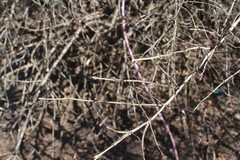
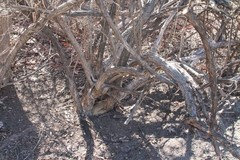
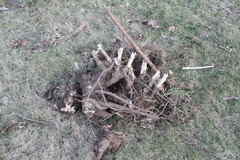
    Here are some more pictures to help with ID:

    Don't mind the blackberry cane in there:

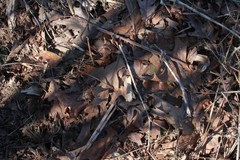
    not sure if these are the leaves from the trees or the bush:

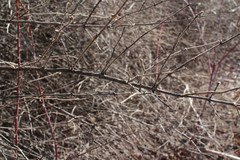
    Hopefully a good view of buds:

    Closer view of trunks:


    Thank you! :-)

  • 10 years ago

    Well it appears to have opposite buds so it isn't Service Berry. And it doesn't look like Elder either, although that has opposite buds. The dead leaves are mostly oak so they have blown in from elsewhere.

    I now think we may be looking at a shrubby honeysuckle. Lonicera species. If it is that you might want to research if it is invasive in your area. Even if it isn't, and you want to keep it, I think the best way to deal with it is to cut the whole lot to the base because if you have tree seedlings and brambles in there it really needs cleaning up before you start working with the shrub itself.

    elizabeth b (zone 5 - northern MA) thanked floral_uk z.8/9 SW UK
  • 10 years ago

    We are already dealing with an enormous amount of Japanese knotweed in another part of the yard, so I'm sure this is invasive as well :-) We originally wanted to clear the area because we had a lot of poison ivy in the area last year, and we had some great blackberries but couldn't get to them - they had overgrown tremendously.

    We'll have to get rid of those self-sown trees there too - they are going to start messing with a little trench that goes under the road soon.

    Thanks!

  • 10 years ago

    If you have Japanese Knotweed ignore all other problem plants for the time being. There is nothing in the entire plant kingdom which is worse than JK.

  • 10 years ago

    You will fight the knotweed for years--keep at it.

  • 10 years ago

    There is this thing called a lawnmower. Become friends with it. I haven't met the nasty invasive yet that doesn't run screaming from its presence.

  • 10 years ago

    Japanese Knotweed is probably the worst weed you will encounter in your life.

    Use a broadleaf weed killer normally used for brush rather than a glysophate product like Roundup. Persistance is the key. I fought it for years after it came in on a rented bulldozer's tracks and started coming up all over my ten acres.

    Mike

  • 10 years ago

    The usual big weedy perennial knot-weed here and some other areas is actually Bohemian knot-weed. Anyway the shrub being asked about will be a lot easier to name after it leafs out and starts doing other things, like flowering. The leaves on the ground in the one picture are most oak leaves, which did not come from the shrub.

  • 10 years ago

    I'd say-from info provided-that the shrub is one of the Lonicera.

    Hey, we all have our own crosses to bear, but in my considerable experience, I'd rate a woods full of non-native invasive honeysuckles, along with equally non-native buckthorn to be a far greater battle than some knotweed! Kee-ripes, next time you want to get rid of some of the latter, I'll trade you the job any time. You can have 5 acres of fully inundated (with plants, not water) woodland, with honeysuckle and buckthorn as the dominant invaders. Way more work. Not even close.

  • 10 years ago

    I had JK in my wood. It took three years of twice a year treatments by professional licensed contractors even to make a dent in it. It cost me over £3000 but luckily I had help from a government grant - it's that serious. It is truly the worst invasive there is in the UK. The laws around its treatment and disposal are akin to those around toxic waste. It reduces land values, can lead to prosecution if you move it from your land to somewhere else and has to be disposed of in licensed dumps. Its removal from the site of the London Olympics took 4 years and cost millions. Japanese Knotweed

  • 10 years ago

    While I do not discount the complications involved in removing various pernicious invasive species, I have yet to see ANY invasive that was more difficult to remove than Japanese/Bohemian/Himalayan or Giant knotweed!! And that includes English ivy. It really doesn't make any difference with regards to the species - they all behave very similarly and are equally as difficult to eradicate.

    No offense, Tom, but your statement makes me wonder if you have ever had to do battle with these thugs. Floral is not exaggerating in her statements - even a front loader scraping off a good portion of the soil profile and all the herbicides one can muster barely put a dent into a thriving knotweed population!!

  • 10 years ago

    I have seen knotweed vigorously come up through freshly installed blacktop. A ground sterilizer was put down first, then the blacktop. I think the chemical was monochlorborate. (sp?)

    I read that it was the first plant to colonize volcano slopes after eruptions in southeast Asia.

    Mike

  • 10 years ago

    Yeah, we deal with Japanese knotweed every year. Mostly isolated patches in our planted "prairies". I just don't see how any number of sprayings of herbicide can compare to huge sprawling plants which must be cut, then treated, then for all that work, you're left with piles of brush in your woods, not nice little wildlife piles, but sprawling stuff you can't pass through. Way more work.

    I had J. knotweed behind my garage many years ago when we bought our house. The glyphosate I used on it did of course take a few apps. What's that? Coming by with a backpack sprayer and spraying some plants? No sawing, no brush to remove, no bounce-back once the stuff's dead, unlike fruiting plants that continuously come up in new spots even after you think the job is done. No comparison in my world...and my world is heavily involved in invasive species removal.

  • 10 years ago

    i like the suggestion of honeysuckle ... a really useless shrub ... as compared to the good vines ... though letting it leaf out ... will be necessary to really ID...


    rather minor flower show.. and otherwise an ugly plant the rest of the year ... though with the size of your property ... who cares ... but for the invasiveness ...


    try to ignore your neighbors gardening suggestions ... lol .. no shrub .. on your size property.. should be sheared .. thats more useful in suburbia ... where peeps plant a shrub that grows to 15 feet... in a 3 by 3 foot spot.. lol ... and insist on keeping it 3 x 3

    ken

    https://www.google.com/search?q=honeysuckle&ie=utf-8&oe=utf-8#q=honeysuckle+shrub


  • 10 years ago

    'I had J. knotweed behind my garage...' Try dealing with it in acres rather than patches.

  • 10 years ago

    Yes floral, but the comparison we're making is between acres of invasive shrubs versus acres of invasive knotweed. Don't apples and oranges me. The comparison is not between one plant of invasive honeysuckle versus your acres of knotweed, it is between equivalent areal coverage of one or the other. Sheesh.....

  • 10 years ago

    Sheesh indeed. All in a spirit of fun.

    I wonder how the OP is getting on?

  • 10 years ago

    I'm as guilty-if not more so-of carrying these raging debates onward long after Elvis and the OP have left the building! Could be this is happening yet again!

  • 10 years ago

    Hey! Doing well here. Love your debate :-). Took the day off work to tackle more. There are 3 'shrubs' on our property and I went 'exclusive rejuvenation' on 2 of them - cutting down to the base. For the last/largest, I removed all low material and tried to thin it out. A lot to learn. I will post a picture of the update in the coming days! :-) The knotweed is waiting for this weekend (our knotweed is behind our garage too - not acres - but for a newbie/rookie, still a challenge). My goal is to learn as much as I can and cover these two areas this spring and hopefully (praying) it will be easier to maintain in future years if I just keep up with it. This is a great forum.

  • 10 years ago

    Elizabeth, read up on Knotweed disposal so you don't spread it about. Don't compost it, bury it or send it to landfill and don't let it get anywhere near a watercourse. The best way of disposal is to burn plant material on the spot. The tiniest fragment can regrow. The very best of luck with it.

  • 10 years ago

    I'd suggest spraying as a more effective management tool than is praying. But you can do both!

  • 10 years ago

    Spraying seems to have minimal effect on knotweed in my area. The DOT routinely sprays each season with whatever potent chemical concoctions they have access to all the JK clumps lining rural roads locally and you will see toasted, brown and dying/dead foliage until the following spring, when they are all back again as healthy and as robustly growing as ever.

    I swear that together with cockroaches, this plant will be growing and thriving after a nuclear winter!!

  • 10 years ago

    Oh sure, even here, it takes more than one app. if glyphosate is used. It may be that other herbicides-or mixtures of herbicides-might do it in faster. Maybe a mix of the glyph with 2-4D. That would give it some faster knock-down power regardless if it actually worked better in the long run, but I think it would do that too. I should call my maintenance contractor and see what they use on it when on our stormwater properties. I used glyphosate back in the day simply because it's what I had on hand. And it did work...just took a while.

    In that sense, it's really no different than Canada thistle, another rhizomatous weed that almost always takes more than one app.

  • 10 years ago

    Does cutting down the canes and painting undiluted glyphosate or triclopyr on the stumps not work? Obviously not practical for acres, but for patches it would be doable. I have yet to meet a plant with stem structure where this doesn't work in one or two applications.

  • 10 years ago

    I sure think that would work...or at least partially so. It is true that with especially vigorous, rhizomatous species, which this is, it can take some applications to finally put it to rest. But I sure think that would work.

  • 10 years ago

    I inject neat glyphosate (with a bit of trichlopyr) right into the vascular system in spring and again in autumn...in the hateful JK growing in my son's housing co-op, Mind, because they are a group of tree hugging, vegan types, they are also overrun with ailanthus, ragwort, elder, sycamore, robinia, alexanders, sasa and the only slightly less offensive russian knotweed. Just waiting on the inevitable giant hogweed. All in one small urban development right next to the railway track (and main culprit). Horror,

  • 10 years ago

    What no Buddleja??


    BTW what's sasa?

  • 10 years ago

    Camp, some time tell us how you really feel....lol!

  • 10 years ago

    Hi Everyone. Thought I'd post some updates.

    Any japanese knotweed that we pulled down went in the burn pile - not put anywhere else in our yard. I started digging up some of what I think are part of the root systems. They are massive.

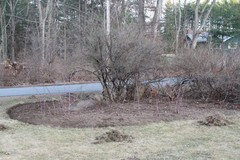
    One of the shrubs was completely cut down, and the area cleaned up. The shrub on my property was cleaned up for any low hanging branches/shooters/etc. but I still left wondering if I should prune more. Thoughts? I can't clean up the area on the right because it's my neighbors. It will be a funny transition. ;-)


    Now just blackberry canes remain and I'll need to get some stakes. I hope I'm doing this right :-). Maybe we'll get one more smaller shrub for some of the area that seems bare, still thinking about it. Still a lot more work to do, but I'm liking it so far. Thanks for your help!

  • 10 years ago

    That looks a lot better! The edging helps a lot too.

    Blackberries are a nuisance here in the Seattle area. It just depends how much land you have and how hard you want to fight them.

    Mike

    elizabeth b (zone 5 - northern MA) thanked Mike McGarvey
  • 10 years ago

    They don't look like blackberries to me, but black raspberries. They are native, and tend to show up all over the place.

  • 10 years ago

    Just looked it up... and yep, black RASPberries sounds about right ;-) (at least from what I remember from last year).

  • 10 years ago

    OK, I talked to my contractor guy about what they (we) use on knotweed: He likes to go with Milestone, which is aminopyralid. That's one of the herbicides that often don't break down in composting systems, such that compost later used in yards and gardens can be phytotoxic. But in this usage, no plant material is being collected and used for anything, so this is not a concern. Spraying the plants when in full bloom is helpful.

    Just looking at my notes, I see imazapyr scribbled down too, but not sure if that was a different conversation. Anyway, like I said, I have used glyphosate to kill knotweed, and yes, this took more than one app. Aminopyralid, on the other hand, can control such tough plants as the knotweed, Canada thistle, and some others, in one pass, so to speak.

    One more note about aminopyralid: In reading up to refresh my memory just now, it quickly became obvious that there have been numerous cases where seemingly tiny amounts of residues from this herbicide have gone on to kill crops and plants. So other than really specific targets, which somewhat ironically appears to consist mostly of vanquishing tough invasives in "natural" areas, this item ought really not to be used, made or sold!

  • 10 years ago

    I've never heard of Japanese Knotweed, and it seems that I am very lucky. Wikipedia mentioned that some banks don't even want to lend funds for the purchase of land with the stuff.

    Controversy

    In the United Kingdom, Japanese knotweed has received a lot of
    attention in the press as a result of very restrictive lending policies
    by banks and other mortgage companies. Several lenders have refused
    mortgage applications on the basis of the plant being discovered in the
    garden or neighbouring garden.[31] The Royal Institution of Chartered Surveyors
    published a report in 2012 in response to lenders refusing to lend
    "despite [knotweed] being treatable and rarely causing severe damage to
    the property".[32]


    I have no clue what the bare shrub is at the top but in the 4th photo, Dogwood came into my head.

    Probably wrong.

  • 10 years ago

    Tete, I see those few red branchlets in there too, and they do remind one of dogwoods, but the main plant is and has been identified as one of the non-native Lonicera, or honeysuckle. That other bit might be something else mixed in.

  • 10 years ago

    Probably the black raspberries. They have amazingly red/purple canes, and are clearly visible in the last two photos.

  • 10 years ago

    Yup.

  • 10 years ago

    We call those black raspberries, Black Caps. They pop up once in a while around here in the more open areas of the woods. I grab them by the roots and pull them up if in the way. Nature hasn't figured out how to put thorns on roots...yet.

    Mike

  • 10 years ago

    Yes, black caps. Very common term here as well.

Sponsored
NME Builders LLC
Average rating: 5 out of 5 stars2 Reviews
Remodeling Company in New Albany, Ohio