Software
Houzz Logo Print
icutmyfinger

waves or ripples on floor help!

10 years ago
last modified: 10 years ago
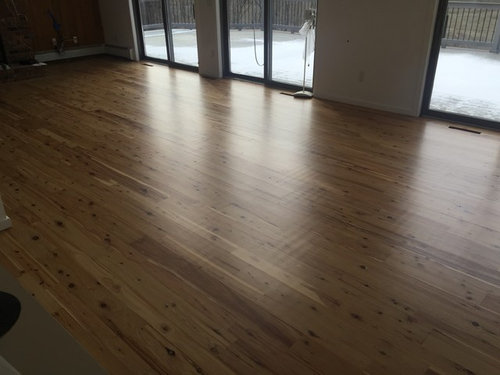
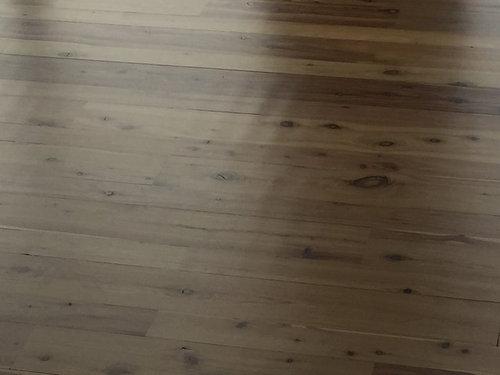
I just had my floor sanded and finished, and got home to see the entire floor has waves spread a couple of inches apart. I'm not sure if this is chatter or what it's called and why it happened. The floor is australian cypress and while it came pre-finished it is not engineered and there was lots of wood to be able to sand.

The flooring person told me this was because of the knots that are all over the floor but that doesn't make sense to me, they are uniform and they are everywhere, and the knots aren't uniform. He said they sanded on a 40 degree angle to make it smooth but it looks terrible, plus there's always a reflection due to the glass windows which makes it even more obvious. When I run my hands on the floor I can clearly feel the wood going up and down unevenly. I'm suspecting faulty machinery but of course he says his equipment is 'the best'. He says this never happened to him but he didn't know the floor was australian cypress (even though I told him) and it's because of my floors, not at all his equipment or people.

I don't think it's fair and would like to know what he did wrong or how this could have been avoided, because I don't buy that this would happen with australian cypress every time or nobody would get it, right?

Comments (28)

  • 10 years ago

    yeah thats pretty aggressive. Im guessing here, but he is probably used to sanding oaks and maples and hasnt done too many softer woods. so he assumed since his oak jobs turn out, that he wasnt going to do anything different, which is where the issue came. Softer woods require more attention to avoid this.

    Its fixable, but will need another cut, followed by a satellite sanding or trio, or a hardplate. it all depends on what the refinisher feels it needs.

    icutmyfinger thanked gregmills_gw
  • 10 years ago

    thanks for the info. So what type of attention would he have needed to avoid it, what was his mistake that was made when sanding?

  • 10 years ago

    And what about his point of blaming it on the knots?

  • 10 years ago

    the last steps of the sanding is was caused it. experienced sanders know that extra steps may need to be taken with certain types of wood. this being one of those types.

    The knots could have played a role, and sometimes large knots can cause some issues, but in your case proper sanding didnt take place and thats why you are seeing what you do.

    Like i said it can be fixed, but your floor guys stubbornness is a different issue.

    icutmyfinger thanked gregmills_gw
  • 10 years ago

    would still love to know specifically what you think happened and I welcome other opinions here

  • PRO
    10 years ago

    My guess would be chatter marks. number of causes from loose joist ,it causes wood to vibrate as the machine passes over it, could also be the machine bad wheels, drum is out of balance.

  • 10 years ago

    There is extensive information on this phenomenon online. Google "chatter marks on wood floor". You'll read that there are several reasons this can happen. Here's one definitive source: http://www.hardwoodfloorsmag.com/troubleshooting/fixing-and-preventing-chatter-and-wave-when-finishing-a-wood-floor.html

    What you have would appear to be waves rather than chatter marks. They have nothing to do with the hardness of the wood nor with the knots. The remedy is to refinish.

    What gregmills is referring to is probably steps that are taken to remove this wave from a floor after the drum or belt sander are used. One can hardplate the floor with sandpaper on a buffer, but many sanding contractors now use a Lagler Trio machine or similar to remove waves and/or chatter and ensure a flat floor. The Trio is like a milling machine that can can knock high spots off of a floor exposing the second ply, so it's not always used on very thin or old floors or in houses that have settled.

    It's not uncommon to see 20+ year old floors with some wave or chatter that were acceptable at that time. Unless it's extreme it doesn't affect the serviceability of the floor and once furniture is placed and window treatments go up, it's much less noticeable. If you don't have enough wood to refinish, perhaps a price consideration would be in order.

    icutmyfinger thanked User
  • 10 years ago

    thanks for the info. Would you guys think it was the flooring persons duty to redo the floors? he's telling me he spent too much on the Bona HD sealer and Finish and is out of pocket. I'm unsure because if he did this I don't know if his team would have the skills to fix it now. I do think there's a little floor left (it was sanded 2 times as he used the wrong sealer the first time) and it was pre-finished wood (but not engineered, the whole slab is wood). Would you have paid him or told him sorry it's his cost to eat it because now i need to fix it. What is morally the right thing to do, and professionally? I know it will be less apparent with rugs etc but because the house is west facing there is always light to easily see reflections off of the floor. I read the links you sent, the floor is definitely not loose. Does that mean it was his fault? again, he's blaming me for having floors that are 'exotic wood'


  • 10 years ago

    It's all his fault. If my guys had done this and the homeowner wanted it redone, I'd do it without question. Unless your contractor provided a finish that cost more than what he proposed, he should do it over at no cost to you. If he used a more expensive finish, it should have been done with your consent/collaboration.

    Others may criticize me, but frankly, I would probably use it as is, assuming I could get some type of concession. Your last picture looks bad but on 1 to 3 you only see the wave in small sections. Nothing done by humans is EVER perfect and even a floor that's 95% perfect only remains that way for a short time. I would be concerned with how much wood is being removed to get this right. That said, my own floor has no waves or ripples. I Trio'd the heck out of it.

    icutmyfinger thanked User
  • 10 years ago

    The pictures of your floor exhibits the wave phenomenon perfectly. I had this happen with two of my jobs; they were resanded and, as jfcwood said, I nTrio'd the heck out of them also to get a flat result. I never would be without my Trio.

  • 10 years ago
    last modified: 10 years ago

    Wow i looked at the price of that Trio, 6 grand, but worth it for pros to get good floors. Do you guys own one or rent it?

  • 10 years ago

    I bought mine slightly used for $3,000.

  • 10 years ago
    last modified: 10 years ago
    I have two at an average price of $3250.00 and one of my finishers owns one.

  • 10 years ago

    The flooring contractor told me he used a Hummel and there was nothing wrong with it. I have photo I can post, obviously it was him and his workers or the way they did it. One person suggested to me that he used way too strong a grit and cut through the floor so he could do the whole job in one pass. Either way I can't believe he tried to blame my floors and didn't even offer to fix this ugly issue that I'm now stuck with. And the irony is that his company is called 'reliable flooring' www.reliablewoodflooring.com

  • 10 years ago

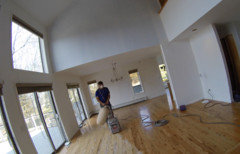
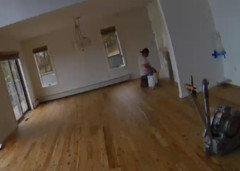
    Here are 2 photos of them sanding. They sanded twice, the first time they used a satin finish and I had asked them for extra matte so they sanded again. I don't have a photo of them sanding the second time to know what direction they sanded because the camera was covered. So the photo of him sanding was the first time they sanded, and then the photo where it's just the sanding machine in the corner of the photo is from the second time they were about to sand. I can't tell if it's the same sander or if it's the Hummel or what? I'm pretty sure they just did one pass on it as they only sanded for a couple of hours max.

  • 10 years ago
    last modified: 10 years ago
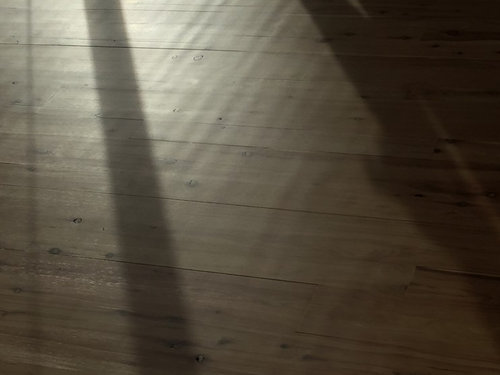
    Hummel looks like a belt sander, could cause ripples (or banding or chattermarks whatever you want to call it) due to a bad drum or bearings, loose belt, or bad paper. It could also happen if they did not move at a uniform pace. The uniform ripples spaced perfectly looks like they moved at the right pace, there must have been something wrong with the sander.

    http://www.hardwoodfloorsmag.com/troubleshooting/fixing-and-preventing-chatter-and-wave-when-finishing-a-wood-floor.html

    "The drum causes 90 percent of all chatter. Drums that are not balanced,
    are out of round, contain hard spots, have incorrect paper installation
    or have compressed rubber can all be the culprits"

    http://www.hardwoodflooringtalk.com/forum/banding-marks-after-using-drum-sander-t10610.html

    "Its nice and smooth but when I started laying the stain down, I noticed
    ripples/banding marks the drum sander left behind. These are small half
    inch wide ripples across the entire floor."

    Either a redo on their dime or lawyer time... The pros here have recommended they use a trio. This may be a lesson learned for them. Maybe print this off and show it to them. Your pictures show the ripples well.

  • 10 years ago

    Why did they resand the floor? Makes no sense. What they could have done was to simply abrade the finish and add a coat of the extra matte.

    As for the wave issue... You can get waves with a floor with tight knots and also with loose boards. The first pass with the belt sander does not cut the hard knots as much as the softwood. On the adjacent pass, the sander wheel follows the topography made by the first pass and the abrasive repeats the topography on that cut and so forth. This may have been a contributing factor for the waves in your floor or the primary cause. Whatever the case may be, my professional opinion is that the floor is unacceptable. You should not be able to see sanding errors from a standing position in normal room lighting. Even if the knots in the floor caused the sanding errors, they are the professionals and ought to be able to deliver an acceptable result regardless of the flooring being worked. I agree with jfcwood...it is all the contractor's fault and he is solely the responsible party.

    Did they follow the belt sanding with a rotary buffer? Although that can reduce the waves some, the only way to flatten a poor belt sanding is by utilizing the Trio or another multidisc sanding machine.

    If you decide to hold their feet to the fire, then engage a certified flooring inspection firm to examine the floor, report its findings and submit its professional testimony in court. That ought to help you recover this loss.


  • 10 years ago
    last modified: 10 years ago

    Why do people advertise "satisfaction guaranteed" when they don't mean it or stand by it? I would think that the investment in the right equipment needed to do a proper job would be a lot less costly than having one's name attached to poor quality results. I hope they make this right for you.

  • 9 years ago

    I realize this is a year old. Was this situation remedied? 1/3 of the comments were correct. 2/3 were not.

    Jftoal3@gmail.com

  • 9 years ago

    James, your math is suspect.

  • 9 years ago

    im curious to know which comments were incorrect?

  • 9 years ago

    Right out of the gate, Greg mills commented that the man sanding may have been used to sanding oaks and maples instead of softer woods. Australian cypress is harder that oak and maple, not softer.

    It can be fixed, as someone said, it's a resand, not another coat.

    icutmyfinger showed pics of them sanding. They said they used hummels but they are clearly Galaxy.


    This terrible sand job was caused by a few things. Bad grit choice that didn't sand evenly. Even though they first cut on an angle , the machine rode the knots and didn't cut them. ( let's put on a used belt, we can save money! ) After the angle they may have run other cuts at an angle, but I suspect this was a 36,80 job. The last cut ran straight and the rear wheel rode the knots and contributed to the waves. Also the machine is probably not well maintained or adjusted so a bad rear wheel, bad drum and incorrect pressure on the drum only exacerbated the problem.

    A hardplate, trio or similar planetary may have helped but these machines won't fix bad sanding. This is just plain bad sanding.

    Glennfc made a good point about 'why resand because they wanted a satin finish'. My guess: I'll bet that the owner of Reliable saw the bad sanding and used that as his excuse to resand and fix it, which was good. His second set of guys, who were also $1 a foot subs, did an equally terrible job, probably worse, since they obviously also had zero understanding of abrasives, grit sequence or best sanding practices.

    Jfcwood is correct on this: it's 100% Reliables fault and it's their responsibility to redo it. I'm sure he's spent a boatload on traffic, but I'll bet he didn't pay either of the subs for the lousy job. So he got his deposit, bought finish, didn't pay the subs and he still made money. Then he walked away.

    Jfcwood is way off on this: only 1 in 3 will notice. ?? This is a high end home, obviously, in Long Island with huge amounts of light coming through huge windows. His friends and company are used to looking at quality. This floor job is complete garbage and needs to be redone

    Here's the only exception: If he chose his floor company based on lowest price, then he deserves this. If he talked Reliable down in price, he deserves this whole mess.

    i hope icutmyfinger got a remedy for this, as it's a black eye on the whole industry. If he didn't and wants to I have 3 friends on Long Island that aren't afraid of "exotic wood" and have extensive experience with best sanding practices and

    this is my opinion based on 32 years of sanding floors, making mistakes, fixing the mistakes and learning from my mistakes. My math may be suspect, however I was referring only to the remedies suggested, and the causes.

    Id sill be interested in knowing how this turned out


    if you guys are in Phoenix, stop me and say hello. I'll be teaching in TechZone

  • 9 years ago
    last modified: 9 years ago

    interesting, last i checked cypress is softer than maple. and only slightly harder than whiteoak, but i guess we're knit-picking.

  • 9 years ago

    Well James, I guess we can add your answer to the ones that are incorrect. We can also deduce that you have reading comprehension issues. Due to your poor comprehension you attributed a quote to me that I didn't make. Then you criticized me for something I didn't write. That's pretty irritating.
    I wrote: "Your last picture looks bad but on 1 to 3 you only see the wave in small sections". Go back up and read it for yourself. There are FOUR pictures of the finished floor. Picture FOUR looks bad. On pictures ONE to THREE you only see the wave in small sections. If you'll look at the pictures again you'll see that my statement was correct. Since my statement was correct, yours is therefore incorrect.

    You should be more careful if you're going to criticize others on a one year old post.

  • 9 years ago

    I was primarily interested in seeimg if this was ever corrected.

    Lok at all 4 pics on a IG screen I had to switch to iPad to see the light is very good in picture 4 and yes it looks the worst the first three don't show it as much but if you blow it up the wave is all the way through that probably, but not limited to, a bad rear wheel

    uou are correct, I was back and forth back and fort reading and writing and I misread, and for that, I apologize


  • 9 years ago

    Greg, not nitpicking, but it isn't the end of the world either.

    We see these things all the time and we hate seeing people get the treatment that icytmyfinger did. even if he cheaped out, he was ripped off.

    Map if icutmyfinger could let us know how it all worked out, it would be interesting. If not, hey, no harm no foul.

  • 5 years ago
    last modified: 5 years ago

    I've been sanding high end floors for 30 years. I don't have this problen on my floors but I've seen this issue and it still baffles me. It would be easy to balme it on faulty equipment or poor workmanship but what I still don't understand is even if the machine has bad wheels, a bad drum or bad bearings it's physically impossible to walk at exactly the same speed on every pass to have those lines appear in exactly the same place across the room. One house that I saw this on was on a hillside where half of the house was on solid ground and the other half was suspended with no soil beneath it. On the side of the house that was suspended the waves were much worse than the rest of the house - so I suspect that some deficency in the subflooring could contribute to the waves and if you run the machine the same direction with mutiple grits then each pass will follow the waves and enhance them and I don't think that a Trio or hard plateing will remove waves that are that deep. My technique is, I use a Hummel and I cross cut with 60, then filler and straight with 80 and 100 then buff with Bona Power-drive buffer with multi disc plate with 100 grit. I never use any grit rougher than 60 on my drum sander, my theory is if you have to 40 & 60 the odds are you could probably 60 twice and get the same result without taking as much wear layer off and without putting such intense scratches in the floor.