Software
Houzz Logo Print
architect97

2016 soil samples - would love any advice

10 years ago
Hello,

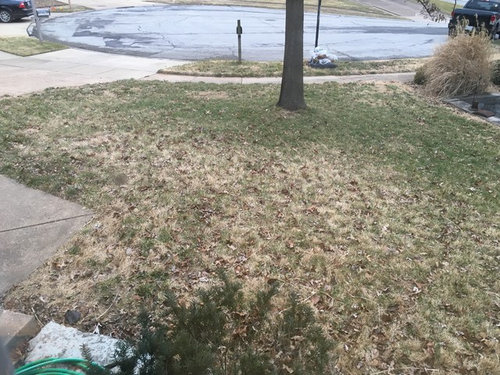
Long time lurker; second time poster. I am in St. Louis, MO, Zone 6a. I need some help with my lawn regimen, please. I have approximately 2500 sq. ft. of some amalgam of grass, weeds and dirt (not even sure I can call it soil). I inherited my house from my grandparents, so the property has been in the family since 1978; same as me. As a kid I remember the lawn in OK shape; my grandpa even grew some grapes. Lawn care was never top on their list, nor mine until recently. Now, with a wife, 6 month old son and two dogs, it's time to attempt having a lawn that my son can roll around in, play catch and dive for the fly balls on!

I had Scott's Lawn Service for the last couple of years and recently cancelled. I tend to have a pretty good amount of weeds. At one point, the yard was all zoysia. Now, there is very little zoysia, and have been told the rest is a fescue. It seems to grow in clusters and at completely different rates.

I am ready to put in the effort and money I need to begin amending my soil, just need some tailored guidance based on the information below.

There will be a multitude of questions coming, so please be patient with someone trying to make the most of their apprenticeship...

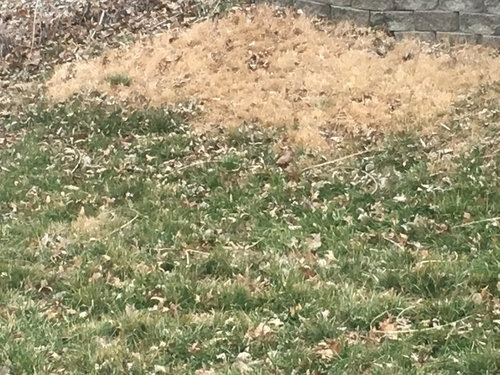
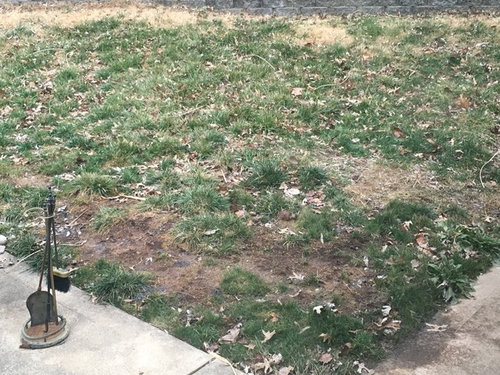
Thanks in advance for any and all help!! First photo is the front yard. Last (3) photos are backyard.

Jeff


Comments (3)

  • 10 years ago

    Front yard soil is from Mars while the back yard is from Venus. Never seen that before. I'm sure morpheus has, so I can't wait to see what he sez.

    The really tan parts are likely the remaining zoysia.

    What is the shade situation? Can you get a picture of the front from the middle of the street and something similar in the back so we can see trees and shade producing buildings, etc. I'm hoping you have enough sunlight for Kentucky bluegrass. KBG will be nice to play on and fill in if after wear and tear. Fescue is similarly nice to play on except it won't fill in when it gets torn up.

    In the mean time it never hurts to apply organic fertilizer. I would wait until the initial fast spring growth is ending and put that down. Early May is roughly about the right time for that. The reason for the organics is to improve the population of microbes in your soil. Your organic content up front is great, so let's feed those guys. The back can use a little more organic content, so if you were not inclined to use organics, I would push you to do that.

  • 10 years ago

    I am from the Lou as well. I was just at a longstanding lawn center today getting some advice and the gentleman I was speaking with was talking about his zoysia lawn and the rebuild he and a number of his customers have been going through. He stated a lot of the mature Meyer zoysia lawns (from the 60s) have gotten a diseased resulting in lawns dying off. He and a lot of their customers have re-sodded segments with Zenith zoysia and then he has been plugging out of the zenith to re- establish his lawn. Just a thought.

  • 10 years ago

    Yeah, this looks like two different planets. :-) Fortunately, that's workable and yeah, I've seen it before. It happens if soils were from two different sources originally, or were treated differently. No biggie.

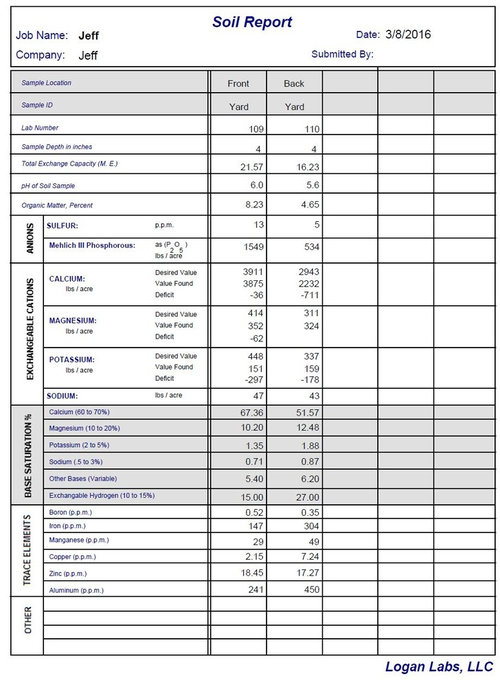
    ME 21/16: Both pretty similar, and both probably silty or having a small amount of clay. Once fixed, the soil will tend to stay put and only require testing every few years.

    pH 6.0/5.6: Both a tad low, but not severe in either case. We'll fix that under Ca, Mg, and K below.

    OM 8.2/4.6: Excellent/Good. With your ME, no more is required, although mulch mowing is always a very good idea.

    Sulfur 13/5: Normal levels for the OM (higher OM equals more sulfur).

    Phosphorus 1500/500: High in both cases, but not a problem. In both cases, however, I'd avoid phosphorus sources. The front is extremely high (but not going to cause issues). The back is just high.

    Calcium 67.4/51.6: Optimal in the front, a little low in back. In back, we'll use calcitic limestone (Encap, Mag-I-Cal, or Pennington Fast Lime) to fix this. Recommendations below.

    Magnesium 10.2/12.4: Although a tad low out front, it's not worth fixing and not a problem. The back is optimal.

    Potassium 1.4/1.9: Quite low in both cases. We use potassium sulfate (sulfate of potash) to fix this, which you can get at most garden shops or landscape stores--or they'll order it for you.

    Minor Elements: Bermuda isn't particularly demanding, and most are fine. Boron is a tad low out front, but ignorable. It's rather low out back, and I'd rather not ignore it.

    Boron 0.52/0.35: We use Milorganite as a carrier and 20 Mule Team Borax as the boron source. You can purchase 20 Mules at the grocery store in the laundry section. In a wheelbarrow or the like, dump the Milo. Spraying very, very lightly with water (I use a spray bottle like the kind people use to damp their clothes when they iron) will help the boron stick. Add the recommended amount of 20 Mule Team Borax and stir, spraying occasionally to get the stuff to stick to the Milo. Then apply over the recommended area. So if going for bag rate Milorganite (1 bag per 2,500 square feet), you'd add 10 tablespoons of 20 Mule Team Borax.

    Recommendations:

    April 1: Apply 9 pounds per thousand square feet of calcitic lime to the back only.

    April 15: Apply 4 tablespoons of 20 Mule Team Borax per thousand square feet to the back only.

    May 1: Apply 3 pounds per thousand square feet of potassium sulfate to front and back.

    September 1: Apply 3 pounds per thousand square feet of potassium sulfate to front and back.

    October 1: Apply 9 pounds per thousand square feet of calcitic lime to the back only.

Sponsored
J.Holderby - Renovations
Average rating: 5 out of 5 stars4 Reviews
Franklin County's Leading General Contractors - 2X Best of Houzz!