Software
Houzz Logo Print
roseseek

Interesting observation...what do you think?

10 years ago
last modified: 10 years ago
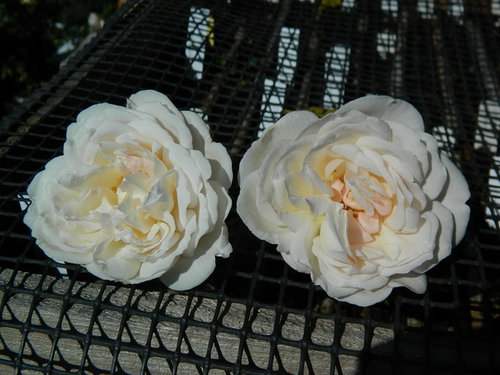
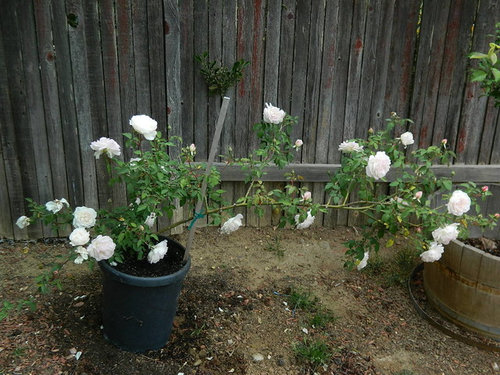
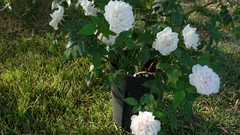
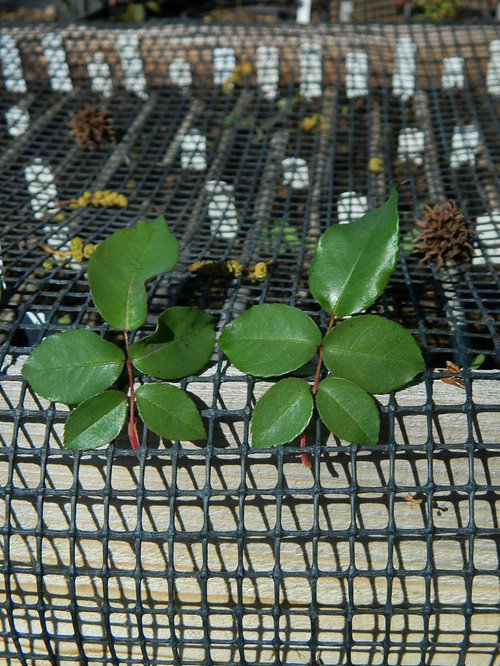
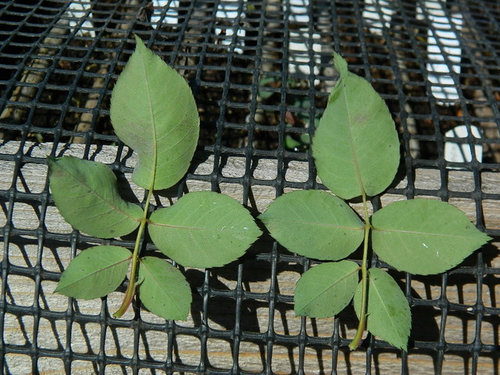
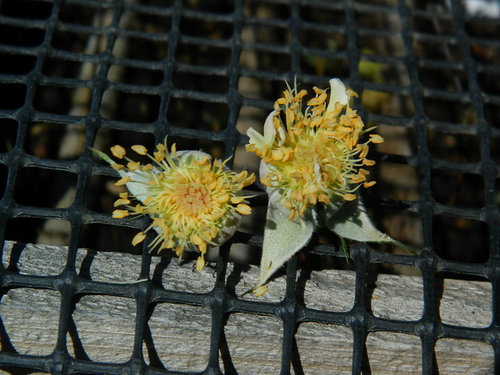
I noticed something very interesting yesterday morning on my morning "photo run". Two plants, one a found rose and one an identified older rose, resembled each other very strongly. I posted these photos to Face Book where several well-versed old rose afficionados are more active and the reactions were positive. Please take a look at these photos and see what you think. The same rose appears in the same position in each photo, so all the plant parts on the left of the images belong to the same variety, and vice versa. I will post the two identities at the end.

Do they resemble each other sufficiently for you to feel they may well be the same variety? The one on the left (and the first prickle photo) is "Huntington La Biche", the rose now identified as Mlle de Sombreuil. The one on the right is the found rose, George Washington Richardson. In the discussion, mention was made that MdS is often a less than vigorous plant while GWR is extremely vigorous and appears to want to either be a huge bush or a climber. Even in Europe, MdS was found to be weak, even for a Tea. GWR is vigorous in all the gardens in which it is grown. Dr. Manners stated on the Face Book thread, "For the record, in December 2015, we tested George Washington Richardson for Prunus Necrotic Ringspot Virus and Apple Mosaic Virus (the two viruses causing "Rose Mosaic" in the USA), and it was free of both. Done by ELISA at Washington State University, Prosser." MdS has not yet been tested. This means we now know both GWR and Atmore Lamarque are free from PNRSV and RMV and can be stated to be "virus indexed". So if you want only "virus free" old roses, these two should be added to your lists. The freedom from infection may, or may not, have something to do with the observed difference in vigor between the two roses. Or, GWR may be a partial sport toward climbing habit, or not. Or, MdS may be a degenerative sport..or not. You have to admit, they certainly resemble each other, don't they?

George Washington Richardson now.

Comments (26)

  • 10 years ago
    last modified: 10 years ago

    Kim, it certainly is interesting. At the very least I think they have to be VERY closely related, whether it's as sport/offspring or identical with and without virus. It would be nice if we could get DNA testing done. I've been trying to get my hands on MdS and GWR for ages. *IF* I ever manage to get them I'll certainly be up to planting them side by side for comparison.

    (bemused) John

  • 10 years ago

    GWR is coming faster than you imagine, John...


  • 10 years ago

    ahem...hint received, thanks tendered ;)

    roseseek thanked fig_insanity Z7b E TN
  • 10 years ago

    Jeri, I agree. And regardless what the eventual consensus is, when I get my GWR (ahem) it will always *be* that in my garden, even if I have to write "aka MdS" on the back side of the label, lol.

  • 10 years ago

    And that's exactly what I do, John. :-)


  • 10 years ago

    For what it is worth, my ARE Mlle de Som was throwing canes up the peach tree. If it wasn't for the gopher it would have been much bigger.... Sigh

  • 10 years ago
    last modified: 10 years ago
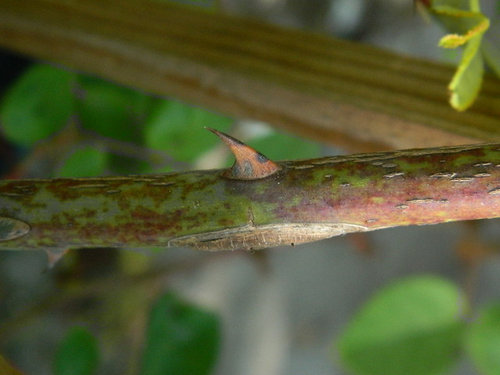
    Interesting, indeed. You have a strong argument, I think, Kim -- additional comparisons of features using HMF photos also show striking resemblances. Along with Kippy's experience, the climbing tendencies of at least some Mlle. de Sombreuil are also mentioned in HMF. As for the vigor differences, first, reading through the comments on HMF, there seem to be at least several versions of MdS around, with differences among them noted. And, then, has GWR only been grown in Z9/10 gardens or has he also been grown in cooler zones where he also survives? Accounts of vigor can be misleading, in some part because of this, I think, as the owner of a 6' tall and 12' wide Westside Road Cream Tea, a 4' tall Mr. Bluebird, a 9' tall Comtesse du Cayla, and so on...

    roseseek thanked User
  • 10 years ago

    There were comments on the FB thread of seeing her in French gardens where she was a rather weak grower. I completely agree with you about California vigor. As long as the conditions don't inhibit the rose's performance, they can induce amazing vigor and flowering. Way back in the "dark ages", I read Southern California Gardens by Victoria Padilla. Even in the early Twentieth Century, the remarkably benign California climate was credited with generating tremendous plants. That book is a must read, in my opinion, for its historic content. There are two versions of the book. The hardback is the original and quite pricy and very enjoyable due to its larger size. There is also a softback reprint that has a cover price of $39.95. I know of two cases where Amazon charged the $100+ hardback price and delivered the soft cover book, so if you go looking for it, be sure you pay no more than the $40 (hopefully, less) and get the softcover version. The print and photos are smaller, but the information is the same and the price significantly more "friendly". It was printed in 1961 and put out by the University of Southern California Press.

    I'm not sure why there is such a wide variation in performance with this rose, but my budded MdS is a small fraction of the vigor GWR demonstrates. If you go back to Nicholas' "A Rose Odyssey", he reports how "improper bud selection" in the US "ruined" General Jacqueminot and how the introducer's grandson, though judicious selection, had refined the variety to almost the quality of a Hybrid Tea. Using blind wood for production had reportedly caused HPs in this country to run to climbing, shy-blooming plants. GWR isn't shy-blooming, but he does seem to want to climb. Perhaps that may have something to do with it, or maybe it's the same issue Week's found with Eyes for You. No matter how they propagated it, less than 60% of the plants generated resulted in Grade #1 plants, which is why they introduced Bull's Eye. E4Y has rudely healthy foliage with incredibly seductive blooms, two traits BE doesn't share, but Bull's Eye would PRODUCE. We know much, but not everything.

  • 10 years ago
    last modified: 10 years ago
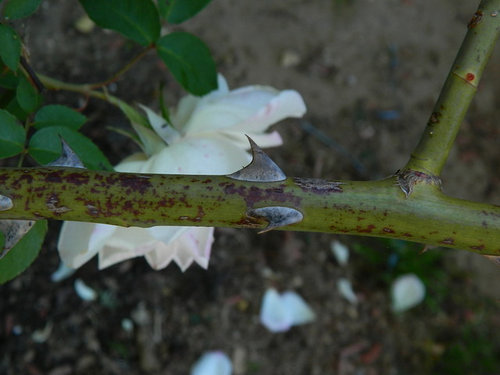
    P.S. Forgot to mention the disconnect on the HMF page for Mlle. de Sombreuil itself: "vigorous, can be trained as a climber" versus "height of up to 4' 1" (125 cm)". Hmmmm..... :-)

  • 10 years ago

    The GWR shown in the pot seems to have more limber canes than my Mme. de Sombreuil, although from its growth habit mine could well be grown as a climber, but with thicker, less flexible canes, and perhaps not a very tall climber. So much depends on local conditions and other variables that planting them side by side would probably be the best comparison, although even that is not foolproof.

    catspa, I think that soil and rainwater are also considerations in the size of plants, since my mature Mr. Bluebird is less than 3 feet tall, and from what I've seen your roses as a whole seem much taller and bushier than mine, even though we're basically in the same zone.

  • 10 years ago

    These two roses do look very much alike and may be the same. However, that doesn't mean they are Mlle de Sombreuil. In France, John Hook, at his nursery La Roseraie du Desert has studied various candidates for Mlle de Sombreuil, including those so named at famous rose gardens in Europe (L'Hay, Sangerhausen, and Tete d'or), as well as what Vintage sold as Mlle de Sombreuil (aka the found rose Huntington La Biche), which Vintage identified by visiting L'Hay and believing the rose grown there labelled Mlle de Sombreuil looked like their rose, therefore it was that rose. Mr. Hook has concluded that what Vintage sold as Mlle de Sombreuil is not the same plant as L'Hay grows as Mlle de Sombreuil--this based not simply on visiting L'Hay and thinking the roses looked alike, but by actually growing clones of each together and observing them over time. But now what we have is that Vintage has put into commerce a rose as Mlle de Sombreuil that is not the same rose in commerce as Mlle de Sombreuil in Europe. This really doesn't help matters. It would also be worthwhile to spend more time in order to determine the real identity of the beautiful rose found by Phillip Robinson in the USA. Perhaps it is a seedling of Mlle de Sombreuil or a different tea rose altogether?


  • 10 years ago

    So, from the above posts am I right in thinking that the Mlle. de Sombreuil I bought last May, which is described as Mlle. de Sombreuil (Roseraie de L'Hay) is NOT the same rose as is being discussed above? My Mlle. de Sombreuil was planted last November and is presently a couple of weeks away from flowering. I'm attaching a couple of photos taken last year (while it was in its original pot) to show the flowers, buds and growth habit -

    Plant in July 2015 -

    Growth habit - October 2015

    Flower and buds - October 2015

    To my (uneducated) eye there seems to be a similarity between 'my' Mlle. de Sombreuil (Roseraie de l'Hay) and the rose Jeri posted above.

    Tricia

  • 10 years ago

    Water makes a HUGE difference in all facets of performance. If I want a bloom to open, I keep the plant flooded. Otherwise, it sits.... All growth, all bud formation, all bloom opening requires the transpiration of water. Any water stress can slow, even stop growth. Yes, that disconnect between the size observations fits what's been observed with the other plants. The GWR in the can has quite stiff wood. It's staked because that was a "basal" from the piece I brought with me that laid out from the plant. I should have either staked it or repotted the plant with that shoot more upright, but I'm lazy and always have half a dozen (or more!) "projects" and other things demanding my attention before I get to such things. You can imagine this standint upright instead of shooting out to the side of the plant. That's likely how you would normally encounter it in someone else's garden.

  • 10 years ago
    last modified: 10 years ago
    It would be very interesting to do a DNA study comparing: Mlle de Sombreuil from L'Hay, Mlle de Sombreuil from Sangerhausen, Mlle de Sombreuil from Tete d'or, Vintage Mlle de Sombreuil/Huntington La Biche, La Biche from L'Hay, George Washington Richardson, and Madame Georges Bruant (1887 offspring, bred in France, of the tea Mlle de Sombreuil) from Pickering. Unless the Pickering rose is misidentified, it should hopefully show a close relationship, via DNA markers, to at least one of the aforementioned roses. Perhaps such a study could be done at Florida Southern, under the watchful eye of Malcolm Manners??? It might help avoid adding to some of the other identity situations we have today with Barcelona/Francis Dubreuil, Irene Watts/Pink Gruss an Aachen, Excellenz von Schubert/Gartendirektor Otto Linne, Jacques Cartier/Marchesa Boccella, Armide/Madame Plantier--or not!

  • 10 years ago

    Thanks, Melissa, that's already been suggested. The glitch is, DNA testing is done by summer school students requiring class credit for demonstrating their proficiency in running the tests. There has to be students and class time available, which so far, for this summer, it appears there may not be. Malcolm has GWR and we can get him MdS if he wants it again. Now we need someone who has imported the European roses to make cuttings available to him so the plants are available when all the other components converge. Unfortunately, he's still waiting for the results from last summer's tests to determine if Colonial White/"Sombreuil" is a VanFleet/New Dawn offspring and whether Schmidt's Smooth Yellow and Belmont Yellow are the same (they share the same PNRSV infection) and if they are one of the parents of De Candolle, the only US available offspring of Eugenie Lamesch. SO many interesting questions to answer and so few student lab hours available!

  • 10 years ago

    Kim, regarding General Jacqueminot, which introduction does Nicholas mention?
    Because according comments (check the first 2 articles from Hazel LeRougetel's book), it was the most profuse, popular rose in late 19 century in US.

    Or was the decline over decades or a century?

  • 10 years ago
    last modified: 10 years ago
    Nicholas' book was dated 1937. This is the HMF reference to an abreviated version of the reference. A Rose Odyssey

    EDIT

    Book (1937) Page(s) 14.

    Several years ago there was a discussion in American Rose Society circles about the genuineness of the American stock of General Jacqueminot. I studied the question abroad and found at Reymond's a line of magnificent everblooming General Jacqueminot, descendants of the original stock he had inherited from his Uncle Roussel, the originator. These had been improved almost to the status of a Hybrid Tea (sic) in floriferousness. We acquired enough plants from Reymond to rejuvenate our stock and the General Jacqueminot stock of Jackson and Perkins is of authentic French origin

    He stated in the book, through propagation in the US, the variety (and many other HPs) ran to rampant, blind growth. Think Dr. Huey suckers with little bloom.

  • 10 years ago

    Thanks a lot! Finally I get it why this rose, ran out of favour over here in North America....

  • 10 years ago

    You're welcome, but my take is, like most HPs and older types, it lost favor due more to changing fashions and advertising. It's difficult to like something you may never have seen before.

  • 10 years ago

    Well, maybe. But the Gen. Jack we had here was a reluctant grower. It bloomed, but on short, weak stems. And it mildewed . . . dear God how it mildewed!

    I wouldn't go out of my way to grow anything from that line, at this point in my life. But of course, not everyone lives where mildew is a plague.


  • 10 years ago

    That makes sense, though, Jeri. HPs found their popularity in Victorian and Edwardian Europe, then in the north eastern US, all areas with heavy coal and oil soot, frequently from high sulfur fuels. It wasn't until low sulfur fuel sources began being burned they were described as having "lost vigor", very likely due to the diseases they were genetically susceptible to, but seldom demonstrated due to the nightly sulfur baths they enjoyed. They are usually also more cold hardy, which seems to also mean "shorter season foliage". Put something which withstands long periods of freezing weather in a hot, long, frost-free climate and you frequently encounter disease and performance issues. It isn't any easier growing penguins in the desert than it is growing cacti in Scandinavia.

  • 10 years ago

    My Danish grandmother loved her epiphyllums. (Guessing smuggled home from ours). She grew red geraniums too. But indoors in a window. I think she had better luck than my trying to grow gooseberries here

  • 10 years ago

    Tricia -- The 'Mlle de Sombreuil' you show looks to be the same as the "Huntington-La-Biche/Mlle. de Sombreuil" found in Santa Rosa by Phillip Robinson. And that is the rose that seems to be a decent match for my "George Washington Richardson".

    In response to an earlier question -- no you are not going to find other people who have been growing "George Washington Richardson." ALL of the GWR currently in existence have been grown from the cuttings we have collected from one mother plant -- just in the past few years.

    The only OTHER plant I know of is in the San Jose Heritage Rose Garden as "Legacy Of The Richardson Family."

    Now -- Does everyone understand why I continue to use Study Names. ;-)

  • 10 years ago

    Why
    you continue using study names, AND how tenuous these "lost roses" find
    themselves. Many filter down to ONE, perhaps two, plants from which all the
    others derive. Just like the older types have done in the commercial catalogs.
    From many sources to two, then usually one, until they slide into obscurity,
    many never to return.

  • 10 years ago
    last modified: 10 years ago
    I have a Mlle de Sombreuil from K and M so she's on fortuniana but POW! She charged out of the gate. Had to move her tho but she's coming around and in bloom now. Would you like to see photos?

    Susan