

Tree help
October Glory:
Our nursery suggested this to us for our backyard. Are surface roots much of a problem? Is there another Maple (preferably one with a narrower spread...like around 25 feet) that has less of that problem?
Purple Hopseed:
Our nursery has some of these in a tree (rather than a hedge). How tall do these get?
Photina:
Our nursery has some of these in a tree form (rather than a bush). How tall and wide do they get? I thought I took a pic of the sign for it but I can't find it.
Cypress Donard Gold:
Opinions? Pros? Cons?
Thuja Emerald Green:
Opinions? Pros? Cons?
Elm trees:
Opinions? Pros? Cons? Trying to decide between Maple and Elm for the large deciduous choice.
Trying to design our backyard, and I'm mulling over lots of options...we live in Zone 9, just outside Sacramento.
Comments (40)
 10 years agolast modified: 10 years ago
I hate to say it, but you are getting pretty boring suggestions from the nursery. May of those trees are trees I could grow in my area...which is a very bad sign, as our climates are VERY different. Cold tolerance is the issue where I am, heat and draught tolerance are the issues where you are. Plus you have lots of options for flowering trees I don't. This smacks of generic "one size fits all" landscaping from someone who is mimicking a climate-inappropriate look from magazines.
As far as whether surface roots are too much of a problem. That really depends on what you are planning on using the land underneath for.
Are you going to attempt a lawn? Will you irrigate? What are irrigation rules in your town? Water is the biggest concern with maple, cypress and thuja in California.
What do you want? Shade, a privacy screen, flowers, to be Earth Friendly? What is your soil like?
I find Thuja Emerald green boring. American Elm are being wiped out by disease in much of the US. What species of Elm are you considering?
You need to get better suggestions. Visit a local arboretum. Check out sites listing native plants.
In Zone 9 California I'd be looking at water-wise native oaks, California Bay Laurel, Big Leaf Maple, and flowering trees for your broad leaf choices.
User
Original Author10 years agoBay Laurel is a consideration for another spot of the yard...not for this part. Big Leaf Maple gets too big. I'm not sure what flowering trees you're speaking of. For the area we are starting with we need many evergreen/conifer/don't drop their leaves choices.
The first area of the backyard that we are planting is along the back wall of our lot. It backs to a sort-of busy-ish road, and across the road they've built more houses (I thought it was supposed to stay a field) and those houses have 2nd story balconies that look right over this way. We need a "living wall" of sorts for privacy. The idea is to make a living wall with one large deciduous tree (in a corner where we don't need quite as much screening) and the rest be evergreen/conifer/etc etc etc. This wall will only serve as a backdrop to other, much more interesting plant choices. We need skinny height as the backdrop so I can plant other things in front of it all.
Oh, and all Juniper is out.
Yes, we will have lawn in the middle. And of course we will irrigate.
Related Professionals
New Braunfels Landscape Architects & Landscape Designers · Plymouth Landscape Architects & Landscape Designers · Kenosha Landscape Architects & Landscape Designers · Lagrange Landscape Architects & Landscape Designers · Tulsa Landscape Contractors · Myrtle Beach Landscape Contractors · Huntington Landscape Contractors · Anniston Landscape Contractors · Jamestown Landscape Contractors · Bronx Landscape Contractors · Augusta Home Additions · Greenville Home Additions · Beckley Home Additions · San Bernardino Home Additions · Grand Junction Home Additions- 10 years agolast modified: 10 years ago
As far as flowering trees, I was thinking of all sorts of kinds of fruit trees, (eg Quince) laurel, and magnolia that won't do well in my area. Not necessarily ideas for a screen,
As far as conifers...many of these may be too big, but there is douglas fir, redwood, and concolor fir. As far as broad leaf trees, there are a number of native oaks, (eg.coast live oak).
Wasn't thinking skinny though...that will require more thought. Most of these do come in dwarf and fastigate varieties.
As far as the irrigation question...your area's exact irrigation policy is a huge consideration in tree selection. If your town occasionally has "water bans" during droughts, you need to select trees that will survive that.
October Glory Maple is a domesticated cultivar of a tree that is also called "swamp maple" and for which Arbor Day (which tends to be optimistic) lists zone 9 as the upper limit of it's heat tolerance. That this would be anyone's first suggestion for a tree in Sacramento rings alarm bells about your nursery...
User
Original Author10 years agoFruit trees, laurel, and magnolia are all super messy. :( I'd love lots of Magnolia but hubby vetoed that based on mess.
- 10 years ago
Ah. Sounds like you have a lot of concerns/requirements in your head that aren't listed here. (eg the Juniper thing) It's kind of pointless to make suggestions then. Of the few trees you have listed that I'm familiar with, a couple aren't great choices for your location. (eg. October Glory Maple) Thuja is boring but would do what you want it to if you give it enough water. Post the species of Elm you are considering so people can offer opinions...I understand some Elm species are being wiped out by diseases, and some others are invasive nuisances. Which species you pick matters a lot.
User
Original Author10 years agoWe just saw some elms on our trip to the nursery. They weren't necessarily suggested to us, we just cruised and took pics of anything that sounded interesting or would fit size wise. Emerald Sunshine. Prospector. Says both are resistant to Dutch Elm disease.
I was looking at 2 Thuja, as a backdrop to a flowering bush or something. So really we'd actually see just the top of the Thuja above whatever bush we choose.
I also saw the nursery has Trident Maple which looks a bit smaller.
The gentleman at the nursery suggested October Glory because he has one and it's doing wonderfully.
I also thought about Redbud. Western or Hearts of Gold. Or Merlot.
User
Original Author10 years agoOH and last night I saw a post mentioning a Tsukasa Silhouette. Those are very tempting, though I'm not sure I'd be able to find it local, probably have to order it online. Not sure how I feel about that.
User
Original Author10 years agoI also looked on Monrovia's website last night online and saw Fullmoon Polyspora, Slim Bottlebrush, Tiny Tower Arborvitae, and Emerald Colonnade Holly though I didn't find those at the nursery the other day. And I don't know enough about all of them to know if they'd suit our purpose or not. Not quite as tall as I would like, but everything can't be the same height, I know. :)
- 10 years ago
The catchy cultivar name is as much a brand/marketing term as anything else. Try to find the Latin name of the species of the cultivars you are interested in. That lets you access all sorts of objective scientific information. If you google the name of the cultivar you mostly get marketing spin from the company.
I do like Japanese maples and holly.  10 years ago
I am a second voice for reconsidering a red maple of any kind as they tend to like a good amount of water. Trees are a long term investment, and if your area has a water ban at some point in the future, yours won't be happy, and you may lose it. They are shallow-rooted and like medium to wet growing conditions which will be difficult to maintain if there is a water ban. Are you willing to risk that? Your area gets about half of the rainfall of areas where this tree grows happily unirrigated.
Here's a thread from the California forum with recommended trees for a small yard. Perhaps one of them will suit.
 10 years ago
Hopseed (Dodonea) makes a cheap fast temporary airy screen to 15-20' with the emphasis on temporary. They are short-lived tall shrubs that reseed lavishly, though the seedlings are easy to pull. Best used paired with slow growers--while the slower trees get going, you have a quick temporary screen or shade giving shrub that is fairly easy to remove after a few years. I got 10-12 footers in three years from seed. Not worth paying a lot for as they decline rather fast.
How big is your lot? The deciduous white flowering 'Natchez' Crepe Myrtle gets 30'+ in California, great fall color that far north, and flowers in summer. It would appreciate your Sacramento heat, isn't particularly thirsty, beautiful bark, and so forth. Look up the EBMUD book on recommended trees and shrubs for Northern California at your local library. Lots of good suggestions with extensive descriptions. Slightly out of your area but very applicable.
User
Original Author10 years agoWe have 2 Crepe Myrtles in our front yard. Not sure which kind but the flowers are pink. I'm not very impressed with them. They aren't very full and they are kind of unattractive because they're so "twiggy". Not sure that I can explain it, they just aren't that great looking.
Hoovb, our lot is large. Though, if you read the whole thread you'll see what we are trying to accomplish. I need narrow bushes and trees that will make a living wall for other things to be planted in front of it. And one big deciduous tree, ideally about 25' wide, not so particular about height. I put more description into a previous post in this thread.- 10 years ago
Sacramento isn't southern california.
How much rain do you all get a year and what is your water situation? Do you have restrictions?
User
Original Author10 years agoWe are restricted to twice a week. But we don't necessarily follow that. Right now it's all off because we had a decently wet winter. Not out of the drought but not too shabby.
We also have access to recycled water to use for landscaping if we want. Not sure how that works but do know we have access.
- 10 years ago
Angie, do you happen to know the rough pH (measure of acidity/alkalinity) of your soil there? Depending on what value it is, that would quickly rule out things like red maples, which absolutely must have acidic soils. Just thought I'd mention, as some of these ideas strike me as possibly unsuited to your area. Plus, I'm into regional horticulture. I've got a friend who travels to your state yearly, albeit during winter. When I asked him what the common street tree was out there-and I think this was Irvine-his reply was Norway maples. I probably can't explain to you how crazy and unimaginative that strikes me. There simply has got to be better Cali-approved choices, both for that community and for your area which while far to the north is still utterly unlike vast swaths of eastern N. America, I should think.
User
Original Author10 years agoI've googled list after list of trees for this area and Maples are always on it. Everything else is either too big, too small, or super messy. And I've said no Juniper because I'm super allergic to it.
The only other tree I've come up with is a Pyramidal Hornbeam. I do want fall color though. I need to look that one back up and see if it has fall color.
As for the "there has to be more interesting choices...." thing...they're trees. I don't find trees exciting no matter what kind they are. We just need 1 deciduous tree choice that fits our size requirements (and preferably has fall color) and several narrow evergreen/conifer/doesn't drop it's leaves choices to make a simple living screen to block the neighbors across the way. I'm sure some of the options the nursery has suggested to us that you guys perceive as boring are because of the growth speed. While I know there are drawbacks to fast growing shrubs and trees, we don't want anything that's going to take 10 years to screen the neighbors. It really is becoming a huge deal.
These choices we make are going to be a simple backdrop for other interesting plantings in front of it all. It's not the end all be all. We just need to get the "first row" going so they get in and start getting established before it hits 100. I can choose other much more interesting things to plant but that will come as the next "phase".
- 10 years agolast modified: 10 years ago
I don't see that anyone objected to the cypress or photina. Its mostly the Autumn Blaze maple that made a few people familiar with it queasy. You asked for opinions on a list of trees...and there was one tree on the list most people objected to. You asked for suggestions and got some. Of course, there were some criteria you had that the rest of us didn't know about, so some of our initial suggestions weren't that useful.
Hornbeam is an interesting idea.
Do you know what species it is? Do you know the actual Latin name of it or the Elm.
looking up hornbeam, Ostrya virginia
seems interesting...a little more heat tolerant then the European variety. Said to look like elm when young. Exact same size as Autumn Blaze but more draught and heat tolerant. Only catch is it has inferior fall color and is harder to find.
Remember, those slick sounding cultivar names were made up by the plant breeder. They are really marketing terms. If you google them, you mostly get ads from people trying to sell it. You get more accurate and objective information if you google the name of the species.
Speaking of google, what exact search terms are you using that yields only maples? Exact search term usage is important. Google is location agnostic. All gardening is local. Thus google will often spit out suggestions that would be perfectly good for the other side of the continent.
Actually, you get much better information if you skip google and go
directly to the websites of botanical gardens and agricultural colleges.
They aren't trying to sell anything, and do real scientific research.Not that anything is particularly wrong with maples. There are A LOT of maple species in the world other then Autumn Blaze. You mentioned a cultivar of Japanese maple and three leaf maple...I personally don't know those cultivars well enough to say whether they are or aren't good choices for your area. Certainly more interesting visually.
hoovb is probably your best resource so far. He knows his stuff and comes from a similar climate.
One thing you have to remember is anyone who is going to take the time to write responses to a total stranger's inquiry about trees on the tree forum is someone who loves trees. To us, what tree you put in your yard is one of the most important decisions a homeowner can make. In ten years that modern kitchen will be dated, most of the flowers and bulbs you put in the flower bed will be replaced several times over. A well chosen tree will be worth many times more in ten years then it is now. It also has a huge impact on your water usage and the energy efficiency of your house. (Thus greatly impacting your natural resource footprint) and whether pollinators and birds find your yard a usable way station. It is the first thing people see when they drive to your house.
- 10 years ago
did i miss how big your yard is .. and how many more trees you need.. if you already have one maple ...
also .. did i miss your actual goal in this project??? ... shade in 20 years.. view blocking... etc ....
when i think.. from MI here.. about CA backyards .. i dont usually think acreage ... it really matters.. when talking about adding trees ...
ken User
Original Author10 years agolast modified: 10 years agoedlincoln, I wasn't complaining about anyone or anything, just trying to make it clear that we just need a simple living wall as the backdrop and more interesting things will be planted in front of it. I'm trying to convey that I'm struggling to find varieties of things that fit our size needs. But we're also on a time crunch. That doesn't help.
I wasn't searching only Maples. I was just saying I've looked at lists and lists of trees for the Sacramento area. Lists of waterwise trees, native trees, shade tree recommendations....that kind of thing.....from area foundations and tree programs as well as places that are blogs with lists. I was trying to say Maples are always on there so I don't think there is an issue with growing them here aside from the water requirement thing...someone was asking about acidity and I have no idea, other than they're widely recommended so I don't think that's a problem. I think we keep getting that recommendation from the nursery and landscape companies (during quote process) because they also grow decently quickly. Like I said, we need to get our neighbors screened out...soon. :)
Is Autumn Blaze the same as October Glory? I also was looking at Trident Maple, because it's a bit smaller...Acer Buergeranum.
Another interesting tree might be Callisemon Citrons Std - Bottlebrush, Lemon Std.
The Hornbeam is Pyramidal European Hornbeam - Carbines betulus 'Fastigata'
The elm is Ulmus Propinqua 'Emerald Sunshine' or Ulmus Wilsonian 'Prospector'. Again these weren't recommended specifically, we just cruised around the nursery and took pics of any trees that might fit our size needs for the corner of the yard.
The redbuds are Cercis Occidentalis Multi or Cercis can. 'Hearts of Gold'. OH or Cercis Canadensis 'Merlot'.
We also were looking at Eleagnus (I might have butchered the spelling on that one) Olive Martini.
I know most of you are tree enthusiasts...that's why I came here. :) I just want to make it clear I don't need an exotic yard. We just need functional. I'm mostly just concerned about finding trees and shrubs or whatever that will fit our size needs and grow at a decent rate so we can get those neighbors screened out... :)
- 10 years agolast modified: 10 years ago
Well, *I* find thuja boring and they are a bit of a water hog, but thuja do do the "living wall" thing well. Redbud are beautiful, easy to find, North American native, if short lived trees. Smaller then October Glory Maple. Not a terrible choice.
Does European Hornbeam survive in zone 9? Some sources lists it's heat limits as Zone 8. I prefer American Hop Hornbeam....more tolerant of heat and drought, and a North America Native.
My parents have a tree/shrub that may be Oregon Grape holly. Sort of looks like Eleganus. Might not be heat tolerant enough for you...says it is for zone 8.
October Glory is a "Freeman Maple"...a red maple/silver maple cross. Autumn Blaze is a straight red maple. Pretty similar. October Glory probably grows a bit faster but may have weaker wood. Not the same, but pretty similar. Sorry, I think I got my maple varieties mixed up.
I think the guy asking about acid wanted more information so he could fine tune his suggestion. You can get a home ph test at Home Depot. Probably not a major concern regardless.
You should take a trip to a local botanical garden to see mature real life examples of the trees we've been suggesting and you've been considering. It would be a fun family outing.
What exactly *ARE* your size range and growth rate requirements?
Out of curiosity', what native and water wise lists did you look at? What maples did you see on them?Remember, any fast growing tree is either short lived or will eventually get huge. Few trees stop growing.
- 10 years ago
Ed, you got the maples crossed up. 'Autumn Blaze' is the Freeman cultivar, 'October Glory' is the straight red. I'm sure you just mixed it up on accident.
Angie, it was I that asked about soil pH. Not all maples are alike, nor are all counties in California alike insofar as soil types. We can't grow red maple in this county, but one to the west, where soils turn sharply acidic and sandy, they do great. So beware of over-broad assumptions that you might be making. The Freeman type is almost surely going to perform better for you in your western, alkaline soil (I think).
You are mentioning plants that turn into 80 ft.+ monsters, and little ornamental foofy fluffys, which is the official term BTW! Callistemon strikes me as more the direction you might want to be looking in. But I make no pretense of really knowing what's up with Cali horticulture, beyond those constants that are in place everywhere.
User
Original Author10 years agoLOL. I was just looking at the Bottlebrush trees a bit more online. The sign at the nursery says Callistemon citrinus Std. (Lemon variety) that online I find has yellow flowers(? - not sure if that's really a flower). The ones at the nursery definitely are red. The sign even says "Bright red". LOL.
We definitely don't need a gargantuan tree in our yard. We have a large lot, so we have some space to fill, which is why we're thinking of one largish tree...I'm thinking a 25 foot spread is plenty (I don't want it going into the neighbors yard too far since it'll be near the side of the yard...and I don't want it overlapping into our lawn area too much either)....The height isn't quite as important.
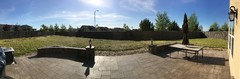
Here's a pano of our yard...our patio really is rectangle... pano mode on my phone skews the shape. That back left corner of the yard would be where the tree goes. Then some narrower evergreen/conifer/green all year type things across the rest of the wall. Those houses across the road back there have balconies and we want a living wall of sorts to screen for privacy. If the living wall "layer" is skinny enough, I will have room to plant other foofy fluffys in front of it, which will break it up and add interest. That wall is 160 feet long...the lot itself is kind of pie shaped. We have large side yards and it widens as you go back toward the back of our lot. We're at the back of a culdesac.The green is not grass...just well rained on weeds. :)
User
Original Author10 years agolast modified: 10 years agoWhile driving out to run errands this morning I took some pics.
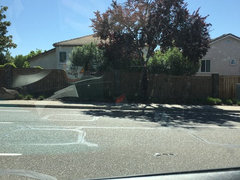
These are common around here. I know it's a bad pic... Some dark red color tree.
These line our neighborhood in the common areas that the city maintains. I don't even know what they are, but the shape of it stays really tight oval:
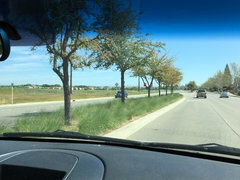
These line the streets outside our neighborhood: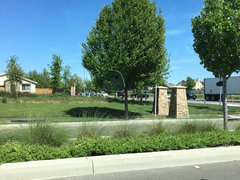
- 10 years ago
I have a 90 foot oak in my yard. IF it were a tree which required watering what would I do? And I live someplace where out biggest problem with water is we build where it floods regularly!
In California I believe unless the human population falls the water problem will only get worse. Then where will you be if you plant a tree which grows even 30 foot tall that can not survive in your environment.
Not that I care if you violate water restrictions already, heck, it will allow me to sell you water!
 10 years ago
What about Jacaranda? I seem to remember seeing them in Cali a lot when I was out there for work. And I think they are drought tolerant as well. Really beautiful in bloom.
- 10 years ago
Hey^ there ya go. Jacs are not natural fits for Cali-they come from much wetter parts of the world-but they do work pretty well there all the same it seems. Especially where irrigation is assured, it could be an option. I do wonder though about that concept-assured irrigation. Seems rather tenuous from where I sit (and from what i read, such as a report yesterday that states that this year's El Nino will fall far short of replenishing major aquifers and snowbanks, save for quite a bit further north where it might not matter to most of Cali. So there's that.
 10 years ago
I'd consider the Chinese pistache, Pistacia chinensis. It is a smallish to medium sized tree highly recommended for your area and produces very nice fall color.Which is never a guarantee for most trees in CA! No particular requirements as to soil or siting except a need for good drainage (which the vast majority of other plants share as well). Also quite drought tolerant once established.
User
Original Author10 years agoThe Chinese Pistache is one that I've considered for quite some time. Except I found out its one of the most allergenic trees out there. Can't do it.
User
Original Author10 years agolast modified: 10 years agoI went to the nursery again today, and this is what is now on my radar:
Deciduous -
Acer Truncatum "Crimson Sunset" - drought/heat tolerant after established
Acer Truncatum "Pacific Sunset"
I considered other trees other than Maples but for one reason or another they just don't work, and if I decide on a not-Maple it would be something that's an evergreen like Fern Pine or something similar.
Evergreen/Conifer -
Thuja Plicate "Forever Goldy" - OMG the yellow is PRETTY. And a nice break from being just "another green tree"
Cupressus Sempervirens "Swane's Golden" - I spy a yellow pattern - lol
Cupressus Macrocarpa "Donard Gold" is still under consideration
Thuja Occidentalis "Emerald Green" is still under consideration
Bushes (evergreen shrubs) that can be grown like small trees -
Ceanothus "Ray Hartman"
Purple Hopseed
.
And now I'm also considering a Saucer Magnolia "Vulcan"...although the nursery claims it's 15'x15' and online I read that it gets larger than that. It would not go along our back wall, so it wouldn't be a screening plant, but I love Magnolias and am told this one is not that messy. The flowers, the leaves, that's it, no constant drop/mess. Since it's not going along the wall it isn't the biggest priority right now though.
- 10 years ago
I like these choices better! Nice, drought and heat tolerant maples. Cupressus Macrocarpa is a California native. By "Ceanothu" do you mean Ceanothus americana aka New Jersey Tea? I've been trying to plant that in my area. Nice drought tolerant nitrogen fixer with flowers.
Saucer Magnolia isn't water wise but the opportunity for flowering trees is the big selling point of gardening in California. I might go with Magnloa grandiflora because it's a North American native and slightly more drought tolerant, but have no idea how the messiness compares. Since many magnolia are evergreen, they actually do make good screening plants, FYI - 10 years ago
"By "Ceanothus" do you mean Ceanothus americana aka New Jersey Tea? I've
been trying to plant that in my area. Nice drought tolerant nitrogen
fixer with flowers."Most ceanothus that grow in CA are native evergreen shrubs (or hybrids of such), some quite large, that are commonly referred to as California lilac. 'Ray Hartman' is such a selection, easily reaching 10-20' tall and with a similar width. Extremely drought tolerant once established, can be trained/pruned into a tree form. And with stunning electric blue flowers. Also deer resistant. But being evergreen, will lack any fall color.
“Ceanothus is best suited to gardens where conditions match or approach
those where the plants are found in the wild. In many of the native
California habitats of Ceanothus, there are a number of ecological
similarities . . . soils drain well, and summers are dry. Ceanothus
grows in a range of soil types but often is found on steep slopes in
soils with low or marginal fertility. . . . . it is not surprising that
most California species will endure long periods of drought, are
intolerant of summer wet environment (or watering ) and require little
or no fertilization.” - 10 years ago
Ceanothus grow well here and are spectacular in bloom. But in the UK they have a reputation for being 'live fast, die young' shrubs. 10 - 15 years perhaps. I don't know if the same would be true in Ca.
User
Original Author10 years agoYep California Lilac or Mountain Lilac.
http://www.laspilitas.com/nature-of-california/plants/139--ceanothus-ray-hartman
^^that's not my local nursery but the page with the best pics I could find.
- 10 years agolast modified: 10 years ago
A California native. Even better! Not commonly grown around here, so I can't say much about them, but I think I did see a gorgeous specimen at a botanical garden.
User
Original Author10 years agoHere's a quote from that site, lol:
"The myth of Ceanothus being short lived is primarily spread by incompetent gardeners that insist on applying drip irrigation, summer water and soil amendments. Upland native plants hate all three. Expect a 25+ year life in most well tended (no overwatering, no soil disturbance, no fertilizing, no drip, no application of soil amendments) gardens."
Although we will have drip, our landscape company is going to put in deep watering tubes (I don't know if there is an "official" name for those) for the trees. Sounds like it otherwise thrives on neglect...sounds like my kind of tree. LOL!!!
Don't get me wrong, I know all these things we put in are going to require some care, but with the size of our lot, I need some things I don't have to do much to so I have time for the things that do require care. And so I can spend time in my veggie garden.
So since the guy at the nursery pointed out that Saucer Magnolias aren't messy like the Southern ones, I've spent the morning looking for a good variety of it that stays smallish (not 20 feet wide...maybe 10) and truly isn't messy like the Southerns. Any suggestions? The nursery has Vulcan but I'm not sure that's the best choice. I just wonder if what he said about Saucer's not being messy is really true of all the Saucers...- 10 years ago
Maybe Ceanothus' reputation for being short-lived here comes from our plentiful precipitation. We can't turn it off ;-) I very much doubt anyone here would dream of giving them any kind of irrigation. My neighbour had a fabulous big one but it died after about 10 years. And it certainly was never watered or fed.
- 10 years agolast modified: 10 years ago
Some dessert plants drown in the level of water people give to their lawn. (And some plants are grown in places wildly inappropriate for them...) Sounds like that may apply to tree lilac. Try to put it in the spots farthest from wherever the water that feeds the lawn comes out. And it's probably a good idea to have a mix of longer and shorter lived shrubsa anyway...the shorter lived plants die off as the slower growing ones expand to fill their space. Remember, there is no such thing as a 20 foot tree...there are trees that are 20 feet at ten years, ones that reach 20 feet in 40 years, etc. A garden is not a static place.
- 10 years ago
Daybreak Magnolia has a narrower profile - although may not be considered a "saucer" magnolia. No idea regarding water needs in your area. My understanding from coworkers in CA is that irrigation is costly and becoming more restricted, so I'm guessing you may want something that requires less water like the Ceanothus. Does the Chinese Pistache shed a lot of pollen - I'm not familiar with trees considered highly allergenic?
- 9 years ago
Jacaranda grow all over San Diego county and with little irrigation once established...I grew up in San Diego..They line 1st Street. One of my favorite trees!! besides the magnificent spring bloom they have a some what open growth.
About bottle Brush.. we had a huge on in our yard as tall as our 2 story house. But the habitat was open and airy and attracted humming birds like crazy. Some old fashioned variety since it was so big and old. We had it next to our deck and it shaded but allowed ample sunlight through. You have to prune them to get good shape.
There are tons of old large Ceanothus here in Oregon too..Neglect them. I've just planted 4.




gardengal48 (PNW Z8/9)