Software
Houzz Logo Print
difficultrun

Soil Test Results Help

10 years ago
Hello all,

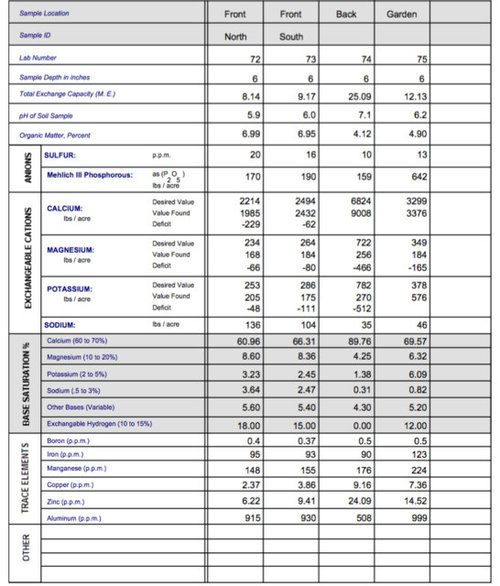
In 2015, I had my soil tested by the Virginia Tech lab and they reported a pH of 6.0, P of 16 (M-), K of 138 (M), Ca of 2708 (VH) and Mg of 164 (H-). Estimated CEC was 9.4. I had it tested again this year using Logan Labs and expanded to 4 test areas, rather than one. The test results are included below:

Morpheus, if you're available could you please take a look and provide some input? I'm located in Lexington, VA (I keep an eye on what Beckyinrichmond is doing since I'm only about 100 miles or so from her). I did one application of lime and starter fertilizer in early Sept. last year, overseeded in mid-September, a Milorganite application in mid-October and winter fertilizer in December. I also put down pre-emergent in early March this year. The front lawn is looking pretty good this year but the back, which is much smaller is still a weed haven (I may have to do a reno back there this year).

Thanks in advance for any help and advice.

Comments (20)

  • 10 years ago

    Hopefully you did not use lime in the back. Morph is going to want to know what kind of lime you used.

    How would you characterize your soil in the front and back? Do they seem to be the same or different?

  • 10 years ago
    last modified: 10 years ago

    Difficultrun. While you are waiting for your answer, can you tell me if that is all you received back from Logan Labs? Any recommendations from them? I am just curious at what the test results consist of beyond the numbers they are providing.

    Edited - Never mind, I went on their site and I am more than happy with my local extension if I ever test again.

  • 10 years ago

    lawncrazy, check out some of the other posts about soil tests here on this forum. Morpheuspa will give you an evaluation that would cost an additional $250 to get from a professional.

  • 10 years ago

    Thanks Dchall. We did a major addition/renovation in the back that resulted in a new backyard with alot of fill dirt and I did not put down lime or test the soil in that area last year. I only focused on the front, which appears to have some really good soil, at least it looks good. The previous owner did not do any maintenance so I wanted to try and improve the soil structure.

  • 10 years ago

    Dchall, do you have a phone number or email for Morpheus? He hasn't posted in about a week. Maybe he's on a trip or has computer problems but he may be sick. I am worried about him. If you are able to get in touch with him, let him know he's missed.


  • 10 years ago

    OP,

    Whatever reason morphouspa is not responding is his alone and I'm respectively not going to speculate. (not meant to be disparaging of you, Becky).

    For $30, Loganlabs.com will provide recommendations. For the present, I'd recommend contacting them and employ that service.

  • 10 years ago

    Sorry 'bout that. A busy time period, plus 10 cubic yards of mulch.

    This soil has a very split personality, but we'll deal with it. Front N and Front S are close enough to fold together. Back is very different, and the Garden is a whole other animal.

    What do you grow in the garden? My recommendations will vary.

    ME 9-ish, 25: Sandy with silt. The back looks overenhanced by the calcium levels, so I'm going to say the 25 is actually an overshoot and it's really closer to 15.

    pH 6-ish, 7.1: A bit low to slightly high. The back isn't a problem and doesn't need adjusting in and of itself.

    OM: All are in the good range, and although I'd recommend mulch mowing, no specific work here is needed.

    Phosphorus 160-190: These are all fine, if a tiny bit trim. If you fed with starter fertilizer in late May instead of a high-N fertilizer, that would be nice--but it isn't necessary. These phosphorus levels won't cause any problems.

    Calcium 60%/66%/90%: Tolerable, optimal, high, respectively. I'd actually like to enhance both Front areas with a high calcitic lime like Encap, Mag-I-Cal, or Pennington Fast Lime. Recommendations below.

    Magnesium 8-ish, 4%: The back is masked a bit by the calcium levels and is really much closer to the front than you might think. We use Epsom salt (grocery store or drug store) to fix this, and it doesn't take much!

    Potassium 3.2%, 2.4%, 1.4%: Again, the back is masked by the calcium and is more like Front-South than one might think! These could use enhancement--using potassium sulfate. Most garden or landscape shops have it or will order it for you.

    Minor Elements: While boron could use a hit, it's not low enough to be deficient and we're going to skip it this year.

    Iron (90-ish) is low for best color, so you can apply Milorganite whenever you want to very slowly raise this.

    Recommendations:

    May 1: Apply 3 pounds of calcitic lime to the Front areas only.

    May 15: Apply 2 pounds per thousand square feet of Epsom salt.

    June 1: Apply 3 pounds per thousand square feet of potassium sulfate.

    September 15: Apply 2 pounds per thousand square feet of Epsom salt.

    October 1: Apply 3 pounds per thousand square feet of potassium sulfate.


  • 10 years ago

    Thanks very much Morph and it's good to see you back online. Looks like I'm going to be very busy this Spring!

    The garden is predominately vegetables and herbs, including tomatoes, garlic, kale, broccoli, spinach, and peppers.

    I do mulch mow and will continue that. I'll use starter fertilizer instead of high N for the end of May feeding. For everything but lime, I'll apply to both front and back. I assume I should use bag rate on the Milorganite and that I could actually put that down tomorrow and then starter fertilizer at the end of May.

    One other question my wife asked me to ask ... we have a number of old Maple, Oak Dogwood and Beech trees on the front yard. Will any of these suggestions harm them?

    Here's what my program will look like this year:

    1. late-March (Complete) Dimension 0-0-7 applied

    2. April 12: Apply Milorganite at bag rate to both front and back

    3. May 1: 3 lb/1000 ft2 of lime to front only

    4. May 15: 2 lb/1000 ft2 of Epsom Salts to front and back

    5. Memorial Day: Starter Fertilizer at bag rate to front and back

    6. June 1: 3 lb/1000 ft2 of Potassium Sulfate to front and back

    7. Labor Day: Hi Nitrogen Fertilizer at bag rate to front and back

    8. Sept 15: 2 lb/1000 ft2 of Epsom Salts to front and back

    9. Oct 1: 3 lb/1000 ft2 of Potassium Nitrate to front and back

    Thanks again and I guess I better get to work!

  • 10 years ago

    For vegetables, we're going to use the same standards as grass overall (perennial plants would differ a bit, and annual flower gardens would differ a LOT, so you can see why I asked).

    For veggies, one thing sticks out: Phosphorus. At 640, avoid any and all phosphorus sources, or you can use this as the excuse as to why many vegetables are a little bitter and rather chewy. Potassium is also high, but that won't hurt anything. I revised these recommendations for the garden only, and kept them with the dates:

    May 1: Apply 3 pounds per thousand square feet of calcitic lime.

    May 15: Apply 2 pounds per thousand square feet of Epsom salt.

    September 15: Apply 2 pounds per thousand square feet of Epsom salt.


  • 10 years ago

    I didn't want to discuss the schedule in the same spot.

    That'll work fine! I'd also recommend a winterization step when grass top growth stops but long before it turns brown (for me in PA, that's in November). That'll help maintain the grass over the winter.

    >>One other question my wife asked me to ask ... we have a number of old Maple, Oak Dogwood and Beech trees on the front yard. Will any of these suggestions harm them?

    Quite the opposite, all this will enhance performance. Remember to feed these in spring and fall (after blooming on the dogwood tree) for best health.

  • 10 years ago

    Thanks again Morpheus. I certainly appreciate your expertise!

  • 10 years ago

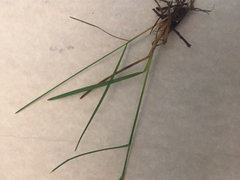
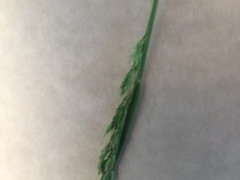
    I have one update and several questions. It appears I've got an outbreak of Poa Annua. I've attached pictures to help with identification. If it is indeed Poa, would that alter any of the applications? I did put down Dimension in mid-March which should help with next year's germination but the current crop has not been treated. Should I use Tenacity or just let the Poa run its course this year until it dies out and put down more Dimension in the fall and next spring?

    Thanks for any help you can offer.

  • 10 years ago

    Here is a page on identifying poa annua. If it is poa annua, it will die this summer and next year's crop will start germinating early this fall. You can use Dimension in late August/early September to help prevent next year's crop. Keep the pre-emergent barrier up through the winter and spring. Even with pre-emergent, there will be some next year -- getting rid of poa is a project for several years. If you have just a few plants, dig them up. Your Dimension in March will help prevent crabgrass and other summer weeds this summer.


  • 10 years ago

    Thank you Becky. I'll keep using the pre-emergent and I did dig some of the Poa out. Do you believe I should continue with Morph's regimen or would the fact that I have a Poa outbreak alter those instructions? Morph, if you're online I'd also appreciate your advice.

    Thanks again.

  • 10 years ago

    Continue with Morph's regimen. That has nothing to do with poa. He is giving you recommendations to improve the soil. He is not addressing nitrogen but you have included some applications in your schedule. I assume you have tttf?Or is it KBG? Either way, most nitrogen should be done in the fall. You have three apps scheduled that have nitrogen (Milo in April, starter Memorial Day, high N Labor Day). Tttf needs 2-3 lb./K of nitrogen; KBG 3-5 lb/K yearly. If you have tttf, I would suggest a slower release nitrogen fertilizer for the Labor Day app (Milo would be fine if you want to use that again) and a quick release, high nitrogen fertilizer (like urea) in late fall after the grass has stopped growing but before the ground freezes. That's 4 apps. If you have KBG, do another nitrogen app in early October in addition to the Labor Day and late fall apps. Next year skip early spring apps and do a light app of nitrogen (Milo would be fine) in late spring. Most fertilizer for this area for cool season grass should go in the fall.


    Are you sure it's poa? Any grass can have seedheads.

  • 10 years ago

    One more thing. It's potassium sulfate for October, not potassium nitrate. Potassium sulfate is 0-0-50. Southern States or Tractor Supply should have it. Crop Production Services is another possible source.

  • 10 years ago

    Thanks Becky. I did overseed with tttf last fall (with seed from SeedSuperstore.com), which was the first year I've owned the property. I don't know what the previous owner did -- although it didn't look like he did much. I researched Poa on the web and found some pictures that look very close to it. I do remember one area that died out last year -- NOW I think it could have been an area of Poa, although last year I didn't have the benefit of this forum and didn't know what it was. I'll adjust the nitrogen applications as you instructed.

  • 10 years ago

    Are you sure that's P. annua? I can't positively ID it as such, but I suck at this.\

    Whether or not, it won't change the lawn recommendations. Personally, I'd start hitting it with Tenacity now to keep it from seeding out as much as possible--and keep a pre-emergent shield up at all times through the growing season!

    Just those two things reduced my lawn from 40-50 breakouts per year down to 3 or 4. That level is trivial to handle.

  • 10 years ago
    last modified: 10 years ago

    Thanks Morph. I'm not sure it is Poa but I did look at a number of Poa pictures on the web, and it appears to be very similar to those pictures. I'll continue with the program and hit it with Tenacity this week.