

Germinating Araucaria Seed?
Hello everyone!
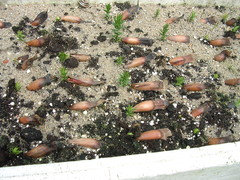
I am currently trying to germinate Araucaria montana and Araucaria cunninghamii seed. I soaked them in warm tap water for 3 days so that 60-70 % of the seeds had sunk to the bottom of the bowl. I've placed the seeds on their sides and pressed them into a moist, fast draining potting mix. I did not cover them with soil or place a plastic cover over them because I have a very difficult time with mold growing on the seed and potting mix. Even without a plastic cover, though, the mix has stayed evenly
moist and very little mold has grown. Some indirect sun, room is about 75-87 F during day, 67-70 F at night. Seeds look swollen, but no real signs of life after eight days in the mix. Am I doing any thing wrong?? I've never had success with germinating Araucaruia seed, so I made sure this time to buy very fresh seed as soon as it became available. Any advice, tips, or help would be greatly appreciated! Thank you!

Comments (52)
Andrew Stevens
Original Author10 years ago@clement_66 thank you for your photo! The little green seedling surfacing in the background is really helpful. Your method of planting them was exactly the technique I was trying to use when planting these seeds. Information is hard to find on growing medium, planting depth, and germination times, and many places just say "after planting them and germinating, then..." What species areRelated Professionals
Chicago Landscape Architects & Landscape Designers · Gloucester Landscape Architects & Landscape Designers · Elmira Landscape Architects & Landscape Designers · Providence Landscape Architects & Landscape Designers · Middletown Landscape Contractors · Tupelo Landscape Contractors · Columbia Landscape Contractors · Niles Landscape Contractors · Grand Rapids Landscape Contractors · St. Louis Home Builders · Ithaca Home Builders · Middletown Home Builders · Tucson Home Builders · Liberal Home Builders · Saint George Home Builders 10 years ago
Keep in mind, the New Caledonian species are in a different section of the genus and germinate differently from angustifolia, araucana, and bidwillii (epigeal vs. hypogeal). But should be planted the same with about 2/3 of the lower part (pointy) of the seed inserted into the soil. Also, these species' seeds lose viability very quickly - so fresh seed is critical. Any more than 6-8 months old will likely be useless.
Andrew Stevens
Original Author10 years ago@sc_77 thank you so much for your post and picture! It's really helpful to see a picture showing what the seed looks like as its recently emerged. It's very difficult to find any pictures or description of newly germinated araucaria seed, so I'm not sure what it would or should look like haha it's good to know too that they push their way out of the soil so strongly. A lot of tree seeds can be fragile when they first emerge. That's a very good point about the seeds not being covered up to keep them constantly moist. I was afraid burning them mostly might cause them to rot--again, it's really hard to find good instructions about how to plant them. Do you think potting mix would work okay?Andrew Stevens
Original Author10 years ago@salicaceae that's a really good point! My first attempt germinating araucaria seed was a packet of Hoop Pine (A. cunninghamii) from a large seed company. The whole shipment was very professional and everything was clearly detailed, but after 3 long months, I finally tossed them with 0% germination. I was really bummed. A few weeks later, I looked back at the company's webpage for the seed I had ordered, and by this time, I had learned Hoop Pine seed loses over half its viability in 6 months in a 3 month half-life process. So seed that is a 1 year old has a 1-5% chance of germinating, and the batch I was sold was over a 1 and a half old! No wonder they didn't germinate! So I started reading a lot of Garden Web's forums about starting Araucaria from seed and a lot of people said their source for their successful seed was RarePalmSeed.com, so I contacted them about their araucaria seed. They had A. Montana coming in stock in just a few weeks later that was freshly collected, so as soon as it came in, I ordered some to make sure it was as fresh as possible. This will be my third try (so far with no success) to germinate araucaria seed, and I believe old or fresher, but poor quality seed were to blame for the first two tries failing. Nevertheless, I am getting nervous that I'm doing something wrong, so I thought I would ask for some help from the awesome people of GardenWeb for any help or advice. I really want to make sure I do this right! Thank you and everyone who has replied to this thread for your help! 10 years ago
My experience with Araucaria germination here in South Australia is mainly with A.bidwillii but I have also grown A.araucana & A. angustifolia from seed. None of them survive drying out of the seed so to be viable seed must be very fresh. Dried seed is still good for eating but certainly not for germination. It is ok to sow any of these covered lightly as they will push the seed up as they develop & the seed stays moist & protected. I saw mention of hypogeal & epigeal germination above but the case of A.bidwillii is unique & termed cryptogeal or cryptocotylar-hypogeal It is curious that these 3 species which are so similar in tree form & cone & seed qualities should have 2 which germinate in a conventional manner with two cotyledon connectors & the third is so different. The first Bunya we germinated (over 50yrs ago) took more than 12 months to emerge. It is now mature & drops dangerous cones every few years. Other plants germinate like this or similar but I don't think any other conifers do. For those who haven't heard this: the Bunya sends down the radicle deep into the soil & forms a swelling like a tuber about 2-3" long from just under the surface to sometimes several inches down. At the top of this forms a tiny cone shaped bud which can remain dormant for extended periods before emerging as the seedling. If the seed is disturbed it comes away with a hollow tube ending in a coned cap which fitted over the above mentioned bud. The seed is still starchy & edible at this stage & the whole process seems a perfect adaption to survive predation.
Andrew Stevens
Original Author10 years ago@peter_out thanks so much for your post! I find this fascinating how a single genus can have so many different forms of germination. I have heard bunya pine's unique germination mentioned several times, but I could never quite grasp why it was so different. Your post explains why this is very well! I have a Bunya Pine growing in a tree liner that's probably 3-4 years old, and it's one of my favorite conifers hands down. I have to admit though I was terrified with such a potentially long window for germination, that I would do something wrong or that it would rot. So I found a small seedling for sale, which took a lot of searching to find in the US haha but all of this has me inspired to try my own someday. I am very curious now, how the other two germination types you mentioned differ from one another and other conifers?Andrew Stevens
Original Author10 years agoUpdate as of 4/27/3016: great news! I now have 6 Hoop Pine seeds about an inch out of the soil! There are around 25 seeds total, but it looks like there are possibly 5-10 more that might germinate in the next week or two. I'm so thrilled--this is the first success I've ever had germinating araucaria seed. Thank you everyone for all your help and advice! I have no doubt they are doing well because of you all! Still no real signs of life from the A. montana seed. It's been about a month since both were planted. At close to 100 seeds though, I thought for sure it would be the most likely to emerge first. Anyone have any experience with this species? I honestly at a bit of a loss. Thanks!- 10 years ago
Andrew do you mean hypogeal & epigeal? They just mean down & up.(literally below & over) So a hypogeal seed stays in or on the ground where it germinated & an epigeal lifts the cotyledons up in the air like a bean or cedars & pines etc. & I guess most conifers. So I spose that makes all the other Araucariaceae spp except Bunya hypogeal as their seed stays put & the root goes down & the shoot goes up? The terms are also seen in hyopcotyl & epicotyl meaning the growth below & above the cotyledons all very logical. I just hope no botanists are reading this as it's only what I've picked up along the way!!!
 10 years agolast modified: 10 years ago
Peter_out, when I germinated A. angustifolia, this is what I observed. The seed germinates. A ghastly, slimy, reddish, mammalian looking something practically slithers out of the seed in just a few days. It grows about 4 inches long, and is maybe 1/4 inch thick. The end of it starts thickening. Eventually that end forms a little more plant-like nodule, 2cm X 6-8 cm. Oval. Looks like another, smaller seed. It has brownish-gray "bark". The slimy slithery "umbilical cord" disintegrates at this point. IIRC this whole process takes about 3-4 weeks. Then, the nodule - which I believe is the buried cotyledon - forms the first foliar bud of the plant, on top of course, and the first roots start forming from the bottom of it.
I don't know if A. araucana goes through similar theatrics, but it fits perfectly with such a weird genera.
BTW the fate of those plants is amusing. One got traded through numerous plant swaps all the way from DC to Alabama, where it was planted by Hayes Jackson and is now quite large. I didn't even try one outside, myself, because a prominent DC area collector told me he'd tried them a couple times before and there was no way they would be long term hardy. The others were bought - for a price wayyyyy too low in retrospect - by some rather strange people in the NYC area who drove down to get them. (in what I wonder now might have been a stolen car...I'm not kidding) I told them that such a marginal plant should not be planted until it was larger. They planted all 4 anyhow. Needless to say that was the year in the early 2000s when NYC had a pretty cold winter...can't remember was it 2002 or 2003? Anyhow the last I ever heard from them, all 4 died. They weren't even willing to protect them.
It was such a rare plant back then, still is but not as bad as before. Desert Northwest sometimes has them for reasonable prices now. The only people ever listing them before 2007 was that Norcal mail order nursery that always had absurdly high prices, I think they wanted $90 for a gallon plant. Can't even remember their name now, long gone. Wasn't Gondwanaland plants, they came along later. It was the one with a very generic, corporate name that was mainly known for selling CA citrus to greenhouse owners in the rest of the country. Something like Pacific Plant Company? California Plant Company? Oh how time flies...can't remember all of this old stuff. (it wasn't Transpacific, they were in Oregon and very inexpensive)
- 10 years ago
David, it is more than 30 years since I germinated A.angustifolia but your description rings bells of memory. The main thing I remember about both angustifolia & araucana is that the both had a pair of cotyledon connectors like all hypogeous germinators (I think I may be making some of these terms up as I go along!) I remember being amazed because I was used to A.bidwillii having its tube connecting the seed to the underground bits. I found both the South American species impossible to grow for any length of time here without grafting them on bidwillii. There were two large A.araucana around Mt. Lofty years ago but both died of root rot as they reached reproductive age. I still have an angustifolia grafted on bunya (it makes a very smooth strong union) in a pot at my front door......another long suffering plant I must get in the ground. The only other angustifolia I know of locally is a large (30y/o) tree in the Mt Lofty Botanic Garden about 5 miles up the road. Unfortunately both araucana & angustifolia it seems, unlike bidwillii are generally dioecious so one plant isn't much use for seed production! Those prices do seem steep especially when you compare the dollar exchange rates. Mind you a Wollemi in a 6" pot here is au$180 .....almost us$140!!! This is so absurd that any I propagate I give away to good homes!
- 10 years agolast modified: 10 years ago
"I remember being amazed because I was used to A.bidwillii having its
tube connecting the seed to the underground bits. I found both the
South American species impossible to grow for any length of time here
without grafting them on bidwillii. There were two large A.araucana
around Mt. Lofty years ago but both died of root rot as they reached
reproductive age."This is very odd. A. angustifolia will grow even in Florida and Texas. From what I know about adiabatic lapse rates and the overall climate of AU, the heights around Mt. Lofty should be pretty cool in summer. Certain no warmer than the 80/60 of the Italian Lakes region, where A. araucana will grow. Even sea level Adelaide is only 85/63 - that would be like central PA in summer...not very muggy by US standards. I can accept that inland locations are warmer during the day, but not much higher at night. And your soils should be leaner and more nutrient poor than any of those places. Surely they both grow in Melbourne?
- 10 years ago
http://www.bom.gov.au/climate/averages/tables/cw_023842.shtml
Yeah as I thought the summit is very cool for a rise of only 2300' in elevation. Summer highs of only 71F! Maybe the Botanic Gardens are at a lower elevation? Oh well. A bit of a mystery to me.
- 10 years ago
Well that may be what they say but I am only about 5-6 miles from the summit & 450' lower & have spent a lot of time up there over the past 60yrs & although it snows there about once every 20yrs it also gets to 110F & has days over 100 for weeks at a time! The limiting factor with the Sth American spp is soil fungus. Actually I just remembered a third monkey puzzle in the Bot Gdns proper but that succumbed too. They die as they mature. Bidwillii seems immune at least I've never seen a dead one & we have utter monsters in the valley below me about 3/4 mile away......I'll take pics of their enormous trunks & canopy & post them when I get the energy to hike down. They are at the top end of the Belair National Park along with some big coast redwoods & a couple of very big giant sequoias but they charge $12 to drive a car in!
- 10 years agolast modified: 10 years ago
"They die as they mature"
At least they last that long. 99.5% of the A. araucana on the east coast die in the first 1-5 years. Which is funny 'cause nurseries charge a fortune for them. I've seen a 1.2m plant for $500 USD!
Maybe there's some local Phytophthora that A. bidwillii resists but the others cannot. Let's hope that one stays down under. Maybe it only grows upside down though!
- 10 years ago
Araucaria montana has epigeal germination, totally different from bidwillii. It looks like cunninhamii when it germinates. Unless seed was collected recently (doubtful), I wouldn't expect much germination. They have very short shelf life.
- 10 years ago
Oh ok so Araucaria has it all covered with representatives of every germination type!! What a wonderfully diverse lot they are!!
- 10 years agolast modified: 10 years ago
Here are some pictures of what must be the biggest Bunya or as big ...it is in Stirling/Crafers South Australia & the guy in the picture is a big stone mason to give you some idea of how enormous it is. It is well over 2m dbh & about 100' tall!!
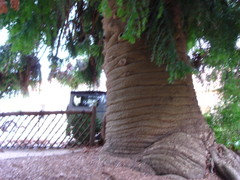
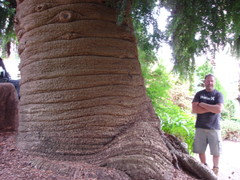
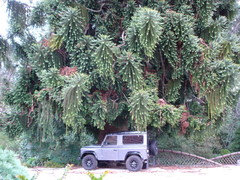
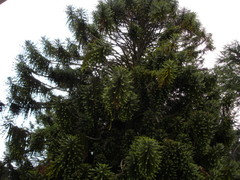
- 10 years agolast modified: 10 years ago
Wow, absolutely incredible. Especially that third picture.
- 10 years agolast modified: 10 years ago
Haha yep the Landrover looks like a toy eh! & its even more disorientating when you're actually standing next to it. The pic with Steve standing next to it looks like he's standing back because of the size disparity but he's not.....he's right next to it & he's a big guy. If you look at the previous photo you see two roots growing downward in an inverted V.....he's standing between them!
- 10 years agolast modified: 10 years ago
I posted the above & another pic of the big tree from a distance as well as a couple of huge Monterey pines in the same garden in their own thread for those who haven't seen this. http://forums.gardenweb.com/discussions/3871777/giant-bunya-araucaria-bidwillii-in-south-australia?n=4
Andrew Stevens
Original Author10 years agoThat's exactly what has happened to me with the A. montana seeds, unfortunately. I'm so glad I got about a dozen hoop pine seeds to germinate, or I might have given up on growing araucaria from seed for good! Even still, I estimate that only 35-40% germinated, so they must loose their viability mind-numbing lay fast haha So, with New Caledonian species like A. montana and A. laubenfelsii etc., they must be REALLY fresh then to germinate? Are there any good seeds sources or times of the year to check for New Caledonian seed?Andrew Stevens
Original Author10 years agoI really didn't expect so many replies! Thank you everyone for your replies and for sharing your experiences and knowledge!- 10 years ago
What are the US seed entry requirements like for these seeds? Bunyas (& most Araucaria) produce massive quantities of seed in the 'on' years & the seed is easy to collect & ship...so it would be easy to get fresh seed to there. You really need seed within a couple of weeks from maturity to get the best germination so the way to go is to find sources right from the trees where possible. I'm trying to think of an example of comparative short viability & I guess chestnuts or most acorns are about the same. Without controlled humidity & temperature storage the seed becomes non-viable very quickly, within a week or two at room temperature. Even seed stored refrigerated without humidity control will dry & also become non-viable very quickly. I am critical of many seed merchants who sell seed which has passed its viable storage time. Some even treat all seed to dry storage & one has to be careful to only purchase those species which remain viable when dried. Thousands of seeds of many species are sold world wide which are just dried shells!!
- 10 years ago
Thought I'd do the experiment so I just ordered a pound of A.araucana seed from a commercial seed house. Our bio security wants a certificate stating that the seed has been treated by "Immersion in 1% sodium hypochlorite
solution for 10 minutes." I believe this seed is from the 2015 crop but US grown so we'll see if it's capable of being stored for 6-7 months or so. If it germinates I'll still have to graft the little ones on Bunya for them to be expected to survive long term here. Here is a picture of an A.angustifolia 6-7' tall grafted on a Bunya (wollemi to the left) & dated 17-11-94 so it's been in a 2 gall pot for 22 years......tough plants eh!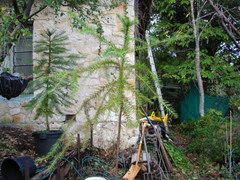
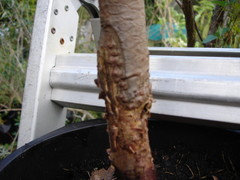
This graft was a normal side graft by the looks (memory lets me down) & all things considered is smooth & strong. I have just potted this into a 4gall pot.........can't rush these things!! Although I'd normally graft conifers in winter here this was a spring graft as Araucarias, at least this, bunya & monkey puzzle can be done almost any time.
- 10 years ago
Damn....neither of the USA sources I tried can export A.araucana seed due to its CITES status.....even though the seed is produced on cultivated trees in the US......madness!
- 10 years ago
Hello Peter,
Next September I would be able to send you seeds if you will be still interested. Andrew Stevens
Original Author10 years agoHey Peter,
Thank you for all your help. This makes me feel much better about my success rates with araucaria seed. I'm by no means a master gardener, but I think I've got a fairly green thumb haha so I've been left scratching my head on this one. Those are some beautiful trees you've got there! I'm perhaps most amazed with the grafting--I didn't know that was possible with Araucaria! Like others have said, I find it interesting that A. angustifolia doesn't survive past adulthood there. Even in the very hot, humid, and mild winter Southeastern US, they seem to do just fine. Now it's sibling, A. araucana, that is exactly what it does here, except few ever make it beyond 5-6 years. The fact that grafting onto A. bidwilii rootstock resolves this makes me almost certain that the problem is with either the soil, or something living within it. I know in the southeastern US, due to the prevalence of heavy clay soil, Phytophthora fungi are a significant problem. Plants that cannot tolerate it eventually succumb--sometimes several decades later. That's very interesting for sure.
Oh my gosh, yes, the CITIES regulations are so frustrating. It makes sense if they applied to indigenous populations and habitats, but for shipping a handful of seed from a non-native region source? I'm not too familiar with international commerce and trade regulations, but you would have thought someone would have said, "Now, wait a minute, what about well-meaning plant collectors and botanists?"Andrew Stevens
Original Author10 years agoHmm, I'm not sure, I'll have to research what laws apply to US seed import. I've not had any trouble obtaining araucaria seed before from different suppliers both in and out of the US. I believe though, Hawaii and Florida require more stringent importation requirements.
That would be fantastic to obtain some fresh araucaria seed from you. Like you said, it's so difficult to find a good supplier that hasn't already had the seeds for at least a month. Thank you so much! I'll check and see if there would be any problems, and I'm glad to pay shipping and for the seeds as well.- 10 years ago
I thought I read that the Monkey Puzzle was a slow grower...I disagree! These things are rockets. Same tree I posted above, about 1 month ago. 7 of 7 seeds germinated and are doing well. These seeds are from Sheffield seed company.
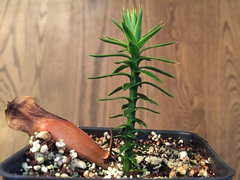
- 10 years agolast modified: 10 years ago
To respond to a few of the above: A.araucana grows very fast the first year or two then settles down to normal rates in my limited experience.
It is really absurd that seed of a listed species harvested in Washington can't be exported from USA but the regulation does state: "from all areas" so the letter of the rule is being applied, I tried both Sheffields & Schumachers .......so I have ordered 1/2 pound of each araucana & angustifolia from Chile & so far the order seems to have gone through ok so we'll see.
A.bidwillii seems to be immune to whatever kills the others. I drove up into the Belair National Park yesterday to visit the Araucarias. There are heaps of Bunya, Hoop & Norfolfk there. The latter two are mature & large but the Bunyas are truly huge! None are quite as big as the giant I pictured above but a couple are about 6' through. Unfortunately I only had my phone camera so couldn't take any good pics (I'll go back with the camera sometime) but got this one of the tree that dropped a cone 5' in front of me on my way home from school as a kid on my bike 50 years ago.
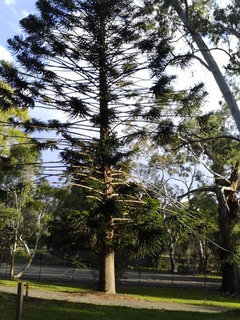
This is a small tree (about 3' through)compared to its brethren a couple of miles further up the valley which are a couple of 6'ers & several close to that.
There are also a few Sequoias of both types which are huge....for here that is , I guess about 1/2 (or maybe 1/3) grown: here are a couple of coast redwoods with a giant sequoia in the background all of which are 40m or so, it'd be interesting to see them in a few hundred years!
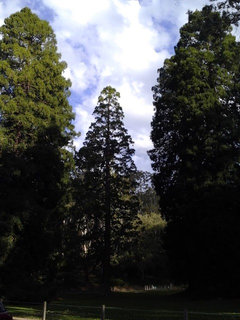
Up where the big bunyas are there are a group of 4 or 5 among which is the tree I took the scion from to graft the "sideways" one I've pictured elsewhere. Near by is a truly huge one with an amazing knobbly trunk which has two self sown seedlings underneath. I remember the 1st of these from about 40 years ago when it was 2' high. It's now 20 or 30'. Next to it is another young one about 6'. Both these are growing right in the creek that runs in winter under the trees so must have needed the extra moisture & protection to germinate & survive. Many seeds used to germinate on the ground & then dry up but now tourists & rats make short work of the fallen seeds unless you get there at dawn & wait for the falling bomb like cones!! It's never sure when the trees will have an "on" year for fruiting (I didn't see any anywhere this year) but I will keep my ear to the ground...... just not under the trees :)
- 10 years agolast modified: 10 years ago
The 250 grams of Araucaria angustifolia seeds I ordered ex Chile have arrived opened & inspected but forwarded without treatment. Although they have been in the post for a full 5 weeks they seem plump & moist & should germinate fine. I also ordered 250 grams of A.araucana seeds at the same time but they haven't come yet. I don't know if they are still en-route in a separate package or are the victim of CITES like the ones I attempted to order from the USA. It is hard to get any communication from the supplier so I guess I'll just have to wait & see! There are approx 35 good seeds & a couple of runts. I think the cost works out to about US$1 each seed. I will soak them for a couple of days to be sure they are well turgid & give them a fungicide treatment before sowing.....I actually may put them in a bag of moist peat & hang them by the fire until they sprout which may prevent them being stolen by varmints while germinating! fingers X'd !
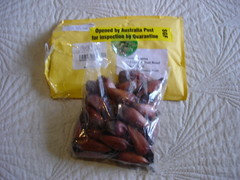
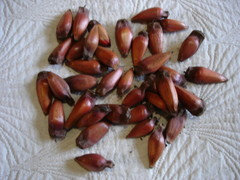
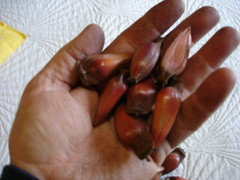
- 10 years ago
Actually pseudosequoia I'm not sure I responded to your earlier offer to send me seed next September...........if you see this could you PM me so we can discuss it? Cheers
- 10 years ago
Here's an interesting paper on cutting the seed tip to induce germination of A.angustifolia & araucana : http://www.scielo.br/pdf/sa/v60n2/15343.pdf
- 10 years agolast modified: 10 years ago
The other Araucaria seed I expected also arrived. Here is a picture of them with the tips cut as described in the article linked above:
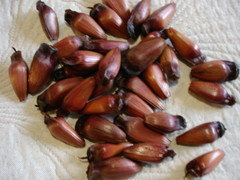
From the look of these they may actually be the A.angustifolia as they are larger & plumper than the first lot......
- 10 years agolast modified: 10 years ago
Keep us updated. I'm still baffled either species has difficulties in what seems like such a mild climate. I almost want to somehow scientifically pursue it to see WTF (pardon my french) is going on. We know Aussie soils are often very mineral deficient. Could there be some mineral deficiency that tends to promote Phytophthora/Pythium etc. susceptibility? What could wash out besides phosphorus? You would only expect the opposite, generally. That too much of something helps those pathogens grow. Or do you have to fertilize more in AU, and that is somehow throwing some kind of soil flora balance into disarray? Very mysterious IMHO. A few monkey puzzles are even known in the the "interior" west coast, according to plant guru Ian Barclay, places like Weed, California, that surely get just as hot and dry as you can. What they seem unable to tolerate in the eastern US is hot and wet. Is is possible that even though your climate is Mediterranean, more or less, you sometimes have gigantic summer rainfalls over 60mm at once? That might do it for the Monkey Puzzle, but not the Parana Pine.
- 10 years ago
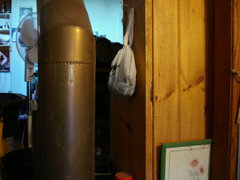
I suspect that our cool very wet winters followed by long hot very dry summers during which we are forced to irrigate heavily make a perfect situation for phytophthora etc. We have the same trouble with other Sth American species such as Gevuina avellana a beautiful proteaceous tree. Both this & Monkey Puzzle seem to do better in Tasmania with its cooler climate. The soils in the higher (a relative term!) Mt Lofty Ranges are quite rich clay/shale/loam & have a good range of minerals. Where I am there are no sandy or lighter soils at all. Unfortunately there are no relatives of the Gevuina here to use as adaptive rootstocks like the Bunya is for its Sth American cousins. Macadamia grows well but isn't quite close enough. Here is how I'm sprouting the Araucaria seeds in a shopping bag of damp peat next to my wood heater flue it gives a gentle constant warmth & the seeds seem to like hanging as they stay moist but very well aerated:
These are some A.bidwillii seedlings for rootstocks 14 months after germination with some only just showing above the surface now! (blurry pic sorry)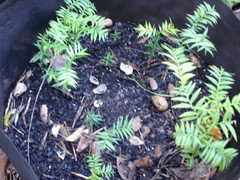
I use 100 liter poly bags for 'seed trays' with a medium depth of about 18" which makes for easy pulling of seedlings with complete undisturbed roots. I just turn the whole bag on its side & roll it about a bit with maybe a punch here & there & then gently yank the seedlings out with whole roots!
- 10 years agolast modified: 10 years ago
"Macadamia grows well but isn't quite close enough."
Thanks for the followup - it's hard to feel too bad for you if you can grow Macadamias! Still though, there are monkey puzzles in irrigated gardens from Seattle to San Francisco so, it remains a mystery to me. Will SW Australian plants grow for you? Like Grevilleas and Kangaroo Paws from around Perth? I've heard those are very susceptible to root rot but I wonder how they compare. Maybe what is missing from your soil is actually a biotic factor, like a microbe that helps keep root rots in check, that occurs on some continents but not others. We know how many human anti-infectives and antibiotics came from other naturally occurring organisms - often soil microbes - so it isn't a stretch in my opinion.
- 10 years ago
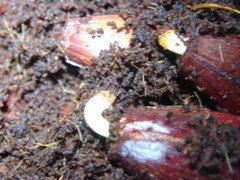
Well it's good when ones intuitive horticultural sense + a little experience & research proves successful........ here's the first germination of the seed hung in the bag of peat 5 days ago after soaking, fungiciding & clipping of the tip as described in the paper mentioned above:
- 10 years agolast modified: 10 years ago
Here's an update for your interest:
Here's some pics of the
above seed 15 days after sowing, of 37 seeds 31 have germinated
normally, 3 have formed blind ends on the root tip & 3 have yet to
germinate: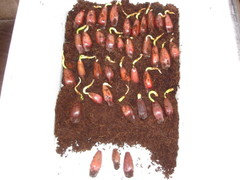
"3 have blind root tips"
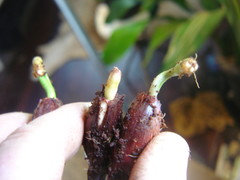
2 of those look like making secondary roots around blind tip
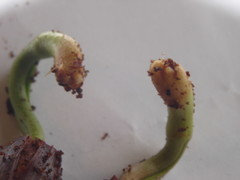
One has 2 embryos . . . . . . bonus!
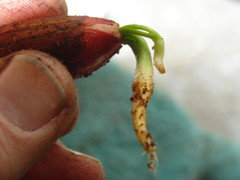
I may've been very lucky to get these seeds as the supplier seems to have vanished after many years of operation! I'm going to tube up these germinated seed into small 3" X 4" tubes as I won't grow any of them on to be trees but rather just maintain them as potted stock plants to provide scions to graft onto Bunya rootstocks. If I were going to plant them on their own roots I'd have given them up to 18" depth for the initial root. 60 years ago we planted a Pinus pinea from a 5" clay pot (before the days of plastic pots!) & after more than 30yrs seemingly good growth the 20' + tall tree fell over & revealed the 5" pot root ball between the trunk & the extensive root system!
Incidentally I was up at the Mt.Lofty Botanic Garden nursery the other day & they told me that the last A.araucana there (a tree of more than 15' ) had just turned up its toes & died.
BTW Andrew sorry to hijack your thread, if these posts aren't of interest just let me know & I'll go dig holes in the garden instead! :)
- 10 years agolast modified: 10 years ago
Interesting pics, thanks for sharing.
"Incidentally I was up at the Mt.Lofty Botanic Garden nursery the other
day & they told me that the last A.araucana there (a tree of more
than 15' ) had just turned up its toes & died."Sad, and really surprising. Horticultural academe has a lot of other things to worry about, but it would really seem prudent for someone to type out the species of Phytophthora et al. that is doing the killing. Bboy mentioned reports of Monkey Puzzles dying in other maritime climates (and that's certainly what Mt. Lofty is, cooler in summer than Portland, OR where there are plenty of MP trees)...so maybe this is going to become a global epidemic. Someone should notify whomever studies the ecology of Araucariaceae in Australia/Oceania. Of course given the mindset of academia, it should probably be someone in charge at that garden, and not one of the unwashed masses.
I'm curious, can you name the supplier that "vanished"? Whenever I think of seeds from South America I think of that English couple with the names right out of an Edwardian adventure novel...which I now forget! Someone will know! Like Jim Archibald, I believe at least one of them departed this Earth and they are no longer in business.
- 10 years ago
David it is certainly very frustrating for me to have seen these monkey puzzles die. There was one which reached fruiting size at Bridgewater about 10 miles from here which looked very healthy & died suddenly in 1984. I remember the year it died as it was the year after the 'Ash Wednesday' bush fires though the fires didn't cause it & got only to within 5 miles of the tree. I remember the owner called me & asked if I wanted the dead body.......I regret not taking her up on it now as some A.araucana timber would have been nice!
I think that 'on the ground' Portland is a little cooler than Mt.Lofty though I agree it appears very similar on paper. I really think that if the soil was in a natural & healthy state the araucanas would probably survive here but the natural soil fungal growth is way out of balance. It's easy for the baddies to thrive if the beneficial population is damaged. Just understanding what is killing them won't stop it. I was watching British antiques roadshow on TV recently & in the distant background was the silhouette of a huge mature dome topped araucana ....utter envy!
- 10 years ago
I was talking to a well known nurseryman from Victoria the other day & he told me that there are 2 or 3 large A.araucanas in cooler areas over there so they can survive in Australia to a relative state of maturity if the conditions are right it seems. I
bought a 1' tall one today from a local hardware store for AUD60 to
graft on a large Bunya stock I have in my backyard. Reckon I'll do an approach graft: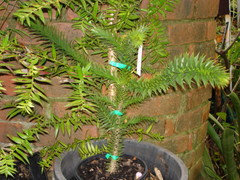
- 10 years ago
Here's the approach graft almost 3 months later
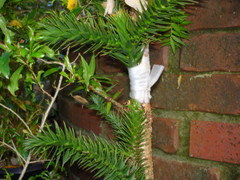
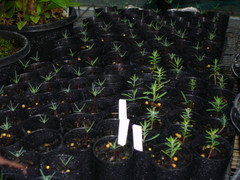
& the Araucaria seedlings (pictured germinating above) after 3 months:

I can't see any difference yet though one box is supposed to be A.angustifolia & the other A.araucana....I guess time will tell! I recall when I grew these 2 some 30 years ago that the angustifolia seed was noticeably larger, these however were the same size! They're quick growers though unlike the Redwood & Giant Sequoia seedlings pictured at similar age!
Hard to believe these could become some of the largest living things on the planet!! The Redwoods on the right were dug from under a tree across the road from my house & the Giant Sequoias are from bought seeds, same age, very different looking. (reckon the 2nd back on far right is a 'ring-in' Cupressus)
- 10 years ago
I'm impressed, peter_out. Approach grafting seems a little more amenable for the "unskilled masses" like me, to successfully carry out without hours of practice. I'm currently trying it with some lepidote rhododendrons.
- 10 years agolast modified: 10 years ago
David approach grafting can be cumbersome & also has the disadvantage of tying up 2 plants or at very least a potted stock & a branch of the scion tree. It takes a long time before it is ready to separate from the scion plant/branch & requires concentration. I have been guilty in the distant past of cutting the top & bottom off wrong way round & being left with a useless combination! I find it best to tie these real tight so use special 1" wide very strong tape. It doesn't show it in the above pic but I have cut the side out of the A.araucana pot to get the Bunya stock up close & then filled in the big pot the stock is in so the 1/2 a pot the Monkey Puzzle is in is potted in the bigger pot! I'll leave it just like that all this summer without cutting anything then unwrap it & inspect the union before cutting anything off. :)
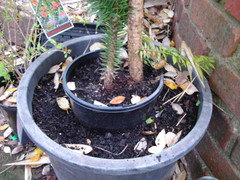
 8 years ago
I just discovered this Araucaria converstion and wanted to add my experience. Andrew with regards to your initial posting...I only soak my Araucaria seeds for 24 hrs...the ones that sink...usually have the greatest chance for germination...for the seeds that don't sink...I wait about 12 hrs and then soak them for another 24 hrs...most of the time you will find more sinkers. I plant all of the seeds...and have been surprised to find that some of the non-sinkers did germinate. I think that prolonged soaking will kill the seed...so to speak. I've had some Araucaria actually germinate during the soaking process...examples are the A. araucana, A. angustifolia and A. bidwillii.
With regards to sowing the seeds...without exception I cover all Araucaria seeds with a small amount of soil...about 1/4 - 1/2 inch. During the cooler months I use heating mats set at about 75 F.
Of all the species I grow: A. araucana, A. angustifolia, A. bidwillii, A. cunninghamii, A. columnaris, A. montana and A. hetrophyllla...I have found that almost without exception some will begin germination within 2-3 weeks....but more importantly...don't give up on the remaining seeds that have not shown any signs of germination...I currently have some that are lagging 3 months behind those that have already germinated.
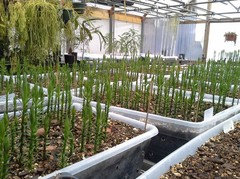
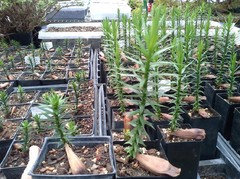
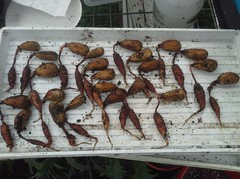
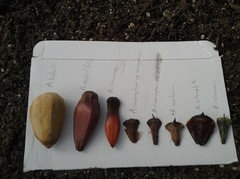
Pictures: #1 - a forest of A. angustifolia, #2 - A. araucana (Left) and A. angustifolia (Right), #3 - A. bidwillii getting ready to be moved up to taller pots, #4 - a display of Araucaria seeds.




sc77 (6b MA)