Software
Houzz Logo Print
darin_bullerwell

Logan Labs 2016

10 years ago
last modified: 10 years ago
Good Day,

I purchased my first home 3 years ago and have been doing my
best to get a handle on proper lawn care. This and another site have given me
tremendous help in many areas, and while I have learned a bunch I still have
much more to figure out. I’m pretty sure I mow at the right height of 3-4in
depending on the time of year. I also do my best to follow the infrequent water
schedule. I would say my biggest current issue is proper yearly feedings on my
lawn as far as schedule goes. Last year I started the organic route with
soybean meal and milorganite and it seemed to work out pretty well. I know the
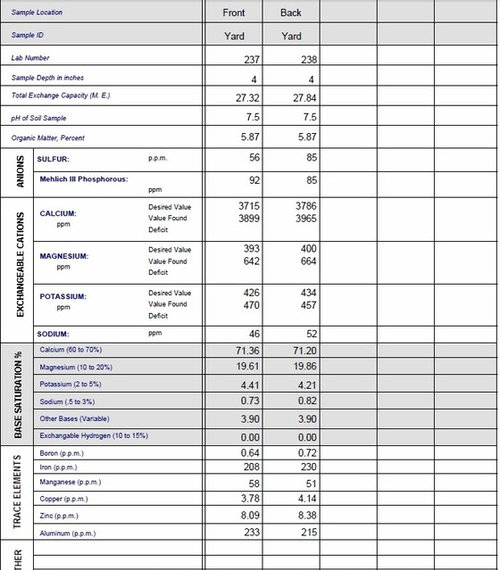
best place to start is a report from Logan labs........so here we go.

I’m in Zone 3 (Southern Alberta Canada) and I have KBG.

Thanks and Cheers.

Comments (11)

  • 10 years ago

    Would really appreciate the help.

  • 10 years ago

    Sorry for the delay!

    Front and back are close enough to fold together, so you can do one test in the future. I made a note where numbers differ, but mostly just used "-ish" where the numbers were close to each other.

    ME 27-ish: You have a dense soil, most likely silty with (actually) some clay. Which is quite rare. It holds tons of resources, doesn't drift quickly, and once you get it in the groove you should only need to test it every 3 to 4 years.

    pH 7.5 (both): A tad high, but not a problem, and with an ME that high you won't be able to change this.

    OM 5.9% (both): Good, bordering Excellent. Definitely mulch mow and mow your fall leaves in, but there's no reason to make any special effort. You can certainly feed organically if you like, though.

    Sulfur 56, 85: Both pretty high, a hallmark of higher organic matter levels (and probably some gypsum in your soil). It's certainly not a problem.

    Phosphorus 90-ish: Low end. My target here would be about 260-280 due to your pH. We use starter fertilizer to enhance this, and just buy the cheapest. They're all the same.

    Calcium 71%-ish: Both a tad high, but not a problem and nothing you can adjust easily. Grasses tolerate high calcium beautifully.

    Magnesium 19.6%-ish: High. This might make your soil tight and hard to dig, plus make it crack when dry. You can't get rid of it--and it's not harming the plants--so you live with it. But avoid magnesium sources as you don't want to make the problem worse!

    Potassium 4.2, 4.4%: Right in the optimal groove!

    Minor Elements: Boron is actually perfect! Manganese, copper, and zinc are all rather high, but that won't be a problem for you. I do mention iron below.

    Iron 200+: This is really very good and should be OK even at your pH. However, if you find the color suffers, you can always use Milorganite to slowly increase this number. Iron is not toxic until absolutely ridiculous levels (50,000 PPM or more).

    Recommendations (the fall ones may need to shift a bit in Alberta):

    Late May: Feed with starter fertilizer at the bag rate.

    September 1: Feed with starter fertilizer at the bag rate.

    October 1: Feed with starter fertilizer at the bag rate (if your soil is going to freeze soon, move the September 1 and October 1 feedings back a bit).


  • 10 years ago

    Morph, why do you change the target for P because of the pH? I think you're saying this soil will need more phosphorus than normal soil because it's alkaline. Would you also say the same thing if it were acidic (below 6.0)? I think this has something to do with P fixation and I'd love to hear more about it. Not sure the poster is interested, so maybe I should ask this in a different thread. If you're busy (and you likely are), this can wait for another day.

  • 10 years ago

    I'm very interested in Beckys question.

  • 10 years ago

    I forgot to say “THANK YOU” to Morph for his hard
    work.......you sir are a gem.

    Morph advised three applications of starter fertilizer
    which I’m guessing is for the Phosphorous. He also mentioned Milorganite to
    keep raising my Iron.

    I guess my questions are as follows

    How does this look for a starter fertilizer? https://www.homedepot.ca/en/home/p.vigoro-lawn-starter-fertilizer---7-kg.1000121354.html

    I want to keep building my microherd in my lawn and from
    what I’ve learned that means organics for them to chew on. What schedule should
    I follow for this? From what I hear with my KBG lawn I’m aiming for about 5lbs
    of Nitrogen for the growing season.

    I have made some BLKH but when do i start the applications?
    I have not put anything in the lawn this year so I’m not sure when to start? Or
    does it matter? Would they just munch on the grass clippings and thatch etc?

    I like Milorganite for the Iron but, is it as effective
    as Soybean meal for my microherd?

    Due to my high magnesium levels which gives me the tight
    soil I’ve encountered is my only real option BLSC? I’ve just mixed a batch and
    have an initial plan of every two to three weeks for its application. Does this
    sound about right to soften the soil and maximize water penetration and
    retention?


    Thanks a ton

  • 10 years ago

    Any thoughts?

  • 10 years ago

    Sorry, my schedule is busy so I'm checking in catch as catch can. Right now I'm trying to juggle way too many things...and garden planting is coming up fast!

    BLKH and BLSC are both completely fine and you can use these right up to the maximum recommended amounts! Both will help loosen your soil, and both will work--just more slowly and not quite as well in a high magnesium soil.

    The combination can be started any time the soil's not frozen, and both will slowly help with eating your thatch (although a severe issue might require an initial dethatching to clear the worst of the problem, depending). Feeding organically will do a lot for thatch as well.

    Vigoro's a great starter and I'm perfectly content with you using that!

    Organics can be started any time, but I feed on May 1, August 1, September 1, and October 1 with an organic that gives 1 pound of nitrogen equivalent (15 pounds per K soybean meal, in my case). While you can do it, I generally recommend against summer applications...although your summers are nothing like mine and 95 degree temperatures are probably pretty uncommon up there!

    For you, that schedule might be May 15, July 15, August 15, and September 15 to give the organics four good weeks before cooler temperatures hit to work.

    Over time, the organics will do as much (or more) to open up your soil than the BLSC and KH. But the spray will work a lot faster and start the process, so both work beautifully together.


  • 10 years ago

    I put Becky's question separately.

    Generally, between about a pH of 6 and 7, I'll simply target around 200 pounds per acre of phosphorus. It's fine....optimal, in fact...due to the fact that P availability is pretty good in that range (with some wiggling at the extreme ranges of it, but it's not very important).

    P is one of those elements that's required, huge amounts go through chemical reactions in any given organism (including us) per day, but there's never much available in the environment. We all recycle it very efficiently. Excessive amounts in the soil aren't required, so 200 PPA (about 1 part in 10,000) is fine. Only a tiny amount of that 200 PPA is actually available at any given instant--usually in the parts per billion.

    As a rough rule, I'll add about 20 PPA for every 0.2 points over 7.0--except that as we go over 7.5 I tend to step that up a bit since P availability drops even faster.

    If I were to allow an acidic soil to stay acidic, I'd do roughly the same thing (without the step-up as it's not as necessary there). However, we usually don't do that--we correct the soil to a normal pH range with calcitic lime, so I'll normalize the target to 200 since that's the ultimate goal for the soil.

    My target for my own soil is a tad higher since I balance beautifully at a pH of 6.2 (a bit low). Due to the volume of added materials, I've actually rocketed past the target so far I won't even tell you how far. :-) Suffice to say that the annual gardens are closer to 1000 than 200, which is actually optimal for annual flowers.

    Excess phosphorus is tolerated well at all pH levels, so that's only rarely a concern in terms of plant health. Although there are some plant families that won't tolerate P in the soil (most native to Australia), those are rare--and you know if you have them since they're difficult and expensive plants.

    What is a problem is soil erosion in high-P soils, which will eventually reach a water course and produce algae, phytoplankton, and cyanobacteria blooms. We call that "eutrophication," which is a very pretty word for a very big problem. So limiting P levels is smart.

  • 10 years ago

    I didn't mention antagonistic elements in the above, either--some elements simply don't play well together and block each other's absorption. The trick there is to balance them appropriately into accepted proportions.

    So I might kick P up if another (or several) antagonists are at higher levels in the soil. Vice-versa, I'll kick up an antagonist if P is very high to make sure the plant can get what it needs.

  • 10 years ago

    Thanks. I've just read a chapter on P and it said P was less available when the pH is not ideal. Under 5.5 because of fixation with Fe, AL, and MN compounds. Over 7.5 because of fixation with CA. So it seemed you are taking that into account. What I found fascinating in the chapter was that microorganisms eat up inorganic P and so it can be kept in reserve that way. P in organic form can make up 15-80% of total P in the soil. And organic P doesn't show up on the soil test. All the more reason to keep feeding the microherd! They are keepers of P. There is a downside to excessive P, from what I'm reading. Excessive P in alkaline soil may induce Fe deficiency when plant-available Fe is low.. The solution there would be to add more iron, like in Milorganite.

  • 10 years ago

    Exactly. Now granted, for most grasses (centipede being the exception), my reaction to a pH of 5.5 would be to dump calcium. That low, there are a dozen reasons the grass isn't doing well, phosphorus only being one of them.

    Phosphorus is in organic storage most of the time in organic soils, it's an integral part of the DNA molecule and the central atom of the ATP and ADP molecules (the heart of energy transport in the cell). We get the P back into the soil when the organism dies, but it's often picked right back up by another living thing and used.

    Most organic feedings are in the 1% P range, so not high enough to correct the issue by themselves, or make it worse if the P levels are very high already. Even bags that list 0% P aren't necessarily correct, it just means that the floor number for phosphorus is under 1% on average.

Sponsored
Schlabach Woodworks
Average rating: 5 out of 5 stars21 Reviews
Franklin County's Reclaimed Wood Professionals