Software
Houzz Logo Print
amanda_medlin80

I don't know where to start!

10 years ago

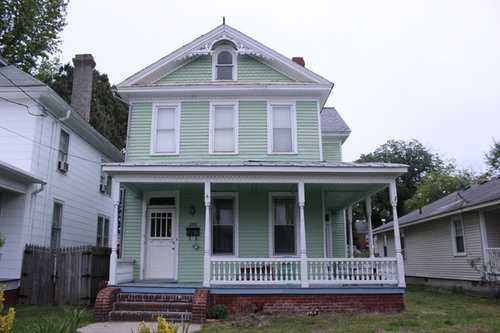
We just moved into a 1910 Victorian and while I dream of an arbor and white picket fence with an overgrown cottage garden, my reality is a bare yard with weeds. My budget is small so I am going to have to build my garden little by little. I would like to go ahead and plant a few ???(evergreens, shrubs, climbing roses, perennials, small tree) in front of the porch. I've done a lot of research as to what is popular in cottage gardens, but where I really struggle is in the placement. I love the random look with varying heights and sizes, but I know I need to have a plan. Help!


For reference, we live in Coastal Virginia and our house faces west. The front of the porch gets morning shade and full sun the rest of the day. The pictured right side of the porch gets full sun all day and the small part to the pictured left of the porch is shaded but has poor drainage so the soil stays very moist on that side. Also for reference, the porch rails measure 54 1/2″ high from the ground and the front bed to the pictured right of the porch steps to the front corner of the porch is approximately 16′ across.


I look forward to hearing your ideas! - Amanda

Comments (6)

  • 10 years ago

    I agree with everything Lilyfinch just said!

    Do you have a preference with colors? My favorites are lavenders, purples, blues, pinks, light yellow and white in the front...but bright yellow, orange, and other zinnia colors in the vegetable garden.

    With the green you have on your home, just about anything is going to look lovely : )

    Amanda Medlin thanked Lavender Lass
  • 10 years ago

    I don't have any suggestions as I am not very knowledgeable when it comes to plants, but I wanted to say your house is adorable!

    Amanda Medlin thanked rockybird
  • 10 years ago

    I adore your home - everything about it!

    If it were mine I'd go with a riot of colors, fragrant flowers, vines, hanging baskets of geraniums from every porch opening - everything.

    Amanda Medlin thanked caroline94535
  • 10 years ago

    For ideas drive around or walk around neighborhoods in your area that are landscaped to see which plants grow well and to get ideas for placement. Note which plants look attractive to you and think about how those or similar plants might work in your yard. One note is that many builders and gardeners place plants too close to the house. Leave enough room to walk behind the plant for home maintenance and plant care and for the plant to reach its mature growth.

    There are many plants that like a bit of moisture and shade including a favorite, primroses. There are different kinds of primrose with different heights, foliage and bloom times, not just the ones commonly seen in grocery stores in spring.

    Amanda Medlin thanked mnwsgal
  • 10 years ago
    last modified: 10 years ago

    Great house! I am particularly fond of Victorians, and yours is lovely.

    I agree with mnwsgal that you want to be sure that shrubs get placed far enough from the building. If you look at the shrub around the side of the house, notice how large it is, but is still almost brushing the building, so the beds need to be deep enough to accommodate the grown size of what you choose plus enough room to walk behind for painting, washing windows, etc, usually a minimum of an extra 2 feet. (This also may help decrease pruning if the plant gets larger than expected, though checking with a botanical garden like the Missouri Botanical Garden Plant Finder as to ultimate size works better than relying on the plant tag which usually gives shrub sizes at 5 years.) To me, with a house the height of yours, a deep bed also balances the house better than a skinny little strip along the front. So I would make a deep bed of a minimum of 6' deep, though better 8'-10' to give you depth for a couple layers of shrubs and perennials, improve the soil with compost or manure, and then add an edging, either a well-buried strip of metal or plastic made for edging, or a deep cut edge, V shaped in cross section. That will keep out the grass and keep the bed looking tidy. Finally, add a layer of corrugated cardboard over the surface and cover it with at least 3" of mulch. This will keep the weeds down while you are adding plants. Having good soil is a key to a good garden, and this will be the foundation of the garden. (I know it's not the fun stuff, but it's worth it!) When you are ready to plant in a particular spot, push aside the mulch, cut an X in the cardboard and tuck the ends under, and plant. If you can only do one side of the house this summer, that is fine. You can prep the other side in late fall or next spring.

    Sources for manure or compost that are free or inexpensive might include your municipality's yard waste recycling facility, a local riding stable or a neighbor that keeps chickens (needs to be composted first) or rabbits or a pet guinea pig. Frugal sources for mulch include the line clearing crews or tree crews that are running chippers (if they are in your neighbor hood, dumping in your driveway often saves them time and dump fees) or if there is a local woodworker using a planer or lathe. I've only rarely needed to pay for either beyond my own labor. If you do need to buy them, getting a truckload from a local place that delivers by the yard is far cheaper than getting bagged materials.

    If there are still some funds available after getting compost and mulch, you can add some sun-loving shrubs and hardy perennials. Be sure to check water daily by sticking a finger in deeply and watering when needed. Then start annuals from seed that will grow large enough to add some presence and volume to fill the rest of the bed for this year. You can get packets of tall marigolds, cosmos, cleome, calendula to name a few, or if you want you can get them as already started 6-packs. You may find some perennials in 6-packs as well, particularly at small neighborhood nurseries. I've gotten several different types for prices ranging from $3.50-$12.00 per 6-pack, which is a good price per plant for perennials. Small new perennials won't probably bloom a lot this year (hence the annuals) but will in future year. Look around your area for plant swaps or sales, either posted in the mid-Atlantic or Virginia forums here on GW or else locally, often coordinated by garden clubs. In my area, new gardeners are always welcome at plant swaps, even when they can't bring any plants; gardeners are generous IME. In fall, spring for some daffodils since they will give the biggest bang for the buck in bulbs IME - the critters never eat them and the clumps expand a bit each year. Just plant them behind perennials so their dying foliage is hidden by emerging perennial foliage.

    The small shady area on the left can get planted with shade plants, but the rest of the front and the side will need to be planted with plants that like full sun - morning shade doesn't really count here since it will get more than 6 hours of full western sun during the hottest part of the day. So no Hydrangeas or other shrubs that will suffer here. I mostly won't make specific plant suggestions since your area is too different from mine, but will second the suggestion to look around for what appeals to you in gardens, not in pots at nurseries to begin with. Look for plants in full sun. You may find ideas in your neighborhood, or in demo gardens at nurseries, or at botanical gardens, or even at commercial businesses. If you take photos you can post them on the Name that Plant forum for ID. Consider all 4 seasons - flowers, leaf color, fall leaf color, leaf size and texture, as well evergreens (either shrubs or perennials) and colorful bark or berries for late fall and winter. Do you want to plant for hummingbirds or butterflies? Do you want plants to string holiday lights on? One of the advantages of using mostly annuals the first year is that you can look for plants that are at their best in fall and winter to extend interest.

    I will suggest that if you are interested in roses, look for ones that are disease resistant in your area (demo gardens may help here). If you like clematis, look for ones that say they are type 3, hard prune plants. They will be easiest in your hot and humid summer weather and only need a hard pruning down to a couple sets of buds once annually in late winter.

    Amanda Medlin thanked NHBabs z4b-5a NH
Sponsored