Software
Houzz Logo Print
rayfow

Troubles in wood....

10 years ago
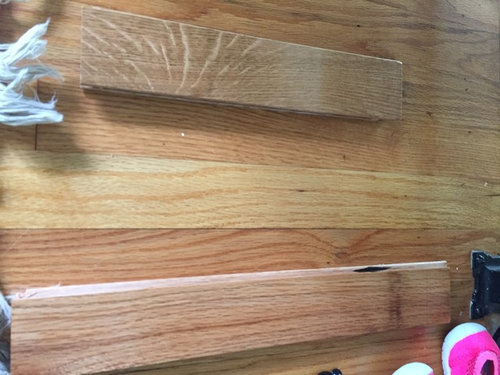
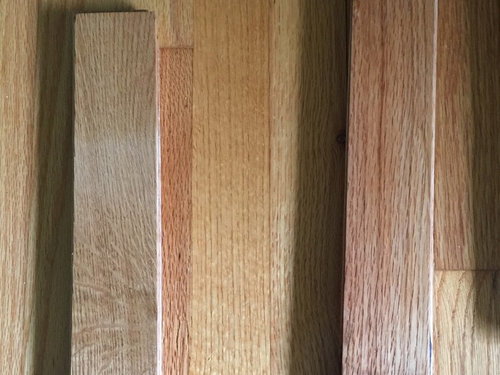
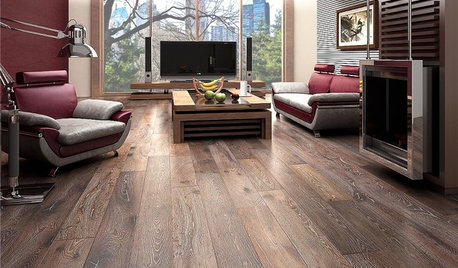
I'm trying to figure out what my flooring is so I can somewhat match it (at least the right color family) in another room. I posted a few days ago but I think you can see in these pics how lemony/orange the floor is. I now believe it may have had an oil finish but then was refinished with poly within the last 10 years. In the pics, the wood to the right or above is white oak with oil poly, the wood to the right or below is red oak with oil poly. Neither look right. The grain marks on mine are almost red and it has a multi-dimensional look to it that isn't capture in the photo.


Comments (19)

  • PRO
    10 years ago

    Your floor is red oak with a clear coat.Probably a waterborne poly.

  • 10 years ago

    Agree with Precision.

    Determining wood types/species on computers is fraught with problems. Color is always different than in person and there are nuances in wood that either do not show up or are emphasized in photos. Adding to those problems is that wood planks from the same tree can be different, and planks from different trees (same species) can be widely different. And oak species are among the bgest for those differences.

    What you have is red oak with a clear finish(oil finishes would be more amber) that has aged for several years. Sunlight does that. Does not have to be direct sun either. Covering with a carpet or area rug makes a difference as well.

    Plus, if the finishes are factory applied(prefinished), the color will be different than what can be achieved with a site applied finish.

    Try to find samples of red oak with a water borne poly and see what the differences are. Be aware the new flooring will change colors as it ages.

  • 10 years ago

    It doesn't show up well in the pic but I cannot express how orange the floor is in person.

  • 10 years ago

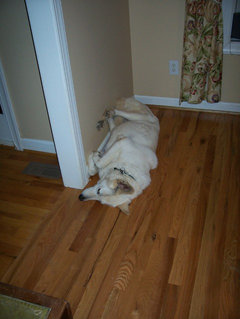
    Does this oak floor look orange to you? Like we all said before, a clear coat of poly will become yellower with age. This floor was covered with classic (not water based) poly. Our home was built in 1998 but the floor where the dog is was added in ~2007. The heat/air register area is original. The area (not shown) beside the hvac register is the front entrance with high traffic. When re-sanded and recovered a couple years ago, it was briefly whiter, but you wouldn't know now.


  • PRO
    10 years ago

    The reason I said " probably a waterborne poly" in my earlier post is because it does not have the amber look that an oil based poly does and does not darken with age.

  • 10 years ago

    The water poly floors I've seen are much more homogenous looking and flatter than my floor. I'd bet that mine are water poly too when they were refinished 10 years ago- but I think the original 1960 finish may have changed the color even after they were sanded down? Is this possible? If I'm putting new floors in to match this, I need to do something to make it match close.

    There is a ton of blond ambering- the orange shellac I bought wasn't quite right. I will try dewaxed blond and see if it helps.

  • 10 years ago

    Actually it kind of looks like this- but how to do this without tung oil which takes 3 weeks to dry? http://www.hullforest.com/red-oak-wide-plank-floors-c-1_17_27_34.html

  • PRO
    10 years ago
    last modified: 10 years ago

    Formbys makes what is called a tung oil finish.I believe Watco does too.They are not pure tung oil and dry much faster but remember with those products you will not get a hard surface finish.You can also add some japan drier to help the drying process.

  • 10 years ago

    rayfow: are we having a failure to communicate? I admit that it is possible to misread my photo one way or another, but it was an attempt to show that my floor looks (as far as I can see) EXACTLY like your floor. I don't know why klem or even precision got sidetracked since they originally said the same thing, but why are you messing with shellac or anything except straight poly. The link you just showed is just a new floor with just poly.

  • PRO
    10 years ago

    How did I get sidetracked.I was simply replying to YOUR post. A oil poly will give more of an amber tone and darken with age as yours has.The OP's pics do not match yours because it was PROBABLY a waterborne poly used.

    Never seen "classic" poly.

  • 10 years ago

    'Never seen "classic" poly.'

    Right. I just couldn't think of the term for organic based poly. I'm guessing that 'oil poly' isn't an agreed term either. But back to basics. Perhaps it is my (or your) monitor, but I didn't/don't see any real difference in the OP's original post and my floor. They are both kind of orange-ish but not orange enough to put something else on other than 'oil poly'.

  • PRO
    10 years ago

    Maybe your not understanding what I have written in two posts.Oil based poly lends an amber tone to the wood and darkens with age.Waterborne does not and looks like what was used in the OP's pic.I do see a difference ,although subtle,between your floor and the ops.

    I'm not judging this from looking at the pictures of your floor and comparing them.I'm giving my opinion after 40 some years being a professional cabinetmaker and remodeling contractor.

    rayfow thanked Precision Carpentry
  • 10 years ago

    I understood you perfectly the first time. To be honest, I didn't know that these new aqueous polys didn't orange. However, it doesn't appear to be an issue here. To quote from the OP: I'm trying to figure out what my flooring is so I can somewhat match it (at least the right color family) in another room. I posted a few days ago but I think you can see in these pics how lemony/orange the floor is.

    The OP appears to want More rather than less orange.

  • 10 years ago

    Maybe I missed it but it appears you guys are saying that the red in the new red oak sample will fade over time and if the right finish is used it will probably look pretty close to the original? Is that what you are recommending? Someone posted 'what you have is red oak' so I assume this is the case.

  • PRO
    10 years ago

    I am simply trying to answer the basic question the op asked. The floor is red oak and I believe it to have a waterborne finish.I posted nothing about wood fading.

    There are different grades of wood flooring availableSome are select and better grades.Some less.All flooring has some heart wood and some deadwood mixed. The heart wood in red oasis the part with the most color.Some is flat swan and some more radially or modular sawn.That is where you get the variation in the grain.

    The op asked a simple question and I thought I answered to the point as simple as possible .I did not mention anything about the wood other than it being red oak.


    rayfow thanked Precision Carpentry
  • 10 years ago
    last modified: 10 years ago

    I believe that I have clearly read every post in the OP's two threads on his floor. I think the only time based color change covered was the yellowing of oil based poly. I don't believe that fading was an issue at all. I do think that the OP may have been hoping to decrease the variation in boards (but maybe not) and was generally pointed in other directions.

    My floors don't appear to change a lot, but when patch re-sanded and re-coated, they do look whiter for a few months. With my oil based poly, the difference disappears in several months so I gather if yellowing continues, it increases fast at first and then slows down.

    and I hadn't seen precision's last post when mine went in.

    rayfow thanked chas045
  • 10 years ago

    I appreciate everyone's comments. As the OP I'm less interested in what's on my floors now than how to make new floors look like that, keeping the same variation if possible. I enjoyed the post that said how hard it is even for experienced professionals. Indeed it is.

    Not that it matters, but how's this for a plausible theory. The original floors in 1960 had some kind of penetrating oil on them. When they were resanded, they didn't go down much. Water based poly was applied on top. It looks like that tung oil pic I posted above but with water based poly on top.

    Thanks for your opinions.

  • PRO
    10 years ago

    Unless it was an architect-designed Danish Modern house, they didn't use oil finish on floors in 1960. Shellac was probably still used by some people, but Flecto Varathane was very popular; that's what my dad used.

    Go and look up Transtint wood dyes, they can be added to the acrylic poly to achieve any desired shade. They make an amber color specifically to emulate oil-based varnish. I would add a few drops of brown mahogany as well.

    Casey