Software
Houzz Logo Print
aztec

Arbutus trees: were great, now looking... bad

10 years ago
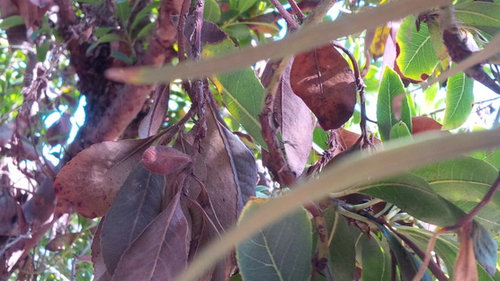
Location: Rancho Santa Fe (inland coastal San Diego county). Posted this in the tree forum first, and was suggested to post here.

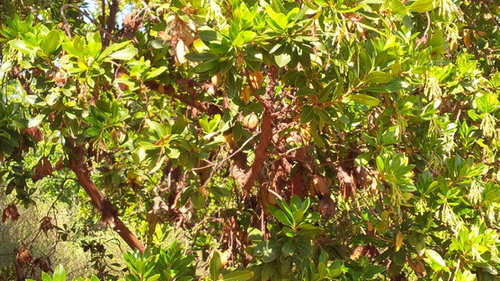
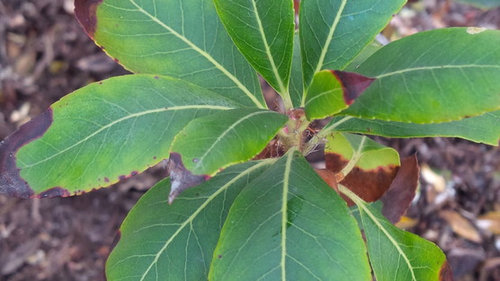
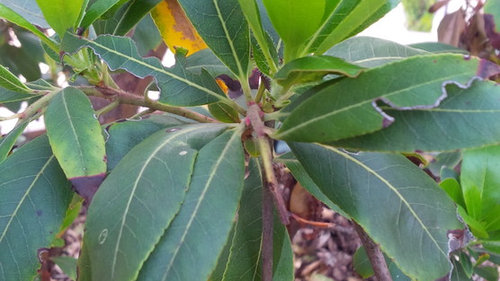
We have a grouping of three arbutus, planted in a slightly raised planter (18" retaining wall on the downhill side of a slight slope). They are about 15' tall x 12' wide, planted several years ago. They have been gorgeous, until recently. Now there are lots of dead brown leaves and entire small branches that are nothing but brown. Despite that, they're pushing out new growth. This made me think it could be one of the fungi problems, but I sure can't tell. Some of the leaves have black spots. Internet-based research so far has suggested more and less watering. Doh!

The previous owner of the house has both heavy rotating sprays and bubblers for these trees (about 2' from the trunk). We've lived here 18 months and immediately reduced the irrigation to them. We haven't watered them much at all, and they looked great in the Fall. The soil around them is damp, possibly from 1" of rain last week and some irrigation zone testing yesterday. The soil is not soaked, although it is wetter by the trunk (probably from the bubbler test). Each tree has a breather tube. The natural litter around them is fairly heavy, and when pushed aside has some white-ish stuff on the decaying leaves (guessing that's normal). When I dug down to check soil dryness, I noted considerable fine rooting right near the surface. I had thought these trees had mostly deep roots.

Losing these trees would be a disaster on many levels. They're the cornerstone of our landscaping, are awesome, and screen road traffic. Anything else I can tell you? Thanks for any help.


Comments (6)

  • 10 years ago

    Close up view displays chronic water stress.

    Whenever a person wants to use less water for existing plants, the change should be gradual.


  • 10 years ago

    As arbutus are recognized to be extremely tolerant of drought stress - to the point where supplying supplemental irrigation to established plants is seldom very necessary at any time, let alone on a routine, automated basis - I would not at all consider this to be a watering (or lack of it) issue. Nor do the symptoms indicate such - they are not consistent with drought stress.

    It would be helpful to know what type of arbutus it is - that could narrow down the problem - but several species/hybrids are quite prone to a range of fungal problems, both as foliar diseases and as root rots/vascular disruptors. Several of these could account for the leaf symptoms and branch dieback. It would also be helpful to know a bit more about the cultural conditions - as a member of the Ericaceae, a slightly acidic soil is preferred, although A. unedo is more lime tolerant than most members of the genus.

  • 10 years ago

    Gardengal,

    I don't know what type of arbutus it is. Is there a way to tell? I've looked at pictures of them, and they all look the same to me (except the Marina, with smooth bark, which these don't have).

    As for ph, we had soil tested in two locations, about 75' away on either side of the trees. One was highly acidic, the other moderately acidic. I've pasted the two test summaries at the bottom.

    As follow up on the irrigation, the bubblers near the trunks probably have not operated in at least 1.5 years. I test ran all of our zones and none of them run water to those. They have been hit by heavy sprays, but as I mentioned, we really haven't watered that area much at all.

    Nitrogen is very low. Phosphorus is optimum and potassium is almost three times

    optimum. Calcium is low and magnesium is sufficient for plant growth. In the micronutrient category

    copper and iron are both ample. Zinc and manganese are low.

    Soluble salts are safe as indicated by the ECe reading of 2.7 dS/m. Soil pH, which is strongly acidic in

    reaction, is not ideal for many landscape plants. Sodium is elevated and may restrict the growth of many

    sodium sensitive plants. The (SAR) sodium absorption ratio is also very high and will negatively impact soil structure as it relates to water retention and infiltration.


    Nitrogen is low. Phosphorus is optimum and potassium is also optimum. Calcium and magnesium are

    sufficient for plant growth. In the micronutrient category copper, manganese and iron are all ample. Zinc

    is low.

    Soluble salts are very high as indicated by the ECe reading of 6.0 dS/m and can restrict the growth of

    many salt sensitive plants. Soil pH, which is moderately acidic in reaction, is acceptable for many

    landscape plants. Sodium is elevated and may restrict the growth of many sodium sensitive plants. The

    (SAR) sodium absorption ratio is also very high and will negatively impact soil structure as it relates to

    water retention and infiltration.


  • 10 years ago

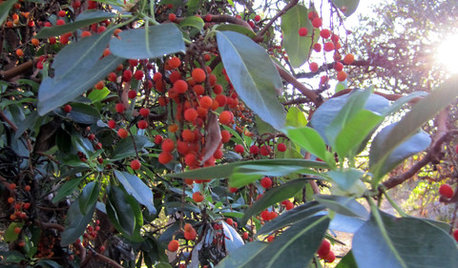
    I'm thinking this is probably Arbutus unedo from its loose, shrubby habit and smaller scale. And rather than a lack of water or drought stress, I believe we are seeing signs of overwatering at some point in the relatively recent past :-) Whatever is wrong, I am pretty certain it is pathogenic rather than cultural in nature, so doubt your soil fertility is of concern with this issue. Drainage is good??

    I'd just prune out the dead wood and the badly disfigured foliage and see how it responds. And I'd keep watering to a minimum, except an occasional deep soakng infrequently during your driest periods.

  • 10 years ago

    Those soil test results don't ring true for San Diego County where the pH is just below neutral, to slightly above, the calcium level typically high due to low rainfall in the area.


    Could be a sampling error. Or something else. Don't know what.


  • 10 years ago
    last modified: 10 years ago

    That looks like A. unedo to me. My Marina has shreddy rather than smooth bark.