Software
Houzz Logo Print
bscalder

rangehood baffle orientation - effectiveness and noise

10 years ago

I have seen much discussion on here about the benefits of capture and advantages of baffles. I believe that I have even seen Kaseki" comment about how there are advantages to increased slope of baffles which is rarely done in residential application, but is typical (I believe) for commercial hoods to have baffles on a steeper (45 degree) slope.

I have found this hood from Best, and it appears to have a steep angle on the baffles, as well as the baffle opening at the front, which is interesting to me as it makes it so you can't actually see the baffles from below, and I am thinking that this design may also cut down on noise as there isn't a direct path for sound from an internal blower to the chef's ear. I am going with a rear-vented orientation for my installation.


Kaseki, if you would care to comment regarding any advantages of the angle of the baffles and possible sound suppression due the the positioning of the baffles in his example? Though maybe there is a downside due to the area coverage of the baffles being smaller relative to the whole hood? But with a 1200CFM blower planned, would smaller baffle area just increase the speed of the airflow through the available area. So a possible trade off, less direct blower noise because of the "around the corner" positioning of the blower from the chef's ear, but increased noise from the higher speed air passing through the baffles?

Have I possibly found a unicorn? an ideally designed hood? Looking forward to people's thoughts and feedback on this.

Comments (5)

  • 10 years ago

    This scheme may reduce noise somewhat at the chef, but perhaps not by as much as hoped. Baffle hiss is fairly
    high in frequency and the emitted sound waves will not only scatter about the hard
    surfaces below the hood, but will also scatter from the hood horn section and impinge on the chef's ears unless higher than the hood edge.

    In what I believe are typical commercial hoods that I've seen, the hood aperture is large, but only one bank of baffles is present. The difference in area is made up by steeply sloped sides rising to the baffles, which themselves are, as noted, normally steep to comply with NFPA 96. Steepness aids grease flow to the grease container; but probably doesn't do much for thin deposits from typical residential cooking except where woking is a significant part of the hood's operational time.

    The bigger challenge for mental computational fluid dynamics (otherwise called flow rate requirement guessing), is dealing with hood interior shapes above the aperture. The basic goal, whether the effluent plume directly hits the baffles or is deflected toward them via a series of reflections, is to assure that the air velocity caused by the blower is enough to keep the flow directed toward the baffles at every reflection and resulting momentum change. If this shape had a high concentration ratio (large aperture feeding a narrow slot), then I would be more concerned with making a prediction because some counterpart to the Lagrange Invariant might become relevant. However, what we have with this hood is a small concentration ratio, apparently less than 2X, so at the usual suggested hood flow velocities I would expect this to work well. Thus, without someone's published analysis to suggest otherwise, I would stick with the suggested specific flow rate of 90 CFM/sq. ft. actual at the aperture.

    What is your hood entrance aperture area? What is your baffle assembly area? (Count both gaps and slats.) Did you see a patent number listed for this hood at Best?

    kas

  • 10 years ago

    Thanks for the info, kas.
    I have ordered a 36" x 24" hood, so I don't have one in hand to provide specifics, I can provide those once I receive the item (not for about 6 weeks). This is the Centro WP29M364SB (for other's curiosity). I am pairing this with an iQ12 blower, with a reported 1200CFM capability. Best/Broan advertises the lower sound output of this blower design (for the size).

    It appears that the baffle area is 32.5" x 8.5" (276 sqin) compared to a rough estimate of 36" x 24" (864 sqin) for the aperture. Smaller than your estimate - just over 3X. I appreciate the clarity around the basis for commercial baffles to be set on such an angle which isn't necessarily a requirement for residential installations. I am assuming that the idea that increasing airspeed across the baffles (through the use of a smaller overall baffle area) beyond kas' suggested target of 90CFM per sqin is a benefit, not a negative for the effectiveness of the baffles to remove material from the air (airspeed increase within reason). The tradeoff being a smaller baffle area would cause a slightly greater restriction on overall airflow. Maybe I am thinking too much about this part.

    My thoughts are that the increased noise of the smaller baffle area (high pitched multi-directional as you indicated) would be less impactful than the reduction of noise because blower would become "around the corner" as I stated above, and some of the noise would be lost, as compared to other "typical" setups where the baffles are simply between the chef's ear and the blower unit, and the presence of the baffles just reduces the intensity somewhat. I may be wrong in that thinking.

    This is an interesting design in that virtually every other hood I have seen with baffles puts them across the opening on a low angle and highly (proudly) visible from below. I can appreciate that this front, interior mounting location may make the baffles somewhat more awkward to remove/reinstall for cleaning. I am also curious as the bottom of the back section will be completely inaccessible, and the lower front section appears to be open and lower than all other interior areas, so hoping that these won't collect buildup of material that passes by the baffles and become problematic. Time will tell.

  • 10 years ago

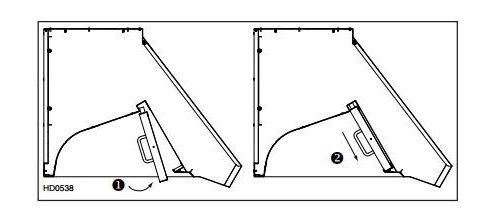
    I think your front-to-back aperture area will be smaller than the overall front-to-back size of the hood. My reference is to the horizontal line just above the circled (1) in your illustration. I'm going to guess 16 x 34 inches or 3.8 sq. ft., calling for 340 CFM actual, or around a 500 CFM rated blower. 1200 is probably overkill, but ... there is an advantage if you go with this blower and have it on a variable control, and that is that running it slower will result in less blade tip turbulence noise than you might get from a 500 CFM rated blower running at full power. It will also provide margin if this configuration, for some non-obvious to me reason, needs a higher flow rate to assure all captured effluent is contained and not leaked back out of the hood.

    Cleaning above the baffles may be difficult with this design; please let us know how it works out.

    The curved semi-horn feed to the baffles will collect direct splatter grease, but it seems easier to reach than some parts above the baffles of Pro-style hoods. I think these deliberately show off their baffles.

    The disadvantage of going with the 1200 CFM rated blower is that you need to start planning for make-up air (MUA), starting with determining what (if anything) is required by your local building code. In principle, if you never exceed an actual 340 CFM (or whatever your true aperture requires), then you may not need any special MUA equipment per your code. But if the code is based on the blower rated (zero static pressure) 1200 CFM, or you need to provide MUA for more than the code threshold level, then a more expensive solution is needed. Please review MUA topics here for more initial help.

    kas

  • 10 years ago
    last modified: 10 years ago

    Thanks Kas,

    A bit premature as I don't have the unit on hand yet to provide actual measurements regarding the aperture, but I just wanted to clear up my understanding regarding capture/aperture/baffles.

    The capture area provides an area to trap/capture fumes and steer them towards the baffles while "waiting" for extraction. If exhaust speed/volume was ideal/extreme, this is less of an issue, because as soon as the fumes crossed the aperture area, they would travel through the baffles and removed, thus no "waiting". No issue of deflection.

    The aperture is the opening of the capture area at the bottom of the hood, you provide guidance that the optimal airflow target is 90CFM at the aperture. I mistakenly assumed that to be a measure to be sued for airflow rate over the baffles as well. Typically the baffle area is less than the baffles, so the airflow rate at the baffles will be higher. In the case of the Centro discussed above, much higher due to the large differential. The negative being that higher airflow means more baffle air noise. Is there an airflow rate that is preferred for the baffles to be effective for grease particle removal? Is this a function of the speed of the air movement, direction change, or the or the temperature drop due to baffle configuration? I am curious as to how it is that the baffles actually collect the grease particles from the air moving over them.

    In your calculations above, you roughly calculated a 340CFM (approx) that would be desired for this hood to be effective. I am trying to reconcile this with the 1CFM for every 100BTU rule of thumb. An example would be that a typical 36" x 24" range hood would have approximately 864 sqin (36 x 24) or 6sqft (assuming an the entire hood dimension is aperture area). This would still only be 540CFM guideline requirement (your guideline amount is irrespective of cooktop output capacity). Using your estimate of 1.5 to get an appropriate nominal rated CFM, provides a result of 810CFM blower rated capacity.

    I am trying to reconcile this with the 1CFM per 100BTU of total cooktop output. The total output of my 36" range is 110K BTU, so that would follow the requirement of a 1100CFM blower. Significantly higher than the estimated requirement using a hood with full aperture (6sqft), and more than 3 times higher than the calculated estimate of 500 rated CFM per the calculation based on aperture assumptions above. Is this to mean that the aperture area is inadequate coverage for the 36" range?

    Shouldn't be the case, and regardless the additional capacity of the larger 1200 CFM blower should allow for enough headroom to fulfill my needs. Not intending/expecting to need full power (often) and will be able to report real-world results once I am installed and using the setup.

    Also, I am in a nothern climate (Alberta), so MUA is not a major issue, the hood will be interlocked with the forced air furnace.

  • 10 years ago

    Furnaces often are sized to deal with house air leakage and thermal conduction and radiation to the outside, but not hundreds of CFM being pulled through the house. Deliberate heating of the MUA will be desirable in Alberta.

    There are several rules of thumb for sizing hood air flow,: IMC linear footage, appliance distributor BTUs, and Greenheck method air velocity. The first and last are addressed in Greenheck's Kitchen Ventilation Systems Application and Design Guide, KVSApplDesign_catalog.pdf, which can be found at Greenheck's web site. I recommend it as a good background introduction. I prefer air velocity (equivalent to specific flow rate -- CFM/sq. ft.) because it relates directly to the ability of a hood baffle system to contain the plume and not allow it to reflect out. However, it is based on measurements of plume velocities, which themselves derive from hot surface temperatures plus hot rising gas combustion products (in the case of gas cooktops), so there is an indirect relationship to BTUs/hr.

    A plume has momentum, and will reflect off of surfaces it hits as it rises. A plume's maximum velocity can exceed 3 ft/sec (180 ft/min) for gas cooking, a bit less for induction cooking. One wants the resultant velocity vector after reflection (plume plus entrained hood air) to be pointed toward the baffle gaps. If the average air velocity at the hood aperture is 90 ft/min, the velocity in the gaps will be in the ballpark of 180 ft/min (for apertures filled with baffles), and my intuition, as well as experience with my hood, suggests that this will be sufficient to ensure containment of the plume captured by the hood aperture.

    There is a second, more subtle requirement for enough velocity through the baffles to ensure extraction of the larger particle size end of the grease aerosol spectrum. However, that is an aerodynamic issue that we can only depend on the manufacturer to make recommendations about. Usually, residential systems do not deposit much grease in the ducting over their lifetimes so this is less of an issue than for commercial systems.

    In the case of a deliberate reflector system directing the plume toward the baffles, I have no direct information. (But see my response to http://ths.gardenweb.com/discussions/3938774/best-by-broan-hood-classico-vs-centro?n=5.) What I expect dominates the containment process is keeping the effluent heading toward the baffles and then ensuring that at the baffles there is no reflection velocity (magnitude and direction) that allows escape from capture.

    Ideally, hoods should overlap the cooking area because the cooking plumes expand as they rise. This has to be achieved in the front-to-back direction also, particularly when the cooktop is on an island or peninsula. There are numerous threads here that discuss this. For example, for a 2.2 foot deep by 3.5 ft wide aperture (7.7 sq. ft.) befitting an island application, my recommendation would be 700 CFM actual, or 1000 CFM rated. Used with a smaller hood, this flow rate might (!) eke out some virtual added aperture size by aiding capture of plume components just missing the physical aperture.

    Also, it is important (see numerous threads where this is addressed) to not confuse required/desired/recommended actual flow rate with blower rated flow rate. For your 6 sq. ft. aperture example, the desired actual is 540 CFM, but the recommended rated flow rate is 810 CFM, which is not that far from the BTU-based rule of thumb of 1100 CFM. Note that rated means at zero static pressure, i.e., the blower is hanging in the open air, not in a duct system in a closed house. The big issue when going from actual to rated is what is the blower fan curve characteristic (loss in flow rate with pressure loss) and what is the house pressure drop when pulling the 540 CFM. If they don't match, then a bigger blower is needed, or boosted MUA is needed, or some of each.

    kas