Software
Houzz Logo Print
maackia

Cornus racemosa

10 years ago
last modified: 10 years ago

This native shrub/tree receives little notoriety and I'm curious as to what your thoughts and/or experience are with it. Michael Dirr in an early version of his Hardy Trees and Shrubs book stated it was a horticultural sleeping giant, implying he expected it to become a popular landscape plant in the future. I haven't seen any evidence of that, and I rarely see it offered in the nursery trade.

There was also a tree form that came out several years ago, which was available for a few years, but now I never see it in commerce. I believe it was named Snow Mantle. Are there issues with this plant that has kept it out of the public eye?

Comments (16)

  • 10 years ago

    I think the only issues with this plant is that it is just mundane, mediocre, average, etc. Having said that, I have quite a few on the place and I enjoy them. They are quiet all year round, not having a blast of flowers or fall color or masses of berries. It is a suckering shrub, but I have a couple trained as small trees. I have plants of two provinences, one mail order from SC, the other from here in TN. The main difference is the foliage, the SC plant's is somewhat larger and colors better in fall than the TN one. For a naturalistic landscape that has benefits for wildlife this plant is excellent. It is hardy, requires no care and is not bothered by any serious pest problems, for me anyway. Some of the other native shrubby Cornus can be bothered by cankers and leaf eaters. I only have one red twig and got rid of my yellow twigs for that reason.

  • 10 years ago
    last modified: 10 years ago

    We have plenty of it around here; maackia - is it very common at your location? Agree with kentrees that it's relatively mundane. Our local plants often have a decent dark red fall color (early fall), and the birds gobble up the berries. But the flowers have a disagreeable odor (IMO), and around here leaf spot can be serious, degrading the foliage and sometimes causing early leaf drop. IMO Cornus drummondii is more attractive (and easier to train to tree form).

  • 10 years ago

    You don't have to go far to find it, but I don't see them in the immediate area. Maybe it's a bit too sandy and dry for them. I take it mundane is the operative word from a horticultural perspective, but sounds like a nice shrub for a more natural area. Everything I read makes it sound as it it's very adaptable, which likely lead Dirr to conclude it would become popular.

    C. Drummondii is another unknown native shrub. I've probably walked by one without knowing it.

  • 10 years ago

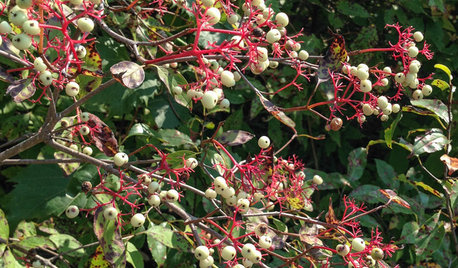
    Very common here in east-central WI. Sometimes labelled "thuggish" due to its capacity to cover lots of ground-I see that as purely positive. Nor do I quite agree with the thought that it's not a showy plant-the racemes in fall with fruit are highly attractive IMO, as are these same bright red racemes after fruit has been eaten by birds, etc.

    Not at all like Cornus sericea (stolonifera) in appearance or in cultural requirements, it is much more a plant of uplands and normally-drained soils, not the wetland specialist that is its red-twigged cousin.

  • 10 years ago
    last modified: 10 years ago

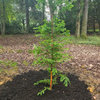
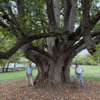
    Just to add, pagoda dogwood doesn't sucker like the above mentioned, and if given enough time can make a handsome small tree w/interesting, layered architecture. The below volunteer under heavy shade already begins to show some of the layering effect -- notice the layer at the ground then another layer just above. Few trees can grow in the root zone of a sugar maple, but this one can:

  • 10 years ago

    Of all the shrubs I have at the house, c. drummondii suckers more than all of them. It sends out suckers 10'+ from the main stem and the plant is only 4-5 years old. I find it interesting it is reported to not sucker in other areas.


    It is a very tough shrub that is drought tolerant and has a nice flower show in spring. I have had some purple on my two plants in the fall but nothing outstanding yet. I'll take a pic and post a pic of them later to show how much they sucker =)

  • 10 years ago
    last modified: 10 years ago

    One OH nursery says this about C drummondii vs C racemosa:

    "When grown in tree form this specimen is far superior to C. racemosa because it forms only minimal suckers and a strong trunk and central leader"

    http://www.klynnurseries.com/klyn_main_images/cornus_drummondii3_l.jpg

  • 10 years ago

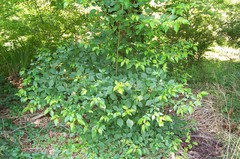
    Whew it certainly doesn't do that here in Arkansas! This has at least 2 dozen stems in this picture


  • 10 years ago

    Geez, I didn't anticipate C. drumondii entering the discussion, but this is interesting. I never see it offered in the nursery trade, but I'm going to start looking for it.

    Beng, C. alternifolia is common in moist woodlands around here. I agree, it is a beautiful small tree, but short lived on my dry upland woods. I'm looking for understory shrubs and small trees to replant once I get all the Buckthorn and Honeysuckle invasives under control, which is why I was looking at Gray Dogwwod. I envy your mild climate with a cool mountain setting. It's a nice part of the country.

  • 10 years ago

    Maack, now that I understand the background to your initial post, indeed, gray dogwood would be very useful. Let's face it-when battling such terrible items as buckthorn, we are willing to deal with another, albeit native, strong colonizer. In that sense, gray dogwood's suckering habit would be purely a positive. It really goes nuts on this side of the state. Got a bunch up at my land too, so it's at least good still up into central Oconto Cty.

  • 10 years ago

    Yes, C alternifolia needs at least some shade, and cool temps and moisture. I noticed there are several more seedlings showing up underneath my sugar maples. Birds eat the berries, perch in the trees, and......


    maackia, summers here are surprisingly mild, as long as there isn't a bad dry period. Over the last 3 summers, the highest temp was 90F on ONE day, and that only for an hr or two. But have to say I have recorded a 98F (but the overnight low next morning was 60F) over my 12 yrs here during a summer heat-wave -- not certain when, but prb'ly July 2010.

  • 5 years ago

    Good read. Planted one today. Along with an arrowwood viburnum, black chokeberry, red twig dogwood and female white fringe. I bought a male to put some where else. I decided to go with some Pennsylvania natives to create a nice border on my property. Hopefully the birds will enjoy. I am here reading forums about the gray dogwood to see how people’s experiences were with them. I see some trimmed up to look more like a tree. Not sure if that’s what I am gonna do yet or not. I am excited too see this dogwood mature.

  • 5 years ago
    last modified: 5 years ago

    Since this came up, I have to add that my pagoda dogwoods are recently getting hammered every year by dogwood sawflies. A whole small tree can get defoliated if I'm not vigilant. They attack red-osier dogwoods too -- so bad I had to remove the one I showed above.

  • 5 years ago

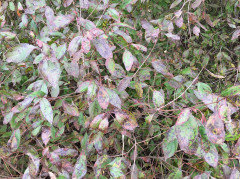
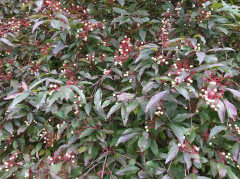
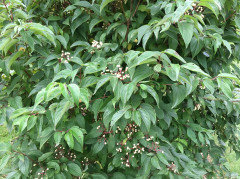
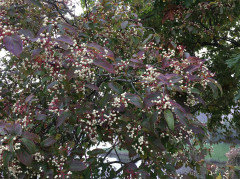
    There's a lot of leaf spot on my gray dogwoods this year (I have several patches of it in the backyard), and a fair amount of the associated early leaf drop on many of them. (All photos taken 10/6 and 10/7/21)

    Birds have been picking away at the fruits. This patch still has a good number left.

    Fall color on my gray dogwoods isn't great, but some other patches I see in the area have colored up fairly well (dark red/maroon).

    My roughleaf dogwood (planted just a couple years ago) is relatively vigorous and resists the leaf spot pretty well, but is not showing much color change yet.

    This roughleaf in the area is beginning to color and has a nice fruit display.

    There is a gray dogwood variety called Irish Setter that is supposed to have good resistance to leaf spot, but I've never seen it available locally.

  • 5 years ago

    Interesting arbordave. Fruits on my red-osier/pagoda dogwoods never last ripe more than a week -- been gone for months. Birds don't seem to care for my brother's Kousa dogwood fruits, they just fall and lay on the ground (but they're much more edible to people than the other fruits).