Software
Houzz Logo Print
nat1611

wild roses taking over

10 years ago

Hello,

I've noticed about 15 different wild roses growing around my property in the past few weeks. I didn't see any at all last year, so I was surprised at first to find them. Is this a common thing in Massachusetts? Part of the yard is essentially a forest that had been ecologically disturbed by invasive blackberries that I mostly cleared. I don't have time to actively manage more than 30% of the yard this year, so if I can just leave them, I will.


The issue is that I have several roses that I am trying to grow, so I am worried that these wild roses could carry diseases if I don't have the ability to constantly check on them as they grow. Also, if they are invasive, I don't want to just be letting another blackberry situation get started.


I can include pics, but they don't have flowers yet, so I don't know if it would be useful. My plan now is to wait until they flower to address if they are native or not, but I wanted to get a second opinion on if I'm asking for trouble with this plan.

Comments (21)

  • 10 years ago

    If you don't want them, get rid of them.

    If it is R. multiflora, R. multiflora is classified as a noxious weed in MA. Fairly good id photos and info here.

  • 10 years ago

    It is probably multiflora.

    What are you eventual plans for the area? Managing woodland isn't easy because there are so many shrubby invasives, and closely spaced trees make mowing difficult or impossible. I will say that I would choose tackling blackcaps over multiflora any day, assuming that is what you were dealing with.

  • 10 years ago
    last modified: 10 years ago

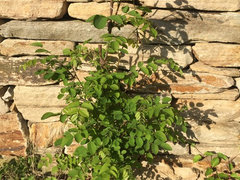
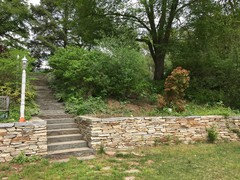
    I'm really not sure what reasonable goals for the property are. It's also on a reservoir with a strip of land for public works vehicles adjacent. That area is totally overgrown, so even if I clear out all invasive species here (which would take years) they will keep coming in. Some of these wild roses are huge now! I don't understand how there were none last year, and now tons! Here is one that I'm not even sure is a rose, it barely has spines and has very rounded leaves.

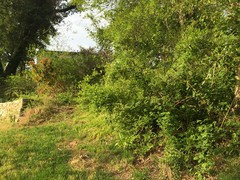
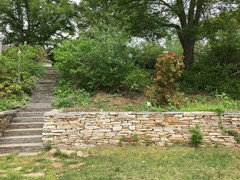
    and this is the kind of massive bramble/blackberry/Wild Rose (?) patches that I'm working with. Clearing that very narrow strip between the greenery on the right and the hydrangeas above the stone wall on the left took 3 weekends with a chainsaw involved.

  • 10 years ago

    Up above the wall, what is that reddish plant?

  • 10 years ago
    last modified: 10 years ago

    Multiflora rose is very difficult to eradicate from an area, but may
    be worth the effort if the incurable rose rosette disease has spread to
    Massachusetts. Cultivated roses growing within 100 yards downwind of
    multiflora rose are at a greater risk for RRD, to which the multiflora
    is highly susceptible and serves as a reservoir.

    http://www.clemson.edu/extension/hgic/pests/plant_pests/flowers/hgic2109.htmlhttp:

    http://rosegeeks.com/index.htm

    nat1611 thanked agardenstateof_mind
  • 10 years ago

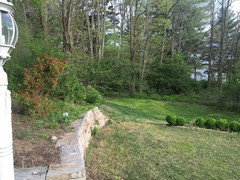
    The red thing is a Japanese Pieris I believe. Here is another view from a different angle. You can see the same shrub to the left on top of the wall.

  • 10 years ago

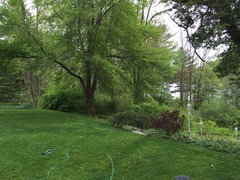
    Here is a view down the stairs to the middle level of the yard and a view straight up. Another forum just identified the vine growing down the stone wall as invasive honeysuckle, sigh, it looks like there are weeks more of pulling ahead. There pictures barely make it seem like anything was cleared, but there used to be nothing clear at all, just 7 feet tall brambles from the top level to the stone wall. You literally couldn't see the stairs or any grass below or any water. To the left of the top picture put of frame are huuuuge brambles.

  • 10 years ago

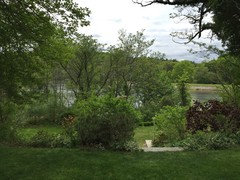
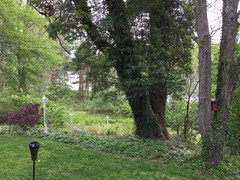
    Here is the untouched brambles behind the big tree. They start here and extend all the way to the water. I'd say it's oils take every weekend until August to clear it. I imagine that there are TONS of wild roses in there. I can glimpse many from the edge:

    This area used to be completely overgrown last summer. All of the lamp

    posts were entirely swallowed. Now there are Lilly of the Valley, native violets, invasive violets and at least 20 wild roses. It's also full of ivy and pachysandra. How nice, right? Only 5 different aggressive spreaders choking out natives!

  • 10 years ago

    agardenstateof-mind:

    I am willing to put in any amount of hard work to protect the area from Rose Rosette Disease. I just have to decide what to tackle and what to live peacefully with, because there simply aren't enough (wo)man hours in the day.


    All of these hardcore spreaders are in my yard, plus more:

    -blackberries

    honeysuckle

    three kinds of ornamental Ivy

    poson ivy

    volunteer invasive barberry shrubs

    random brambles

    multiflora rose

    Weed violets

    lily of the valley

    Pachysandra

    creeping charlie

    myrtle / vinca creeping vine

    huge fields of unknown yellow weeds


    plus, there is an entire area equal to the top yard that I haven't even dared look at, which is by the water.


  • 10 years ago

    Several years ago, we happened to be at the Connecticut shore when multiflora was in bloom there. There were many places where the shore line looked like lines of massive multiflora. (They seemed to almost thrive being next to the Sound.)

    Wait until multiflora blooms, and then get an idea of how widespread it is.

  • 10 years ago

    The roses were probably there, you just didn't notice them. Just like many invasive plants, they meld into the background when not in bloom. I never knew how much multiflora there was in my area until they bloomed one year (I don't think they bloom every year, at least not as massively as they have this year.) Same with privet and invasive Japanese honeysuckle. I have a 'wild' part of my yard with much the same stuff, brambles (I think mine were wild raspberries) honeysuckle, muscadine vines, trashy maple and oak trees, privet, poison ivy, smilax (cat brier). I tried maintaining it with cutting it back, but last year the county needed to do some work in my yard and removed some of the pine trees. With all the sun, the invasive weeds went into over drive, including the PI that I had previously eradicated (or so I thought). I resorted to the poison ivy round up and got rid of most of it. The honey suckle has not grown back, the PI made a brief appearance, but I sprayed it again. The muscadine is coming back, but that is native, so I'm not that upset about it, I just will not let it get too wild. I didn't have to deal with ivy, but I would love lily of the valley! (it's too hot for it down here). If you don't want to spray, you can cut back the base of the vines and roses and apply the RU full strength with a cotton ball. I actually used those little plastic vials they put flowers in for arrangements on a few stubborn honey suckle and privet stems. You may have to do this a few times, but I think you can make some headway. It looks like you have done a lot so far.

  • 10 years ago

    I just took out a multi flora in my yard that was huge. It took my husband hours to get it all. It grew soooo fast and became very unmanageable. I have a lot of small multi floras popping up everywhere and I just dig them right out. In Connecticut they are considered invasive and learned my lesson from letting when of them get so big. I worry about rose rosette in ct because of all he multi flora. That is why I am working so hard to keep them off my property.

  • 10 years ago
    last modified: 10 years ago

    I find that in my acid clay, multiflora won't regenerate from root fragments like Dr. Huey. If whack off the roots, the plant dies. I tried propagating multiflora for rootstock before they outlawed it in Connecticut.

  • 10 years ago

    What a beautiful setting, though. It looks so inviting and peaceful. love the terraced stone walls.

    Have you tried smothering the plants? We have what is referred to in Massachusetts as "picker bushes", brambles or briers to the rest, and I cut them to the ground on our hillside and them covered them with cardboard, black tarps, or anything else that wouldn't let light through and weighed it down with rocks. It took a while to kill them but they didn't come back. I think that you could smother the ivy and pachysandra this way and the multiflora rose if you cut it down first. Quite a chore but unless you use some kind of chemical to kill it this is probably the only way to rid this chemical free. If the leaves are deprived of sunlight the plant can't perform photosynthesis and the plant will eventually die. You can kill any unwanted lawn using the same technique. It just takes a while. Another option to kill lawn under new flower beds is tio cover it with a thick layer of newspapers then put your soil and mulch right on top, cutting through the newspaper for your planting holes. Or plant first and then fit damp newspaper around the plants like a jigsaw puzzle, tearing where necessary and then covering with a top layer of soil and mulch. This also helps to keep the weeds under control.

    Straight bleach works extremely well as a weed killer but I don't know of the toxicity or lasting effects on the environment and couldn't find any info via google search. It usually requires only one application though. It kills poison ivy, "picker bushes", wild plantain, burdock and other plants effectively. If you spray it at high sun on dry foliage it works best.

    Sharon

    nat1611 thanked enchantedrosez5bma
  • 10 years ago

    enchantedrosez6a:

    Thank you! It is a very nice setting. I am lucky to have lots of great big established plants, I just have to get rid of the stuff in between... I haven't tried smothering anything, that's a great idea! I am not opposed to using chemicals, but I just think it is more of a tricky issue to find ones that are safe next to a waterway and animals.

    I want to keep the pachysandra, it actually spreads very slowly here and hasn't encroached on the lawn even five inches in 10 years, so I think it is the least harmful ground cover to help stop erosion down the hill. But I will definitely try smothering some of the yellow flower weeds/multiflora etc.


    Unfortunately, even if I get rid of all the multiflora on my property, there is tons of it surrounding the reservoir that I've seen recently.


    zack_lau z6 CT:

    Believe it or not, I can't figure out of my soil is clay or not. Sometimes I am positive it is, sometimes I'm positive it's not. I guess I need to have a soil test. I am still very much a beginner. What I will say, is that this property seems to be steroids for plant survival. I have found tulips, hydrangeas, lilies, irises, shrubs and much more surviving in the middle of the forest once the blackberries are cleared. I can't believe they made it this long in the middle of a weed jungle! So, I don't really have much hope that the multiflora will kick the bucket without substantial encouragement.

  • 10 years ago

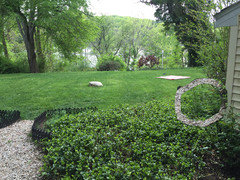
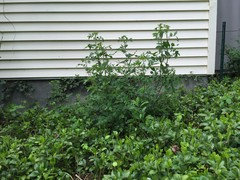
    Here is the biggest wild rose I've found. It's right up against the house and almost 2X as big as my Blaze that's directly on the corner. It's about 3.5 feet tall! It's inside the circle, Blaze is right below it in the lower right corner. I included the rest of the yard for perspective, all other wild roses are past the lawn part.

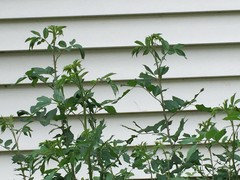
    here's a closeup

    It has different shaped leaves than the big one by the stone wall.

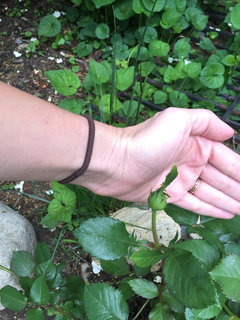
    And now I'm worried about this possibly weird bud growth on my Abe Darby! Does this look suspicious?

  • 10 years ago

    No, that looks like Abe. Multiflora has clusters of tiny flowers, not big fat solitaries like Abe.

  • 10 years ago

    Zack-lau, I know what you mean about the soil because I have about 4 different types of soil in my yard. My front yard it red soil for 2 feet with clay under it. My back yard is nice dark brownish black soil. Btw I'm in ct near Hartford.

    nat1611, your yard is absolutely gorgeous! Has rose rosette spread to Massachusetts?

  • 10 years ago

    I know that one is Abe, I meant to ask does it look like a potential early start to RRD, with a seemingly new branch growing out of the top of a bud.


  • 10 years ago

    Looks normal.

    nat1611 thanked zack_lau z6 CT ARS Consulting Rosarian