Software
Houzz Logo Print
mld780

Fence planting in Littleton

10 years ago
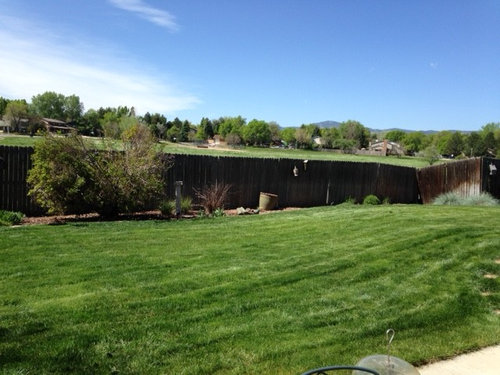
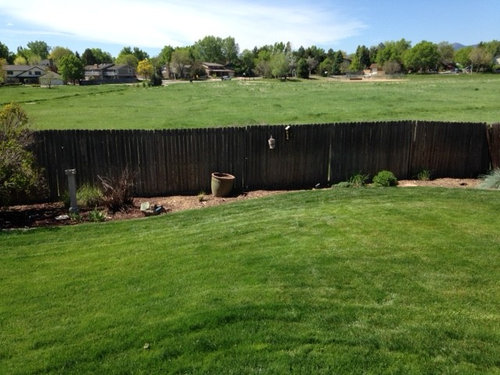
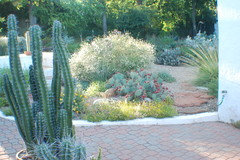
I am looking for year-round bushes or trees to hide my ugly fence. Right now, it feels like we live in a playpen. And I see opportunity to turn ugly into beauty! The bush on the left is a viburnum. The little bush to the right of the white column WAS a spirea, now dead after 30 years! I had a broom brush in the far corner on the right side of lower image by the blue wheat grass and it did well for 3 years until a bad frost came along. I have looked at evergreen trees and other trees. Do not want anything higher than 8 feet OR SO that would block our view of the mountain in the distance (yeah, it's there!!!).

To the left of the viburnum is a thornless Hawthorne.

Littleton, CO is zone 5, semi-arid. Backyard is south facing. Light: the corner on the right only gets morning sun. These shots were taken at 10 am. Red rocks is the decorative mulch.


Thanks for any help.

Comments (16)

  • 10 years ago
    last modified: 10 years ago

    Howdy neighbor! I don't do a lot of shrubs, but I do have some redtwig dogwood (Cornus sericea) which would provide year round interest. Well, mostly winter with their blazing red stems. They aren't much to write home about in the summertime, though there is a variegated one. This species is also native to our parts, so no worries about hardiness. There are also yellowtwig and some European dogwoods that are red at the base and the stems turning to yellow further up. They are a riparian plant though, so they love water.

    If you are looking for ones that can survive on neglect, rabbitbrush and Apache plume (prairie smoke) are drought tolerant natives, but both kind of big and can look a little "rangy" in my opinion. Not sure about winter interest with them either.

    If you are open to ornamental grasses I can suggest some good ones (they are probably my favorite or at least a close second, plant). While not a FULL 12 months of interest a solid 9-10 months out of the year they look pretty good.

  • 10 years ago

    I'll check out the dogwood. And yes, open to grasses.


  • 10 years ago

    Little bluestem is always a top choice for me. They get to be about 3-4 feet tall, standing upright and vertical with fine leaves. They are, surprise surprise, often a powdery blue color during the growing season, similar to the blue wheatgrass color (maybe a little less "blue"). But in winter, they turn a gorgeous red/pink/coppery color. They also stand up well to snow, and often bounce back to upright, or semi upright, after a storm in winter. They are low water, low fertility plants, and will often "lodge" (flop over) if growing in soil that is too wet and/or rich. There are lots of varieties available for landscape use and they vary in their blue-ness, and some having more purple "highlights," also vary in their fall/winter color, some more red, others more copper. Also there is some variability in height.

    Blue grama is another good choice. There is currently only one "ornamental" variety available ('Blonde Ambition') and condition wise, this guy is pretty much the same as the little blue. Dry, well draining, infertile soils are optimum. These are more "round" rather than vertical and also shorter, the "wild type" is very short, only about a foot tall, but the 'blonde ambition' is 2.5-3'. They are a green color, with MAYBE a hint of blue, of you look close and squint your eyes (I have always been a little confused as to why they called it blue grama). They turn straw colored in fall, and probably stand up the best to snow, retaining their shape almost all winter long, also having narrow leaves. As a neat feature, it happens to be the state grass of Colorado.

    For grasses that like it a little more wet (but can still tolerate some drought when established) you can't beat switchgrass, Panicum virgatum. Like little blue, there is a ton of different varieties for sale. Shenandoah is a common one and it's light green with some maroon "highlights" on the leaf tips, which become more apparent as the weather cools in fall. This one gets to be around 4' tall. 'Cheyenne sky' is, as far as I can tell, nearly identical to 'Shenandoah' except the maroon highlights might be a little more noticeable and reliable. Dallas blues, heavy metal, and northwind are all a steely-blue color (northwind being less so) and all get about 5' tall. Panicums have much wider leaf than the first two I mentioned, tolerate clay soils well, are vertical, and turn yellow/straw color in fall. These guys probably hold up to snow the least, among the first to collapse and not bounce back. Once gain, while they appreciate more water than the other two, too moist and too rich will make them flop over. I'm not going to lie, panicum is probably my favorite grass.

    And another one that conditions wise is similar to the panicums is big bluestem. If you want a tall grass, that is the one you want. It can reach a solid 5-6 feet, maybe more with the seed heads, mostly upright form. It can be hard to find though, unless you order online, and there's quite a few varieties available. I don't have any in my yard (though I want it) so I can't comment too much on it, other than fact I have SOME experience of it growing in "the wild" where it is a blue/green/purple color in summer and turns red in the fall. Really a cool looking grass.

    If you are going for the more "standard" grasses, feather reed is ubiquitous and a solid performer, if a little too common for my liking. I don't know what kind I have in my yard, its either overdam or avalanche, a variegated one. It's reliable, about 4-4.5' tall and upright. It's pretty self sufficient. I never give it extra water and pretty much just let it go. Like I said though, these guys just a little too "overused" in my opinion.

    I also grow blue fescue, which a very nice grass, but I'm not sure if it's big enough for you. Also I have a blue wheatgrass, but you already have some I probably don't need to tell you about it haha. So, in any case I hope this gives you some ideas!

  • 10 years ago
    last modified: 10 years ago

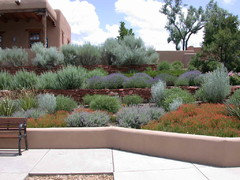
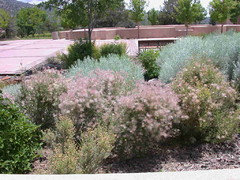
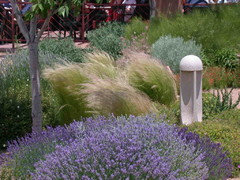
    Here's three shots of a mass planting using a lot of Apache Plume and Chamisa at a Museum in Santa Fe, typical NM look with the adobe walls but I think these are both native to Colorado too. Clipped up they don't look rangy at all and are very thick, I saw a lot of them in Santa Fe used as trimmed landscape shrubs on medians and elsewhere. The garden below also had Lavender, Pine Leaf Penstemon, Mexican Feather Grass & some green stuff I can't remember. If you plant M. Feather Grass you will always have seedlings on hand -- it makes good cheap filler and gets that nice blonde color. I can't grow the pine leaf penstemon here but I would if I could.

    I like the way they grouped plants together, chamisa's in the back were left untrimmed. You could mix in some conifers for a more Colorado look.


    Below is a mature sized Apache Plume I've had growing here in Oklahoma for 10 or 15 years. I trim back the top 1/3'rd each spring, they really take to trimming because they bloom on new growth, other than that its zero maintenance. This was shot late in the year when its really loaded with plumes although the pink tends to fade to white after a time. They are very easy, fast growing and hardy. They take our long hot summers quite well and do good in winter too, even the cold wet ones. I've planted some of the volunteers in other spots, I'm using them in front of an ugly chain link fence on the east side along with giant sacaton.

    When backlit in late afternoon sun, the entire shrub glows with light.

    I agree with Zach, little Bluestem is a top choice, especially several planted together. Blonde Ambition is pretty large compared to the regular Blue Grama. I was surprised how big they get.

  • 10 years ago

    For some flowering interest, I would say Lilac and Rose of Sharon are some good options. If it were me, I think I'd also plant a couple of fruit trees as anchors somewhere. It won't hide the fence, but could lessen the "empty expanse" feel.

  • 10 years ago

    Oh my, such good ideas. Thank you all.

  • 10 years ago
    last modified: 10 years ago

    I love my blonde ambition, I wanted to plant more this year but it seems as if no one around here is carrying it, save for some I saw in 5 gallon buckets for 50$. Sorry I ain't playing that game.

    Anyways, it seems the trick to rabbit brush and Apache plume is to trim them every year. If they look as good as TR's I think they would be awesome right there. Rabbit brush is native here, not sure about Apache plume.

    If you aren't looking for height, lavender is awsome and grows spectacularly here on the Front Range, it loves our dry, alkaline soil. Its evergreen, too (well, technically ever "silver"). On that same note... the Southwestern agastaches like A. rupestris and A. cana are also great plants for our area.

    A " subshrub" that I planted last year is Mojave sage (Salvia pachyphyla). I'm not 100% sure how well it does here (though it is a Plant Select winner so that's a good sign) mine look a little beat up from the winter, but are coming back wonderfully. They were only about 3" tall when I planted them last spring so no flowers, but I am hopeful for this year. You could give that one a shot, if you want.

    All in all, it kind of depends one what direction you want to go with that bed. Texas Ranger and myself have given you some ideas for native stuff that will thrive without much attention and has kind of a western/southwestern kind of feel. Mama has given some really good choices if you want to go a more mesic/wetter route if you want what I think of as a more traditional feel to it.

  • 10 years ago

    You're getting some really great options. You said you're wanting to hide that fence and you want year round. Are you looking to hide the fence completely, year round or would some varying heights be ok?

    Is there a gait in the second picture?

    I'm thinking you could come a little further in to the grassy area, a little more room for the bed and to make sure you have access for fence painting/repair. I'd do a mixed planting if you're good with varying heights. I'm thinking lilac, viburnum, serviceberry for tall shrubs, ornamental grasses, perennial shrubs and a few conifers like Sea Green or Mint Truffle junipers, narrow, upright pines like pinus cembra 'Chalet' or 'Nana' for height mixed in, although eventually the pines will go over 8 feet. Looks like a fun project!

    Barb

  • 10 years ago
    last modified: 10 years ago

    Zach, I purchased 6 Blonde Ambition on sale from SRG year before last during the fall sale @ half price (about $3.50 apiece). Whatever local nursery where you are finding these native grasses, their prices are outrageous in my opinion. The next year those small 4" plants got as big as Muhly Riverchonnii ( I was flabberghasted), three plants spaced 2 feet apart would fill in a sizable space. Must be quite profitable to sell a grass that is that fast growing for such a price, these are REAL fast growing. I planted seeds from them and have some grass up, now I am waiting to see if they come true. Worst case is I will end up with regular BG's but since Blonde Ambition was a discovery in found growing the wild rather than the result of a man-made breeding project to produce an improved cultivar I think there might be a good chance they will. I'll let you know, I could send some seeds your way.....

    Desert Willow would be a nice small tree in a mixed planting, they bloom all summer into fall and attract hummingbirds but I don't know if they are hardy there, if they are its probably the absolute limit. New Mexico Locust is hardier and has pink flowers, they sucker and form clumps. There were some planted here up by the capitol building and they were quite pretty blooming.

    Other drought & cold hardy choices: Cliff Spirea, New Mexico Privet, Fernbush, Desert Holly (Mahonia haematocarpa), Littleleaf Mockorange (Philadelphia microphyllus) & Golden Current.

    I know if this was my situation it wouldn't take very long for me to start giving the fence the evil eye and considering it as a temporary situation until I got a 'living fence' established. I don't know if you have dogs or children and need the fence or if its a neighborhood thing, but with a nice long wide view like that, the fence looks very unnatural and none of the houses way off in the distance have fences. Of course sometimes we are stuck with stuff, like I'm stuck with living next door to a jungle of trees that I keep wishing would disappear or that the guy would just take a bit of interest in keeping up his side. I keep giving those trees the evil eye but it doesn't do any good.

  • 10 years ago

    Love everyone's comments. I'm sort of stuck with the fence since my husband insists on keeping it as a privacy measure (there's a sidewalk down below). I'm resigned to that these days. But I still would like to hide it.

  • 10 years ago

    Hi Mid,

    I know you asked about trees and bushes, and that's what everyone has been suggesting so far, but if it were "my fence" I'd plan for a couple trees, set in a little bit from the fence, and then some bushes fairly close to it, whichever ones you decide you like the best, and then leave some fairly large spaces along the fence here and there for some nice perennial beds, which, in my world, would include some ornamental grasses of varying heights.

    My favorite grass, which Zach hasn't mentioned because he's not wild about it, is Miscanthus. There are a LOT of different varieties ranging in height from about 3' to about 8'.

    With the perennials I'd go with all different heights, with taller ones against the fence, and then ranging down to shorter ones in front. Once you get some trees and/or bushes here and there along the fence, the "unbroken line" of the fence will be "interrupted" and what's still visible of the fence will effectively become a "backdrop" for the perennials or any shorter grasses you put in. With some "big things" to break up that "straight line," and then with areas of color wherever you want them, I think you'll actually wind up being very happy to have it there! You have so much space out there that I can imagine all kinds of wonderful perennial beds, and after a couple years of getting it established, I bet you'll love walking along The Fence--in privacy!--to look at and enjoy the things that are blooming!

    Think about it!

    Skybird


  • 10 years ago

    Thanks so much. I, too, would like to put in a tree - especially in the big empty corner. It can't be too high because we don't want to block the view. So, I'd be looking for sometting that is no higher than 8 feet or so. What do you suggest?

  • 10 years ago

    Great thread with lots of interesting ideas! And now I want some Blonde Ambition Blue Grama, too, among some other plants mentioned. I shouldn't have read this thread! Why am I so easily tempted by plants? :-D

    Holly

  • 10 years ago

    Holly, it's a sickness, really and I share in it!

    mld780,

    If 8 feet is your max height, that eliminates most trees. There was a thread a while back on a Japanese lilac tree. I think it's a shrub grafted onto a tree, but it'll stay smaller. It seems like it was expensive and a bit hard to find.

    I'll include a link below in case you'd like to peruse native shrubs to Colorado.

    Colorado native shrubs

    For non native shrubs I'm liking Sea Green juniper, Cheyenne privet and Alleghany viburnum.

    I would include at least one or a few trees in the mix, planted further back into the lawn area and placed where they won't block the mountain view. Shade is a welcome commodity, and well, I am treebarb! For smaller trees I'm thinking Bigtooth (Canyon) maple, Korean maple, crabapple, serviceberry or chokecherry.

    I'd have to have at least one larger tree, a Burr or Heritage oak, Kentucky Coffee, American Yellowwood or a Catalpa. But that's me, and it's your yard!

    Barb

  • 10 years ago

    I understand that you don't want tall plants to block your view of the mountains. My sister had the same concern at her home in Windsor, CO. I did, however, suggest that she plant a few trees at either end of her view to frame the mountains. She then planted a few ornamentals (crabs and serviceberries) and was very happy with the result.

    Like Skybird, I'm a fan of Miscanthus. I particularly like Miscanthus sinensis 'Gracillimus,' which grows 5-6'H and produces copper seedheads. You could plant tall penstemons and agastaches in front of it for lots of summer color.

    If you like a desert-y look, you could also consider Ephedra, which is extremely drought-tolerant, has blue stems and grows 5-6'H. It looks somewhat like a desert version of broom.