Software
Houzz Logo Print
lyssalea

Landscaping help for shady zone 4 garden (with pics)

10 years ago
last modified: 10 years ago
Hi, all,

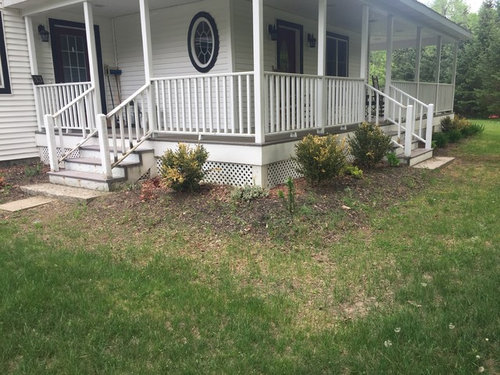
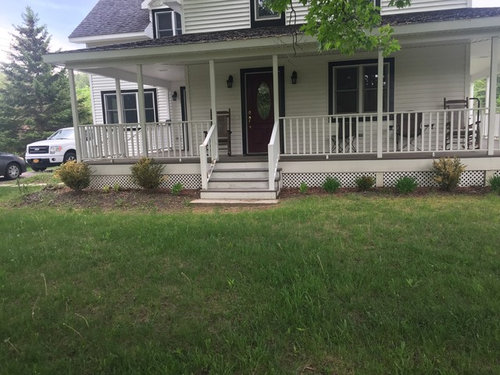
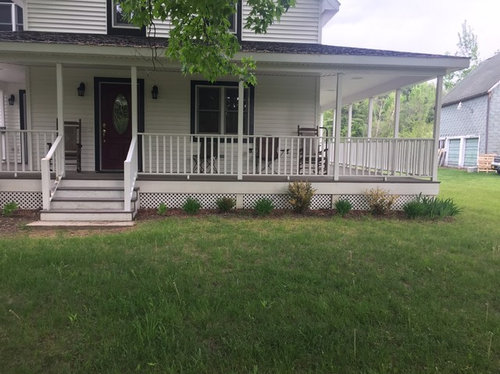
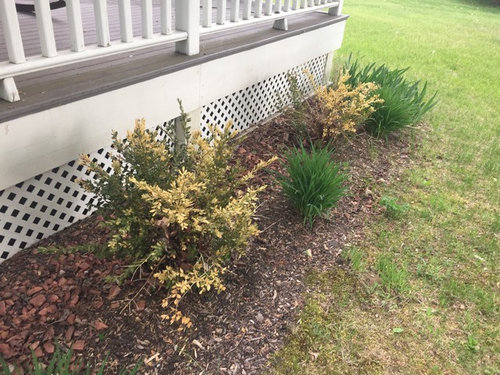
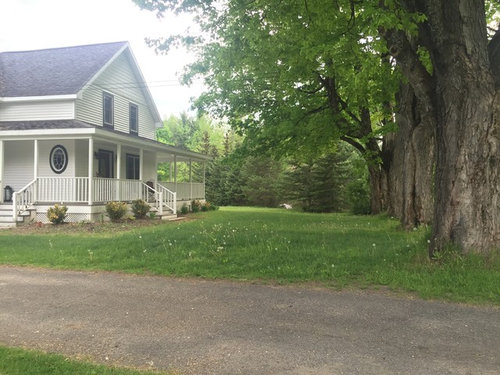
I'm in NNY, zone 4 near the Adirondacks, and the house we've moved into has a narrow garden bed all along the front porch. It's been planted with evenly spaced boxwoods, hostas on either side of the stairs, 3 clumps of daylilies, a trio of Oriental lilies at one corner, and a few purple irises at the other. It's in terrible shape though--the boxwoods are dying (aside from one tiny one I replaced last year), the weeds are overtaking everything, and I've never been terribly fond of the planting arrangement. Everything is so evenly spaced, and I prefer something...messier... for lack of a better term. I like a fuller, layered look and more natural for certain. Can I get some recommendations?

I LIKE all of the existing plants--even the boxwoods weren't so bad left unshaped. But since I think I need to rip out the boxwoods, I thought I'd take the opportunity to rehab the whole thing.

I've added pictures below. As you can see, the large maples provide a lot of shade once they leaf out. The front of the house faces roughly Northwest. (The bed wraps around a little farther on the corner that faces the driveway, but that portion actually actually gets a fair amount of light, though, so it has some heuchera that are not visible.)

I am so terribly clueless, but I can't stand how sad this situation has become. I think I'd like some astilbe, but I haven't any clue what to do for more substantial plantings once the boxwoods go. Anyone care to plant plant "dressup" and throw out some ideas? Interested in shrubs and perennials mainly, although I don't mind adding a few annuals each year.

Sincerely,

Overwhelmed Wannabe Gardener

(Please ignore the ripped out stair ballisters! We're mid(many)-projects!)

Comments (4)

  • 10 years ago

    Your lovely house reminded me of one I saw years ago in Martha Stewart. The link is to a brief slideshow on the foundation planting for a great wrap around porch mostly in shade. I wish a could post a picture here but that is not working. I always loved this look - lush, full and balanced but also natural and informal. It is hard to explain.

    There is at least one planting plan in the show with types of plants (not specific varieties) if I remember correctly the full article had more details. Maybe a local library would have back copies?

  • 10 years ago

    Oh, my goodness, Maisie, that link is wonderful! Thank you so much. This helps me tremendously--I can finally start to visualize it. I hate stiff and formal, and this feels so much more natural.

  • 10 years ago

    What a great house! I've been think about this . . .

    I think your boxwoods just have some winter damage, so I would for this summer just cut out the tan parts which are dead, and leave the rest. You may be quite surprised at how they start to fill in over the next couple of years, and they provide a consistent evergreen backbone, but if they don't you can remove them when you are ready to plant. Leave everything as is for now, except get a scuffle hoe (AKA stirrup hoe) and stir up the mulch or dirt with the weeds several times over about a week so the vast majority of the weeds die. Then put down cardboard (go around the plants) and add mulch over the cardboard. Put in a tidy edging to keep the grass out, either a deep cut V or a buried plastic or metal edging with a line of bricks along the inside edge to give the mower wheels a surface so you don't have to edge it. This will give you at least a tidy look for this season while you plan. If you want to, put a couple of large pots with flowers at the stair base. All the beds should come out at least as far as the landing at the bottom of the steps so you have room to layer in the plants rather than just have a single row. You can make it as deep as you want, but leave some room at the back to do maintenance. My foundation beds range from 6'-12' deep.

    Then you should start planning. Watch carefully how much light each side of the house gets. For instance, the side with the big maples will be both shadier due to the overhanging trees and drier due to the maples' roots. You can get a soil test done to see if your soil is acid or if it is alkaline or neutral as far as pH, and also see what the texture is (clay or sandy or loamy or most probably a mis of all 3.) See if water stays in a a hole for a really long time or if it drains relatively quickly. Think about whether you want the plants to come above the level of the porch or if you like the open view of lower plants from the house and looking at the house.

    Starting now, begin looking at and thinking about plants:

    - Notice that the garden linked above used shrubs and perennials to give longer season interest (though please don't plant them closer than recommended since that will create much future maintenance.)

    - Consider foliage (as mentioned in the article) - color, size, shape, and texture. If you only have fine-texture in green, it will be less of the varied look you are going for, so you want a range of leaves that are skinny, broad, ferny, gold, green and variegated to carry the garden when plants aren't blooming. Many shade plants bloom early, so count on foliage and annuals for summer color.

    - think about all 4 seasons: evergreens or bright bark or interesting branching for winter, spring and summer bloom and the foliage I already mentioned, and fall bloom and changing foliage color.

    - Many of the specific plants mentioned in the article won't work for you, either due to lack of hardiness in zone 4 (oak leaf hydrangea) or wrong light levels (catmint/Nepeta) so you will need to research zone 4 plants that like bright shade, darker shade, and perhaps part sun.

    - Visit gardens if there are open garden days in your area, notice ones in your neighborhood and as you travel around. When you see plants you like, post them on the Name that Plant forum or here to get IDs. Look at websites with garden eye candy and get books with photos from the library. That way you will start to find plants that appeal to you.

    Here's an article on planning a long border. The repeating part is important for it to look cohesive. Again, many of the specific plants won't work, but it may give you ideas.

    Some plants to check out that are hardy for you:

    Shrubs and shrub-sized perennials:

    Hydrangea paniculata/panicled hydrangea comes in various sizes from 3'-12', is long blooming, but likes at least a half day of sun or all day bright shade.

    Hydrangea arborescens/smooth hydrangea such as Annabelle - bright shade to morning sun. various long-blooming cultivars are pink, lime, or white, but all are about 4'

    Red-twigged dogwood (Cornus alba or C. sericia) come in various heights and will give you winter interest as well as some have variegation or nice fall color. Will want part sun.

    Kalmia latifolia/mountain laurel - evergreen and likes full shade to part shade

    Aralia 'Sun King' - large with gold foliage, but a perennial - part or bright shade makes the gold brighter

    Kerria japonica - part shade

    Any of the 'Lights' series of deciduous rhododendrons/azaleas - bright shade or part sun; spring flowers and fall color; needs acid soil

    Blueberries will grow in part sun and have flowers, berries, and fall color; needs acid soil

    bulbs:

    Daffodils - pests don't bother them and they are long-lived. Plant behind perennials so the dying foliage is hidden. Need half to all day sun.

    Allium Purple Sensation - part sun to full sun, but another bulb that critters won't eat

    Perennials:

    Astilbe - full shade to morning sun is fine as long as it doesn't dry out.

    Hosta - huge range of foliage size and color but deer like them. Part to full shade.

    Jacob's Ladder/Polemonium

    Primrose - not all like shade or will be hardy, but most will be

    Siberian iris - Wants 3-4 hours sun or more to bloom well.

    Polygonatum/Solomon's seal has variegated types

    Crested iris - spring bloomer, full shade is fine. spreads slowly.

    Digitalis - some are perennial and some biennial; toxic; half sun to full shade

    Ferns - shade is fine, though there are an enormous number of kinds and not all will be hardy for you

    Aquilegea/columbine - mostly sun to mostly shade

    Dicentra (AKA Lamprocapnus)/bleeding heart - mostly shade to mostly sun

    Hellbore - mostly shade to mostly sun

    Epimedium - part to full shade

    Closed gentian - part shade, moist

    Brunnera is available with green or silver-patterned leaves full to part shade

    Aconitum - shade is fine, but may look better in brighter shade to part sun; toxic

    Pulmonaria/lungwort - silvery patterns on leaves and pink/blue flowers

    Ligularia

    Mertensia/Virginia bluebells

    Phlox divericata

    Actaea Aka Cimicifuga AKA bugbane - dark red varieties shade is fine

    Anemone canadensis (spring) or A. Honorine Jobert (fall) - will spread vigorously, so plant to pull bunches of it out annually

    There may be sedges that work, but I am not familiar enough with their zone ratings to be sure

    Thalicturm/meadow rue

    Tiarella/foamy bells have flowers and many have colorful foliage

  • 10 years ago

    Thank you so very much, NHBabs, for the thoughtful response! I really appreciate it. I have so much to learn, and I really appreciate you taking the time to respond so thoroughly. You've given me lots to think about!