Software
Houzz Logo Print
eastautumn

Juniper ID?

10 years ago
last modified: 10 years ago
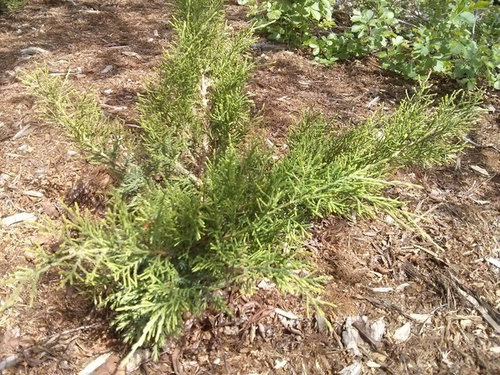
I'm hoping someone can help me ID the variety of juniper I purchased (from Home Depot) and planted last spring. This is my first experience with growing juniper, and what I wanted was a ground cover type to plant under some crab apples trees to the side of our driveway. I see them a lot in our area and they look healthy, so I thought it would be a good choice for this sloped area. Although they're under the trees, they get some morning sun and full afternoon sun.

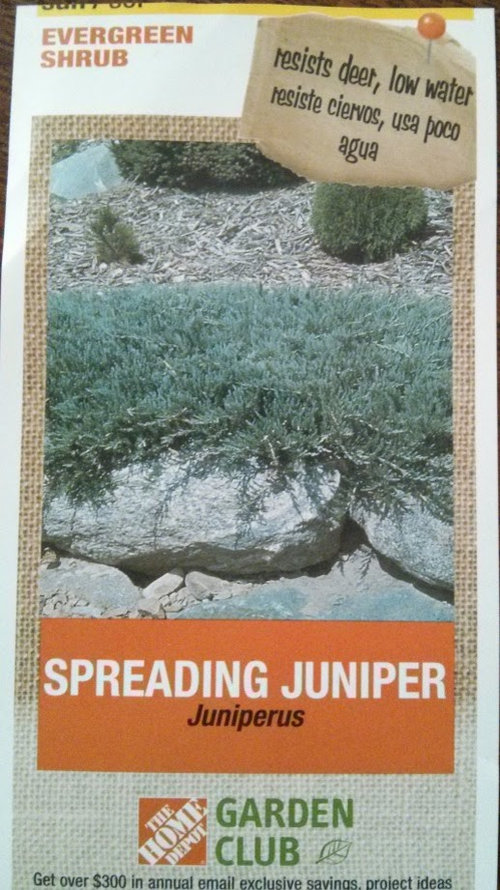
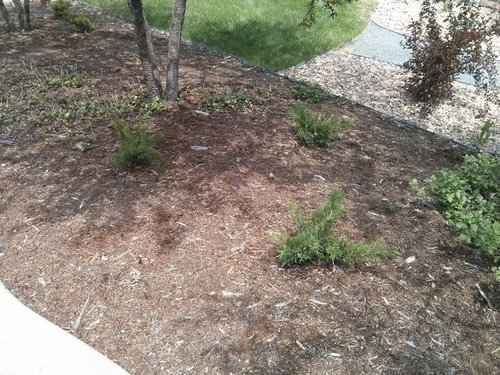
I planted some gro-low sumac toward the top of the driveway, and there's a sweep of plumbago in the middle, then 2 areas where I planted groups (of 3 and 4) of the juniper plants. A couple years ago I tried juniper "blue chip" there, but none of them made it through the winter. Last spring, I replaced the dead blue chip junipers with 7 of these "spreading juniper" plants. Looking at the tag, the plants appeared to be a ground cover type, and they looked healthy so I went ahead and got them. I thought it slightly odd that they were only labeled "spreading juniper/juniperus," but decided I didn't care that much about the specific type as long as they had a ground cover habit (as the picture showed). The tag obviously isn't the same type I purchased though, because the one on the tag is blue, and the ones I purchased are green.

This spring I was thinking about adding one more to the grouping of 4, so I inspected the tag a little more to make sure I got the same type... The tag actually says 18-36" tall x 2-6' wide! I know these shrubs won't be taking any math classes and those numbers are just estimates, but I definitely don't want 3-foot tall shrubs growing under the trees :( So now I'm mad at myself for not doing more research ahead of time. They look healthy and perky this spring, but look like they're growing as tall as they are wide. Can anyone tell from these pictures what type of juniper they are? I'd at least like to know what I have, so I can determine whether I can make them work or whether I'll be fighting a losing battle as they mature.

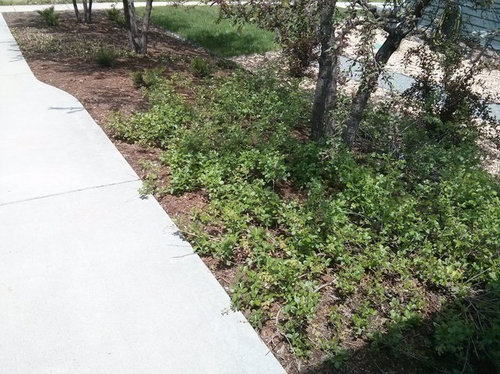
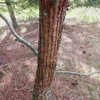
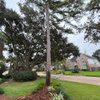
Here are a few pictures, both close up and showing the overall setting.

Close up:

Grouping of 3:

Full planting strip (gro-low sumac in foreground):

Tag they came with:

Thank you!!

Comments (12)

  • 10 years ago

    Probably a generic plant tag that they use on ALL the junipers they sell. This is only one of many reasons why purchasing plants at a box store, rather than at a proper retail nursery or garden center, is not the great bargain or cost savings many think it is :-)

    eastautumn thanked gardengal48 (PNW Z8/9)
  • 10 years ago

    and do understand.. conifers are trees .. they really never stop growing ...


    size estimates on a properly named plant are at ten years ... and you can easily presume double size at 20 years ...


    ken

    eastautumn thanked ken_adrian Adrian MI cold Z5
  • 10 years ago

    "conifers are trees"

    Not if they are groundcovers :-) Groundcover conifers typically do not exceed much beyond listed heights unless a specific growing condition (like crowding) dictates and while they do spread, there IS a limit to that as well.

    The generalization that you can expect double the listed size at 20 years is not necessarily appropriate to ALL woody plants.

    eastautumn thanked gardengal48 (PNW Z8/9)
  • 10 years ago

    conifers typically do not exceed much beyond listed heights unless a
    specific growing condition (like crowding) dictates and while they do
    spread, there IS a limit to that as well

    By what means, specifically, do you imagine a still living woody plant of any type completely stops growing at some point?

  • 10 years ago

    LOL!! Notice that you very conveniently edited to omit the 'groundcover' designation, which is what I was referring to specifically. And I never said they "completely stop growing".

    Try reading what I wrote again - perhaps it will become clearer.

    'Blue Rug' juniper seldom exceeds 6-12" in height regardless of how long it has been planted. Its primary growth is focused horizontally and that can become a significant spread over time but is not infinite. Even those examples in place for 20-30 years will seldom extend more than about 10-12 feet in diameter. So assuming the tag states a 6" height and 6-8' spread in 10 years (Monrovia) it is not reasonable or accurate to assume the plant will automatically be 12" tall and 12-16' across in 20 years.

  • 10 years ago

    This is the first time I've purchased conifers from a big box store, so I suppose it's a lesson learned the hard way. They were small enough last spring that I couldn't get a sense of the growth habit, which sure doesn't seem to be the "horizontalis" variety I was expecting. My original plan for conifers in that area was a spreading scots pine, but after taking 5 years to get the one I planted on the other side of the driveway established (it looked ratty until this spring), I decided something lower maintenance would work better. So much for that idea...

    I purchase groundcovers and other "generic" (widely available) plants at big box stores occasionally because they often have smaller pots than what I can find at the garden centers, and particularly when I'm digging multiple holes (and around established trees) smaller pots is a huge benefit. But this is a good lesson in being more careful buying plants I'm not that familiar with at a big box store :(

    Thanks for the information. My gut was telling me something wasn't right about them, but I was hoping I was wrong.

  • 10 years ago

    Guys, guys...for an interesting and educational look at just how and why trees ever stop growing, look into the work of noted west coast tree researcher James Clark. No, I don't have a specific link in mind-I saw him live-but so far as I'm aware, Clark has done more than anyone else to look into exactly what mechanism-or failure of same-leads to senescence in long-lived species. Hint: It has to do with pumping water to great heights.

  • 10 years ago

    yeah that stinkin gravity is such a reality bummer.. lol ... resin told us long ago ... that is was speculated.. that some redwood at 385 feet tall or some such.. simply could not pump water any higher ... which is basically what tom said ...


    but the problem here gal ... is i dont see a precise ID that this plant is a groundcover ...


    the actual plant in the first pic.. is already growing at a 45 degree angle ... it is NOT on the ground ... and if its already 18 inches off the ground [just guessing from the pic ...] .... its going to be 24 or 30 inches off the ground in another year or two ... which is getting darn close to her max wish size ...


    and.. being a tree... it will continue that growth ... upward.. forever ... or until pruned down ...and Js are not a fun tree to prune.. they will hurt skin ...


    ken

  • 10 years ago

    I agree, Ken - we don't specifically know if the conifer planted in the ground is a groundcover form or not. Looks more like one of the shrubby forms of J. chinensis to me (and these also will not produce unending upwards growth :-)) But the plant on the photo tag is definitely a groundcover juniper and if that is a generic tag for any juniper HD sells, no wonder the OP was confused!! I'd consider that to be pretty misleading.

  • 10 years ago
    last modified: 10 years ago
    so far as I'm aware, Clark has done more than anyone else to look into
    exactly what mechanism-or failure of same-leads to senescence in
    long-lived species. Hint: It has to do with pumping water to great
    heights

    See relevant papers under Tree structure and function.

    http://www2.humboldt.edu/redwoods/publications.php

  • 10 years ago

    Do plants actually "pump" water, or do they just draw it out of the ground and transport it to the leaves via capillary action?